Ask most IT or finance leaders whether Software Asset Management is under control, and the first answer is usually yes. Ask a few more questions, and a different picture emerges: software costs keep climbing, audits stay reactive, and nobody is fully confident in the underlying data.
Traditional SAM was built to answer one question — what do we own — in a world of fixed seats and quarterly reviews. Today’s enterprise runs on SaaS subscriptions, cloud-linked licensing, and AI consumption billed by token, credit, and API call. None of that sits still long enough for a periodic inventory to stay accurate.
In this perspective, Qyrus covers:
Why most SAM programs create an illusion of control — and what that gap actually costs
Why visibility alone isn’t enough, and what “context” needs to mean
The seven capabilities modern SSAM has to deliver
Qyrus’s approach: continuous discovery, a live enterprise knowledge graph, and agentic execution
Our recommendations for IT and finance leaders evaluating a platform
Qyrus was recently named a notable vendor in Forrester’s “The SaaS And Software Asset Management Solutions Landscape, Q3 2026.” [Read more →]
Fill out the form to get the Qyrus perspective.
QyrusAI has been named among notable vendors in Forrester’s “The SaaS And Software Asset Management Solutions Landscape, Q3 2026,” published August 12, 2026 by Biswajeet Mahapatra with Frederic Giron, Laura Demarki, and Bill Nagel.
The report notes that “[SaaS and software asset management solutions] connect software assets, SaaS, IT assets, FinOps, procurement, finance, security, and business operations via a trusted data foundation and continuous governance loop.” Qyrus’ inclusion reflects our industry focus on Financial Services, Manufacturing, and Utilities.
Organizations need visibility that goes beyond a static inventory to answer harder questions: who’s actually using what, whether spend maps to business value, and whether the data would hold up in an audit.
That’s the category Forrester’s “The SaaS And Software Asset Management Solutions Landscape, Q3 2026” sets out to map — providing an overview of vendors across software asset management, SaaS management, IT asset management, and FinOps as buyers look for platforms that connect fragmented consumption data to defensible financial and governance outcomes.
For Qyrus, its inclusion among the notable vendors in this landscape reflects the SaaS and software asset management capability built on the Qinfinite foundation, now part of Qyrus, with a recognized industry focus in Financial Services, Manufacturing, and Utilities.
Forrester does not endorse any company, product, brand, or service included in its research publications and does not advise any person to select the products or services of any company or brand based on the ratings included in such publications. Information is based on the best available resources. Opinions reflect judgment at the time and are subject to change. This report is part of a broader collection of Forrester resources, including interactive models, frameworks, tools, data, and access to analyst guidance. For more information, read about Forrester’s objectivity here.
Building a Connected System of Record for Real-time IT Risk Reduction
In today’s complex IT, cloud, SaaS, and OT environments, fragmented tools leave security and operations teams blind to fast-moving vulnerabilities. This Forrester Trends Report outlines the critical path to building a connected risk backbone.
Discover how to eliminate unmanaged assets, and stop configuration drift
Don’t let unknown assets define your enterprise risk.
Learn how to turn asset intelligence into measurable, organization-wide risk reduction through automated workflows and accurate prioritization.
What You Will Learn in This Report:
Why managing asset risk requires a single, continuously updated view of all your exposures.
How to bridge the gap between discovery, real-time risk scoring, and treatment.
The foundational elements required to build your own unified risk backbone.
Qinfinite in the Spotlight: Proven Results for the Autonomous Enterprise
We are proud to share that Qinfinite’s Agentic AI and ITSM capabilities are featured in this report through two major enterprise case studies.
Global Financial Services Firm:
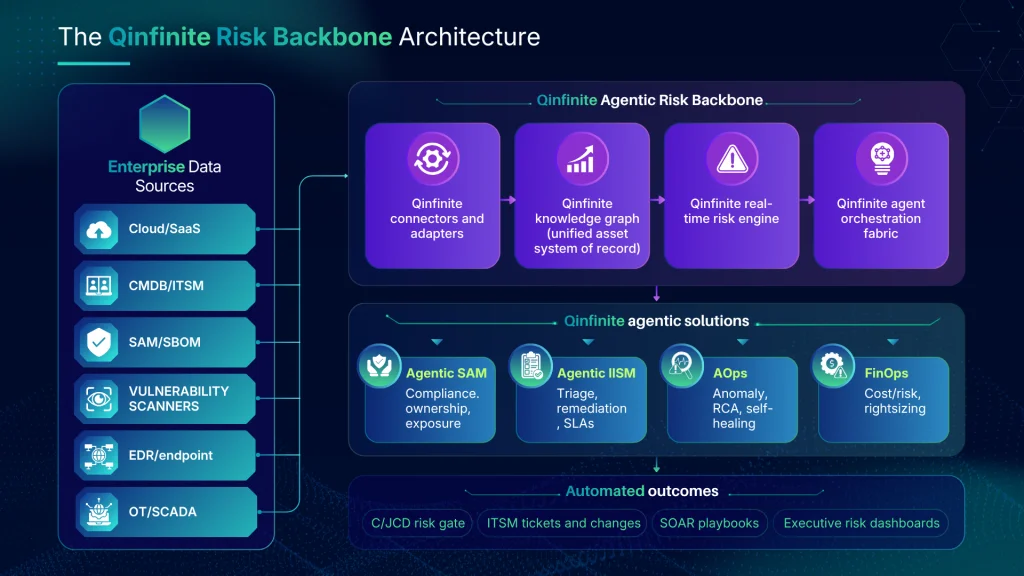
Managing over 45,000 assets, this firm struggled with 30% lacking CMDB records and 25% missing ownership. By deploying the Qinfinite unified risk backbone integrating discovery, scoring, and automated ServiceNow ticketing, asset visibility jumped from 70% to 98% in just 45 days.The mean time to remediate (MTTR) high-risk vulnerabilities plummeted by 65%, while drastically improving SLA tracking and audit readiness.
Multinational Manufacturer:
To tackle OT risk, this manufacturer deployed the full Qinfinite stack, including agentic software asset management, agentic ITSM, AIOps, and FinOps. Within six months, they created a continuous risk loop that reduced unplanned downtime by 40% and completely transformed the coordination between their security and operations teams.
Qinfinite (now part of QyrusAI) Risk Backbone Architecture Diagram
Software development just hit a massive turning point. We no longer spend our days sweating over low-level memory management or fighting complex syntax. Instead, we use natural language to prompt AI, review the resulting code, and move to the next task if the “vibe” feels right. This shift created a new category of tools: the Agentic IDE.
These environments do more than just autocomplete your sentences; they act as autonomous collaborators. The results are undeniable. Recent industry data shows that developers using AI-powered tools complete tasks nearly 55% faster than those working without them[cite: 115]. Inside the enterprise, the numbers are even more aggressive. Teams currently report delivering features 3.4 times faster than their previous benchmarks.
Today, 85% of developers use some form of AI for their professional roles. However, this lightning-fast output creates a glaring paradox. While we generate 41% of production code through AI, we often leave the most critical part behind: the verification.
The Invisible Wall: Testing Debt
Testing debt compounds by the hour in an AI-driven workflow. While developers churn out features, the most glaring statistic remains at zero. Standard coding agents currently produce zero auto-generated tests alongside their output. This creates a massive disconnect in the software delivery cycle.
During a typical hour of AI-assisted coding, developers generate roughly 8 to 12 API endpoints. Manually creating a single test for one of these endpoints requires approximately 45 minutes. Consequently, one developer accumulates 6 hours of testing debt every single day. Organizations often experience a quality backlash once this hidden cost surfaces.
In regulated sectors like fintech or healthcare, this gap creates a compliance liability. Code volume now outpaces the human capacity for manual review. When testing remains stuck at human speed while coding moves at machine speed, the business faces substantial risk.
“Testing debt does not accumulate slowly with AI coding. It’s compounding by the hour. Code volume now outpaces human capacity to review, and testing debt compounds silently sprint after sprint.” — Ravi Sundaram
Scaling Quality with Parallel Testing Agents
We solve this tension by introducing a parallel testing pipeline. This approach eliminates the traditional sequential handoff where developers wait for a separate QA cycle. Modern agentic quality involves a testing agent that operates in real-time alongside your coding assistant. This integration ensures that every new line of code receives immediate verification.
Industry leaders now prioritize tools that offer native IDE integration to minimize context switching. The qAPI agent specifically supports popular environments like VS Code, Cursor, JetBrains, and IntelliJ. By sitting directly inside the developer’s workspace, the agent maintains a constant watch over the source code. It automatically detects new routes and API endpoints the moment you save them.
A Gartner report predicts that agentic AI will transform software engineering by enabling specialized agents to handle complex workflows like testing and security audits. By using a specialized testing agent, teams ensure that velocity doesn’t compromise enterprise standards.
“This is a parallel pipeline. It is not some kind of sequential handoff. Build with AI and scale with Qyrus.” — Ravi Sundaram
The “Agentic” Workflow in Action
Modern testing agents transform the developer experience by removing the friction from verification. When you update a file in your IDE, the agent immediately analyzes the source code to identify new routes and API endpoints. You see options to generate tests, mock data, or run a security audit directly next to your code. This allows you to validate business logic without ever switching applications. Research shows that even brief mental blocks created by shifting between tasks can cost as much as 40% of someone’s productive time.
The agent doesn’t just guess; it understands the specific intent of your code. It synthesizes realistic data payloads or pulls from existing datasets to ensure your logic handles various edge cases. Testing at this layer remains vital because most business logic now resides in the API layer. Catching errors here provides immediate feedback before you deploy to a front-end or staging environment.
“The testing model in this agent is smart enough to understand exactly which parts of your code need testing. At the API layer, where the majority of business logic resides, the more you test, the better the outcome. Even while the agent automates the heavy lifting, you retain full control over every aspect of the API calling logic. This approach allows you to build with AI speed and then run with enterprise scale.” — Ameet Deshpande
Developers retain complete ownership of the entire process. While the AI suggests the test logic, you can open and edit any parameter, including data, query, or path variables. If you need a more tailored approach, you can interact with a two-way chat window to refine the output.
Proven Results: From 23% to 95% Coverage
Data from real-world implementations proves that agentic testing is not just a theoretical improvement. In a study of 31 development teams over a 90-day period, those using parallel testing agents saw testing debt related to AI-generated code drop by 89%. These teams didn’t just maintain their existing pace; they accelerated it. Test coverage per sprint increased 3.4 times compared to traditional manual methods.
The shift also impacts the bottom line of software delivery. Release frequency rose by 55% while the teams maintained their rigorous quality gates. Most importantly, catching bugs earlier in the IDE led to a 76% drop in post-deployment defects. General industry findings from the World Quality Report mirror this trend, showing that organizations prioritizing AI-driven automation see significantly higher reliability in their release cycles.
Before adopting this agentic approach, teams often struggled to reach 23% test coverage within a six-week window. With the QAPI agent, that number skyrocketed to 95%. These outcomes show that you can maintain enterprise discipline even while moving at machine speed. Qyrus converts AI speed into enterprise-grade confidence.
“These are not projections; these are outcomes that teams reported after 90 days of testing, and the ROI is fast, it’s real, and it’s measurable. If Vibe Coding created the velocity opportunity and velocity problem, then Vibe Testing is the answer.” — Ravi Sundaram
Build with AI, Scale with Confidence
An Agentic IDE offers an unprecedented opportunity to accelerate software delivery. However, your tool is only as effective as the quality it guarantees. If you build at machine speed without an equivalent verification layer, you simply create a faster path to technical failure. Enterprise-grade software requires more than just a quick prompt; it requires repeatable, scalable, and audit-ready artifacts that satisfy the most rigorous standards.
While publications like The Wall Street Journal confirm that engineers now ship production code at record speeds[cite: 16], the lack of oversight remains a critical concern for business leaders. We believe that while AI builds the software, a specialized testing agent builds the confidence you need to ship it. By integrating agentic quality directly into your development flow, you ensure that every feature is fundamentally sound. You no longer have to choose between moving quickly and staying compliant.
“AI is obviously building software, but we believe that Qyrus can build confidence for you as you’re doing that simultaneously. Build it once with AI and then scale it to multiple environments.” — Ravi Sundaram
The jump from 23% to 95% test coverage represents a total shift in how teams manage the software lifecycle. We invite you to experience this transformation yourself. Download the qAPI extension for your preferred IDE and join the engineers who prioritize both speed and stability. Watch the full webinar recording to see how the agentic lifecycle redefines enterprise standards.
Qyrus is proud to announce our official integration with SurrealDB, providing a dedicated data quality assurance layer for the world’s most advanced multi-modal AI agent database.
As SurrealDB 3.0 redefines the database landscape with first-class agent memory and multi-modal storage, Qyrus Data Testing ensures that every record remains accurate, every migration is certified, and every AI model is trustworthy.
This official partnership empowers organizations to move from legacy relational and document databases to SurrealDB with absolute confidence.
Revolutionizing Data Migration for the Multi-Modal Era
Moving data from PostgreSQL, MongoDB, or MySQL into a multi-modal architecture like SurrealDB introduces significant risks to data integrity. Qyrus Compare Jobs solve this by performing record-level, cross-source comparisons that map columns between heterogeneous systems automatically. Teams can now validate that relational rows, JSON blobs, and foreign keys have correctly transformed into SurrealDB documents, nested objects, and graph edges.
Validating the Future of AI with SurrealDB 3.0
SurrealDB 3.0 introduces a fundamental shift toward persistent agent memory and context graphs. Qyrus provides specialized AI evaluation testing to verify that agent memory payloads persist correctly and that context relationships remain bidirectional. With native support for vector search validation, Qyrus allows AI engineers to detect embedding drift and verify RAG pipeline quality before it impacts production performance.
No-Code Quality for Schema less Scalability
While SurrealDB offers incredible flexibility through its schema-less mode, maintaining data contracts is essential for enterprise stability. Qyrus Evaluate Jobs allow QA teams to enforce schema-level checks—such as null verification, regex pattern matching, and duplicate detection—without writing a single line of SQL. This “quality-at-the-testing-layer” approach ensures that business rules are upheld even in the most dynamic data environments.
Democratizing Data Excellence
This integration bridges the gap between data engineers, AI scientists, and compliance teams. Data Engineers can automate post-migration checks, while AI Engineers can run continuous regression tests on context graphs. Compliance and Governance teams gain access to tamper-evident audit trails and automated daily reports, aligning SurrealDB’s performance with regulatory requirements like GDPR and SOC 2.
Getting Started with SurrealDB and Qyrus
The Qyrus connector is now available as an official data quality validator on SurrealDB. Setup takes minutes—simply configure your SurrealDB endpoint in the Qyrus platform to begin running continuous, AI-augmented data validations today.
Does your “QA Department” consist of your Lead Developer hoping nothing breaks on Friday?
Growing businesses face a brutal reality: you must release features immediately to survive, yet a single critical bug could cost you your biggest client. You don’t have the luxury of massive QA departments or endless release cycles. Instead, your developers often double as testers, creating a dangerous friction where speed cannibalizes quality.
This whitepaper outlines a “force multiplier” strategy for lean teams. It moves beyond theory to show how AI agents act as the dedicated QA staff you can’t afford to hire, allowing a small squad to deliver enterprise-grade reliability.
What You'll Learn in This Whitepaper
The “Force Multiplier” Strategy: How to use AI agents as “fractional experts” that allow a 5-person team to output the quality of a 50-person department.
Escaping the “Fix-It-Later” Trap: Why the traditional “test-last” model is bankrupting your innovation budget—and how to shift left without slowing down.
The ROI of Autonomous Quality: How to achieve a payback period of less than 6 months and get $2 of work for every $1 spent on intelligent automation.
Leveling the Playing Field: How SMBs are using agentic orchestration to bypass legacy integration headaches and compete directly with enterprise giants.
Who Should Read This?
Founders & CTOs: Who need to scale their product’s user base 10x without hiring 10x more QA staff.
Engineering Leads: Who are tired of wasting their best developers’ time on manual regression testing and script maintenance.
Product Managers: Who want to stop choosing between meeting a launch deadline and ensuring a bug-free release.
Sneak Peek: The Cost of Waiting
The market isn’t waiting for you to hire more testers. With the AI testing market projected to grow at an 18.7% CAGR, your competitors are already automating the mundane.
“Investing in AI-powered quality is no longer just an option; it is a critical business imperative. Companies that invest now in intelligent test design and self-healing automation will unlock faster releases and superior products, while laggards risk technical debt and market irrelevance.”
Stop trading speed for quality. Download the blueprint to autonomous, self-healing testing.
The Velocity Gap in BFSI Software Quality
Why Traditional QA Fails Modern Finance
The BFSI sector faces immense pressure to deliver rapid digital transformation, but outdated, manual QA has become a bottleneck. AI accelerates innovation but introduces unpredictable behaviors that legacy approaches can’t handle. Fragmented toolchains and slow, error-prone testing expose banks to security risks, costly inefficiencies, and customer churn.
Download this whitepaper to learn how to:
Address non-determinism in AI-powered financial systems
Move from reactive bug-finding to proactive trust engineering
Integrate holistic, automated testing across web, mobile, and APIs
Quantify the bottom-line impact of engineered software quality
What You’ll Discover Inside
Core principles of Trust Engineering for BFSI institutions
Qyrus platform’s role in enabling unified, intelligent, and automated QA.
Case study: 200% ROI for a leading UK bank using agentic QA.
Strategies to protect customer data, enhance user experience, and reduce manual testing effort.
SAP releases updates at breakneck speed. Development teams are sprinting forward, leveraging AI-assisted coding to deploy features faster than ever. Yet, in conference rooms across the globe, SAP Quality Assurance (QA) leaders face a grim reality: their testing cycles are choking innovation. We see this friction constantly in the field—agility on the front-end, paralysis in the backend.
The gap between development speed and testing capability is not just a process issue; it is a financial liability. Modern enterprise resource planning (ERP) systems, particularly those driven by SAP Fiori and UI5, have introduced significant complexities into the Quality Assurance lifecycle. Fiori’s dynamic nature—characterized by frequent updates and the generation of dynamic control identifiers—systematically breaks traditional testing models.
When business processes evolve, the Fiori applications update to meet new requirements, but the corresponding test cases often lag behind. This misalignment creates a dangerous blind spot. We often see organizations attempting to validate modern, cloud-native SAP environments using methods designed for on-premise legacy systems. This disconnect impacts more than just functional correctness; it hampers the ability to execute critical SAP Fiori performance testing at scale. If your team cannot validate functional changes quickly, they certainly cannot spare the time to load test SAP Fiori applications under peak user conditions, leaving the system vulnerable to crashes during critical business periods.
To understand why SAP Fiori test automation strategies fail so frequently, we must examine the three distinct evolutionary phases of SAP testing. Most enterprises remain dangerously tethered to the first two, unable to break free from the gravity of legacy processes.
Wave 1: The Spreadsheet Quagmire and the High Cost of Human Error
For years, “testing” meant a room full of functional consultants and business users staring at spreadsheets. They manually executed detailed, step-by-step scripts and took screenshots to prove validation.
This approach wasn’t just slow; it was economically punishing. Manual testing suffers from a linear cost curve—every new feature adds linear effort. Industry analysis suggests that the annual cost for manual regression testing alone can exceed $201,600 per environment. When you scale that across a five-year horizon, organizations often burn over $1 million just to stay in the same place. Beyond the cost, the reliance on human observation inevitably leads to “inconsistency and human error,” where critical business scenarios slip through the cracks due to sheer fatigue.
Wave 2: The False Hope of Script-Based Automation
As the cost of manual testing became untenable, organizations scrambled toward the second wave: Traditional Automation. Teams adopted tools like Selenium or record-and-playback frameworks, hoping to swap human effort for digital execution.
It worked, until it didn’t.
While these tools solved the execution problem, they created a massive maintenance liability. Traditional web automation frameworks rely on static locators (like XPaths or CSS selectors). They assume the application structure is rigid. SAP Fiori, however, is dynamic by design. A simple update to the UI5 libraries can regenerate control IDs across the entire application.
Instead of testing new features, QA engineers spend 30% to 50% of their time just setting up environments and fixing broken locators. This isn’t automation; it is just automated maintenance.
Wave 3: The Era of ERP-Aware Intelligence
We have hit a ceiling with script-based approaches. The complexity of modern SAP Fiori test automation demands a third wave: Agentic AI.
This new paradigm moves beyond checking if a button exists on a page. It focuses on “ERP-Aware Intelligence”—tools that understand the business intent behind the process, the data structures of the ERP, and the context of the user journey. We are moving away from fragile scripts toward intelligent agents that can adapt to changes, understand business logic, and ensure process integrity without constant human intervention.
To achieve the economic viability modern enterprises need, automation must do more than click buttons. It must reduce maintenance effort by 60% to 80%. Without this shift, teams will remain trapped in a cycle of repairing yesterday’s tests instead of assuring tomorrow’s releases.
The Technical Trap: Why Standard Automation Crumbles Under Fiori
You cannot solve a dynamic problem with a static tool. This fundamental mismatch explains why so many SAP Fiori test automation initiatives stall within the first year. The architecture of SAP Fiori/UI5 is built for flexibility and responsiveness, but those very traits act as kryptonite for traditional, script-based testing frameworks.
The “Dynamic ID” Nightmare
If you have ever watched a Selenium script fail instantly after a fresh deployment, you have likely met the Dynamic ID problem.
Standard web automation tools function like a treasure map: “Go to X coordinate and dig.” They rely on static locators—specific identifiers in the code (like button_123)—to find and interact with elements.
SAP Fiori does not play by these rules. To optimize performance and rendering, the UI5 framework dynamically generates control IDs at runtime. A button labeled __xmlview1–orderTable in your test environment today might become __xmlview2–orderTable in production tomorrow.
Because the testing tool cannot find the exact ID it recorded, the test fails. The application works perfectly, but the report says otherwise. These “false negatives” force your QA engineers to stop testing and start debugging, eroding trust in the entire automation suite.
The Maintenance Death Spiral
This instability triggers a phenomenon known as the Maintenance Death Spiral. When locators break frequently, your team stops building new tests for new features. Instead, they spend their days patching old scripts just to keep the lights on.
If you spend 70% of your time fixing yesterday’s work, you cannot support today’s velocity. This high rework cost destroys the ROI of automation. You aren’t accelerating release cycles; you are merely shifting the bottleneck from manual execution to technical debt management.
The “Documentation Drift”
While your engineers fight technical fires, a silent strategic failure occurs: Documentation Drift.
In a fast-moving SAP environment, business processes evolve rapidly. Developers update the code to meet new requirements, but the functional specifications—and the test cases based on them—often remain static.
This creates a dangerous gap. Your tests might pass because they validate an outdated version of the process, while the actual implementation has drifted away from the business intent. Without a mechanism to triangulate code, documentation, and tests, you risk deploying features that are technically functional but practically incorrect.
The Tooling Illusion: Why Current Solutions Fall Short
When organizations realize manual testing is unsustainable, they often turn to established automation paradigms, but each category trades one problem for another. Model-based solutions, while offering stability, suffer from a severe “creation bottleneck,” forcing functional teams to manually scan screens and build complex underlying models before a single test can run. On the other end of the spectrum, code-centric and low-code frameworks offer flexibility but remain fundamentally “blind” to the ERP architecture. Because these tools rely on standard web locators rather than understanding the business object, they shatter the moment SAP Fiori test automation environments generate dynamic IDs, forcing teams to simply trade manual execution for manual maintenance.
Native legacy tools built specifically for the ecosystem might feel like a safer bet, but they lack the modern, agentic capabilities required for today’s cloud cadence. These older platforms miss critical self-healing features and struggle to keep pace with evolving UI5 elements, making them ill-suited for agile SAP Fiori performance testing. Ultimately, no existing category—whether model-based, script-based, or native—fully bridges the gap between the technical implementation and the business intent. They leave organizations trapped in a cycle where they must choose between the high upfront cost of creation or the “death spiral” of ongoing maintenance, with no mechanism to align the testing reality with drifting documentation.
Code-to-Test: The Agentic Shift in SAP Fiori Test Automation
We built the Qyrus Fiori Test Specialist to answer a singular question: Why are humans still explaining SAP architecture to testing tools? The “Third Wave” of QA requires a platform that understands your ERP environment as intimately as your functional consultants do. We achieved this by inverting the standard workflow. We moved from “Record and Play” to “Upload and Generate.”
SAP Scribe: Reverse Engineering, Not Recording
The most expensive part of automation is the beginning. Qyrus eliminates the manual “creation tax” through a process we call Reverse Engineering. Instead of asking a business analyst to click through screens while a recorder runs, you simply upload the Fiori project folder containing your View and Controller files.
Proprietary algorit hms, which we call Qyrus SAP Scribe, ingest this source code alongside your functional requirements. The AI analyzes the application’s input fields, data flow, and mapping structures to automatically generate ready-to-run, end-to-end test cases. This agentic approach creates a massive leap in SAP Fiori test automation efficiency. It drastically reduces dependency on your business teams and eliminates the need to manually convert fragile recordings into executable scripts. You get immediate validation that your tests match the intended functionality without writing a single line of code.
The Golden Triangle: Triangulated Gap Analysis
Standard tools tell you if a test passed or failed. Qyrus tells you if your business process is intact.
We introduced a “Triangulated” Gap Analysis that compares three distinct sources of truth:
The Code: The functionality actually implemented in the Fiori app.
The Specs: The requirements defined in your functional documentation.
The Tests: The coverage provided by your existing validation steps.
Dashboards visualize exactly where the reality of the code has drifted from the intent of the documentation. The system then provides specific recommendations: either update your documentation to match the new process or modify the Fiori application to align with the original requirements. This ensures your QA process drives business alignment, not just bug detection.
The Qyrus Healer: Agentic Self-Repair
Even with perfect generation, the “Dynamic ID” problem remains a threat during execution. This is where the Qyrus Healer takes over.
When a test fails because a control ID has shifted—a common occurrence in UI5 updates—the Healer does not just report an error. It pauses execution and scans the live application to identify the new, correct technical field name. It allows the user to “Update with Healed Code” instantly, repairing the script in real-time. This capability is the key to breaking the maintenance death spiral, ensuring that your automation assets remain resilient against the volatility of SaaS updates.
Beyond the Tool: The Unified Qyrus Platform
Optimizing a single interface is not enough. SAP Fiori exists within a complex ecosystem of APIs, mobile applications, and backend databases. A testing strategy that isolates Fiori from the rest of the enterprise architecture leaves you vulnerable to integration failures. Qyrus addresses this by unifying SAP Fiori performance testing, functional automation, and API validation into a single, cohesive workflow.
Unified Testing and Data Management
Qyrus extends coverage beyond the UI5 layer. The platform allows you to load test SAP Fiori workflows under peak traffic conditions while simultaneously validating the integrity of the backend APIs driving those screens. This holistic view ensures that your system does not just look right but performs right under pressure.
However, even the best scripts fail without valid data. Identifying or creating coherent data sets that maintain referential integrity across tables is often the “real bottleneck” in SAP testing. The Qyrus Fiori Test Specialist integrates directly with Qyrus DataChain to solve this challenge. DataChain automates the mining and provisioning of test data, ensuring your agentic tests have the fuel they need to run without manual intervention.
Agentic Orchestration: The SEER Framework
We are moving toward autonomous QA. The Qyrus platform operates on the SEER framework—Sense, Evaluate, Execute, Report.
Sense: The system reads and interprets the application code and documentation.
Evaluate: It identifies gaps between the technical implementation and business requirements.
Execute: It generates and runs tests using self-healing locators.
Report: It provides actionable intelligence on process conformance.
This framework shifts the role of the QA engineer from a script writer to a process architect.
Conclusion: From “Checking” to “Assuring”
The path to effective SAP Fiori test automation does not lie in faster scripting. It lies in smarter engineering.
For too long, teams have been stuck in the “checking” phase—validating if a button works or a field accepts text. The Qyrus Fiori Test Specialist allows you to move to true assurance. By utilizing Reverse Engineering to eliminate the creation bottleneck and the Qyrus Healer to survive the dynamic ID crisis, you can achieve the 60-80% reduction in maintenance effort that modern delivery cycles demand.
Ready to Transform Your SAP QA Strategy?
Stop letting maintenance costs eat your budget. It is time to shift your focus from reactive validation to proactive process conformance.
If you are ready to see how SAP Fiori test automation can actually work for your enterprise—delivering stable locators, autonomous repair, and deep ERP awareness—the Qyrus Fiori Test Specialist is the solution you have been waiting for. Don’t let brittle scripts or manual regressions slow down your S/4HANA migration. Eliminate the creation bottleneck and achieve the 60-80% reduction in maintenance effort that your team deserves.
Let’s confront the reality of mobile testing right now. It is messy. It is expensive. And for most teams, it is a constant battle against entropy.
We aren’t just writing tests anymore; we are fighting to keep them alive. The sheer scale of hardware diversity creates a logistical nightmare. Consider the Android ecosystem alone: it now powers over 4.2 billion active smartphones produced by more than 1,300 different manufacturers. When you combine this hardware chaos with OS fragmentation—where Android 15 holds only 28.5% market share while older versions cling to relevance—you get a testing matrix that breaks traditional scripts.
But the problem isn’t just the devices. It’s the infrastructure.
If you use real-device clouds, you know the frustration of “hung sessions” and dropped connections. You lose focus. You lose context. You lose time. These infrastructure interruptions force testers to restart sessions, re-establish state, and waste hours distinguishing between a buggy app and a buggy cloud connection.
This chaos creates a massive, invisible tax on your engineering resources. Instead of building new features or exploring edge cases, your best engineers are stuck in the “maintenance trap.” Industry data reveals that QA teams often spend 65-70% of their time maintaining existing tests rather than creating new ones.
That is not a sustainable strategy. It is a slow leak draining your return on investment (ROI). To fix this, we didn’t just need a software update; we needed a complete architectural rebuild.
The Zero-Migration Paradox: Innovation Without the Demolition
When a software vendor announces a “complete platform rebuild,” seasoned QA leaders usually panic.
We know what that phrase typically hides. It implies “breaking changes.” It signals weeks or months of refactoring legacy scripts to fit new frameworks. It means explaining to stakeholders why regression testing is stalled while your team migrates to the “new and improved” version.
We chose a harder path for the upcoming rebuild of the Qyrus Mobility platform.
We refused to treat your existing investment as collateral damage. Our engineering team made one non-negotiable promise during this rebuild: 100% backwards compatibility from Day 1.
This is the “Zero Migration” paradox. We completely re-imagined the building, managing, and running of mobile tests to be faster and smarter, yet we ensured that zero migration effort is required from your team. You do not need to rewrite a single line of code.
Those complex, business-critical test scripts you spent years refining? They will work perfectly the moment you log in. We prioritized this stability to ensure you get the power of a modern engine without the downtime of a mechanic’s overhaul. Your ROI remains protected, and your team keeps moving forward, not backward.
Stop Fixing the Same Script Twice: The Modular Revolution
We need to talk about the “Copy-Paste Trap.”
In the early days of a project, linear scripting feels efficient. You record a login flow, then record a checkout flow, and you are done. But as your suite grows to hundreds of tests, that linear approach becomes a liability. If your app’s login button ID changes from #submit-btn to #btn-login, you don’t just have one problem; you have 50 problems scattered across 50 different scripts.
This is the definition of Test Debt. It is the reason why teams drown in maintenance instead of shipping quality code.
With the new Qyrus Mobility update, we are handing you the scissors to cut that debt loose. We are introducing Step Blocks.
Think of Step Blocks as the LEGO® bricks of your testing strategy. You build a functional sequence—like a “Login” flow or an “Add to Cart” routine—once. You save it. Then, you reuse that single block across every test in your suite.
The magic happens when the application changes. When that login button ID inevitably updates, you don’t hunt through hundreds of files. You open your Login Step Block, update the locator once, and it automatically propagates to every test script that uses it.
This shift from linear to modular design is not just a convenience; it is a mathematical necessity for scaling. Industry research confirms that adopting modular, component-based frameworks can reduce maintenance costs by 40-80%.
By eliminating the redundancy in your scripts, you free your team from the drudgery of repetitive fixes. You stop maintaining the past and start testing the future.
Reclaiming Focus: Banish the “Hung Session”
We need to address the most frustrating moment in a tester’s day.
You are forty minutes into a complex exploratory session. You have almost reproduced that elusive edge-case bug. You are deep in the flow state. Then, the screen freezes. The connection drops. Or perhaps you hit a hard limit; standard cloud infrastructure often enforces strict 60-minute session timeouts.
The session dies, and with it, your context. You have to reconnect, re-install the build, navigate back to the screen, and hope you remember exactly what you were doing. Industry reports confirm that cloud devices frequently go offline unexpectedly, forcing testers to restart entirely.
We designed the new Qyrus Mobility experience to eliminate these interruptions.
We introduced Uninterrupted Editing because we know testing is iterative. You can now edit steps, fix logic, or tweak parameters without closing the device window. You stay connected. The app stays open. You fix the test and keep moving.
We also solved the context-switching problem with Rapid Script Switching. If you need to verify a different workflow, you don’t need to disconnect and start a new session. You simply load the new script file into the active window. The device stays with you.
We even removed the friction at the very start of the process. With our “Zero to Test” workflow, you can upload an app and start building a test immediately—no predefined project setup required. We removed the administrative hurdles so you can focus on the quality of your application, not the stability of your tools.
Future-Proofing with Data & AI: From Static Inputs to Agentic Action
Mobile applications do not live in a static vacuum. They exist in a chaotic, dynamic world where users switch time zones, calculate different currencies, and demand personalized experiences. Yet, too many testing tools still rely on static data—hardcoded values that work on Tuesday but break on Wednesday.
We have rebuilt our data engine to handle this reality.
The new Qyrus Mobility platform introduces advanced Data Actions that allow you to calculate and format variables directly within your test flow. You can now pull dynamic values using the “From Data Source” option, letting you plug in complex datasets seamlessly. This is critical because modern apps handle 180+ different currencies and complex date formats that static scripts simply cannot validate. We are giving you the tools to test the app as it actually behaves in the wild, not just how it looks in a spreadsheet.
But we are not stopping at data. We are preparing for the next fundamental shift in software quality.
You have heard the hype about Generative AI. It writes code. It generates scripts. But it is reactive; it waits for you to tell it what to do. The future belongs to Agentic AI.
In Wave 3 of our roadmap, we will introduce AI Agents designed for autonomous execution. Unlike Generative AI, which focuses on content creation, Agentic AI focuses on outcomes. These agents will not just follow a script; they will autonomously explore your application, identifying edge cases and validating workflows that a human tester might miss. We are building the foundation today for a platform that doesn’t just assist you—it actively works alongside you.
Practical Testing: Generative AI Vs. Agentic AI
Dimension
Generative AI
Agentic AI
Core Function
Generates test code and suggestions
Autonomously executes and optimizes testing
Decision-Making
Reactive; requires prompts
Proactive; makes independent decisions
Error Handling
Cannot fix errors autonomously; requires human correction
Automatically detects, diagnoses, and fixes errors
Maintenance
Generates new tests; humans maintain existing tests
Actively uses tools, APIs, and systems to accomplish tasks
Feedback Loops
None; static output until new prompt
Continuous; learns and adapts from every execution
Outcome Focus
Process-oriented (did I generate good code?)
Results-oriented (did I achieve quality objectives?)
Conclusion: The New Standard for 2026
This update is not a facelift. It is a new foundation.
We rebuilt the Qyrus Mobility platform to solve the problems that actually keep you awake at night: the maintenance burden, the flaky sessions, and the fear of breaking what already works. We did it while keeping our promise of 100% backwards compatibility.
You get the speed of a modern engine. You get the intelligence of modular design. And you keep every test you have ever written.
Get Ready. The future of mobile testing arrives in 2026. Stay tuned for the official release date—we can’t wait to see what you build.
The financial services sector is in the midst of a profound transformation. Fintech competition and rising customer expectations have made software quality a primary driver of competitive advantage, not just a back-office function. Modern customers manage their money through a dense network of mobile and web applications, pushing global mobile banking usage to over 2.17 billion users by 2025. This digital-first reality has placed immense pressure on the industry’s technology infrastructure, but many financial institutions have yet to adapt their testing practices.
This guide makes the case that automated app testing for financial software is a strategic imperative for survival and growth. It’s the only way to embed resilience, security, and compliance directly into the software development lifecycle. This guide explores the benefits of automation, the key challenges unique to the financial sector, and the transformative role of AI.
The Core Benefits of Automated App Testing for Financial Institutions
Automated app testing for financial software is a powerful force that drives significant, quantifiable benefits across the organization, transforming quality assurance from a cost center into a strategic enabler of business growth.
Accelerated Time-to-Market
Automated testing drastically cuts down the time and effort required for manual testing, which can consume 30-40% of a typical banking IT budget. By automating repetitive tasks, institutions can reduce testing cycles by up to 50%. This acceleration allows financial firms to release new features and updates faster, a crucial advantage in a highly competitive market where new updates are constantly being deployed. Integrated automation can enable a 60% faster release cycle.
Enhanced Security and Risk Mitigation
Financial applications are prime targets for cyber threats, and over 75% of applications have at least one flaw. Automated security testing tools regularly scan for known vulnerabilities and simulate cyberattacks to verify security measures. This includes testing common vulnerabilities like SQL injection, cross-site scripting attacks, and broken access controls that could allow unauthorized fund transfers. This proactive approach helps to reduce an application’s attack surface and keep customer data safe.
Ensuring Unwavering Regulatory Compliance
The financial industry faces overwhelming regulatory scrutiny from standards like the Payment Card Industry Data Security Standard (PCI DSS), the Sarbanes-Oxley Act (SOX), and the General Data Protection Regulation (GDPR).
Automated app testing for financial software simplifies this burden by continuously ensuring adherence to these standards and generating detailed audit trails. Automated compliance testing can reduce audit findings by as much as 82%.
Increased Accuracy and Reliability
Even minor mistakes can have significant financial consequences in this domain. Automated tests follow predefined steps with precision, which virtually eliminates the humanhuman error inherent in manual testing. This is critical for maintaining absolute transactional integrity, such as verifying data consistency and accurately calculating interest rates and fees.
Greater Test Coverage
Automation enables comprehensive test coverage by executing a wider range of scenarios, including complex use cases, edge cases, and repetitive tasks that are often difficult and time-consuming to perform manually. In fact, automation can lead to a 2-3x increase in automated test coverage compared to manual methods. By leveraging automation for tedious, repeatable tasks, human testers can focus on more complex, strategic work that requires critical thinking and creativity.
Key Challenges in Testing Financial Software
Despite the clear benefits, financial institutions face a complex and high-stakes environment for app testing. A generic testing strategy is insufficient because a failure can lead to severe consequences, including financial loss, reputational damage, and legal penalties. These challenges are distinct and require specialized attention.
Handling Sensitive Data
Financial applications handle immense volumes of sensitive customer data and personally identifiable information (PII). Testers must use secure methods to prevent data leaks, such as data masking, anonymization, and synthetic data generation. According to one report, 46% of banking businesses struggle with test data management, highlighting this significant hurdle. The use of realistic but non-production banking data is essential to protect sensitive information during testing.
Complex System Integrations
Modern financial systems are often a complex web of interconnected legacy systems and new APIs. The rise of trends like Open Banking APIs and Banking-as-a-Platform (BaaP) relies on deep integration between different systems and platforms, often from various providers. Ensuring seamless data transfer and integrity across this intricate web is a major challenge. The complexity of these integrations makes manual testing impossible at scale, making automation a prerequisite for the viability and reliability of these new platforms.
High-Stakes Performance Requirements
Financial applications must be able to handle immense transaction volumes and unexpected traffic spikes without slowing down or crashing. This is especially true during high-traffic events like tax season or flash sales on payment apps. Automated performance and load testing tools can simulate thousands of concurrent users to identify performance bottlenecks and ensure the application’s scalability.
Navigating Device and Platform Fragmentation
With customers using a wide variety of devices and operating systems, addressing device fragmentation and ensuring cross-platform compatibility is a significant hurdle for automated mobile testing. The modern financial journey is not linear; it spans web portals, mobile apps, third-party APIs, and core back-end systems. A single, unified platform is necessary to orchestrate this entire testing lifecycle and provide comprehensive test coverage across all critical technologies.
A Hybrid Approach: Automated vs. Manual Testing
The most effective strategy for app testing tools for financial software is not an “either/or” choice between automation and manual testing but a strategic hybrid approach. Each method has its unique strengths and weaknesses, and the optimal solution leverages both to ensure comprehensive quality and efficiency.
Automation’s Role
Automation excels at high-volume, repetitive, and data-intensive tasks where precision and speed are paramount. For financial applications, automation is indispensable for:
Regression Testing: As financial applications frequently update, automated regression tests are critical to ensure that new code changes do not negatively impact existing functionalities. This allows for the rapid re-execution of a comprehensive test suite after every code change.
Performance Testing and Load Testing: Automated tools can simulate thousands of concurrent users to identify performance bottlenecks, ensuring the application can handle immense transaction volumes without crashing.
API Testing: FinTech applications rely heavily on APIs to process payments and verify accounts. Automated API testing is essential for ensuring the functionality, performance, and security of these critical communication channels by directly sending requests and validating responses.
Manual Testing’s Role
While automation handles the heavy lifting, manual testing remains vital for tasks that require human adaptability and intuition. These are scenarios where a human can uncover subtle flaws that a script might miss:
Exploratory Scenarios: Testers can creatively explore the application to find unexpected issues, bugs, or use cases that were not part of the initial test plan.
Usability Evaluations: This involves assessing the intuitiveness of the user interface and the overall user experience to ensure the application is easy and seamless for customers to use. A landmark 2023 study found that global banks are losing 20% of their customers specifically due to poor customer experience.
The most effective strategy for B2B app testing automation and consumer-facing applications leverages a mix of both automation and manual testing. By using automation for tedious, repeatable tasks, human testers are freed to focus on more complex, strategic work that requires critical thinking and creativity, ensuring a more optimal use of resources. This synergistic relationship ensures that an application is not only functional and secure but also provides a flawless and intuitive user experience.
The Future is Here: The Role of AI and Machine Learning
The next frontier of financial software quality assurance lies in the strategic integration of artificial intelligence (AI) and machine learning (ML). These technologies are making testing smarter and more proactive, transforming QA from a reactive process to an intelligent function.
AI-Powered Test Automation
AI is not just automating tasks; it’s providing powerful new capabilities:
Self-Healing Tests: AI-powered tools can enable “self-healing tests” that automatically adapt to changes in the user interface (UI). This feature saves testers from the tedious task of continuously fixing brittle test scripts that break with every new software update. One study suggests that integrating AI can decrease testing cycles by 40% while increasing defect detection rates by 30%.
Test Case Generation and Prioritization: AI can intelligently generate test cases based on product specifications, user data, and real-world scenarios. This capability moves beyond a static test suite to a dynamic one that can prioritize tests to focus on high-risk areas and ensure more comprehensive coverage.
Autonomous Testing and Agentic Test Orchestration by SEER
The rise of AI has led to a new paradigm called Agentic Orchestration. This approach is not about running scripts faster; it is about deploying an intelligent, end-to-end quality assurance ecosystem managed by a central, autonomous brain. Qyrus, a provider of an AI-powered digital testing platform, offers a framework called SEER (Sense → Evaluate → Execute → Report). This intelligent orchestration engine acts as the command center for the entire testing process.
Instead of one generalist AI trying to do everything, SEER analyzes the situation and deploys a team of specialized Single Use Agents (SUAs). These agents perform specific tasks with maximum precision and efficiency, such as:
Sensing Changes: SEER monitors repositories like GitHub for code commits and design platforms like Figma for UI/UX changes.
Evaluating Impact: The Impact Analyzer agent uses static analysis to determine which components are affected by a change, allowing for targeted testing instead of running an entire regression suite.
Executing Coordinated Action: SEER orchestrates the parallel execution of multiple agents, such as API Builder to validate new backend logic or TestPilot to perform functional tests on affected UI components.
Qyrus’ SEER Framework
Real-Time Fraud and Anomaly Detection
AI and ML algorithms can continuously monitor transaction logs to identify anomalies and potential fraud in real-time. This proactive approach significantly enhances security and mitigates risks associated with financial fraud. A case study of a payment processor revealed that an AI model achieved a 95% accuracy rate in identifying threats prior to deployment.
Qyrus: The All-in-One Solution for Financial Services QA
Qyrus is an AI-powered, codeless, end-to-end testing platform designed to address the unique challenges of financial software. It offers a unified solution for web, mobile, desktop, API, and SAP testing, eliminating the need for fragmented toolchains that create bottlenecks and blind spots. The platform’s integrated approach provides a single source of truth for quality, offering detailed reporting with screenshots, video recordings, and advanced analytics.
Mobile Testing Capabilities
The Qyrus platform’s mobile testing capabilities are built to handle the complexities of native and hybrid applications. It includes a cloud-based device farm that provides instant access to a vast range of real mobile devices and browsers for cross-platform testing. The Rover AI feature can autonomously explore applications to identify anomalies and potential issues much faster than any manual effort. It also intelligently evaluates outputs from AI models, a crucial capability as AI is integrated into fraud detection and credit scoring.
Solving Financial Industry Challenges
Qyrus directly addresses the financial industry’s unique security and compliance challenges with its secure, ISO 27001/SOC 2 compliant device farm and powerful AI capabilities. The platform’s no-code/low-code test design empowers both domain experts and technical users to rapidly build and execute complex test cases, reducing the dependency on specialized programming knowledge. This is particularly valuable given that 76% of financial organizations now prioritize deep financial domain expertise for their testing teams.
Quantifiable Results
The value of the Qyrus platform is demonstrated through powerful, quantifiable results. Key metrics from an independent Forrester Total Economic Impact™ (TEI) study highlight a 213% return on investment and a payback period of less than six months. A leading UK bank, for example, achieved a 200% ROI within the first year by leveraging the platform. The bank also saw a 60% reduction in manual testing efforts and prevented over 2,500 bugs from reaching production.
Curious about how much you can save on QA efforts with AI-powered automation? Contact our experts today!
Investing in Trust: The Ultimate Competitive Advantage
Automated app testing is no longer a choice but a necessity for financial institutions to stay competitive, compliant, and secure in a digital-first world. A modern QA strategy must move beyond simple cost-benefit calculations to a broader understanding of its role in risk management, compliance, and innovation.
By adopting a comprehensive testing strategy that combines automation with manual testing and leverages the power of AI, financial organizations can move beyond simply finding bugs to proactively managing risk and accelerating innovation.
The investment in a modern testing platform is a foundational step towards building a resilient, agile, and trustworthy financial technology stack. The future of finance will be defined not by those who offer the most products, but by those who earn the deepest trust, and that trust must be engineered.