Enterprises rush to deploy Large Language Models (LLMs) to gain a competitive edge. However, speed without control invites disaster. One incorrect answer in a customer support portal or a security flaw in AI-generated code can lead to legal action or a data breach.
We know that quality assurance defines the success of any software deployment. AI requires even stricter standards. You must treat AI output validation as the steering wheel of your innovation, not the brake pedal.
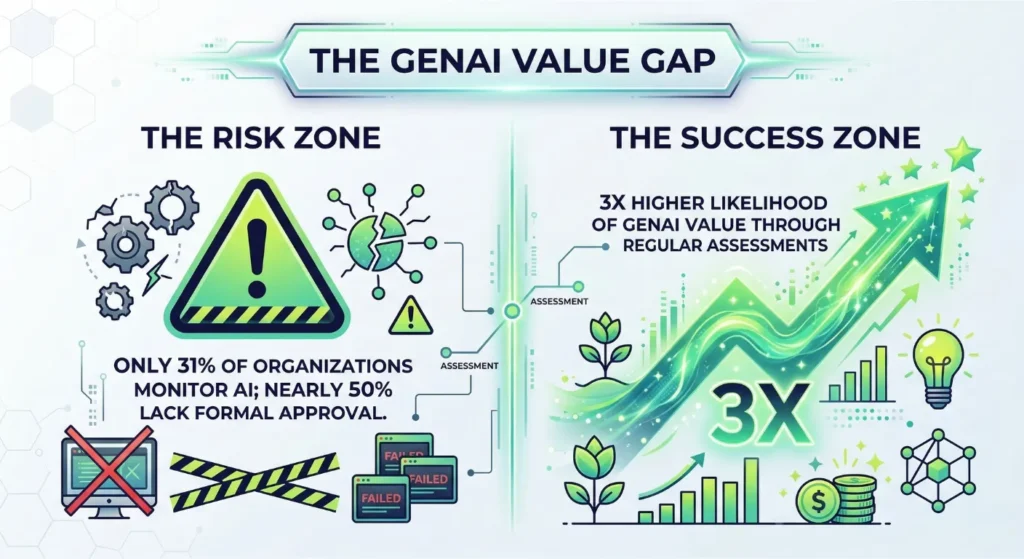
Current data highlights a massive gap in enterprise readiness. While healthcare data breaches affected over half the U.S. population in 2024, only 31% of organizations actively monitor their AI systems. This lack of oversight exists. It persists despite evidence that regular assessments triple the likelihood of achieving high value from GenAI.
Organizations must implement robust LLM evaluation to bridge this safety gap. You protect your brand only when you prioritize generative AI testing throughout the model’s lifecycle.
Why Is Simple Keyword Matching Failing Your AI Strategy?
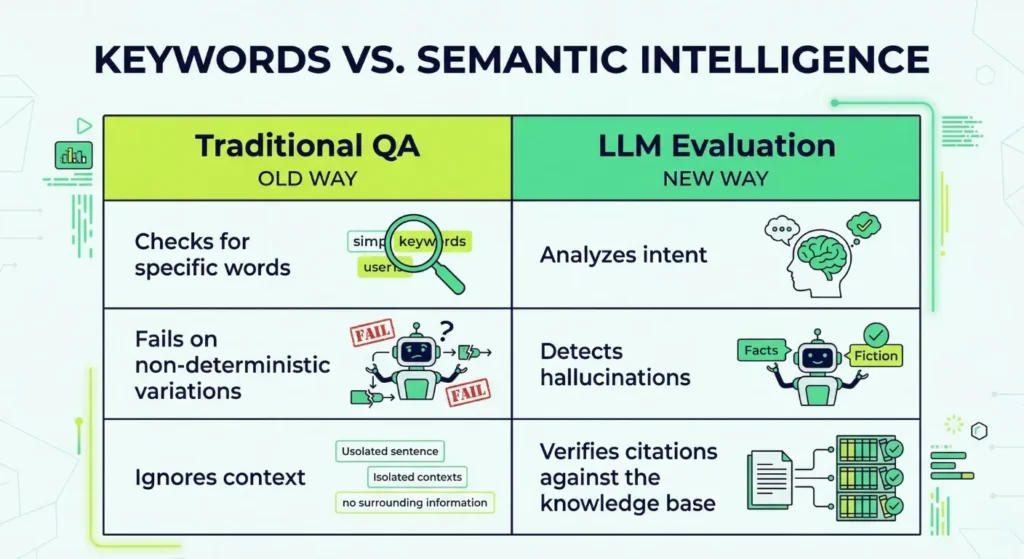
Traditional software testing relies on predictable, binary outcomes. If you input X, the system must return Y. LLMs behave non-deterministically. They produce thousands of variations for the same prompt. This unpredictability creates a massive challenge for AI output validation. If your quality assurance team relies solely on keyword matching, they will miss subtle but dangerous errors.
Effective LLM evaluation rests on three key pillars:
First, you need deep semantic analysis. You must verify that the AI captures the user’s intent rather than just repeating terms.
Second, rigorous hallucination detection in LLM is non-negotiable. You must confirm that every claim the model makes exists within your trusted knowledge base. Industry analysts expect the market for these observability platforms to reach to about USD 8.07 billion by the early 2030s as companies prioritize safety.
Finally, every response needs citation integrity. If an AI provides financial advice or technical specs, it must link back to a verified source. High-performing teams that automate these checks often see a 25% improvement in complex query accuracy.
Is Your Generative AI Testing Covering the Whole Architecture?
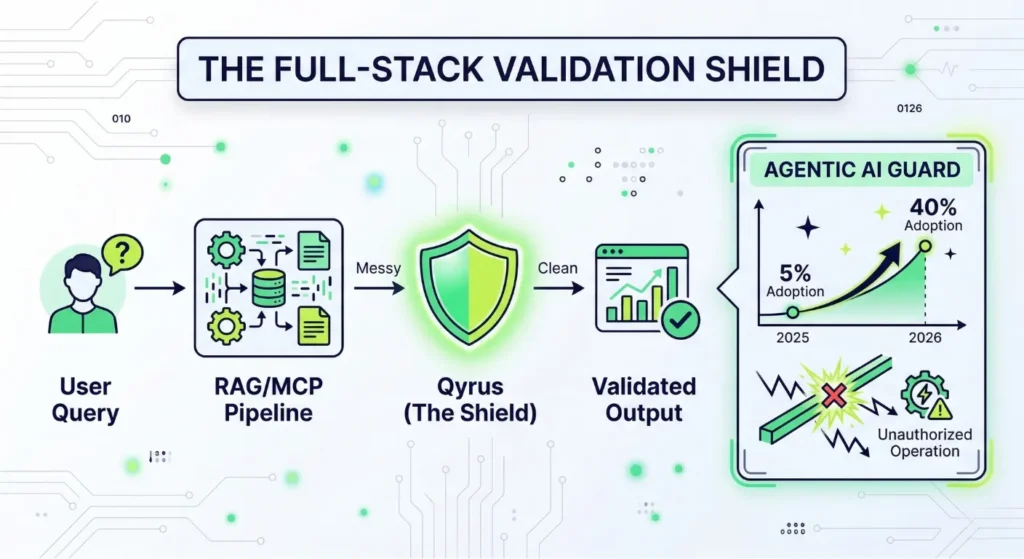
Many teams make the mistake of only checking the model’s final response. This narrow focus misses the technical cracks in your underlying architecture. Enterprise-grade generative AI testing must validate the entire stack. This includes your Retrieval-Augmented Generation (RAG) and Model Context Protocol (MCP) pipelines.
Qyrus runs deep system-level checks to expose failures that surface-level reviews ignore. You must ensure your retrieval layer gathers the correct context before the model even starts writing.
Agentic AI introduces even more complexity as autonomous systems take actions on your behalf. Industry forecasts suggest that enterprise applications using task-specific agents will surge from less than 5% in 2025 to 40% by the end of 2026. Without a robust LLM testing strategy that handles autonomous behavior, these agents might perform unauthorized operations.
Qyrus provides an Agentic AI Guard to keep these systems within defined bounds. It verifies tool selection and blocks risky actions in real-time. Our AI Quality Suite achieves over 98% faithfulness in validated outputs. This level of precision ensures your agents remain reliable as they scale across your organization. Consistent LLM Evaluation ensures your AI stays on-task and secure.
How Do You Audit an AI That Never Gives the Same Answer Twice?
Traditional testing fails when your software generates unique text for every single user. You cannot write a manual test case for every possible sentence an LLM might produce. Instead, you must build a system that understands intent and accuracy.
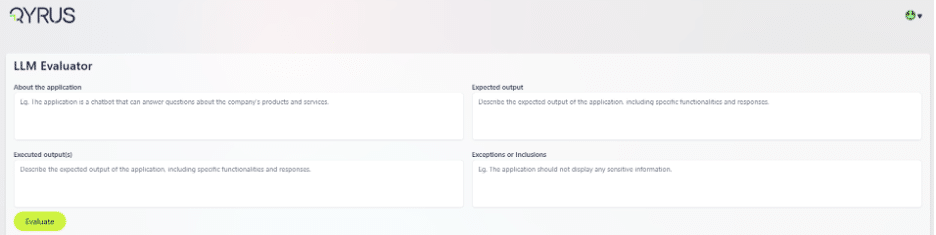
Qyrus LLM Evaluator simplifies this complexity by providing a structured framework for generative AI testing. You begin by defining the “About the Application” section to provide the evaluator with context. Then, you establish the “Expected Output”—your gold standard for what the AI should ideally say.
The real power lies in defining “Exceptions or Inclusions.” For example, you might command the bot to never disclose account balances over one million dollars or to always include a specific legal disclaimer.
You then input the “Executed Outputs” from your model. The system instantly analyzes the response, providing a relevance score from one to five and a detailed reasoning for that score.
Can Your Team Scale LLM Evaluation Without Losing Precision?
Automation is the only way to keep pace with rapid model updates. Manual reviews simply take too long and introduce human bias. A robust LLM testing strategy uses a “judge” model to verify the primary model’s work. It checks for specific positives and negatives in every response. Did the bot mention the account balance? Did it follow the formatting rules? The evaluator answers these questions in seconds.
By automating your AI output validation, you achieve a level of consistency that human auditors cannot match. This automated layer provides a safety net that catches errors before they reach your customers. It handles the heavy lifting of hallucination detection in LLM by cross-referencing every generated claim against your source documents.
When you integrate this into your CI/CD pipeline, LLM Evaluation becomes a continuous process rather than a final hurdle. You gain the confidence to deploy updates daily, knowing your guardrails remain intact and your brand remains protected.
How Does Industry Context Change Your Validation Strategy?
Enterprise risk shifts significantly depending on your field. A typo in a blog post might be embarrassing, but a mistake in a medical summary or a legal contract can destroy a company. You must tailor your AI output validation to the specific regulatory and operational pressures of your vertical.
Will Your Internal Assistant Accidentally Violate Labor Laws?
Internal HR bots often handle sensitive employee data and policy inquiries. If your AI provides incorrect guidance on overtime pay or hiring practices, you face immediate legal exposure. Quality engineering teams must implement LLM testing to verify that every response stays within corporate and legal guardrails.
We focus on automated auditing that cross-references AI suggestions against current labor regulations. This prevents the model from exposing personally identifiable information (PII) or suggesting discriminatory practices. Rigorous LLM Evaluation ensures your internal tools protect your employees and your legal standing.
Could a Helpful Chatbot Cost You $11,000 in a Single Transaction?
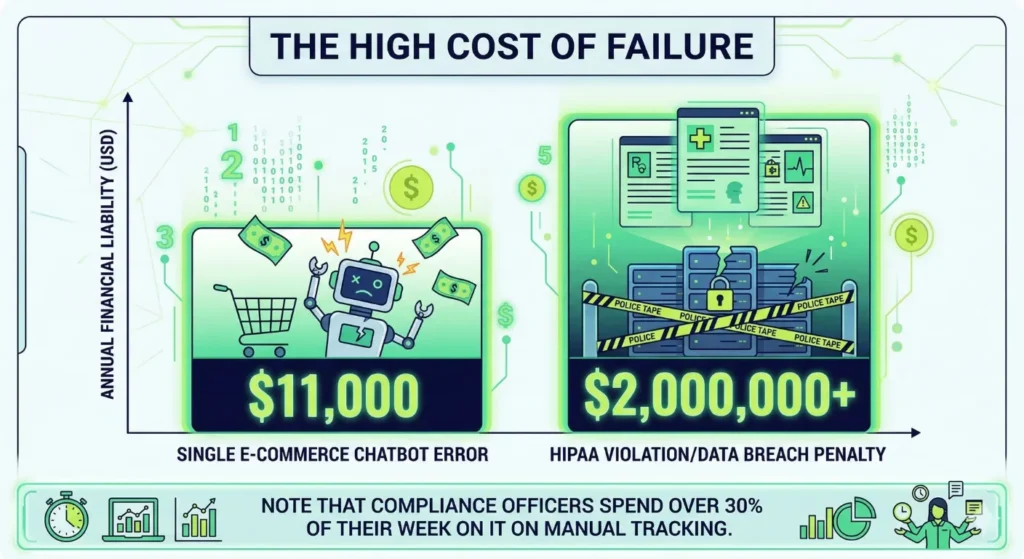
Ecommerce brands often prioritize a “polished” tone, but tone without accuracy creates merchant liability. One chatbot famously offered an 80% discount without any human approval. The resulting order totaled nearly $11,000. This is a real risk. Generative AI testing identifies these outliers by running thousands of simulated interactions before you go live.
You must ensure your bot hits 95% accuracy against your live product manuals and pricing sheets. We use automated judges to flag any unauthorized promises, ensuring your AI remains a sales asset rather than a financial drain.
Is Your Clinical AI a Multi-Million Dollar Liability Waiting to Happen?
Healthcare and finance demand the highest levels of precision. In 2024, data breaches affected over half the U.S. population. Regulators now levy penalties exceeding $2 million annually for HIPAA failures. Meanwhile, financial compliance officers spend over 30% of their week manually tracking enforcement actions. You can automate much of this oversight.
We implement deep hallucination detection in LLM to ensure clinical summaries or financial advice match verified source documents perfectly. Our platform achieves over 98% faithfulness in these high-stakes environments. This level of control allows you to innovate without fearing a regulatory crackdown.
Why Automated LLM Testing Is the Key to Your Enterprise Growth
Software quality defines the modern business. Generative AI testing simply extends those rigorous standards to the next generation of applications. Organizations that conduct regular assessments significantly increase the likelihood of extracting high value from their AI investments. You cannot afford to deploy models that act as black boxes. Qyrus and our LLM Evaluator transform these systems into transparent, reliable assets.
We believe that quality functions as the steering wheel for your innovation. Our AI Quality Suite automates the most difficult parts of LLM Evaluation and AI output validation. We achieve over 98% faithfulness in validated outputs, allowing your team to move at high velocity without fear. Robust hallucination detection in LLM turns your AI from a liability into a competitive edge. It is time to move past experimental pilots and into governed, measurable operations.
Secure your enterprise AI today. Reach out to the Qyrus team to schedule a demo and see how our platform safeguards your future.
Frequently Asked Questions
How to detect hallucinations in LLMs before they reach your customers?
You must implement an automated judge that cross-references AI claims against your internal documents. Qyrus uses semantic comparison to identify assertions without evidence. This automated hallucination detection in LLM saves hundreds of manual auditing hours. It ensures every response stays grounded in your data. Relying on human reviewers for thousands of logs is impossible.
Which LLM response validation methods offer the highest accuracy?
Semantic scoring outperforms simple keyword matching. You should use LLM response validation methods that assign a score (1-5) based on relevance and faithfulness to the source. Our LLM Evaluation framework provides clear reasoning for every grade. This helps your team identify why a model failed and how to refine the prompt.
Why is automated testing for generative AI essential for scaling?
Manual testing cannot keep up with models that update frequently. Automation lets you run thousands of test cases in a single afternoon. Teams that use automated testing for generative AI reduce production time by 50% and see a 30% improvement in data extraction accuracy.
What are the best tools for LLM evaluation on the market today?
You need a platform that validates the entire architecture, not just the output. Qyrus Pulse and the LLM Evaluator provide full-stack visibility. We offer the precision required for enterprise-grade LLM testing. Our suite handles everything from simple chatbots to complex autonomous agents.
How should your team approach validating LLM outputs for enterprise AI?
Start by defining your “Expected Output” and “Exceptions or Inclusions.” This establishes the rules for the AI. You then compare the “Executed Output” against these rules. Since only 31% of organizations monitor their AI, validating LLM outputs for enterprise AI gives you a major security advantage. It prevents brand liabilities before they happen.
What is the most effective way of testing RAG pipelines?
You must run system-level checks on the retrieval layer and the prompt assembly. Testing RAG pipelines involves verifying that the vector search gathered the correct context. Qyrus Pulse exposes failures that surface-level reviews miss. We ensure your RAG system achieves over 98% faithfulness to the original source.
How to test AI chatbots for legal and financial risks?
Run adversarial simulations to see if the bot violates your internal policies. How to test AI chatbots requires setting clear “Negatives”—things the AI should never do. For example, you might block the bot from revealing account balances over a certain limit. This type of AI output validation stops costly errors in their tracks.
Are there specific AI compliance testing tools for regulated sectors?
Yes, you need tools that specifically address HIPAA and financial regulations. Regulated sectors face penalties exceeding $2 million annually for privacy failures. Qyrus offers specialized AI compliance testing tools that automate the auditing of clinical and legal outputs. We keep your AI within the strict bounds of the law.
How to scale the momentum of ‘Vibe Coding’ using intelligent test automation to enforce rigorous regression and security guardrails essential for the financial sector.
March 25
8:30 PM IST | 3:00 PM GMT | 10:00 AM EST
Software development has entered a new mode: Vibe Coding. It is fast, exploratory, and driven by the question, “Does it work?” rather than “Is it perfect?”. For startups and hackathons, this momentum is a superpower. But in banking, unchecked “vibes” can lead to hidden costs: tech debt, brittle systems, and compliance failures.
How do financial institutions adapt to this new speed without compromising stability?
Join our leaders, as they unveil the Hybrid Model for banking software. This session will demonstrate how to operationalize the speed of Vibe Coding by wrapping it in automated, intelligent guardrails that ensure scalability, security, and maintainability.
What You Will Learn
The “Vibe” vs. “Regulation” Conflict: Why the “code fast, fix later” approach fails in banking—and how to fix it without killing developer velocity.
The Hybrid Model: A practical framework for a two-phase development lifecycle: Phase 1 (Vibe) for rapid prototyping and discovery, followed by Phase 2 (Formalize) for standardization and testing.
Building Qyrus Guardrails: How to utilize the Qyrus platform to automate the “boring correctness” of software delivery:
Contract-First Development: Using API Builder and hosted mocks to define boundaries early.
Automated Test Generation: Using TestGenerator and QyrusJourneys to create tests directly from real user behaviors and stories.
Data & Orchestration: Leveraging Echo for synthetic boundary data and SEER framework for agentic self-healing and prioritization.
The Vibe-Weighted Pyramid: How to restructure your testing strategy (60% Unit, 30% API, 10% E2E) to support rapid changes while maintaining evidence-driven quality.
Who Should Attend
Banking CXOs: Seeking faster time-to-value with bounded risk and auditability.
Engineering Leaders: Who need to scale innovation pods and proofs-of-concept into robust, maintainable systems.
QA Architects: Looking to transition from manual scripting to automated quality gates and “fix-forward” workflows.
Meet Our Experts
Ravi Sundaram
President, Qyrus
Ameet Deshpande
SVP, Product Engineering, Qyrus
Yadvendra Rathore
VP, Client Success, Qyrus
Ready to Operationalize Your Vibe?
Vibe Coding is powerful, but chaotic if unchecked. Don’t let hidden costs like brittle systems and knowledge silos slow you down. See how Qyrus uses AI-driven tools—from API Builder to SEER—to wrap your rapid development in automated quality gates.
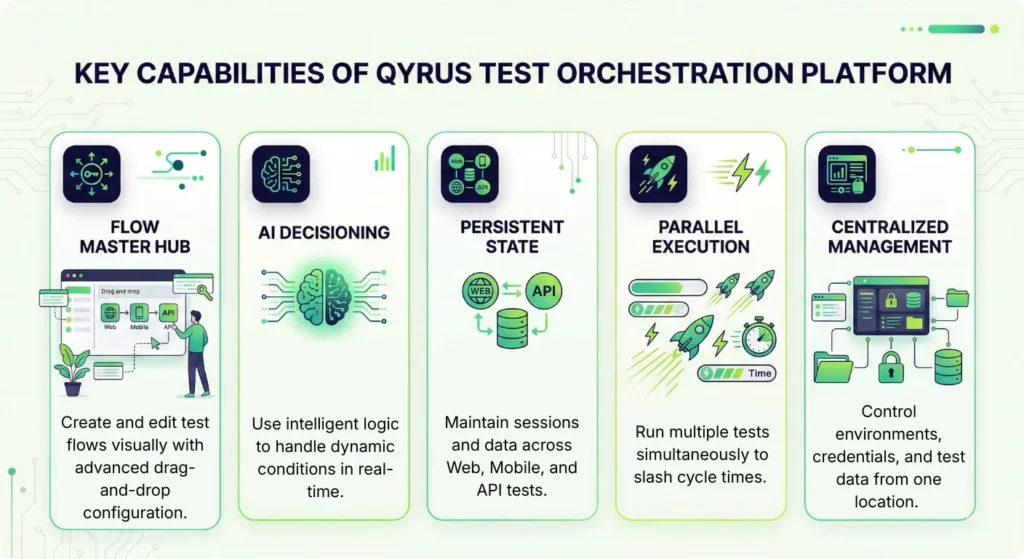
Software quality defines market leadership. QA teams today face a clear choice: continue managing fragmented scripts or switch to an integrated system that handles the entire testing lifecycle. Qyrus Test Orchestration provides this bridge. It allows teams to coordinate complex test scenarios across diverse environments using a visual, no-code interface. By centralizing execution and using AI to handle dynamic conditions, organizations move products from development to release faster than ever.
Current data highlights a significant opportunity for growth. While 83% of developers now work within DevOps environments, 36.5% of firms still lack any form of test orchestration. This gap creates bottlenecks in high-velocity pipelines. Qyrus solves this with a workflow-driven automation platform that ensures every test runs in the right sequence, on the right device, at exactly the right time.
The Strategic Need for Enterprise Test Orchestration Software
Many organizations struggle with “automation silos.” Teams write scripts for specific features, but these scripts rarely talk to each other. This fragmentation causes major delays. According to a survey, 82% of testers still perform manual or component-level testing daily. Even more concerning, only 45% of teams have automated their standard regression suites. Isolated tests fail to capture how different components interact in the real world.
Enterprise test orchestration software moves beyond simple execution. It acts as the brain of your testing strategy. Standard automation tools run scripts; orchestration platforms manage the relationship between those scripts. They handle data dependencies, environment setup, and error recovery automatically.
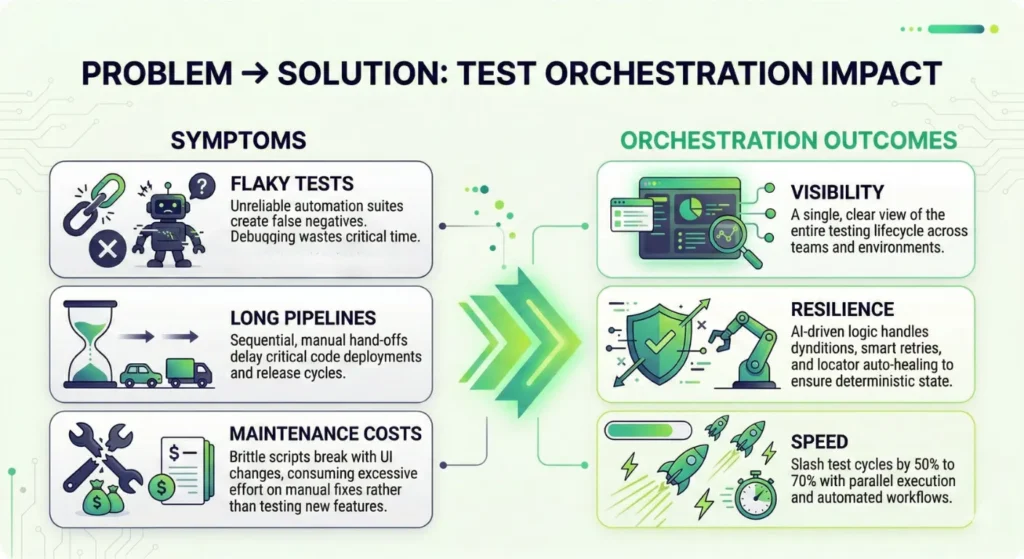
This shift reduces the “flakiness” that plagues most pipelines. When tests fail for non-functional reasons, it wastes developer time and slows down the release cycle. By coordinating the entire flow, orchestration cuts cycle times by 50% to 70% for many teams.
Leaders prioritize orchestration because it lowers the defect escape rate. It creates a safety net that spans the entire software development lifecycle. You no longer hope that your components work together. You prove it. Consistent orchestration ensures that every code change undergoes rigorous validation across every layer of the system.
Qyrus: The Modern Workflow-Driven Automation Platform
Qyrus transforms testing from a collection of isolated tasks into a cohesive, managed system. It operates as a workflow-driven automation platform that integrates four core pillars: the visual Flow Hub, a centralized Data Hub, a powerful Orchestration Engine, and extensive third-party integrations. This structure allows teams to reduce manual testing efforts by 80% while maintaining total control over the release pipeline. Unlike standard tools that require heavy scripting to manage dependencies, Qyrus uses an AI decision layer to handle complex logic and environment promotion automatically.
Flow Hub: Visual Logic Creation
The Flow Hub serves as the primary workspace for your testing strategy. You drag and drop “Nodes”—individual units representing Web, Mobile, API, or Desktop scripts—and connect them to form a sequence. This visual approach allows QA experts to build sophisticated scenarios without writing a single line of code. Each node contains its own execution settings, allowing you to customize timeouts and skip conditions for every specific step.
Data Hub & State Persistence
Managing data dependencies often creates the biggest hurdle in automation. Qyrus simplifies this through a centralized Data Hub that supports Global, Workflow, and Step scopes. This ensures that an ID generated in an API test can move seamlessly into a Mobile or Web script. Furthermore, unique session persistence capabilities allow a single browser or device session to remain active across multiple scripts. This prevents the need for constant re-logins and ensures your tests mirror real user behavior.
Resilience Patterns
Flaky environments often derail even the best automation projects. Qyrus counters this with built-in resilience patterns, including “Retry with Backoff” and “Stop” actions. If an API call fails due to network lag, the platform automatically retries the operation using a linear or exponential delay. These patterns act as circuit breakers, preventing a single transient error from failing an entire multi-hour suite and saving your team hours of manual debugging.
Integrations
A platform must fit into your existing ecosystem to provide value. Qyrus connects directly with CI/CD tools and communication platforms like Slack and Microsoft Teams to keep stakeholders informed in real-time. It also supports major cloud providers and various test runners. This connectivity ensures that your orchestrated workflows remain a natural part of your DevOps stack.
Core Features & How They Map to Enterprise Needs
Enterprise testing requires more than just high-speed script execution. Large-scale organizations manage sprawling portfolios of legacy systems and modern microservices that must function in unison. Enterprise test orchestration software bridges this gap by addressing the specific structural failures that cause 73% of automation projects to fail.
Visual Test Flows for Complex Coverage
Most QA teams struggle to automate complex journeys because the underlying code becomes too brittle to maintain. Qyrus solves this through the Flow Hub. You drag and drop test nodes to map out the entire user journey visually. This approach enables teams to achieve higher coverage across multi-platform systems without the technical debt of thousands of lines of custom code.
Conditional Logic for Environment-Aware Testing
Tests often fail because they lack the intelligence to adapt to different environments. Logic control within the platform allows you to define “If-Then” scenarios. For example, a workflow can skip an email verification step in the Development environment but require it in Staging. This environment-aware testing ensures that the same workflow remains valid across the entire release pipeline.
Session Persistence for True E2E Tests
Standard automation tools usually restart the browser or clear the device cache between test scripts. This resets the user state and makes deep end-to-end testing nearly impossible. Qyrus maintains session persistence across Web, Mobile, and API tests. A single login at the start of a workflow carries through every subsequent node, mirroring exactly how a real customer interacts with your brand across different platforms.
Data Hub for Deterministic State
Inconsistent test data causes frequent false negatives. The Data Hub acts as a centralized repository that passes information, such as unique Order IDs or customer tokens, between steps. This ensures a deterministic state throughout the run. When every test uses fresh, accurate data from the previous step, you eliminate the “data pollution” that often breaks shared testing environments.
Parallel Nodes for Faster Pipelines
Cycle time remains the primary metric for DevOps success. Orchestration allows you to run independent test nodes in parallel rather than waiting for one to finish before starting the next. This capability significantly slashes execution time, helping teams meet the demand for daily or even hourly releases.
AI Decisioning for Resilient Testing
Flaky tests are a significant drain on resources, often consuming up to 16% of a developer’s time. Qyrus integrates an AI test orchestration platform layer to identify whether a failure is a genuine bug or a transient environment glitch. Smart retries and circuit-breaker patterns allow the system to recover from minor network lags automatically. This ensures your team only investigates real issues, which improves overall execution accuracy and builds trust in the automation suite.
The AI Advantage: Why an AI Test Orchestration Platform Matters
Traditional automation often collapses under the weight of flaky tests. When a locator changes or a network blips, scripts break and require manual fixes. An AI test orchestration platform solves this by introducing “self-healing” capabilities. If the system detects a modified UI element, it automatically updates the locator during execution to prevent a failure. This shift toward intelligence is why 76% of developers now use or plan to use AI tools in their development process.
Smart classification provides the second major advantage. Instead of a generic “failed” report, the platform uses machine learning to categorize the root cause. It distinguishes between a transient environment glitch and a genuine code regression. This clarity allows teams to reduce triage time by up to 35%. You no longer waste hours investigating “ghost” failures that fix themselves on a rerun.
Intelligence also optimizes how you run your tests. The platform analyzes historical data to prioritize high-risk areas. If a specific microservice fails frequently, the AI places those tests at the front of the queue. While the system handles these complex decisions, human oversight remains vital. The platform provides “Confidence Scores” for every automated decision, allowing QA leads to verify and approve major structural changes. This collaboration ensures that speed never comes at the cost of accuracy.
The market reflects this move toward smarter systems. MarketsandMarkets expects the AI in software testing market to grow at a CAGR of 22.3% through 2032. By letting AI handle the routine repairs, your engineers can focus on designing better user experiences.
Visual suggestion
Flow with AI decision node: show a node that uses AI confidence to choose retry vs fallback.
Placement: next to the AI section
Typical Enterprise Use Cases & Playbooks
Enterprise teams don’t just test features; they test business outcomes. A single user action often triggers a complex chain reaction across dozens of services, internal APIs, and legacy databases. Manually triggering these tests or relying on loosely coupled scripts leads to “blind spots” where integration failures hide. Orchestration provides a structured playbook for these high-stakes scenarios.
Release Smoke + Regression Across 40 Microservices
Large-scale applications now rely on hundreds of independent services. When a developer updates one microservice, you must validate how it interacts with the rest of the dependency graph. A workflow-driven automation platform allows you to chain contract tests, API mocks, and UI smoke tests into a single, synchronized flow.
This coordinated approach helps companies achieve shorter test cycles by eliminating manual hand-offs between infrastructure and QA teams.
The Resilient Payment Journey
A standard checkout involves a UI interaction, an API call to a payment gateway, a ledger update, and a final customer notification. If the ledger update fails, the system shouldn’t just stop. Qyrus uses “circuit breaker” and “rollback compensation” patterns to manage these failures.
If a critical step fails, the orchestrator can automatically trigger a compensating transaction or send an immediate high-priority alert to the DevOps team. This ensures that a failure in one layer doesn’t leave the system in an inconsistent state or corrupt customer data.
Cross-Platform Continuity with Session Persistence
Modern customers often start a journey on a mobile app and finish it on a desktop browser. Traditionally, testing this required two separate scripts with no shared data or session history. Enterprise test orchestration software changes this through session persistence.
The orchestrator keeps the user logged in as the test moves from a mobile device to a web browser or a desktop application. This validates the true end-to-end experience and catches state-sync issues that isolated tests miss. By testing the way customers actually behave, you catch defects that usually escape to production.
Security, Compliance & Enterprise Governance
Enterprises in highly regulated sectors like finance and healthcare cannot compromise on data integrity. While cloud adoption grows, 90% of organizations will maintain hybrid cloud deployments through 2027 to meet strict residency and security requirements. Enterprise test orchestration software must provide the same level of control as the production environments it validates. A single data breach now costs companies an average of $4.4 million, and regulatory fines under frameworks like GDPR can reach 4% of global annual turnover.
Governance and Data Control
A workflow-driven automation platform acts as a secure vault for your testing assets. Qyrus handles sensitive information through dedicated credential management, ensuring that API keys and passwords never appear in plain text within test scripts. Role-Based Access Control (RBAC) limits visibility, so only authorized personnel can view or edit critical workflows in production-level environments. This prevents unauthorized changes and protects sensitive system configurations.
Auditability and Segregation
Regulated industries require a clear paper trail for every code change. The platform maintains detailed audit trails and activity logs that track who executed a test, what parameters they used, and when the run occurred. This transparency simplifies compliance audits and internal reviews.
Furthermore, environment segregation prevents accidental cross-contamination between development, staging, and production tiers. By using data masking, teams can run realistic tests without exposing actual Personally Identifiable Information (PII) to the QA environment. This approach maintains the high standards of an AI test orchestration platform while protecting the organization from legal and financial risk.
Migration Path: From Component Tests to Orchestrated Workflows
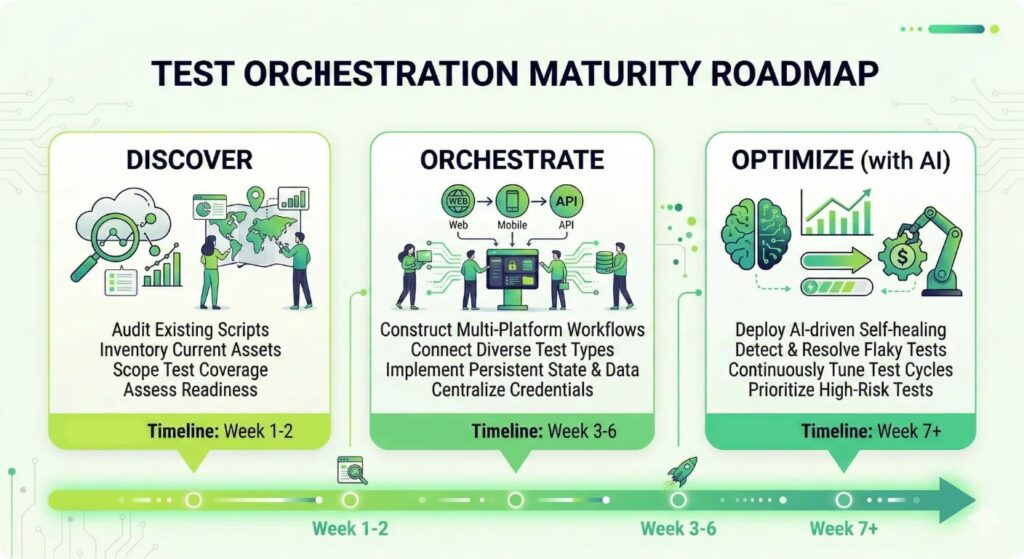
Transitioning from fragmented component testing to a structured workflow-driven automation platform requires a tactical, phased approach. Organizations cannot simply lift and shift every script overnight without creating technical debt. A successful migration moves through four distinct stages to ensure stability and immediate value.
Stage 1: Inventory and Audit
Begin by auditing your existing library of unit and functional scripts. Identify which tests provide the most value and which have become redundant or “flaky.” Statistics show that flaky tests consume up to 16% of a developer’s time, so this is the perfect moment to prune low-quality assets. Categorize your scripts by their role in the user journey to prepare them for the Flow Hub.
Stage 2: Quick Wins with Smoke Workflows
Do not attempt to orchestrate your entire regression suite on day one. Instead, focus on “quick wins” by building automated smoke tests for your most critical paths. Qyrus provides templates for login and session validation that allow teams to get up and running in just 1-2 hours. These high-visibility workflows demonstrate immediate ROI and build team confidence in the new system.
Stage 3: Expanding Orchestrated Flows
Once your smoke tests are stable, begin connecting more complex nodes. This stage involves using the Data Hub to pass information between Web, Mobile, and API scripts. Use session persistence to maintain a single user state across these platforms. Most enterprises find that coordinating these multi-component systems results in 50% to 70% shorter test cycles compared to their old manual hand-off processes.
Stage 4: Optimize with an AI Test Orchestration Platform
The final stage involves layering intelligence over your workflows. Enable smart retries and “retry with backoff” patterns to handle transient environment issues automatically. As the system gathers data, use the AI test orchestration platform capabilities to identify failure patterns and suggest locator fixes. This maturity level allows your team to stop “firefighting” and start focusing on strategic quality engineering.
Migration Best Practices and Pitfalls
Avoid the common pitfall of 1-to-1 script migration. Simply running an old script inside a new container does not capture the benefits of orchestration. Instead, re-think how those scripts should interact. Qyrus minimizes the technical burden by offering a managed migration process that typically requires only a 2-day downtime window to move all existing web scripts from old component services to the core orchestration engine.
Quality Engineering: From Managing Scripts to Governing Systems
Quality engineering moves from managing scripts to governing systems. Modern delivery pipelines demand more than isolated checks. They require a coordinated, intelligent strategy. Adopting enterprise test orchestration software allows your team to connect Web, Mobile, and API tests into one seamless journey. This shift removes the bottlenecks that prevent high-velocity releases.
The financial and operational benefits remain high across all industries. Teams using a workflow-driven automation platform report shorter test cycles, lower maintenance costs, and reduced manual testing efforts. These improvements ensure your engineers spend their time building features rather than repairing brittle scripts. Early adoption provides a clear market advantage. Orchestration gives you the stability needed to release with absolute confidence.
Information integrity defines the success of the modern autonomous enterprise. By 2026, 75% of all enterprise data will originate and undergo processing at the network edge. This massive shift creates a data stream of 79.4 zettabytes annually. Organizations face a choice: do you monitor for corruption after it hits your production systems, or do you stop it at the source?
Poor data quality costs organizations an average of $12.9 million every year. iCEDQ addresses this by acting as a powerful production sentry, utilizing an in-memory engine built to audit billions of records for compliance and governance. It excels at detecting errors that have already breached your environment.
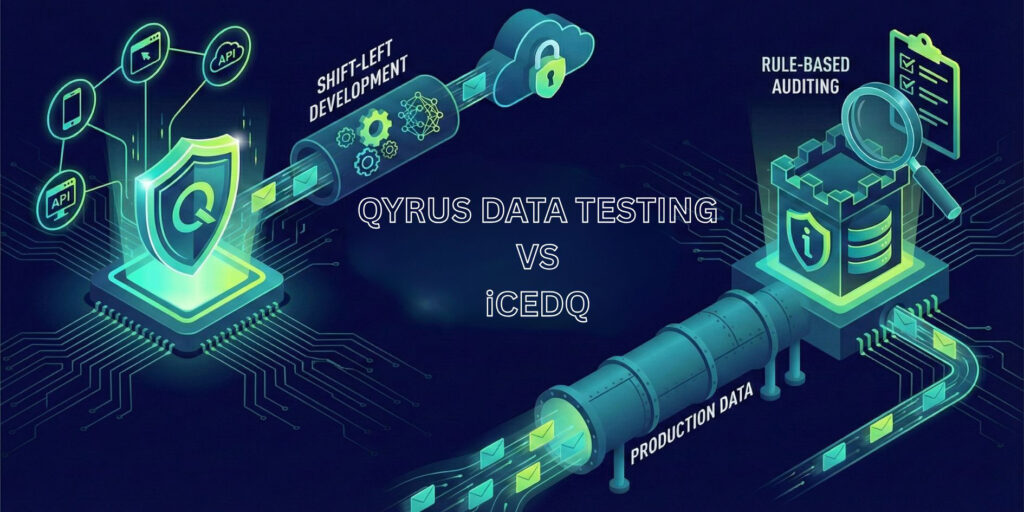
Qyrus Data Testing takes the “Shift-Left” approach. It uses Generative AI to build test cases that identify logic flaws during the development phase, ensuring only “clean” data reaches your storage layers. High-speed decision-making requires absolute accuracy. While iCEDQ manages the end-state, Qyrus eliminates the “dirty data” problem before it becomes a liability.
Data Source Connectivity: Finding Signal in a 79 Zettabyte Haystack
Connectivity serves as the nervous system of your data architecture. By 2026, the volume of information generated by IoT devices alone will reach 79.4 zettabytes. However, a massive library of connectors does not guarantee a clear view of your operations.
iCEDQ positions itself as a heavyweight in enterprise connectivity, offering 50+ SQL connectors to support massive, established data environments. It excels in high-volume, rules-based auditing for Big Data stores like Snowflake and AWS Redshift. For organizations with vast, legacy-heavy footprints, iCEDQ provides the stable, wide-reaching “bridge” needed to monitor production end-states.
Data Source Connectivity
Feature
Qyrus Data Testing
iCEDQ
SQL Databases
MySQL
✓
✓
PostgreSQL
✓
✓
MS SQL Server
✓
✓
Oracle
✓
✓
IBM DB2
✓
✓
Snowflake
✓
✓
AWS Redshift
✓
✓
Azure Synapse
◐
✓
Google BigQuery
◐
✓
Netezza
✓
✓
Total SQL Connectors
10+
50+
NoSQL Databases
MongoDB
✓
✓
DynamoDB
✓
✓
Cassandra
✗
✓
Hadoop/HDFS
✗
✓
Cloud Storage & Files
AWS S3
✓
✓
Azure Data Lake (ADLS)
✓
✓
Google Cloud Storage
◐
✓
SFTP
✓
✓
CSV/Flat Files
✓
✓
JSON Files
✓
✓
XML Files
◐
✓
Excel Files
◐
✓
Parquet
✗
✓
APIs & Applications
REST APIs
✓
✓
SOAP APIs
◐
✓
GraphQL
◐
◐
SAP Systems
✗
◐
Salesforce
✗
✓
Legend: ✓ Full Support | ◐ Partial/Limited | ✗ Not Available
Conversely, Qyrus addresses a more pressing modern challenge: the integration gap. Research reveals that only 29% of enterprise applications are actually integrated, leaving the vast majority of data sources unmonitored. Qyrus prioritizes the API layer—specifically REST and GraphQL—where a significant portion of the 75% of edge data first appears. It maintains a focused set of 10+ core SQL connectors, choosing to master the critical pathways that feed modern digital transformations.
Velocity requires more than just a list of ports; it requires visibility at the point of origin. While iCEDQ monitors the final destination, Qyrus validates the flow at the source.
Data Source Connectivity: Why Your Validation Logic Must Live at the Edge
Data validation determines whether your autonomous systems act on reliable intelligence or dangerous assumptions. While traditional cloud architectures introduce significant round-trip latency, mission-critical operations now require results in single-digit windows. Your choice of validation tool either secures this window or creates a bottleneck.
iCEDQ serves as an industrial-scale auditor for production environments. It utilizes a high-performance in-memory engine to verify final data states against complex business rules. This rules-based approach ensures that massive datasets remain compliant with governance standards once they reach the central repository. It provides the deep surveillance necessary for regulated industries that cannot afford a breach in production integrity.
Data Validation & Testing Capabilities
Feature
Qyrus Data Testing
iCEDQ
Comparison Testing
Source-to-Target Comparison
✓
✓
Full Data Comparison
✓
✓
Column-Level Mapping
✓
✓
Cross-Platform Comparison
✓
✓
Reconciliation Testing
✓
✓
Aggregate Comparison (Sum, Count)
◐
✓
Single Source Validation
✓
✓
Row Count Verification
✓
✓
Data Type Verification
✓
✓
Null Value Checks
✓
✓
Duplicate Detection
✓
✓
Regex Pattern Validation
✓
✓
Custom Business Logic/Functions
✓
✓
Referential Integrity Checks
◐
✓
Schema Validation
◐
✓
Advanced Testing
Transformation Testing
✓
✓
ETL Process Testing
✓
✓
Data Migration Testing
✓
✓
BI Report Testing
✗
✓
Slowly Changing Dimensions (SCD)
✗
✓
Tableau/Power BI Testing
✗
✓
Pre-Screening / Data Profiling
◐
✓
Data Lineage Tracking
✗
✓
Legend: ✓ Full Support | ◐ Partial/Limited | ✗ Not Available
Qyrus shifts the validation strategy to the left to prevent defects before they enter the high-latency pipeline. By employing Generative AI for Test Cases, Qyrus identifies logic flaws in the transformation layer during development. This proactive method supports high-speed environments, such as manufacturing lines that have achieved a significant reduction in false positive rates through localized quality control. Qyrus also allows teams to inject custom Lambda functions into their automated data quality checks, ensuring that unique business logic remains intact from the point of origin.
Your ETL data testing framework must provide a clear mirror of your operational truth. Whether you lean on iCEDQ’s industrial auditing or Qyrus’s AI-powered prevention, your goal remains the same: stop the rot before it reaches the warehouse.
Automation & Integration: Orchestrating the Future of AI-Ready Data Pipelines
Automation serves as the engine that drives modern data operations from development to the network edge. Without seamless integration, your data quality strategy creates friction that stalls innovation. Gartner predicts that by 2026, 40% of enterprise applications will feature task-specific AI agents. These intelligent systems require pipelines that function with absolute precision and zero manual intervention.
iCEDQ provides massive orchestration power for high-scale enterprise workloads. It integrates natively with dominant enterprise schedulers like Control-M and Autosys to manage rules-based testing across production environments. This deep integration allows DataOps teams to trigger automated audits as part of their existing high-volume batch processing. For organizations managing thousands of production jobs, iCEDQ acts as the heavy-duty transmission that keeps the engine running at scale.
Automation & Integration
Feature
Qyrus Data Testing
iCEDQ
Test Automation
No-Code Test Creation
✓
✓
Low-Code Options
✓
✓
SQL Query Support
✓
✓
Visual Query Builder
✓
✓
Test Scheduling
✓
✓
Reusable Test Components
✓
✓
Parameterized Testing
✓
✓
AI/ML Capabilities
AI-Powered Test Generation
✓
◐
Auto-Mapping of Columns
✓
✓
Self-Healing Tests
◐
◐
Generative AI for Test Cases
✓
✗
DevOps/CI-CD Integration
REST API
✓
✓
Jenkins Integration
✓
✓
Azure DevOps
✓
✓
GitLab CI
✓
✓
GitHub Actions
✓
✓
Webhooks
◐
✓
Swagger Documentation
◐
✓
Number of API Calls
N/A
50+
Issue & Test Management
Jira Integration
✓
✓
ServiceNow Integration
◐
✓
Slack/Teams Notifications
✓
✓
Email Notifications
✓
✓
Legend: ✓ Full Support | ◐ Partial/Limited | ✗ Not Available
Qyrus shifts this automation focus to the earliest stages of the development cycle. Using its Nova AI engine, the platform enables teams to build automated test cases 70% faster than traditional manual methods. This “Shift-Left” approach ensures that quality checks live directly within your Jenkins or Azure DevOps pipelines. Qyrus empowers manual testers to contribute to the automation suite through its no-code interface, effectively removing the technical bottleneck that often slows down development.
True velocity requires an architecture that prevents defects before they reach your storage layers. While iCEDQ manages the industrial-scale orchestration of production audits, Qyrus provides the AI-driven speed needed to stay ahead of the development curve.
Reporting & Analytics: Solving the Visibility Crisis in Distributed Architectures
Transparency acts as the final line of defense for data-driven organizations. As the edge computing market expands toward an estimated $263.8 billion by 2035, the sheer volume of distributed nodes makes manual oversight impossible. Without a centralized lens, your team cannot distinguish between a minor network hiccup and a systemic data corruption event.
iCEDQ provides a specialized command center for production monitoring and rules-based auditing. It offers the deep visibility needed to track data health at scale, ensuring that massive datasets comply with internal governance and external regulations. This “DataOps” approach excels in environments where audit trails and production stability are the highest priorities. iCEDQ ensures that your storage layer remains a reliable repository of truth through continuous, high-volume surveillance.
Reporting & Analytics
Feature
Qyrus Data Testing
Tricentis Data Integrity
Real-Time Dashboards
✓
✓
Drill-Down Analysis
✓
✓
Root Cause Analysis
◐
✓
PDF Report Export
✓
✓
Excel Report Export
✓
✓
Trend Analysis
◐
✓
Data Quality Metrics
◐
✓
Custom Report Templates
◐
✓
BI Tool Integration (Tableau, Power BI)
✗
✓
Audit Trail
✓
✓
Legend: ✓ Full Support | ◐ Partial/Limited | ✗ Not Available
Qyrus delivers a unified “TestOS” dashboard that consolidates signals from every layer of the application. This comprehensive view aligns with IDC’s forecast that 60% of enterprises will deploy unified frameworks by 2027 to manage operational complexity. By merging reports from Web, Mobile, API, and Data testing, Qyrus eliminates the fragmentation that often hides critical defects. This holistic reporting allows you to achieve a 70-95% reduction in bandwidth consumption by validating only the most relevant, high-value data insights.
Your monitoring strategy must evolve from simple log collection to intelligent observability. Whether you require the specialized production auditing of iCEDQ or the cross-layer visibility of Qyrus, your dashboard must turn raw telemetry into a clear signal for action.
Platform & Deployment: Choosing Between Production Guardrails and Development Agility
The physical location of your data processing now dictates your quality strategy. By 2026, 75% of enterprise-generated data will originate and undergo processing at the network edge, far from centralized cloud hubs. This structural change demands deployment models that can live exactly where the data lives.
iCEDQ provides a robust infrastructure for high-scale production surveillance. Its in-memory engine handles the massive computational load required to monitor billions of records in real-time. This platform supports Cloud (SaaS), On-Premises, and Hybrid models, giving DataOps teams the flexibility to build a permanent sentry within their core data center or cloud region. For organizations with strict data residency requirements, iCEDQ offers a mature, secure environment built for the long-term governance of enterprise information.
Platform & Deployment
Feature
Qyrus Data Testing
Tricentis Data Integrity
Cloud (SaaS)
✓
✓
On-Premises
✓
✓
Hybrid Deployment
✓
✓
Docker Support
✓
✓
Kubernetes Support
◐
✓
Multi-Tenant
✓
✓
SSO/LDAP
✓
✓
Role-Based Access Control
✓
✓
Data Encryption (AES-256)
✓
✓
SOC 2 Compliance
◐
✓
Legend: ✓ Full Support | ◐ Partial/Limited | ✗ Not Available
Qyrus prioritizes the agile, containerized workflows that define the modern “Shift-Left” movement. Because most enterprise deployments will soon reside on-premises at the network edge, Qyrus utilizes Docker and Kubernetes to ensure its automated data quality checks scale effortlessly alongside your microservices. As a unified “TestOS” ecosystem, it allows you to manage Web, Mobile, API, and Data testing within a single infrastructure footprint. While it actively expands its feature set, Qyrus provides the lightweight, AI-ready architecture needed to prevent “dirty data” from escaping the development cycle.
Your deployment choice depends on where you want to draw your line of defense. If you need a battle-tested sentry for production monitoring at a massive scale, iCEDQ is your champion. If you want to decentralize your quality checks and catch errors at the source, Qyrus provides the modern framework for an autonomous future.
The Industrial Sentinel vs. The AI Architect: Choosing Your Data Destiny
The architectural shift toward the network edge forces a total re-evaluation of the testing stack. Organizations must decide whether to invest in heavy-duty production surveillance or intelligent development-side prevention.
iCEDQ acts as a specialized industrial sentinel for the production environment. It utilizes a high-performance in-memory engine designed to audit billions of records for absolute compliance. Its “Rule Wizard” stands as a primary differentiator, offering a 90% reduction in effort for teams managing massive, rules-based auditing workflows. Deep integration with enterprise orchestrators like Control-M and Autosys makes it the dominant choice for DataOps teams who manage high-scale production schedules. If your world revolves around maintaining a pristine, audited end-state in a massive data warehouse, iCEDQ provides the necessary muscle.
Key Differentiators
Vendor
Unique Strengths
Best For
Considerations
Qyrus Data Testing
Unified testing platform (Web, Mobile, API, Data)
AI-powered function generation
Lambda function support for validations
Single-column & multi-column transformations
Part of comprehensive TestOS ecosystem
Organizations wanting unified testing across all layers;
Teams already using Qyrus for other testing needs
Beta product with growing feature set
Limited Big Data connectors currently
No BI report testing yet
iCEDQ
Rules-based auditing approach
In-memory engine for billions of records
Strong production data monitoring
Rule Wizard (90% effort reduction)
Deep enterprise orchestrator integration
DataOps teams; Production monitoring needs;
Large-scale data operations
Steeper learning curve
Premium pricing tier
Less AI/GenAI features
Qyrus functions as the AI architect, prioritizing the “Shift-Left” philosophy to eliminate defects at the source. It distinguishes itself as a unified “TestOS,” allowing teams to validate Web, Mobile, API, and Data layers within a single ecosystem. While iCEDQ monitors for errors, Qyrus uses Generative AI for Test Cases to predict and prevent them during development. This approach is vital for an environment where zettabytes of IoT data flow annually, requiring immediate, accurate processing. Qyrus also empowers technical teams with Lambda function support for complex transformations, ensuring that logic remains sound before data ever reaches the warehouse.
Choosing between these platforms depends on where you want to draw your line of defense. Organizations with heavy production monitoring needs and massive, rules-based auditing requirements should choose iCEDQ. However, teams seeking to consolidate their stack into a single platform and use AI to build tests 70% faster should choose Qyrus. In a world where 50% of enterprises are moving toward edge strategies by 2025, your quality strategy must match the speed of your data.
Stop the data rot at the source—prevent defects before they reach production with Qyrus. Begin your 30-day sandbox evaluation today to verify your integrity across every layer of the stack.
Welcome to our November update! As we approach the end of the year, our mission to simplify and supercharge your testing lifecycle continues with renewed vigor. In November, we’ve focused on removing the friction between your tools and your goals, delivering enhancements that offer greater visibility, deeper ecosystem integration, and a more personalized AI experience.
In November, we are bridging critical gaps in your workflow. We’ve made reporting clearer with context-rich screenshots, streamlined test creation with instant cURL imports, and empowered enterprise teams by unlocking full Test Suite executions directly within Xray. Plus, our AI algorithms are now smarter than ever, capable of leveraging memory to adapt to your specific context. These updates are all about giving you the clarity and control you need to test with confidence.
Let’s dive into the powerful new features available on the Qyrus platform in November!
Web Testing
Context is King: Step Descriptions Now Label Your Screenshots!
The Challenge:
Previously, screenshots in execution reports were labeled with a generic “Screen Shot” tag. This forced users to constantly cross-reference the image with the test log to understand exactly what action was being captured in that specific frame, making the review process slower and less intuitive.
The Fix:
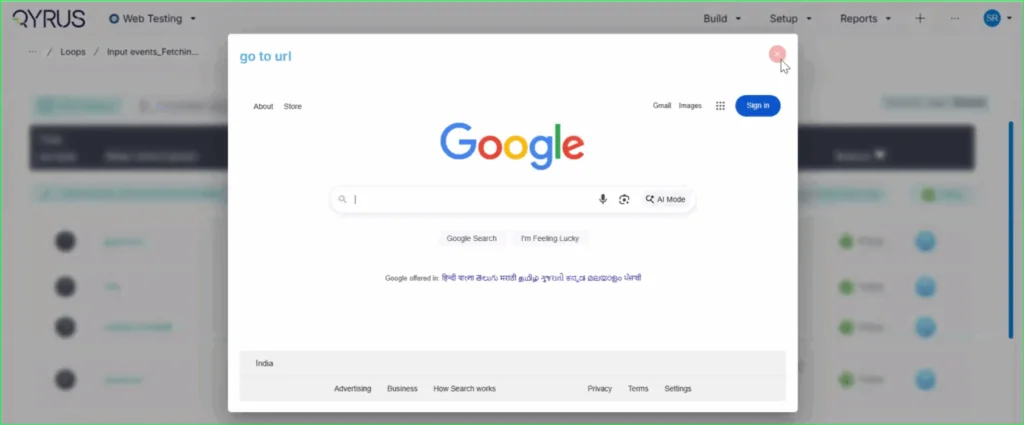
We have updated the reporting engine to replace the generic “Screen Shot” label. Now, the specific step description (e.g., “go to url”) is automatically displayed directly on the top left of every screenshot in the report.
How will it help?
This enhancement provides immediate context for every visual in your report. You can now browse through screenshots and instantly understand the specific test action being depicted without needing to look elsewhere. This significantly improves report readability, reduces cognitive load, and speeds up the debugging and review process.
No More Toggling: View Recorded Locators Instantly on the Step Page!
The Challenge:
Previously, after using the Qyrus Recorder to capture a test flow, the specific locator values (like XPaths or CSS selectors) were not immediately visible on the main test step page. To view or verify these locators, functional testers found it cumbersome to have to re-enter “record mode” via the Encapsulate Chrome extension, disrupting their workflow just to check technical details.
The Fix:
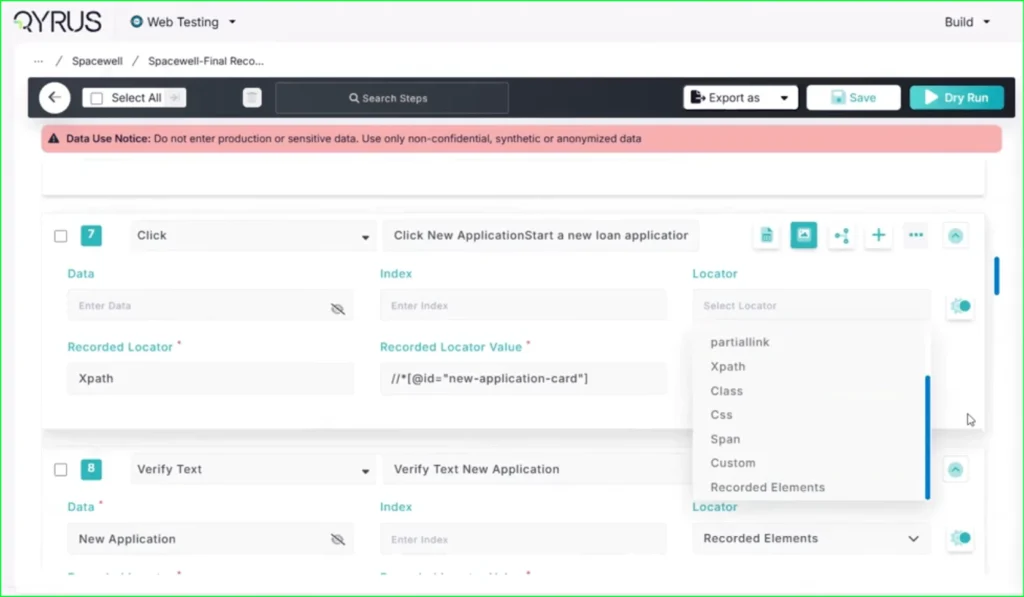
We have updated the Qyrus Recorder with improved locator detection and data handling. Now, after recording a session, all captured locator values are immediately populated and visible directly on the step page within the Qyrus platform.
How will it help?
This update significantly streamlines the script review and validation process. You no longer need to switch back and forth between the platform and the recorder extension just to see how an element is being identified. This gives functional testers and automation engineers instant visibility into their test logic, making it faster and easier to verify scripts and ensure the correct elements are being targeted.
Scale Your Xray Testing: Suite Execution Now Supported!
The Challenge:
Previously, our integration with Xray was limited to triggering single test scripts. This created a workflow bottleneck for teams who needed to execute larger batches of tests or full regression sets, as there was no capability to launch a complete Test Suite directly from the Xray interface.
The Fix:
We have upgraded our Xray integration to fully support Test Suite execution. Users can now trigger the execution of entire suites from within Xray with the same ease and simplicity as running a single script.
How will it help?
This update allows you to significantly scale your testing efforts directly from your test management tool. You are no longer restricted to triggering scripts one by one; instead, you can launch comprehensive test suites in a single action. This streamlines your execution workflow, ensuring that your Xray-driven testing is as efficient and powerful as your needs demand.
qAPI Product Release Update
Copy, Paste, Done: Import APIs Instantly with cURL!
The Challenge:
Creating API tests manually can be a tedious process of copy-pasting individual components—headers, bodies, URLs, and methods—from your documentation or browser developer tools into the test platform. This manual reconstruction is not only slow but also increases the risk of transcription errors, leading to frustrated testers and broken initial tests.
The Fix:
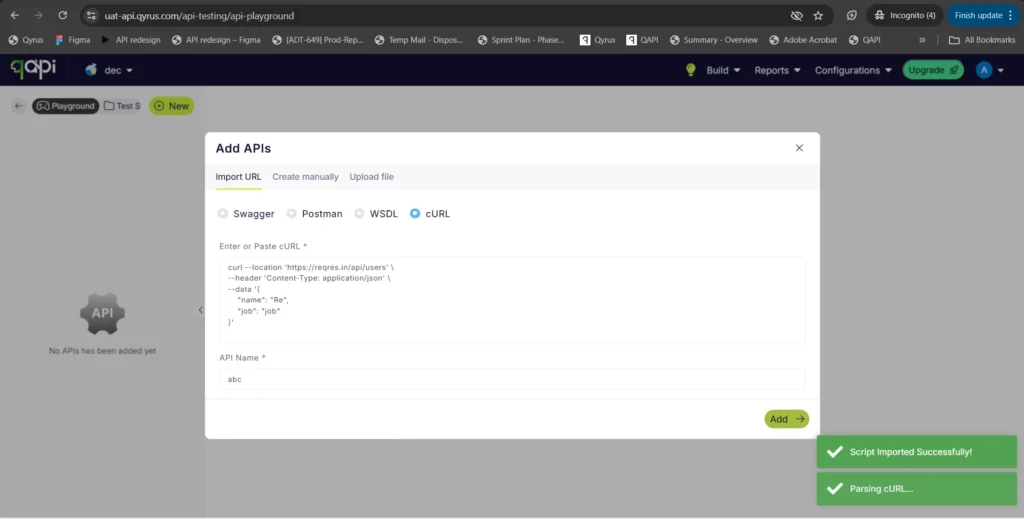
We have introduced a new “Import via cURL” option in the API creation workflow. You can now simply paste a raw cURL command directly into Qyrus. The system will automatically parse the command and instantly create a fully configured API test with all the correct parameters, headers, and body content mapped for you.
How will it help?
This feature is a massive time-saver that bridges the gap between development and testing. Developers and testers often have cURL commands readily available (from API docs or network logs). By allowing direct import, we eliminate the manual data entry, ensuring your API tests are set up instantly and accurately, exactly as they were defined in your cURL command.
AI Enhancements
AI That Remembers: Enhanced Algorithms Now Access User Memory!
The Challenge:
Previously, while our AI algorithms were powerful, they often operated in isolation for each interaction. Without access to a persistent memory of past preferences, specific project contexts, or user-defined constraints, the AI could sometimes provide generic suggestions or require users to repeatedly provide the same background information, slowing down the workflow.
The Fix:
We have rolled out significant enhancements to all our AI algorithms. For users who have opted into the memory feature, these algorithms can now securely access and utilize stored context and preferences.
How will it help?
This upgrade makes your AI interactions significantly smarter and more personalized.
Reduced Repetition: The AI remembers your specific constraints and preferences, so you don’t have to repeat them.
Better Suggestions: Whether generating test data or building scenarios, the AI now understands your unique context, leading to more relevant and accurate results.
Seamless Workflow: Experience a more continuous and intelligent partnership with the platform, as the AI learns and adapts to your specific way of working over time.
Ready to Accelerate Your Testing with November Upgrades?
We are dedicated to evolving Qyrus into a platform that not only anticipates your needs but also provides practical, powerful solutions that help you release top-quality software with greater speed and confidence.
Curious to see how these October enhancements can benefit your team? There’s no better way to understand the impact of Qyrus than to see it for yourself.
We stopped asking “can we automate this?” in 2025. Instead, we started asking a much harder question: “How much can the system handle on its own?”
This year changed the rules for software quality. We witnessed the industry pivot from simple script execution to genuine autonomy, where AI doesn’t just follow orders—it thinks, heals, and adapts. The numbers back this shift. The global software testing market climbed to a valuation of USD 50.6 billion , and 72% of corporate entities embraced AI-based mobile testing methodologies to escape the crushing weight of manual maintenance.
At Qyrus, we didn’t just watch these numbers climb. We spent the last twelve months building the infrastructure to support them. From launching our SEER (Sense-Evaluate-Execute-Report) orchestration framework to engaging with thousands of testers in Chicago, Houston, Santa Clara, Anaheim, London, Bengaluru, and Mumbai, our focus stayed sharp: helping teams navigate a world where real-time systems demand a smarter approach.
This post isn’t just a highlight reel. It is a report on how we listened to the market, how we answered with agentic AI, and where the industry goes next.
The Pulse of the Industry vs. The Qyrus Answer
We saw the gap between “what we need” and “what tools can do” narrow significantly this year. We aligned our roadmap directly with the friction points slowing down engineering teams, from broken scripts to the chaos of microservices.
The GenAI & Autonomous Shift
The industry moved past the novelty of generative AI. It became an operational requirement. Analysts estimate the global software testing market will reach a value of USD 50.6 billion in 2025, driven largely by intelligent systems that self-correct rather than fail. Self-healing automation became a primary focus for reducing the maintenance burden that plagues agile teams.
We responded by handing the heavy lifting to the agents.
Healer 2.0 arrived in July, fundamentally changing how our platform interacts with unstable UIs. It doesn’t just guess; it prioritizes original locators and recognizes unique attributes like data-testid to keep tests running when developers change the code.
We launched AI Genius Code Generation to eliminate the blank-page paralysis of writing custom scripts. You describe the calculation or logic, and the agent writes the Java or JavaScript for you.
Most importantly, we introduced the SEER framework (Sense, Evaluate, Execute, Report). This isn’t just a feature; it is an orchestration layer that allows agents to handle complex, multi-modal workflows without constant human hand-holding.
Democratization: Testing is Everyone’s Job
The wall between “testers” and “business owners” crumbled. With manual testing still commanding 61.47% of the market share, the need for tools that empower non-technical users to automate complex scenarios became undeniable.
We focused on removing the syntax barrier.
TestGenerator now integrates directly with Azure DevOps and Rally. It reads your user stories and bugs, then automatically builds the manual test steps and script blueprints.
We embedded AI into the Qyrus Recorder, allowing users to generate test scenarios simply by typing natural language descriptions. The system translates intent into executable actions.
The Microservices Reality Check
Monolithic applications are dying, and microservices took their place. This shift made API testing the backbone of quality assurance. As distributed systems grew, teams faced a new problem: testing performance and logic across hundreds of interconnected endpoints.
We upgraded qAPI to handle this scale.
We introduced Virtual User Balance (VUB), allowing teams to simulate up to 1,000 concurrent users for stress testing without needing expensive, external load tools.
We added AI Automap, a feature where the system analyzes your API definitions, identifies dependencies, and autonomously constructs the correct workflow order.
Feature Flashback
We didn’t just chase the AI headlines in 2025. We spent thousands of engineering hours refining the core engines that power your daily testing. From handling complex loops in web automation to streamlining API workflows, we shipped updates designed to solve the specific, gritty problems that slow teams down.
Here is a look at the high-impact capabilities we delivered across every module.
Web Testing: Smarter Looping & Debugging
Complex logic often breaks brittle automation. We fixed that by introducing Nested Loops and Loops Inside Functions, allowing you to automate intricate scenarios involving multiple related data sets without writing a single line of code.
Resilient Execution: We added a Continue on Failure option for loops. Now, a single failed iteration won’t halt your entire run, giving you a complete report for every data item.
Crystal Clear Reports: Debugging got faster with Step Descriptions on Screenshots. We now overlay the specific action (like “go to url”) directly on the execution image, so you know exactly what happened at a glance.
Instant Visibility: You no longer need to re-enter “record mode” just to check a technical detail. We made captured locator values immediately visible on the step page the moment you stop recording.
API Testing: Developer-Centric Workflows
We focused on making qAPI speak the language of developers.
Seamless Hand-offs: We expanded our code generation to include C# (HttpClient) and cURL snippets, allowing developers to drop your test logic directly into their environment.
Instant Migration: Moving from manual checks to automation is now instant. The Import via cURL feature lets you paste a raw command to create a fully configured API test in seconds.
AI Summaries: Complex workflows can be confusing. We added an AI Summary feature that generates a concise, human-readable explanation of your API workflow’s purpose and flow.
Expanded Support: We added native support for x-www-form-urlencoded bodies, ensuring you can test web form submissions just as easily as JSON payloads.
Mobile Testing: The Modular & Agentic Leap
Mobile testing has long been plagued by device fragmentation and flaky infrastructure. We overhauled the core experience to eliminate “maintenance traps” and “hung sessions.”
Uninterrupted Editing: We solved the context-switching problem. You can now edit steps, fix logic, or tweak parameters without closing the device window or losing your session state.
Modular Design: Update a “Login Block” once, and it automatically propagates to every test script that uses it. This shift from linear to component-based design reduces maintenance overhead by up to 80%.
Agentic Execution: We moved beyond simple generation to true autonomy. Our new AI Agents focus on outcomes—detecting errors, self-healing broken tests, and executing multi-step workflows without constant human prompts.
True Offline Simulation: Beyond basic throttling, we introduced True Offline Simulation for iOS and a Zero Network profile for Android. These features simulate a complete lack of internet connectivity to prove your app handles offline states gracefully.
Desktop Testing: Security & Automation
For teams automating robust desktop applications, we introduced features to harden security and streamline execution.
Password Masking: We implemented automatic masking for global variables marked as ‘password’, ensuring sensitive credentials never appear in plain text within execution reports.
Test Scheduling: We brought the power of “set it and forget it” to desktop apps. You can now schedule complex end-to-end desktop tests to run automatically, ensuring your heavy clients are validated nightly without manual intervention.
Test Orchestration: Control & Continuity
Managing end-to-end tests across different platforms used to be disjointed. We unified it.
Seamless Journeys: We introduced Session Persistence for web and mobile nodes. You can now run a test case that spans 24 hours without repeated login steps, enabling true “day-in-the-life” scenarios.
Unified Playback: Reviewing cross-platform tests is now a single experience. We generate a Unified Workflow Playback that stitches together video from both Web and Mobile services into one consolidated recording.
Total Control: Sometimes you need to pull the plug. We added a Stop Execution on Demand feature, giving you immediate control to terminate a wayward test run instantly.
Data Testing: Modern Connectivity
Data integrity is the silent killer of software quality. We expanded our reach to modern architectures.
NoSQL Support: We released a MongoDB Connector, unlocking support for semi-structured data and providing a foundation for complex nested validations.
Cloud Data: We built a direct Azure Data Lake (ADLS) Connector, allowing you to ingest and compare data residing in your Gen2 storage accounts without moving it first.
Efficient Validation: We added support for SQL LIMIT & OFFSET clauses. This lets you configure “Dry Run” setups that fetch only small data slices, speeding up your validation cycles significantly.
Analyst Recognition
Innovation requires validation. While we see the impact of our platform in our customers’ success metrics every day, independent recognition from the industry’s top analysts confirms our trajectory. This year, two major firms highlighted Qyrus’ role in defining the future of quality.
This distinction matters because it evaluates execution, not just vision. We received the highest possible score (5.0) in critical criteria including Roadmap, Testing AI Across Different Dimensions, and Testing Agentic Tool Calling. The report specifically noted our orchestration capabilities, stating that our SEER framework (Sense, Evaluate, Execute, Report) and “excellent agentic tool calling result in an above-par score for autonomous testing”.
For enterprises asking if agentic AI is ready for production, this report offers a clear answer: the technology is mature, and Qyrus is driving it.
As developers adopt GenAI to write code faster—reporting productivity gains of 10-15%—testing often becomes the bottleneck. Gartner identified Qyrus as an example vendor for AI-augmented testing, recognizing our ability to keep pace with these accelerated development cycles. We don’t just test the code humans write; we validate the output of the generative models themselves, ensuring that speed does not come at the cost of reliability.
Community & Connection
We didn’t spend 2025 behind a desk. We spent it in conference halls, hackathons, and boardrooms, listening to the engineers and leaders who are actually building the future. From Chicago to Bengaluru, the conversations shifted from “how do we automate?” to “how do we orchestrate?”
Empowering the SAP Community
We started our journey with the ASUG community, where the focus was squarely on modernizing the massive, complex landscapes that run global business. In Houston, Ravi Sundaram challenged the room to look at agentic SAP testing not as a future luxury, but as a current necessity for improving ROI. The conversation deepened in New England and Chicago, where we saw firsthand that teams are struggling to balance S/4HANA migration with daily execution. The consensus across these chapters was clear: SAP teams need strategies that reduce overhead while increasing confidence across integrated landscapes.
We wrapped up our 2025 event journey at SAP TechEd Bengaluru in November with two energizing days that put AI-led SAP testing front and center. As a sponsor, we brought a strong mix of thought leadership and real-world execution. Sessions from Ameet Deshpande and Amit Diwate broke down why traditional SAP automation struggles under modern complexity and demonstrated how SEER enables teams to stop testing everything and start testing smart. The booth buzzed with discussions on navigating S/4HANA customizations, serving as a powerful reminder that the future of SAP quality is intelligent, adaptive, and already taking shape.
Leading the Global Conversation
In August, we took the conversation global with an exclusive TestGuild webinar hosted by Joe Colantonio. Ameet Deshpande, our SVP of Product Engineering, tackled the industry-wide struggle of fragmentation—where AI accelerates development, but QA falls behind due to disjointed tools. This session marked the public unveiling of Qyrus SEER, our autonomous orchestration framework designed to balance the Dev–QA seesaw. The strong live attendance and post-event engagement reinforced that the market is ready for a shift toward unified, autonomous testing.
The momentum continued in September at StarWest 2025 in Anaheim, where we were right in the middle of the conversations shaping the future of software testing. Our booth became a go-to spot for QA leaders looking to understand how agentic, AI-driven testing can keep up with an increasingly non-deterministic world. A standout moment was Ameet Deshpande’s keynote, where he challenged traditional QA thinking and unpacked what “quality” really means in an AI-powered era—covering agentic pipelines, semantic validation, and AI-for-AI evaluation.
Redefining Financial Services (BFSI)
Banking doesn’t sleep, and neither can its quality assurance. At the BFSI Innovation & Technology Summit in Mumbai, Ameet Deshpande introduced our orchestration framework, SEER, to leaders facing the pressure of instant payments and digital KYC. Later in London at the QA Financial Forum, we tackled a tougher reality: non-determinism. As financial institutions embed AI deeply into their systems, rule-based testing fails. We demonstrated how multi-modal orchestration validates these adaptive systems without slowing them down, proving that “AI for AI” is already reshaping how financial products are delivered.
The Developer & API Ecosystem
APIs drive the modern web, yet they often get tested last. We challenged this at API World in Santa Clara, where we argued that API quality deserves a seat at the table. Raoul Kumar took this message to London at APIdays, showing how no-code workflows allow developers to adopt rigorous testing without the friction. In Bengaluru, we saw the scale of this challenge up close. At APIdays India, we connected with architects building for one of the world’s fastest-growing digital economies, validating that the future of APIs relies on autonomous, intelligent quality.
Inspiring the Next Generation
Innovation starts early. We closed the year as the Technology Partner for HackCBS 8.0 in New Delhi, India’s largest student-run hackathon. Surrounded by thousands of student builders, we didn’t just hand out swag. We put qAPI in their hands, showing them how to validate prototypes instantly so they could focus on creativity. Their curiosity reinforced a core belief: when you give builders the right tools, they ship better software from day one.
Conclusion: Ready for 2026
2025 was the year we stopped treating “Autonomous Testing” as a theory. We proved it is operational, scalable, and essential for survival in a market where software complexity outpaces human capacity.
We are entering 2026 with a platform that understands your code, predicts your failures, and heals itself. Whether you need to validate generative AI models, streamline a massive SAP migration, or ensure your APIs hold up under peak load, Qyrus has built the infrastructure for the AI-first world.
The tools are ready. The agents are waiting. Let’s build the future of quality together.
Let’s start with a hard truth. A bad website experience actively costs you money. It is not just a minor annoyance for your users; it is a direct financial liability for your business.
Consider that an overwhelming 88% of online userssay they are less likely to return to a website after a bad experience. That is nearly nine out of ten potential customers gone, perhaps for good. The damage is immediate and measurable. A single one-second delay in your page load time can trigger a7% reduction in conversions.
Now, think bigger. What if the bug isn’t just about speed, but security? The global average cost of just one data breach has climbed to $4.88 million.
Suddenly, “web testing” isn’t just a technical task for the QA department. It is a core business strategy for protecting your revenue and reputation.
But before you can choose the right tools, you must understand what you are testing. The terms used for testing web products get tossed around, but they are not interchangeable.
Website Testing: This primarily focuses on an informational experience. Think of a corporate blog, a marketing page, or a news portal. The main goal is delivering content. Testing here centers on usability, ensuring content is accurate, links work, and the visual presentation is correct across browsers.
Web Application Testing: This is a far more complex discipline. This is where interaction is the entire point. We are talking about e-commerce platforms, online banking portals, or sophisticated SaaS tools. This type of application testing must verify complex, end-to-end functional workflows (like a multi-step checkout), secure data handling, API integrity, and performance under load.
The ecosystem of website testing tools is massive. You have open-source frameworks, AI-powered platforms, and specialized tools for every possible niche. This guide will help you navigate this world. We will break down the best tools by their specific categories so you can build a testing toolkit that actually protects your bottom line.
Website vs. Web Application Testing
Feature
Website Testing
Web Application Testing
Primary Purpose
To deliver information and content.
To provide interactive functionality and facilitate user tasks.
User Interaction
Mostly passive (reading, navigating).
Highly active and complex (workflows, data entry).
Key Focus
Visual elements, content accuracy, link integrity, and ease of navigation.
End-to-end functional workflows, data handling, API integrity, security, and performance.
Example
A corporate informational site, a blog.
An e-commerce platform, an online banking portal.
Beyond the ‘Best Of’ List: How to Select the Right Web Application Testing Tools
Jumping into a list of website testing tools without a plan is a recipe for wasted time and money. The sheer number of options can be paralyzing. The “best” tool for a JavaScript-savvy startup is the wrong tool for a large enterprise managing legacy code.
Before you look at a single product, you must evaluate your own environment. Your answers to these five questions will build a framework that narrows your search from hundreds of tools to the one or two that actually fit your needs.
What problem are you really trying to solve?
Do not just search for “testing tools.” Get specific. Are you trying to verify that your login forms and checkout process work? That is Functional Testing. Are you worried your site will crash during a Black Friday sale? You need Performance and Load Testing. Are you trying to find security holes before hackers do? That is Security Testing. A tool that excels at one of these is often mediocre at others. Be clear about your primary goal.
Who will actually be using the tool?
This is the most critical question. A powerful, code-based framework like Selenium or Playwright is fantastic for a team of developers who are comfortable writing scripts in Java, Python, or JavaScript. But what if your primary testers are manual QA analysts or non-technical product managers? Forcing them to learn advanced coding will fail. In this case, you need to look at the new generation of low-code/no-code platforms. These tools are designed to democratize application testing, allowing non-technical members to contribute to automation.
What browsers and devices actually matter?
It is easy to say “we test everything,” but that is impractical. Does your team just need to run quick checks on local browsers like Chrome and Firefox? Or do you need to provide a flawless experience for a global audience? To do that, you must test on a massive grid of browser-based combinations and real user devices (like iPhones and Androids). This is where cloud platforms like Qyrus become essential, offering access to thousands of environments on demand.
How does this tool fit into your workflow?
A testing tool that lives on an island is useless. Modern development relies on speed and automation. Your tool must integrate with your existing CI/CD pipeline (like Jenkins, GitHub Actions, etc.) to enable continuous testing. It also needs to communicate with your project management and bug-tracking systems. If it cannot automatically file a detailed bug report in Jira, your team will waste hours on manual data entry.
What is your real budget?
This is not just about licensing fees. Open-source tools like Selenium and Apache JMeter are “free” to download, but they carry significant hidden costs in setup, configuration, and ongoing maintenance. Commercial platforms have an upfront subscription cost, but they often save you time by providing an all-in-one, supported environment. You must calculate the total cost of ownership, factoring in your team’s time.
Your Tool Evaluation Checklist
Question
You Need a Code-Based Framework If…
You Need a Commercial Platform If…
1. Team Skillset
Your team is mostly developers (SDETs) comfortable in JavaScript, Python, or Java.
Your team includes manual QAs, BAs, or non-technical users who need a low-code/no-code interface.
2. Key Goal
You need deep, flexible control for complex functional and API tests within your code.
You need an all-in-one solution for functional, performance, and cross-browser testing with unified reporting.
3. Coverage
You are okay with setting up your own Selenium Gridor running tests on local machines.
You need to run tests in parallel on thousands of real mobile devices and browser/OS combinations.
4. Integration
You have the expertise to manually configure integrations with your specific CI/CD pipeline and reporting tools.
You need out-of-the-box, supported integrations with tools like Jira, Jenkins, and GitHub.
5. Budget
Your budget for licensing is low, but you can invest significant engineering time in setup and maintenance.
You have a budget for subscriptions and want to minimize setup time and ongoing maintenance costs.
The 2026 Toolkit: Top Website Testing Tools by Category
The world of website testing tools is vast. To make sense of it, you must break it down by purpose. A tool for finding security holes is fundamentally different from one that checks for broken links.
Here is a breakdown of the leading tools across the six essential categories of quality.
1. Functional & End-to-End Testing Tools
What they do: These tools are the foundation of application testing. They verify the core functions of your web application—checking if buttons, forms, and critical user workflows (like a login process or an e-commerce checkout) actually work as expected.
Selenium: This is the long-standing, open-source industry standard. Its greatest strengths are its unmatched flexibility—it supports numerous programming languages (like Java, Python, and C#) and virtually every browser. However, this flexibility comes at the cost of complexity. Selenium requires more setup, can be slower, and often leads to “flaky” tests that require careful management.
Playwright: This is the powerful, modern challenger from Microsoft. It has gained massive popularity by directly addressing Selenium’s pain points. It offers true, reliable cross-browser support (including Chromium, Firefox, and WebKit for Safari) and is praised for its speed. Features like auto-waits and native parallel execution mean tests run faster and are far less flaky.
Cypress: This is a developer-favorite, all-in-one framework built specifically for modern JavaScript applications. It is known for its fast execution and fantastic developer experience, which includes a visual test runner with “time-travel” debugging. Its main trade-off is that it only supports testing in JavaScript/TypeScript.
2. Performance & Load Testing Tools
What they do: These tools answer two critical questions: “Is my site fast?” and “Will it crash during a traffic spike?” They measure page speed, responsiveness, and stability under heavy user traffic.
Apache JMeter: A powerful and highly versatile open-source tool from Apache. While it is widely used for load testing web applications, it can also test performance on many different protocols, including databases and APIs. Its GUI-based test builder makes it accessible, but it can be very resource-intensive.
k6 (by Grafana): A modern, developer-centric load testing tool that has become extremely popular. Instead of a clunky UI, you write your test scripts in JavaScript, making it easy to integrate into a developer’s workflow and CI/CD pipeline. It is designed to be like “unit tests for performance”.
GTmetrix: This is less a load-testing tool and more an easy-to-use page speed analyzer. It is an excellent free tool for getting a quick, actionable report on your site’s performance and how it stacks up against Google’s Core Web Vitals.
3. Usability & User Experience (UX) Tools
What they do: These tools help you understand the real user journey. They provide qualitative insights into how people actually interact with your site, capturing their clicks, scrolls, and confusion to help you improve the user experience.
Hotjar: This tool is famous for its intuitive heatmaps and session recordings. Heatmaps give you a visual, aggregated report of where all your users are clicking and scrolling. Session recordings are even more powerful, letting you watch an anonymous user’s complete journey on your site, allowing you to see exactly where they get frustrated or lost.
UXTweak: This is a comprehensive UX research platform that goes beyond just observation. It allows you to run a wide range of usability tests, from card sorting and tree testing (to fix your navigation) to running surveys and testing tasks with either your own users or a panel of testers.
4. Security & Vulnerability Scanners
What they do: These essential tools scan your web applications for security weaknesses, helping you find and fix vulnerabilities like those listed in the OWASP Top 10 (e.g., SQL injection, Cross-Site Scripting) before attackers do.
OWASP ZAP (Zed Attack Proxy): This is the world’s most popular open-source security tool. Maintained by a global community of security experts, it is a powerful and free resource for running Dynamic Application Security Testing (DAST) scans to find common security flaws.
Pentest-Tools.com: This is a commercial DAST tool that provides a suite of scanners for a comprehensive vulnerability assessment. It is known for its clear, actionable reports that help you find vulnerabilities related to your network, website, and infrastructure and then provide clear steps for remediation.
5. Accessibility Testing Tools
What they do: These tools check if your website is usable for people with disabilities, ensuring compliance with legal standards like the Web Content Accessibility Guidelines (WCAG) and the Americans with Disabilities Act (ADA).
WAVE (Web Accessibility Evaluation Tool): This is a popular free tool from the organization WebAIM. It provides a visual overlay directly on your page, injecting icons and indicators that identify accessibility errors like missing alt text, low-contrast text, and incorrect heading structures.
ANDI (Accessible Name & Description Inspector): This is a free accessibility testing bookmarklet provided by the U.S. government (Section508.gov). It is a simple tool that analyzes content and provides a report on accessibility issues found on the page.
6. Cross-Browser & Visual Testing Platforms
What they do: These are cloud-based platforms that solve one of the biggest testing web challenges: ensuring your site looks and works correctly everywhere. They provide on-demand access to thousands of different browser-based combinations (Chrome, Safari, Firefox on Windows, macOS, iOS, Android).
BrowserStack: The undisputed market leader. BrowserStack offers a massive cloud infrastructure of over 30,000 real devices and browser combinations. It allows for both manual “live” testing and, more importantly, running your entire automated test suite (from Selenium, Cypress, etc.) in parallel on their grid.
Sauce Labs: A top enterprise-focused competitor to BrowserStack. It provides a robust and scalable cloud for testing web, mobile, and even API functionality. It is known for its strong analytics and debugging tools, like video recordings and detailed logs for every test run.
LambdaTest: A fast-growing and often more cost-effective alternative. It has gained significant traction by offering a comparable feature set, a massive grid of over 3,000 browser and OS combinations, and a reputation for having the broadest range of CI/CD integrations.
The Hidden Cost of Your ‘Perfect’ Testing Toolbox
You have just reviewed a list of more than 15 top-rated tools across six different categories. This is the “best-in-class” strategy: you pick the perfect, specialized tool for every single job.
On paper, it looks incredibly smart. In reality, for most teams, it is a maintenance nightmare.
You have just created a problem called “tool sprawl.” Your team is now drowning in a sea of disconnected systems, dashboards, and subscription fees.
Fragmented Data: Your functional test results live in Selenium. Your performance reports are in JMeter. Your security vulnerabilities sit in a ZAP log. To get a single, coherent answer to the simple question, “Is this release ready?” You need a committee, three spreadsheets, and a data analyst. This fragmented approach makes a true, modern application testing strategy nearly impossible.
Sky-High Costs: Those commercial subscriptions add up. You are paying for a cross-browser cloud, a UX analytics tool, a security scanner, and maybe more. The costs are not just in dollars, but in the time spent managing all those separate accounts and invoices.
The Maintenance Trap: This is the biggest hidden cost. Every tool has its own scripting language, its own update cycle, and its own way of breaking. Your Selenium scripts are brittle and fail when a developer changes a button ID. Your JMeter scripts need constant updates for new API endpoints. Your team ends up spending more time fixing their tests than they do finding bugs in your product. This test maintenance is an incredibly time-consuming black hole that drains your engineering resources.
Debilitating Skill Gaps: You have also created knowledge of silos. The “Selenium expert” cannot touch the “k6 performance scripts.” Your front-end team that knows Cypress has no idea how to read the security reports. The entire process of testing web applications becomes slow, brittle, and completely dependent on a few key people. Your collection of website testing tools becomes a bottleneck, not a solution.
The “Tool Sprawl” Problem
Data
Fragmented. Test results are scattered across 5+ different tools.
Maintenance
High. Teams spend most of their time fixing brittle scripts for each tool.
Skills
Siloed. Requires separate experts for Selenium, JMeter, ZAP, etc.
Cost
High. Multiple subscription fees plus the hidden cost of maintenance time.
The Solution: Unify Your Entire Application Testing Strategy with Qyrus
Instead of juggling a dozen disconnected website testing tools, what if you could use a single, unified platform? What if you could replace that fragmented, high-maintenance toolbox with one intelligent solution?
This is where the Qyrus GenAI-powered platform changes the game. It was designed to solve the exact problems of tool sprawl by consolidating the entire testing lifecycle into one end-to-end platform.
One Platform, Every Function
Qyrus directly replaces the need for multiple, separate tools by integrating different testing types into a single, cohesive workflow:
No-Code/Low-Code Functional Testing: Qyrus uses a simple low-code/no-code approach. This democratizes application testing, allowing your manual QAs and business analysts to build robust automated tests for complex web applications without needing to become expert coders. This is not a niche idea; research shows that no-code automation is projected to make up 45% of the entire test automation market.
Built-in Cross-Browser Cloud: You can stop paying for that separate BrowserStack or Sauce Labs subscription. Qyrus includes its own robustBrowser Farm, allowing you to execute your tests in parallel across a wide range of browsers (like Chrome, Edge, Firefox, and Safari) and operating systems (including Windows, Mac, and Linux).
Integrated API & Visual Testing: Why use a separate tool for API testing? Qyrus supports API requests (like GET, POST, PUT, DELETE) directly within your test scripts. Furthermore, it integrates Visual Testing (VT), which captures screenshots during execution and compares them against a baseline to catch unintended UI changes.
Solving the Maintenance Nightmare with AI
The most significant drain on any test automation initiative is maintenance. Scripts break every time your developers change the UI, and your team spends all its time fixing tests instead of finding bugs.
Qyrus tackles this problem head-on with practical AI:
AI-Powered Healing: The “Healer AI” feature is the solution to brittle tests. When a test fails because an element’s locator (like its ID or XPath) has changed, Healer AI intelligently references a successful baseline run. It then suggests updated locators to “heal” the script automatically, drastically cutting down on maintenance time.
AI-Powered Creation: Qyrus also uses AI to accelerate test creation from scratch. “Create with AI (NOVA)” can generate entire test scripts automatically from a simple, free-text description of a use case. It can even fetch requirements directly from Jira Integration to build tests. To ensure you have full coverage, “TestGenerator+” analyzes your existing scripts and generates new ones to cover additional scenarios, even categorizing them by criticality.
Instead of a fragmented chain of tools, Qyrus provides a single, end-to-end solution that covers the entire lifecycle: Build, Run, and Analyze. It replaces tool sprawl with an intelligent, unified platform that makes testing web applications faster and far less time-consuming.
The world of website testing tools never sits still. The strategies and tools that are cutting-edge today will be standard practice tomorrow. To build a future-proof quality strategy, you must understand the forces that are redefining application testing.
Here are the three dominant trends that are shaping the future of quality.
1. AI and Machine Learning Become Standard Practice
For years, AI in testing was a marketing buzzword. Now, it is a practical, value-driving reality. AI is moving from a “nice-to-have” feature to the core engine of modern testing platforms. In fact, 68% of organizations are already using or have roadmaps for Generative AI in their quality engineering processes.
This is not about robot testers; it is about empowering human teams with:
Self-Healing Test Scripts: AI automatically detects when a UI element has changed and updates the test script to fix it. This single feature saves countless hours of manual test maintenance.
Intelligent Test Generation: AI can analyze an application and automatically generate new test cases, helping teams find gaps in their coverage.
Predictive Analytics: By analyzing historical bug data and code changes, ML models can predict which parts of your application are at the highest risk for new defects. This allows teams to focus their limited testing time where it matters most.
2. The “Shift-Everywhere” Continuous Quality Loop
The old idea of testing as a separate “phase” at the end of development is dead. It has been replaced by a continuous, holistic “shift-everywhere” paradigm6.
Shift-Left: This is the practice of moving testing activities earlier and more often in the development process. Developers run automated tests with every code commit, and static analysis tools catch bugs as they are being written8. The goal is to find bugs when they are simple and up to 100 times cheaper to fix than if they are found in production.
Shift-Right: This practice extends quality assurance into the production environment10. It involves using techniques like A/B testing and canary releases to test new features with a small subset of real users before a full rollout. This provides invaluable feedback based on real-world behavior.
Together, these two movements create a continuous quality loop, where quality is built-in from the start and refined by real-user data.
3. The Democratization of Testing with Codeless Automation
Another transformative trend is the rapid rise of low-code and no-code automation platforms. These tools are “democratizing” testing web applications by enabling non-technical team members to build and maintain sophisticated automation suites.
Using intuitive visual interfaces, drag-and-drop actions, and simple commands, manual QA analysts, business analysts, and product managers can now automate complex workflows without writing a single line of code. This is not a niche movement; Forrester projected that no-code automation would comprise 45% of the entire test automation tool market by 2025. This frees up specialized developers to focus on more complex challenges, like security and performance engineering.
Table Content: The Future of Testing
Trend
What It Is
Why It Matters
AI & Machine Learning
Using AI for tasks like self-healing tests, test generation, and risk prediction.
Drastically reduces the high cost of test maintenance and focuses effort on high-risk areas.
Shift-Everywhere
Testing “left” (early in development) and “right” (in production with real users).
Catches bugs when they are cheap to fix and validates features with real-world data.
Codeless Automation
Platforms that allow non-technical users to build automation using visual interfaces.
“Democratizes” testing, allowing more team members to contribute and accelerating feedback loops.
Conclusion: Stop Just Testing, Start Ensuring Quality
The “best website testing tool” does not exist. That is because “testing” is not a single activity. A successful quality strategy requires a comprehensive approach that covers every angle: from functional workflows and API integrity to performance under load, security vulnerabilities, and cross-browser usability.
We have seen the landscape of tools: powerful open-source frameworks like Selenium and Playwright, specialized performance tools like JMeter, and essential cloud platforms like BrowserStack.
But we have also seen the stakes. The cost of a bug found in production can be up to 100 times higher than one caught during the design phase. A bad user experience will send 88% of your visitors away for good. This is not a technical problem; it is a business-critical investment.
Building a modern testing strategy is a direct investment in your user experience and your bottom line. Whether you choose to build your own toolkit from the powerful open-source options listed above or unify your entire strategy with an AI-powered, low-code platform like Qyrus, the time to get serious abouttesting web quality is now.
Frequently asked questions
Q: What is the most popular website testing tool?
A: It depends on the category. For open-source functional automation, Selenium is the most widely adopted and well-liked solution, with over 31,854 companies using it in 2025. For commercial cross-browser cloud platforms, BrowserStack is a market leader, offering a massive grid of real devices and browsers. For new AI-powered, unified platforms, Qyrus represents the next generation of testing, combining low-code automation with features like Healer AI and built-in cross-browser execution.
Q: What is the difference between website testing and web application testing?
A: It comes down to complexity and interaction. Website testing primarily focuses on content, usability, and visual presentation. Think of a blog or a corporate informational site—the main goal is ensuring the content is accurate and the layout is consistent. Web application testing is far more complex. It focuses on dynamic functionality, end-to-end user workflows, and data handling. Examples include an e-commerce store’s checkout process or an online banking portal, which require deep testing of APIs, databases, and security.
Q: Are free website testing tools good enough?
A: Free and open-source tools are incredibly powerful for specific tasks. Tools like Apache JMeter are excellent for performance testing , and Selenium is a robust framework for functional automation. However, “free” does not mean “zero cost.” These tools require significant technical expertise to set up, configure, and maintain, which can be very time-consuming. They also lack the unified reporting, AI-powered “self-healing” features, and on-demand real device clouds that commercial platforms provide to accelerate testing and reduce maintenance.
The software world is experiencing a fundamental change, moving from simple automation to true autonomy. This is the “agentic shift,” a transformation reflected in massive market momentum. The global agentic AI market, valued at $5.25 billion in 2024, is projected to explode to $199.05 billion by 2034. An agentic orchestration platform sits at the center of this shift, coordinating a dynamic ecosystem of specialized AI agents, legacy automation systems, and human experts. These components work together in a single workflow to execute complex, end-to-end business processes.
For decades, “automation” meant rigid, predefined scripts. Traditional automation is deterministic; it follows a strict, rules-based path. This model is collapsing under its own weight. Industry research shows that software teams spend a staggering 60-80% of their test automation effort just on maintenance. If the application or workflow changes even slightly, the script breaks, trapping engineers in a cycle of constant, costly human intervention.
Agentic Automation breaks this fragile cycle. It is goal-based and adaptive. Instead of following a static script, specialized Cognitive Reasoning agents perceive their environment, make independent decisions, and take actions to achieve a high-level goal. The focus shifts entirely from brittle “scripts” to resilient “goals”.
It is important to understand a key distinction. “AI Orchestration” (platforms like MLflow or Kubeflow) is an MLOps or data science function. It focuses on managing ML models, training, and data pipelines. Agentic Orchestration is different. It is a business process function that explicitly focuses on the real-time coordination of autonomous, decision-making agents to complete work.
Why Your QA Process Is Creating a Velocity Gap
Generative AI is accelerating development at a startling rate. At major tech companies, AI already writes between 20-40% of all new code. This surge in development speed has exposed a critical vulnerability: a massive “velocity gap”. Quality assurance (QA) practices, stuck in a manual or semi-automated past, simply cannot keep pace.
This creates a dangerous bottleneck, and the legacy QA model is failing on three distinct fronts:
The Manual Bottleneck: Even in 2024, manual testing remains the single most time-consuming activity for 35% of companies. It’s a guaranteed chokepoint.
The Maintenance Crisis: Teams that embraced traditional automation are now drowning in technical debt. As applications change, brittle scripts break. Up to 30% of a test engineer’s time is lost to just maintaining and fixing old tests, trapping them in a reactive, inefficient cycle.
The Skills Gap: QA professionals see the iceberg coming. 82% of QA pros recognize that AI skills are critical for their careers, yet 42% of today’s engineers admit they lack the necessary machine learning expertise. This gap makes it impossible for most companies to “build their own” agentic systems, creating a clear need for a pre-built, autonomous solution.
This leads to a strategic imperative. You cannot pair an AI-driven development cycle with a human-driven QA process. Software testing is the primary proving ground for Agentic Automation because it directly addresses the core challenges of fragility, high maintenance, and slow delivery that plague quality assurance.
Traditional Test Automation Vs. Agentic Test Automation
Dimension
Traditional Test Automation
Agentic Test Automation
Core Unit
Script-based
Goal-based
Structure & Flexibility
Linear and rigid; requires manual reprogramming for any change.
Non-linear and adaptive; agents can re-plan and self-correct.
Cognitive Capability
No context awareness; cannot handle ambiguity.
Perceives, decides, and acts using LLMs and reasoning engines.
Maintenance
High; brittle scripts break easily with application changes.
Low; features self-healing capabilities to adapt to changes.
Human Role
Script Author/Maintainer
Strategist/Overseer.
Scalability
Limited by maintenance overhead and script brittleness.
Natively scalable; agents can be added to handle growing workloads.
Not All Agentic Orchestration Platforms Are Created Equal
The market for agentic orchestration platforms is expanding quickly, but the platforms themselves serve very different purposes. They generally fall into three distinct categories, each with a different focus and target user. Understanding these differences is critical to choosing the right solution.
Enterprise-Grade Platforms (Broad Business Process)
These are end-to-end, high-governance solutions designed to automate general business operations. Their goal is to orchestrate a hybrid workforce of Cognitive Reasoning agents, existing RPA bots, and human employees across the entire enterprise (think HR, Finance, and IT).
UiPath: A leader in RPA, UiPath has expanded into Agentic Automation to orchestrate this complex workforce. Its platform includes “Maestro” for high-level orchestration, an “Agent Builder” for creating custom agents, and a “Trust Layer” focused on enterprise-grade governance. For testing, it offers an “Autopilot for Testers” and a “Test Cloud” that integrates with over 190 enterprise apps like SAP and Salesforce.
IBM (watsonx Orchestrate): IBM’s platform focuses on natural language-driven automation for business professionals in regulated industries. It uses a centralized orchestration model to connect with over 80 enterprise applications, including deep integrations with SAP and Workday, ensuring strong governance and hybrid cloud deployment.
Aisera: This platform categorizes its specialized agents by business function, offering “Prescriptive Knowledge Agents” for compliance, “Dynamic Workflow Agents,” and “User Assistant Agents” for tasks in customer service or logistics.
Developer-Centric Frameworks (Open-Source)
This category includes open-source toolkits for developer teams that need maximum flexibility to build custom agentic systems from scratch. These frameworks provide building blocks for multi-agent collaboration but require significant engineering effort.
LangChain / LangGraph: A popular framework for building custom, stateful multi-agent systems. LangGraph, in particular, allows developers to define agent interactions as a graph, enabling more complex, cyclical reasoning.
Microsoft AutoGen: An open-source framework from Microsoft that focuses on creating conversational, collaborative agents that “chat” with each other (and with humans) to solve complex tasks.
CrewAI: A role-based framework where developers assign specific roles (like “researcher” or “writer”) and goals to a “crew” of agents, which then collaborate to achieve the objective.
AI-Enabled Workflow Platforms (Low-Code)
This third category is distinct. Tools like Domo are powerful but focus more on connecting data pipelines and AI models (not necessarily autonomous agents) into workflows. They are excellent at data automation and empowering business analysts, but they are not purpose-built for coordinating autonomous, decision-making Cognitive Reasoning agents to handle dynamic, complex processes.
A Vertical Solution for the Velocity Gap: The Qyrus SEER Framework
The general-purpose platforms just described are horizontal. They provide a broad toolkit to automate any business process, from HR to finance. Software testing is just one of many things they can do, but you must build the specialized testing agents yourself.
Qyrus is different. It is a vertical agentic orchestration platform. It was purpose-built with one goal: to solve the deep, complex problems of the software quality lifecycle and close the “velocity gap”.
AI-Powered Agents (SUAs): These are Specialized User Agents, each an expert in a specific QA task. Instead of one generalist agent, Qyrus deploys squads of specialists.
The Orchestration Layer: This is the “central nervous system”. It intelligently deploys the right agents at the right time to achieve the testing objective.
Continuous Feedback Loops: The system learns. It analyzes historical test results and defect trends to continuously improve its own strategy, making the entire process smarter with every cycle.
The SEER Framework in Action
The framework operates in a continuous, four-stage loop:
Stage 1: SENSE
In the Sense stage, Qyrus’ “Watch Tower” agents proactively monitor your entire ecosystem—GitHub, Jira, Figma—for changes in real-time. The system doesn’t wait for a manual trigger; it senses a change as it happens.
Stage 2: EVALUATE
The Evaluate stage works as the “cognitive core”. When a change is detected, a squad of “Thinking Agents” analyzes the potential impact to create a targeted test plan.
Impact Analyzer: Traces the code change to see exactly what’s affected.
Test Generator+: Uses NLP to read requirements in Jira or new design files to autonomously generate new test scenarios.
UXtract: Extracts UI/UX changes directly from design platforms like Figma to inform test creation.
Stage 3: EXECUTE
The Execute stage performs an autonomous precision strike. The orchestration layer deploys a squad of “Execution Agents” to validate every layer of the application.
TestPilot: Executes functional UI tests across web and mobile.
API Builder: Validates backend services and complex workflows.
Rover: An autonomous explorer that navigates the application to uncover hidden bugs and untested pathways that scripted tests miss.
Healer: The maintenance expert. It automatically analyzes UI changes and repairs broken test scripts, delivering true self-healing.
Stage 4: REPORT
The Report stage is the “voice” of the operation. “Analyst Agents” transform raw data into business intelligence. The system provides AI-driven risk assessment to prioritize defects and delivers concise reports instantly to Slack, email, or Jira, closing the loop in minutes.
Horizontal vs. Vertical: Why a General Platform Isn’t a Testing Solution
The core difference between the platforms described earlier and a purpose-built system like Qyrus comes down to a simple concept: horizontal vs. vertical.
General-Purpose (Horizontal) Platforms: Platforms like UiPath, IBM, and Aisera are horizontal. They are designed to orchestrate a wide range of general business process workflows across an entire enterprise. Their agents are built for tasks like “invoice processing,” “customer onboarding,” or “HR approvals”. While you could theoretically use their tools to build testing automation, it’s not their primary purpose. You would be starting from scratch, building your own specialized testing agents.
Qyrus SEER (Vertical) Platform: Qyrus is vertical. It is a purpose-built agentic orchestration platform designed only to solve the deep, complex problems of the software quality lifecycle5. Every agent is pre-specialized for a specific QA task like Test Generation, Self-Healing, and Autonomous Exploration.
This difference is critical. You don’t use a general-purpose screwdriver to perform heart surgery; you use a specialized instrument. The same applies here.
Feature Comparison: General vs. QA-Specific Orchestration
Capability
General Platforms (e.g., UiPath, IBM)
Qyrus SEER Platform
Primary Goal
Business Process Automation (HR, Finance, etc.)
Autonomous Software Quality Assurance
Specialized Agents
“Prescriptive Knowledge Agents,” “Workflow Agents” for business tasks.
“Test Generator+,” “Healer,” “Rover,” “UXtract” for specific QA tasks.
Test Generation
Requires manual modeling or a developer to build a new custom agent.
Autonomous. The Test Generator+ agent reads requirements (Jira) and auto-generates test cases.
QA Teams, Testers, Developers, and DevOps Engineers.
How to Choose the Right Agentic Orchestration Platform
Your choice depends entirely on the primary business problem you are trying to solve. Ask yourself these two questions:
1. What is my real bottleneck?
Is your biggest problem slow, manual business approvals in HR or finance? If yes, a horizontal, general-purpose platform might be a good fit.
But if your biggest problem is the speed and quality of your software releases—if your bottleneck is testing, high maintenance, and a growing “velocity gap”—you need a vertical, purpose-built QA platform.
2. Do I want a “Platform” or a “Solution”?
Many general platforms provide tooling (like an “Agent Studio”) that lets you build an agentic solution from scratch. This requires a highly skilled team of AI and ML engineers and a significant investment in time.
A purpose-built platform like Qyrus provides a fully autonomous solution out-of-the-box. It comes with pre-built, specialized agents for every step of the testing lifecycle, ready to work on day one.
The “velocity gap” is the most critical challenge facing modern development. You cannot win a race in a sports car that’s being held back by a parachute. Yet, that’s what companies are doing when they pair up an AI-accelerated development pipeline with a manual, script-based QA process.
An agentic orchestration platform is the only viable solution to this problem, but as we’ve seen, not all platforms are built for the job.
The Qyrus SEER framework provides a definitive architectural answer. It is a purpose-built, vertical solution that deploys a squad of specialized Cognitive Reasoning agents to create a system that is invisible (operates autonomously in the background) and invincible (delivers higher quality, greater coverage, and unwavering confidence).
Stop trying to fix brittle scripts. It’s time to adopt a truly autonomous quality platform.
See how the Qyrus SEER framework can close your velocity gap and transform your QA from a bottleneck into an accelerator.
Q: What is the main difference between agentic orchestration and traditional test automation?
A: Traditional automation follows a rigid script (e.g., “click button A, then type X”). If the script breaks, a human must fix it. Agentic Automation is goal-based (e.g., “log in and verify the dashboard”). An autonomous agent uses AI to decide the best steps, and if the UI changes, it can adapt or self-heal to achieve the goal without human intervention.
Q: What is an “AI agent” and how is it different from an RPA bot?
A: An RPA bot is a “doer.” It’s designed to execute a simple, repetitive, rules-based task. An AI agent is a “decider” or “thinker.” It uses generative AI and Cognitive Reasoning to analyze information, make decisions, and autonomously handle complex workflows and unexpected changes.
Q: Will an agentic orchestration platform replace my QA team?
A: No, it elevates them. It automates the most time-consuming and frustrating parts of the job, like script maintenance—which can consume 50% of an engineer’s time—and repetitive test creation. This frees skilled engineers from being “script maintainers” and allows them to become “AI Testing Strategists,” focusing on high-level goals, risk analysis, and complex exploratory problems.
Q: Why can’t I just use a general-purpose platform like UiPath for testing?
A: You can, but it’s not built for it. General platforms are horizontal—they give you tools to automate any business process (like HR or finance). You would have to build your own specialized testing agents from scratch. Qyrus is a vertical platform—it comes pre-built with a full squad of specialized agents like Healer, Rover, and Test Generator+ designed specifically for the complex processes of software quality.
Application Programming Interfaces (APIs) are no longer just integration tools; they are the core products of a modern financial institution. With API calls representing over 80% of all internet traffic, the entire digital banking customer experience—from mobile apps to partner integrations—depends on them.
This market is exploding. The global API banking market will expand at a compound annual growth rate (CAGR) of 24.7% between 2025 and 2031. Here is the problem: the global API testing market projects a slower 19.69% CAGR.
This disparity reveals a dangerous quality gap. Banks are deploying new API-based services faster than their quality assurance capabilities can mature. This gap creates massive “quality debt”, exposing institutions to security vulnerabilities, performance bottlenecks, and costly compliance failures.
This challenge is accelerating toward 2026. A new strategic threat emerges: AI agents as major API consumers. Shockingly, only 7% of organizations design their APIs for this AI-first consumption. These agents will consume APIs with relentless, high-frequency, and complex query patterns that traditional, human-based testing models cannot anticipate. This new paradigm renders traditional load testing obsolete.
Effective banking API automation is no longer optional; it is the only viable path forward.
The Unique Challenges of Banking API Testing (Why It’s Not Like Other Industries)
Testing APIs in the banking, financial services, and insurance (BFSI) sector is a high-stakes discipline, fundamentally different from e-commerce or media. The challenges in API testing are not merely technical; they are strategic, regulatory, and existential. A single failure can erode trust, trigger massive fines, and halt business operations.
Challenge 1: Non-Negotiable Security & Data Privacy
API testing for banks is, first and foremost, security testing. APIs handle the most sensitive financial data imaginable: Personally Identifiable Information (PII), payment details, and detailed account data. Banks are “prime targets” for cybercriminals, and the slightest gap in authentication can be exploited for devastating Account Takeover (ATO) attacks.
Challenge 2: The Crushing Regulatory Compliance Burden
Banking QA teams face a unique burden: testing is not just about finding bugs but about proving compliance. Failure to comply means staggering financial penalties and legal consequences. Automated tests must produce detailed, auditable reports to satisfy a complex web of regulations, including:
PCI DSS (Payment Card Industry Data Security Standard)
GDPR (General Data Protection Regulation)
PSD2 (Revised Payment Services Directive) in Europe
US Regulations (like FFIEC, OCC, and CFPB)
A 2024 survey highlighted this, revealing that 82% of financial institutions worry about federal regulations, with 76% specifically concerned about PCI-DSS compliance.
Challenge 3: The Legacy-to-Modern Integration Problem
Financial institutions live in a complex hybrid world. They must connect modern, cloud-native microservices with monolithic legacy systems, such as core banking mainframes-built decades ago. The primary testing challenge lies at this fragile integration layer, where new REST API validation processes (using JSON) must communicate flawlessly with older SOAP API automation scripts (using XML).
Challenge 4: The “Shadow API” & Third-Party Risk
The pressure to bridge this legacy-to-modern divide is a direct cause of a massive, hidden risk: “Shadow APIs”. Developers, facing tight deadlines, often create undocumented and untested APIs to bypass bottlenecks. These uncatalogued and unsecured endpoints create a massive, unknown attack surface. This practice is a direct violation of OWASP API9:2023 (Improper Inventory Management).
Furthermore, banks rely on a vast web of third-party APIs for credit checks, payments, and fraud detection. This introduces another risk, defined by OWASP API10:2023 (Unsafe Consumption of APIs), where developers tend to trust data received from these “trusted” partners. An attacker who compromises a third-party API can send a malicious payload back to the bank, and if the bank’s API blindly processes it, the results can be catastrophic.
The 6-Point Mandate: An API Testing Strategy for 2025
To close the “quality gap” and secure the institution, QA teams must move beyond basic endpoint checks. A modern, automated strategy must validate entire business processes, from data integrity at the database level to the new threat of AI-driven consumption.
1. End-to-End Business Workflow Validation (API Chaining)
You cannot test a bank one endpoint at a time. The real risk lies in the complete, multi-step business workflow. API testing for banks must validate the entire money movement process by “chaining” multiple API calls to simulate a real business flow. This approach models complex, end-to-end scenarios like a full loan origination or a multi-leg fund transfer, passing state and data from one API response to the next request.
An API can return a “200 OK” and still be catastrop hically wrong. The ultimate test of a transaction is validating the “source of truth”: the core banking database. An API to database consistency check validates that an API call actually worked by querying the database to confirm the change.
The most critical test for this is the “Forced-Fail” Atomicity Test. Financial transactions must be “all-or-nothing” (Atomic).
GIVEN: Account A has $100 and Account B has $0.
WHEN: An API test initiates a $50 transfer.
AND: Service virtualization is used to simulate a failure in a dependent service (e.g., the “credit Account B” service fails).
ASSERT: The entire transaction must be rolled back. A database query must confirm Account A’s balance is still $100. If the balance is $50, you have failed the test and “lost” money.
3. Mandated Security Testing (OWASP & FAPI)
In banking, security testing is an automated, continuous process, not an afterthought. This means baking token-based authentication testing (JWT, OAuth2) and OWASP Top 10 validation directly into the test suite.
The “Big 4” vulnerabilities for banks are:
API1: Broken Object Level Authorization (BOLA): The most common and severe risk.
Test Case: Authenticate as User A (owns Account 123). Then, call GET /api/accounts/456 (owned by User B). The API must return a 403 Forbidden. If it returns 200 OK with User B’s data, you are critically vulnerable.
API2: Broken Authentication: Test for weak password policies and JWT vulnerabilities.
API5: Broken Function Level Authorization: Test if a standard user can call an admin-only endpoint (e.g., DELETE /api/accounts/456) .
API9: Improper Inventory Management: The “Shadow API” problem we covered earlier.
For Open Banking, standard OAuth 2.0 is not enough. Tests must validate the advanced Financial-grade API (FAPI) profile and DPoP (Demonstrating Proof of Possession) to prevent token theft.
4. Performance & Reliability Testing (Meeting the “Nines”)
Averages are misleading. The only performance metric that matters is the experience of your worst-perceiving users. You must measure p95/p99 latency—what the slowest 5% of your users experience.
Understand the “Cost of Nines”:
99.9% (“Three Nines”): Allows for ~8.7 hours of downtime per year. For a bank, this is a catastrophic business failure.
99.99% (“Four Nines”): Allows for ~52 minutes of downtime per year. This is the new minimum standard.
Your endpoint latency monitoring must use realistic, scenario-based load testing, not generic high-volume tests. Simulate an “end-of-month processing” spike or a “market volatility event” to find the real-world bottlenecks.
Many banking processes (loan approvals, transfers) are not instant. You must test these asynchronous flows.
Asynchronous API Polling: For long-running jobs, the test script must call a status endpoint in a loop (e.g., GET /api/loan_status/123) until a “COMPLETED” status is received, measuring the total time elapsed.
Webhooks: To validate notifications from third parties (e.g., payment gateways), the most critical test is security. A webhook URL is public, so you must validate the HMAC signature. Your test must assert that any request with a missing or invalid signature is rejected with a 401/403 error.
Message Queues: Test internal data streams (like Kafka) for guaranteed delivery and data integrity at scale.
6. The New Frontier: Testing for AI Consumers
This is the new strategic threat for 2026. As noted, only 7% of organizations design APIs for AI-first consumption. AI agents will consume API-driven BFSI systems with relentless, high-frequency query patterns that will break traditional models.
This demands a new “AI-Consumer Testing” paradigm focused on OWASP API4:2023 (Unrestricted Resource Consumption).
Bad Test: “Can I get a loan quote?”
Good Test (AI-Consumer): “Can I request 10,000 different loan quotes in one second?”
This test validates your rate-limiting and resource-protection controls against the specific patterns of AI agents, not just malicious bots.
The “Two Fronts” of API Governance: Managing Legacy & Modern Systems
To manage the complexity of a hybrid environment, banks must fight a war on two fronts. A mature API-driven BFSI system requires two distinct governance models—one for external partners and one for internal microservices.
The External Front (Top-Down): OpenAPI/Swagger
For your public-facing Open Banking APIs and third-party partner integrations, the bank must set the rules as the provider.
The OpenAPI (Swagger) specification serves as the non-negotiable, provider-driven “contract”. This specification is the single source of truth that allows you to enforce consistent design standards and automate documentation. This “contract-first” approach is the foundation for API contract testing (OpenAPI/Swagger), where you can automatically validate that the final implementation never deviates from the agreed-upon specification.
The Internal Front (Bottom-Up): Consumer-Driven Contract Testing (Pact)
For your internal microservices, a top-down model is too slow and rigid. Traditional E2E tests become brittle and break with every small change.
This is where Consumer-Driven Contract Testing (CDCT), using tools like Pact, is superior. This model flips the script: the “consumer” (e.g., the mobile app) defines the exact request and response it needs, which generates a “pact file”. The “provider” (e.g., the accounts microservice) then runs a verification test to ensure it meets that contract.
This is a pure automation game. It catches integration-breaking bugs on the developer’s machine before deployment, enabling CI/CD pipelines to run checks in minutes and eliminating the bottleneck of slow, complex E2E test environments.
A mature bank needs both: top-down OpenAPI governance for external control and bottom-up CDCT for internal speed and resilience.
Solving the Un-testable: The Critical Role of Service Virtualization
The most critical, high-risk scenarios in banking are often impossible to test. How do you safely run the “Forced-Fail” ACID test from Section 3? How do you performance-test a third-party API without paying millions in fees? And how do you run a full regression suite when the core mainframe is only available for a 2-hour nightly window?
SV (or “mocking”) solves the test-dependency problem. It allows you to simulate the behavior of these unavailable, costly, or unstable systems. Instead of testing against the real partner API, you test against a “virtual” version that is available 24/7, completely under your control, and can be configured to fail on demand.
This capability unlocks the testing strategies that banks must perform:
Negative Testing: SV is the only way to reliably run the “Forced-Fail” ACID Atomicity test. You can configure the virtual service to return the 500 error needed to validate your system’s rollback logic.
Performance Testing: You can finally load-test the “un-testable.” SV allows you to simulate the performance profile of the mainframe, capturing bottlenecks without any risk to the real system.
Parallel Testing: It decouples your teams. The mobile app team can test against a virtual core banking API without waiting for the mainframe team, enabling true parallel development.
The business case for SV is not theoretical; it is proven by major financial institutions.
Speed: A report covering over 20 financial institutions, including Bank of America, found that projects using SV deliver software 40% faster.
Efficiency: An ING case study showed that by virtualizing key dependencies, their test environment setup and execution time was reduced from 5 days to 1 day.
The challenges are significant, but the “quality gap” is solvable. Closing it requires a platform that is built to handle the specific, hybrid, and high-stakes nature of API-driven BFSI systems. Manual testing and fragmented, code-heavy tools cannot keep pace. A unified, AI-powered platform is the only way to accelerate banking API automation and ensure quality.
A Unified Platform for a Hybrid World
The core legacy-to-modern integration problem (Challenge 3) requires a single platform that speaks both languages. Qyrus is a unified, codeless platform that natively supports REST, SOAP, and GraphQL APIs. This eliminates the need for fragmented tools and empowers all team members—not just developers—to build tests, making testing with Qyrus 40% more efficient than code-based systems.
Solve End-to-End & Database Testing Instantly
Qyrus directly solves the most complex banking test scenarios, Strategies 1 and 2.
API Process Testing: This feature directly maps to E2E Business Workflow Validation. A visual, drag-and-drop canvas allows you to chain APIs together to test complex money movement flows, passing data from one call to the next.
API-to-Database Assertion: This feature is built to solve the API-to-Database Consistency problem. You can visually map an API request or response directly to a database (like Oracle, PostgreSQL, or DB2) and assert that the transactional data is correct.
AI-Powered Automation to Close the Quality Gap
To overcome the “Shadow API” problem (Challenge 4) and the new AI-Consumer threat (Strategy 6), you need AI in your testing arsenal.
Service Virtualization & API Builder: Qyrus provides robust Service Virtualization to run the “Forced-Fail” ACID tests and mock 3rd-party dependencies. Its GenAI-powered API Builder can even create a new virtualized API from just a text description, letting your teams test before the real service is even built.
API Discovery: Qyrus’s AI-powered browser extension directly solves the “Shadow API” (OWASP API9) problem. It records network traffic as you browse your application, discovers all APIs (even undocumented ones), and automatically generates test scripts for them.
Nova AI: Qyrus’s AI assistant accelerates test creation by autonomously analyzing an API response and suggesting assertions for headers, schemas, and body content, ensuring comprehensive coverage.
Built for Performance, Compliance, and CI/CD
Qyrus completes the strategy by integrating endpoint latency monitoring and compliance reporting directly into your workflow.
Integrated Performance Testing: You can reuse your functional API tests as Performance Tests. This allows you to run realistic, scenario-based load tests and validate your p99 latency targets, capturing key metrics like hits per second and response times over time.
Jira & Xray Integration: Qyrus integrates directly with Jira and Xray. When tests run, the results are automatically pushed back, creating the crucial, auditable report trail required for regulatory compliance (Challenge 2).
CI/CD Integration: Native plugins for Jenkins, Azure DevOps, and other tools enable true banking API automation within your pipeline, shifting quality left.
Conclusion: From “Quality Gap” to “Quality Unlocked”
The stakes in financial services have never been higher. The “quality gap”—caused by rapid API deployment, legacy system drags, and new AI-driven threats—is real.
Manual testing and fragmented, code-heavy tools are no longer a viable option. They are a direct risk to your business.
The future of API testing for banks requires a unified, codeless, and AI-powered platform. Adopting this level of automation is not just an IT decision; it is a strategic business imperative for security, compliance, and survival.
Ready to close your “quality gap”? See how Qyrus’s unified platform can automate your end-to-end API testing—from REST to SOAP and from security to performance.