Is Your QA a Bottleneck?
Why Fragmented Tools Fail in the Age of AI
Software development has hit hyperdrive. AI coding assistants now contribute to as much as 67% of new code, creating a massive velocity gap that leaves traditional QA—and its fragmented toolchain—behind. While your developers accelerate, your testing processes are likely trapped by manual triage, endless script maintenance, and the complexities of managing multiple, disconnected tools.
Download this whitepaper to learn how to:
- Eliminate the QA Bottleneck: Align your testing with the speed of modern, AI-assisted development.
- Slash Maintenance Overhead: Discover how specialized AI agents, like Healer and Rover, can reduce script maintenance by up to 70%.
- Unify Your Quality Process: Move from a chaotic, fragmented toolchain to a single, multimodal platform for Web, Mobile, API, and more.
- Drive Measurable ROI: Build a compelling business case for autonomous testing with data-backed insights on improving speed, quality, and your bottom line.
What You’ll Discover Inside
- The SEER Orchestration Engine: A detailed breakdown of the Sense -> Evaluate -> Execute -> Report framework and how it uses a team of Single Use Agents (SUAs) to deliver intelligent, autonomous testing.
- The End of Maintenance Hell: Learn how specialized AI agents provide self-healing capabilities, reducing the time your engineers spend fixing broken tests by 65-70%.
- The ROI of Autonomy: Explore the data-backed benefits of a unified platform, including a 50-70% reduction in testing time and a 25-30% improvement in defect detection.
- Solving the AI Testing Paradox: Understand how to test the non-deterministic behavior of modern AI-powered applications without sacrificing the consistency needed for reliable regression.
- Eliminate the QA Bottleneck: Align your testing with the speed of modern, AI-assisted development.
- Slash Maintenance Overhead: Discover how specialized AI agents, like Healer and Rover, can reduce script maintenance by up to 70%.
- Unify Your Quality Process: Move from a chaotic, fragmented toolchain to a single, multimodal platform for Web, Mobile, API, and more.
- Drive Measurable ROI: Build a compelling business case for autonomous testing with data-backed insights on improving speed, quality, and your bottom line.
- The SEER Orchestration Engine: A detailed breakdown of the Sense -> Evaluate -> Execute -> Report framework and how it uses a team of Single Use Agents (SUAs) to deliver intelligent, autonomous testing.
- The End of Maintenance Hell: Learn how specialized AI agents provide self-healing capabilities, reducing the time your engineers spend fixing broken tests by 65-70%.
- The ROI of Autonomy: Explore the data-backed benefits of a unified platform, including a 50-70% reduction in testing time and a 25-30% improvement in defect detection.
- Solving the AI Testing Paradox: Understand how to test the non-deterministic behavior of modern AI-powered applications without sacrificing the consistency needed for reliable regression.
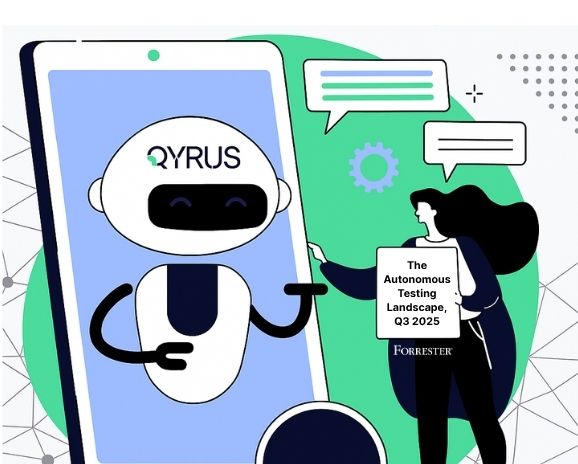
Qyrus, a leading AI-powered test automation platform, has been recognized in the latest Forrester report, “The Autonomous Testing Platforms Landscape, Q3 2025”.
Autonomous Testing Platforms (ATPs) leverage AI-driven test automation to accelerate time to value, mitigate strategic risk, enhance governance quality, and promote democratized testing and cross-team collaboration. The report emphasizes that organizations must choose from a diverse range of vendors to realize these advantages.
Forrester defines ATPs as “Platforms that combine traditional automation with AI and genAI agents to continuously perform increasingly autonomous testing tasks”. These platforms are capable of generating and executing a broad spectrum of functional and nonfunctional end-to-end tests across various products and applications, including those infused with AI, ensuring comprehensive and adaptive quality validation.
At Qyrus, we proactively embrace critical industry trends like AI and GenAI to best serve our customers. Our inclusion in Forrester’s “The Autonomous Testing Platforms Landscape, Q3 2025” reflects our commitment to leveraging cutting-edge technology for customer success and satisfaction, particularly as the market evolves towards increasingly autonomous and intelligent testing solutions.
At Qyrus, our suite of AI agents, including TestPilot, TestGenerator, TestGenerator+, Rover, Eval, API Builder, Echo, and Healer, are designed to transform the testing lifecycle. These agents automate critical tasks such as test creation, exploration, data generation, and self-healing, directly from URLs, application screens, or even JIRA tickets. This empowers teams to achieve greater efficiency and ensure superior software quality through intelligent, autonomous testing.
Explore This Research To:
- Understand Forrester’s perspective on the value of ATPs: Learn how autonomous testing platforms can accelerate time to value through AI-driven test automation, reduce strategic risk, increase the quality of governance, and democratize testing and cross-team collaboration.
- Discover why Qyrus is recognized in the Autonomous Testing Platforms Landscape: Gain insights into Qyrus’s focus, deployment models, and impact within the ATP market.
- Learn about the key benefits ATPs offer product and application testers: Understand how ATPs help accelerate time to value by leveraging AI, reduce strategic risk through intelligent test orchestration, and democratize testing with no-code/low-code interfaces and natural language test authoring.
- Gain insights into the evolving market dynamics and future of autonomous testing: Understand the shift from traditional scripting to AI-driven, agentic, and intent-based testing, and the challenges buyers face in this transforming market
Forrester, The Autonomous Testing Platforms Landscape, Q3 2025, Diego Lo Giudice with Chris Gardner, Angela Lozada, Kara Hartig, July 25, 2025.
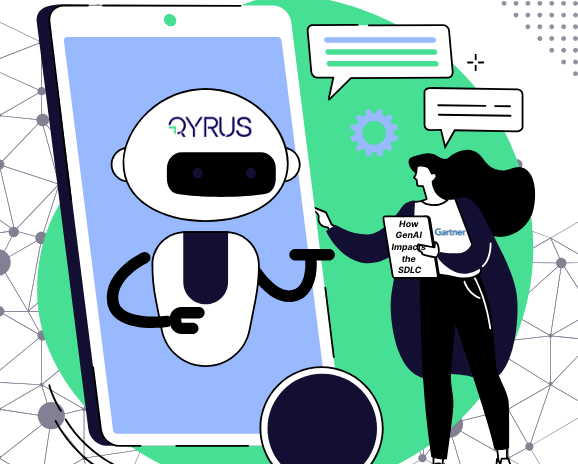
Qyrus, a leading AI-powered test automation platform has been featured in Gartner’s latest report on the impact of Generative AI (GenAI) on the Software Delivery Life Cycle (SDLC).
GenAI is rapidly changing how software is built, tested, and delivered. The new-gen technology offers significant quality-of-life improvements for developers, with Gartner clients reporting productivity gains of around 10-15%. The real value lies in enhancing the developer experience and tackling specific SDLC bottlenecks.
Download Now
This Gartner report, “How Generative AI Impacts the Software Delivery Life Cycle” (April 4, 2025), provides crucial insights into leveraging GenAI effectively while navigating its challenges.
At Qyrus, we proactively embrace critical industry trends like GenAI to best serve our customers. Our inclusion as an example vendor in Gartner’s research on AI-augmented testing reflects our commitment to leveraging cutting-edge technology for customer success and satisfaction.
Explore this research to:
- Understand Gartner’s perspective on GenAI’s role in areas like code generation, debugging, application modernization, and AI-augmented testing.
- Discover why Qyrus is recognized in the AI-augmented testing landscape.
- Learn about the key benefits and risks software engineering teams should consider when adopting GenAI tools.
- Gain insights into effectively integrating GenAI into your software development and testing workflows.
Gartner, How Generative AI Impacts the Software Delivery Life Cycle, Matt Brasier, 4 April 2025.