Qyrus Named a Leader in The Forrester Wave™: Autonomous Testing Platforms, Q4 2025 – Read More

SAP Functional Testing

A Strategic Framework for CIOs, CTOs, and IT Leaders Navigating SAP Quality Assurance 

Imagine a global manufacturer closing its books for the quarter. On a Tuesday morning, a routine SAP transport—a minor configuration patch applied the previous Friday—silently severs the integration between Sales and Distribution and Financial Accounting. Purchase orders continue to flow. Inventory updates in real-time.  

Yet, invoices stop posting to the general ledger. The oversight remains undetected until Wednesday afternoon, when the finance team discovers a 36-hour gap in receivables. By the time leadership identifies and remediates the break, the company absorbs three days of operational disruption, a delayed financial close, and an emergency session with external auditors. The catalyst? A single change that skipped regression testing before promotion to production. 

This scenario repeats in SAP environments every quarter across every major industry. The financial stakes are absolutely important.  
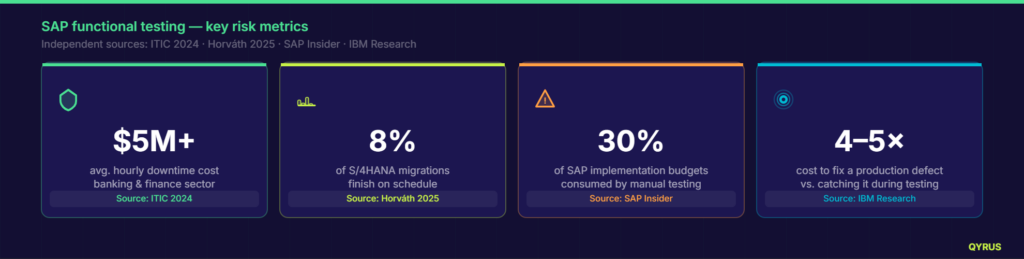
SAP functional Testing-key risk metrics

We designed this guide for executives accountable for the integrity of that nervous system. It outlines: 

  • The Business Risk Profile: Identifying the true cost of inadequate sap functional testing. 
  • Life Cycle Strategy: Defining your testing requirements at every phase of the SAP journey. 
  • The Maturity Model: An honest assessment of the path from manual testing to AI-driven orchestration. 
  • The Executive Diagnostic: A five-question audit to determine if your current approach is a hidden liability. 
  • Systemic Remediation: How Qyrus helps enterprise SAP programs close these gaps. 

Why SAP Testing Failures Are a Board-Level Risk, Not Just an IT Problem 

The ITIC 2024 Hourly Cost of Downtime Survey reveals that 97% of large enterprises report a single hour of downtime costs over $100,000. In sectors like finance, manufacturing, and retail, average hourly outage costs frequently exceed $5 million. SAP serves as the nervous system for these organizations; when it fails, the entire business halts. 

Many leadership teams still misclassify SAP testing as a localized IT task—a technical checkbox to clear before a release. This perspective is a dangerous strategic miscalculation. In reality, SAP quality assurance represents a fundamental pillar of business continuity, financial reporting integrity, and regulatory compliance. 

Over 440,000 organizations worldwide utilize SAP to orchestrate their most critical operations, including payroll, procurement, order management, and global supply chain logistics. These are not peripheral functions; they are the heart of the enterprise. When a core SAP module fails, the resulting operational paralysis extends far beyond the IT department, hitting the balance sheet and achieving board-level visibility within hours. 

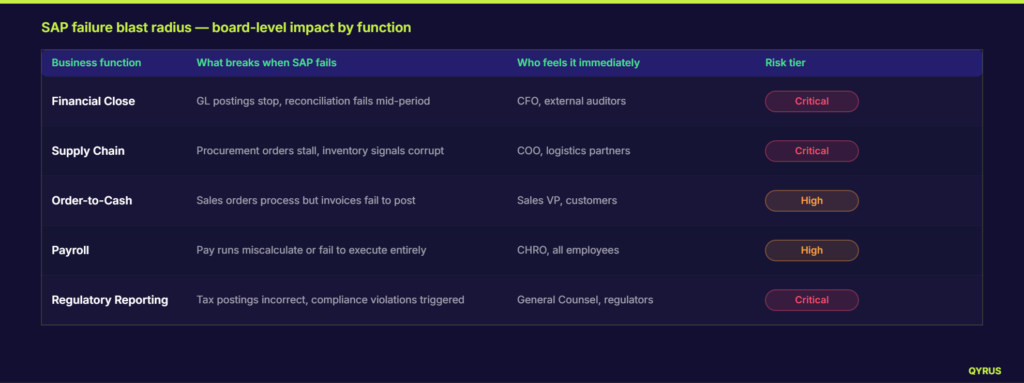
The following table illustrates the immediate impact an untested SAP change can have across typical enterprise functions:

Business Function 

Operational Impact of Failure 

Primary Stakeholders 

Financial Close 

General Ledger postings halt; reconciliation logic fails. 

CFO, External Auditors 

Supply Chain 

Procurement orders stall; inventory signals become corrupt. 

COO, Logistics Partners 

Order-to-Cash 

Sales orders process, but invoices fail to post to the ledger. 

VP of Sales, Customers 

Payroll 

Pay runs miscalculate or fail to execute entirely. 

CHRO, Employees 

Regulatory Reporting 

Incorrect tax postings or compliance omissions trigger penalties. 

General Counsel, Regulators 


SAP Failure blast radius

The Capital Efficiency Problem 

Beyond the immediate operational risk, a significant capital allocation dimension exists that CFOs rarely surface in testing discussions. Research from SAP Insider confirms that manual testing still consumes up to 30% of total SAP implementation budgets. On a $20 million transformation program, the organization effectively spends $6 million on a methodology that is both slower and less effective than modern automated alternatives. We do not view this as a QA budget line; we view it as a massive drain on capital efficiency. Redirecting that capital toward faster release cycles or innovation provides a genuine competitive advantage. 

The Remediation Multiplier 

Post-release risk compounds this financial picture further. According to IBM’s Systems Sciences Institute, fixing a defect in production costs 4 to 5 times more than identifying it during earlier testing phases. However, in the SAP ecosystem, the multiplier is even more punishing. Because SAP modules are so tightly linked, a single defect often cascades across multiple business units. The true remediation cost—accounting for developer hours, business downtime, and extensive data cleanup—frequently grows by an order of magnitude. 

“What gets skipped in testing shows up as a live system issue. And live system issues cost far more to fix.” — SAP S/4HANA Migration Risk Guide 

By shifting testing “left” and automating the validation process, we help enterprises transform QA from a cost center into a risk-mitigation engine that protects the organization’s most vital assets. 

Defining the Domain: What SAP Functional Testing Actually Validates 

Sap functional testing is the process of confirming that configured business processes align with specific business requirements. It is a distinct discipline from end-to-end, performance, or security testing, though a mature quality program must include all four. While other methods test for scale or vulnerability, functional testing confirms that the logic inside your SAP modules matches how your business actually operates. 

The distinction is critical. In most struggling SAP programs, the failure isn’t that teams test too little; they test the wrong things, in the wrong order, using fragmented data. 

The Four Essential Testing Layers 

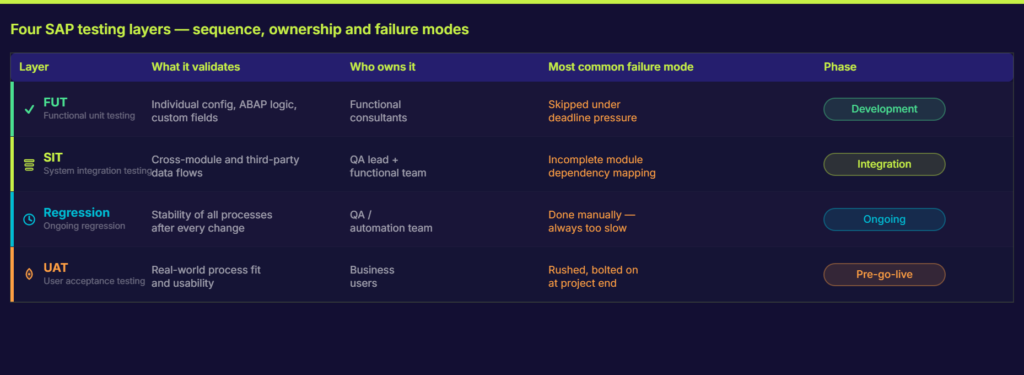
To maintain system integrity, every enterprise SAP program requires a structured approach across these four layers: 

Layer 

Strategic Validation 

Primary Ownership 

Primary Failure Mode 

Functional Unit Testing (FUT) 

Validates individual configurations, ABAP logic, and custom fields. 

Functional Consultants 

Sacrificed under timeline pressure. 

System Integration Testing (SIT) 

Validates cross-module and third-party data exchanges. 

QA Leads + Functional Teams 

Fragmented module dependency mapping. 

Regression Testing 

Protects the stability of existing processes after every patch or transport. 

QA / Automation Teams 

Manual execution vs. release velocity. 

User Acceptance Testing (UAT) 

Validates real-world process fit and day-to-day usability. 

Business Users 

Rushed and bolted on at the project’s end. 


The “Integration Wall”: Why SAP Defies Modular Testing 

Most enterprise software allows for siloed, module-by-module testing. SAP does not. Its architecture creates what practitioners call the “Integration Wall”, the point where isolated testing produces false confidence because it ignores how modules interact. 

Consider a practical example: A development team applies a pricing configuration change within the Sales and Distribution (SD) module. In isolation, the change validates perfectly. A sales order generates, the pricing logic applies, and the tester signs off. 

The risk lies in the downstream chain that remains untested: that SD pricing change alters the value of a document auto-generated in Financial Accounting (FI). This, in turn, corrupts the tax calculation logic posting to your general ledger accounts, which eventually breaks the month-end balance sheet reconciliation. These defects rarely surface until the finance team attempts to close the books. 
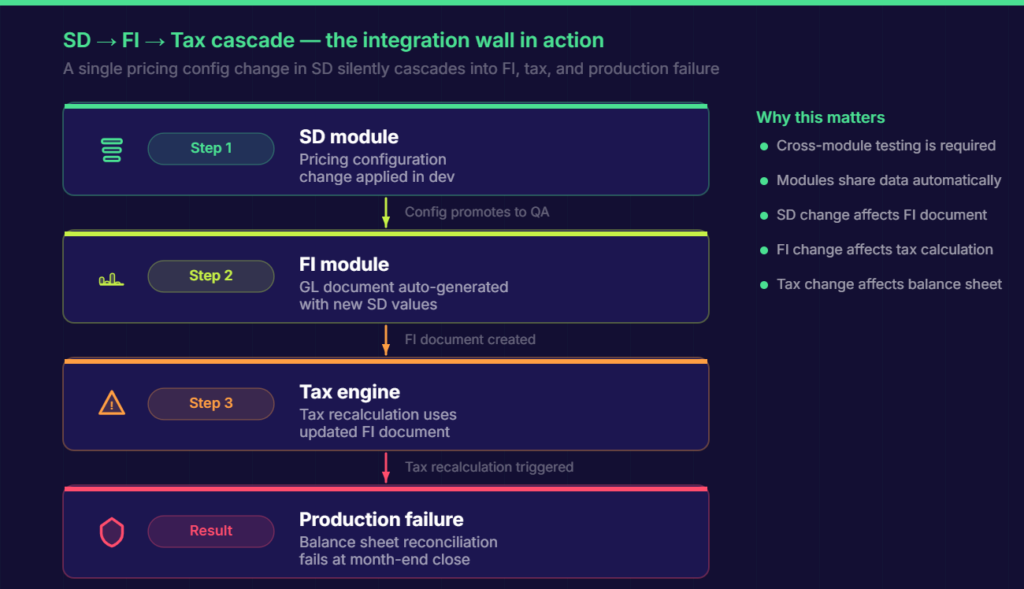
Tax Cascade

This is not an edge case. In a 2025 iLab Quality case study, a manufacturing enterprise discovered, just two weeks before a major go-live, that a critical procurement workflow silently depended on a deprecated transaction code. Because the team had tested isolated modules rather than end-to-end processes, the issue remained invisible. The resulting remediation delayed go-live by six weeks while the team mapped the entire dependency chain. 

S/4HANA and Fiori: The Legacy Script Liability 

If your organization is among the 60% actively planning or undergoing an SAP S/4HANA migration, your existing ECC test scripts represent a systemic risk. They will not just fail occasionally; they will fail systematically. 

The move to S/4HANA introduces three shifts that render legacy test cases obsolete: 

  1. The Fiori UI Layer: Standard SAP GUI scripts cannot interact with web-based Fiori apps. Test automation built over the last decade for the legacy GUI requires complete re-engineering. 
  2. Simplified Data Models: The S/4HANA Universal Journal consolidates tables that previously lived separately across FI and CO. Validation logic that targets specific ECC table structures will return errors or corrupt results in S/4HANA. 
  3. Real-Time Processing: S/4HANA replaces ECC’s batch-oriented processes with real-time processing. This shift invalidates performance assumptions, transaction sequences, and timing dependencies. 

The data confirms the difficulty of this transition. A 2025 Horváth study of 200 SAP user companies found that over 60% experienced schedule and quality deviations during migration, with projects running 30% longer than planned. Only 8% finished on schedule. In the S/4HANA era, undertested migrations have become the norm, not the exception. 

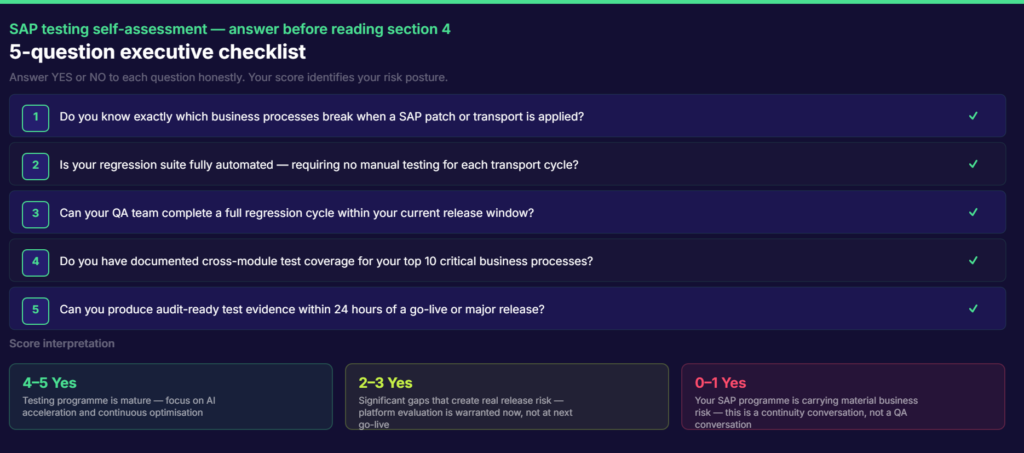
 Is Your SAP Testing Strategy a Hidden Liability? A 5-Question Executive Checklist 

Before evaluating platforms or vendors, you must conduct an objective audit of your current SAP testing maturity. These questions bypass technical jargon to focus on governance and risk. If your leadership team cannot answer these with absolute certainty, your organization is likely carrying unmanaged operational risk. 

Question 1: Impact Visibility 

Do you know exactly which business processes are at risk when an SAP patch or transport is applied? 

Most organizations lack this visibility. They recognize that a change occurred and perhaps identify the specific module it touched, but they cannot trace the downstream impact. Without automated change impact analysis, your team relies on “assumption-based testing.” These assumptions are precisely how six-week go-live delays happen. 

Question 2: The Automation Bottleneck 

Does your regression suite run autonomously, or do you still rely on manual intervention for every transport? 

Partial automation is a bottleneck in disguise. SAP environments receive a constant stream of security patches, enhancement packages, and configuration updates. Each one introduces regression risk. Manual testing creates a compounding cost burden that eventually breaks the project budget. If your testing does not scale horizontally with your release frequency, the math will eventually fail. 

Question 3: The Execution Window 

Can your QA team complete a full regression cycle within your current release window? 

This is the question internal teams often avoid. If your team must “selectively” skip tests to meet a deadline, you are making implicit risk decisions under pressure. Strategic quality assurance requires that every critical path receives validation every time. If your window is shrinking while your manual effort remains static, you are essentially gambling on system stability. 

Question 4: Process-Level Coverage 

Do you have documented cross-module test coverage for your top 10 critical business processes? 

Standard documentation usually lives at the module level (e.g., SD or FI). However, your business operates through end-to-end chains: Order-to-Cash, Procure-to-Pay, and Record-to-Report. If your testing validates modules but ignores the connective tissue between them, you have a massive coverage gap at the process level—where the most expensive failures occur. 

Question 5: Audit and Compliance Readiness 

Can you produce audit-ready test evidence within 24 hours of a major release? 

Regulatory frameworks like SOX, GDPR, and GxP require definitive proof that you validated critical processes before go-live. If your evidence is scattered across spreadsheets and email threads, you lack a proper system of record. This creates a compliance vulnerability that auditors will eventually expose, leading to significant fines or remediation costs. 


Scoring Your Risk Posture 

Score 

Strategic Implication 

4–5 “Yes” 

Mature: Your program is resilient. Focus on AI-driven acceleration and continuous optimization. 

2–3 “Yes” 

At Risk: Significant gaps exist that threaten release stability. A platform evaluation is a priority, not a future project. 

0–1 “Yes” 

Critical Liability: Your SAP program carries material business risk. This is a business continuity conversation that requires immediate executive intervention. 

SAP Testing Checklist

The Evolution of SAP Test Automation: From Scripts to Agentic AI 

Understanding your organization’s position on the testing maturity curve is the prerequisite for any defensible investment decision. Not every enterprise must reach Stage 4 immediately. However, every leader managing a mission-critical SAP environment must identify their current stage—and calculate the literal cost of remaining there. 

Stage 1: Manual Testing 

This is the legacy starting point where many organizations remain stuck. Functional consultants and business users execute test cases manually, following scripts documented in Excel or Word. They capture results in spreadsheets and exchange sign-offs via email. 

The primary deficit here is not just a lack of speed; it is a lack of repeatability. A manual tester executing 200 cases over three days rarely identifies defects consistently across cycles. Fatigue, interpretation drift, and deadline pressure make manual testing inherently variable and prone to oversight. 

The financial case against this approach is overwhelming. SAP Insider research indicates that manual testing consumes up to 30% of total implementation budgets. On a $15 million S/4HANA program, that represents $4.5 million poured into a methodology that your competitors have already replaced with automation. In this stage, you aren’t just testing software; you are hemorrhaging capital. 

Stage 2: Script-Based Test Automation 

The first wave of automation introduced record-and-playback tools and scripted frameworks. These systems improved repeatability and reduced manual effort significantly. However, they introduced a new problem: brittleness. Scripts written for the SAP GUI often break when screen layouts shift, a frequent occurrence during enhancement package updates or Fiori migrations. 

Maintenance costs represent the “hidden trap” of Stage 2. Many organizations that invested heavily in scripted automation during the ECC era now find their test libraries are liabilities rather than assets. Re-engineering thousands of brittle scripts for S/4HANA Fiori often costs as much as building a new suite from scratch. This realization creates difficult conversations with boards that previously approved major automation investments. 

Stage 3: Model-Based Test Automation (MBTA) 

Model-based testing represents a shift toward resilience by decoupling test logic from the application’s UI layer. Instead of scripts that reference specific, volatile screen elements, MBTA utilizes a business process model. This model describes what a process does—not how the UI renders it. 

This approach offers three strategic advantages: 

  1. Resilience: Test cases survive application changes without manual re-engineering. 
  1. Accessibility: Business users can own and validate test cases without programming expertise. 
  1. Hybrid Coverage: For large enterprises running SAP GUI and Fiori in parallel, a single process model generates tests for both paradigms simultaneously. This is the only sustainable way to manage quality during a long-term migration. 

Stage 4: Agentic AI and Intelligent Orchestration 

The current frontier moves beyond simple automation into genuine intelligence. Agentic AI tools act as “doers.” They receive plain-language instructions—such as “Create a sales order in SD, verify stock reservation in MM, and confirm the FI document posts correctly”—and execute the full cross-module scenario autonomously. 

Early adopters report massive acceleration. A Forrester Total Economic Impact study found that advanced automation can accelerate application delivery by up to four times, with organizations reporting a 334% return on investment. More recent implementations of AI-driven sap test automation report test creation timelines dropping from hours to mere minutes. 

The most transformative dimension of Stage 4 is Automated Change Impact Analysis. Instead of a “test everything and hope” approach, intelligence identifies exactly which business processes a transport will affect before it reaches the QA environment. Teams focus their energy on the 20% of processes that carry 80% of the business risk. This strategy enables faster releases with higher confidence, improving both velocity and coverage in tandem. 

The market reflects this shift: between 2023 and 2025, intelligent testing tools reduced manual effort by nearly 34% on average. Automation now influences approximately 49% of SAP testing engagements, representing a total paradigm shift in how we secure the enterprise nervous system. 
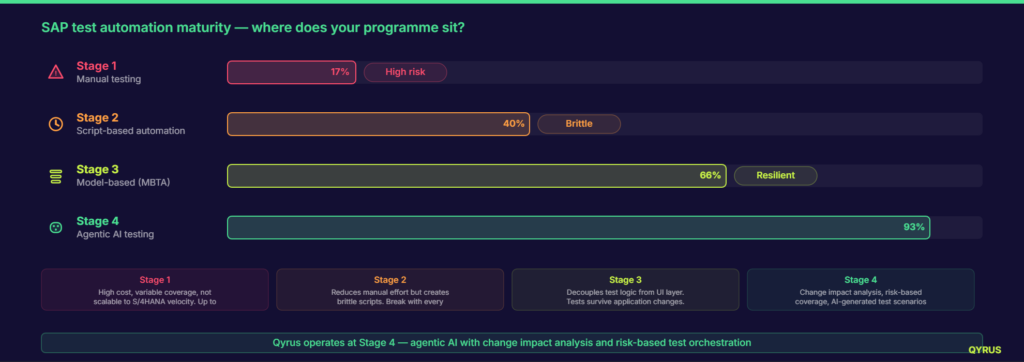
SAP Test Automation Maturity

Bridging the Gap: How Qyrus Secures the Modern SAP Landscape 

Legacy testing platforms often feel like an anchor in an S/4HANA world. They were built for an era of stable ECC instances, infrequent updates, and massive, dedicated QA teams. Today’s reality is the opposite: volatile cloud updates, hybrid GUI/Fiori environments, and release cycles that have compressed from quarters to weeks.  

Qyrus bridges the gap between legacy QA constraints and modern release velocity. We provide an intelligent quality engineering platform that addresses the three points where traditional approaches consistently fail: test creation speed, cross-module visibility, and automation sustainability. 

Proof Point 1: Accelerating Test Creation Across GUI and Fiori 

Manual script authorship is a technical debt factory. In traditional models, functional consultants spend weeks translating process documentation into executable scripts. For an enterprise with hundreds of critical workflows, this process takes months and is often obsolete before it finishes. 

Qyrus uses AI to compress this timeline. Business analysts can describe a process in plain language, and the platform generates executable test scenarios that run across both SAP GUI and Fiori apps. You no longer need separate test libraries for different interfaces—a massive advantage during S/4HANA migrations where both environments must coexist. 

Proof Point 2: Ensuring Genuine Cross-Module Coverage 

The most expensive testing gap isn’t an untested module; it’s an untested module interaction. A failure in an order-to-cash process that spans SD, MM, and FI usually stems from data that doesn’t flow correctly between the modules. 

Qyrus validates these end-to-end chains, not just isolated steps. We trace data from the initial sales order through inventory reservation, goods issue, and final GL reconciliation. This prevents configuration changes in one area from triggering unexpected downstream failures that only surface in post-go-live “war room” sessions. 

Proof Point 3: Resilience by Design 

Most SAP automation efforts fail because they are brittle. Scripts break whenever an enhancement package updates a screen layout or a Fiori interface shifts. Maintenance costs eventually outpace the value of the automation, forcing teams back to manual testing. 

Qyrus utilizes a model-based approach that decouples test logic from the UI. When SAP updates an interface, the underlying business process model remains valid. Because updates are localized rather than wholesale re-engineering projects, your automation becomes a long-term asset that survives every update cycle. 
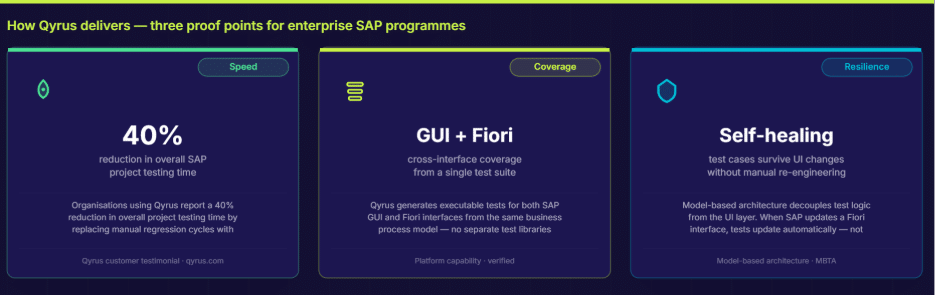
SAP Fiori

6 Strategic Best Practices for High-Performing SAP Programs 

These are not generic QA suggestions. They address the specific failure patterns we see in SAP programs that overrun budgets and miss go-live dates. 

  1. Map Cross-Module Dependencies First

Inadequate scoping causes more defects than inadequate testing. If you write test cases before mapping how SD affects FI or how MM triggers CO postings, you are testing in the dark. Build the dependency map first. This upfront investment saves multiples of that time in production remediation and emergency patching. 

  1. Automate Regression in Parallel,Notas “Phase 2” 

Many leaders treat automation as a secondary activity to be handled after go-live. By then, the team has already built a manual “technical debt” library. Start automation in parallel with test case development. Integrating even partial automation into your implementation creates a sustainable foundation for long-term maintenance. 

  1. Apply the 80/20 Rule to Risk

Not all SAP processes carry equal business risk. A configuration change in a minor HR report is not the same as a change to a high-volume pricing engine. High-performing programs explicitly rank processes by business criticality. Ensure your most critical 20% of workflows receive the deepest testing rigor and the most frequent automated execution. 

  1. Treat Test Data as a Strategic Asset

Misaligned test data causes nearly 30% of migration delays. Tests often fail not because the system is broken, but because the data doesn’t satisfy validation rules. This erodes team confidence and stalls sign-off cycles. Invest in data refresh utilities, masking for sensitive fields, and environment parity from day one. 

  1. Transition to Event-Driven Testing

In many organizations, testing is a periodic activity scheduled before a major release. In a mature program, testing is continuous. Every SAP transport represents a regression risk. Automated checks should fire every time a transport moves from development to QA. This is the only way to catch integration defects before they accumulate into a systemic failure. 

  1. Move Business Users from Gatekeepers to Partners

Late User Acceptance Testing (UAT) is the primary cause of go-live delays. When business users are treated as the final checkpoint, they often find critical defects when the window for remediation has already closed. Integrate UAT as soon as stable builds are available. Shifting UAT “left” ensures that the solution meets operational needs throughout the development cycle, not just at the end. 

SAP Functional Testing — Frequently Asked Questions 

What is SAP functional testing? 

SAP functional testing is the validation that configured business processes in SAP operate according to defined business requirements. It confirms that the logic inside modules like Finance, Materials Management, and Sales and Distribution produces the correct outputs for real business scenarios — not just that individual screens display correctly, but that end-to-end process chains work as your business actually operates. 

How is SAP functional testing  different from SAP performance testing? 

Functional testing validates correctness: does the process produce the right result? Performance testing validates scale: does the process remain fast and stable when 5,000 users are executing it simultaneously? Both are necessary. A process that is functionally correct but collapses under production load is still a production risk. 

How long does a typical SAP functional testing cycle take? 

It depends heavily on the scope of change and the maturity of the test automation program. For a major release in a manual-testing environment, regression cycles often run two to four weeks. For organizations with mature automation coverage, the same cycle can run in hours to days. This compression is one of the primary ROI drivers of investing in SAP test automation. 

What is the difference between SIT and UAT in SAP? 

System Integration Testing (SIT) validates that SAP modules and connected external systems exchange data correctly — it is primarily an IT-led activity focused on technical integration. User Acceptance Testing (UAT) validates that the system meets operational needs from a business user perspective — it is primarily a business-led activity focused on process usability and correctness. Both are required. SIT without UAT misses business process gaps. UAT without SIT misses integration defects. 

How do you protect sensitive data during SAP testing? 

Best practice is to replicate production data volumes in test environments while applying data masking to sensitive fields — employee personal information, customer financial data, and payroll details. This ensures test data reflects real-world complexity and volume without creating compliance exposure. Automated data refresh utilities are essential for maintaining environment parity across long test programs. 

Is SAP test automation worth the investment for mid-size organizations? 

The economics are compelling even at mid-scale. IDC research cited in enterprise testing studies shows enterprises implementing test automation achieving 548% ROI over five years, with average payback periods of seven months. For organizations facing S/4HANA migration timelines, the question is less “is it worth it?” and more “can we afford not to?” Manual testing cannot keep pace with modern SAP release velocity. The choice is not automation versus no automation — it is automation versus repeated production incidents. 

Ready to Close the Gaps in Your SAP Testing Program? 

Treating SAP quality as a secondary IT concern is no longer a viable strategy. As S/4HANA migration deadlines loom and release cadences accelerate, the margin for error has effectively vanished. In this environment, a single production failure carries a price tag—operational, financial, and reputational—that most enterprises simply cannot afford. 

The organizations successfully navigating this shift do not rely on the sheer size of their QA departments. Instead, they prioritize intelligence: risk-based, autonomous testing programs designed specifically for the complexities of modern SAP development. 

Qyrus provides that level of strategic resilience. By addressing the core friction points of enterprise quality—collapsing test creation timelines across GUI and Fiori while deploying automation that actually survives the next update—Qyrus helps teams move beyond the limitations of manual testing. This approach identifies the deep-seated logic defects that legacy scripts and manual checks consistently miss. 

Request a Demo or start with a self-assessment: ask your team the five questions in this guide and see how many you can answer with confidence. The gaps in those answers are the gaps in your SAP risk posture. 
Featured Image - Test Orchestration

Software quality defines market leadership. QA teams today face a clear choice: continue managing fragmented scripts or switch to an integrated system that handles the entire testing lifecycle. Qyrus Test Orchestration provides this bridge. It allows teams to coordinate complex test scenarios across diverse environments using a visual, no-code interface. By centralizing execution and using AI to handle dynamic conditions, organizations move products from development to release faster than ever. 

Current data highlights a significant opportunity for growth. While 83% of developers now work within DevOps environments, 36.5% of firms still lack any form of test orchestration. This gap creates bottlenecks in high-velocity pipelines. Qyrus solves this with a workflow-driven automation platform that ensures every test runs in the right sequence, on the right device, at exactly the right time. 

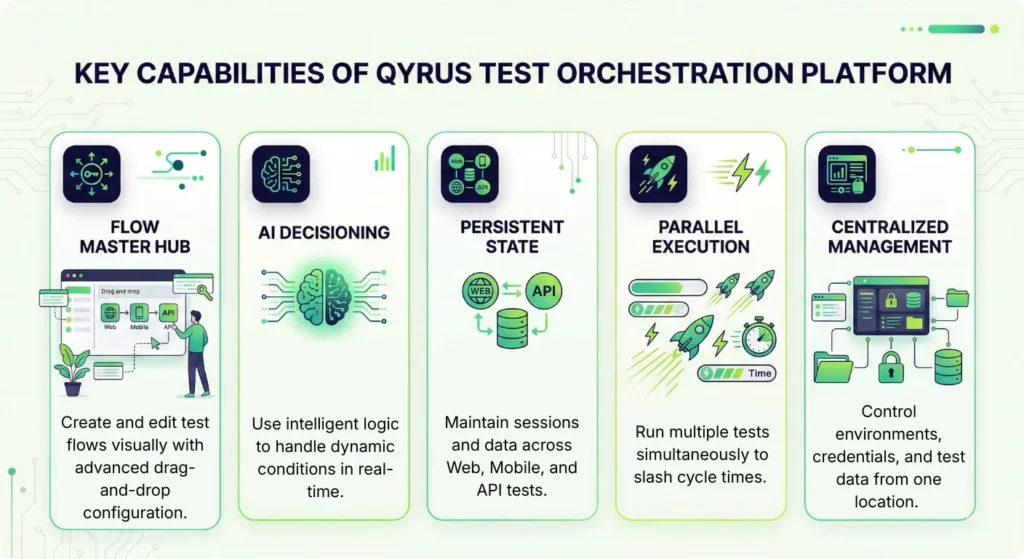
Key Capabilities of Qyrus test Orchestration

The Strategic Need for Enterprise Test Orchestration Software 

Many organizations struggle with “automation silos.” Teams write scripts for specific features, but these scripts rarely talk to each other. This fragmentation causes major delays. According to a survey, 82% of testers still perform manual or component-level testing daily. Even more concerning, only 45% of teams have automated their standard regression suites. Isolated tests fail to capture how different components interact in the real world. 

Enterprise test orchestration software moves beyond simple execution. It acts as the brain of your testing strategy. Standard automation tools run scripts; orchestration platforms manage the relationship between those scripts. They handle data dependencies, environment setup, and error recovery automatically.  

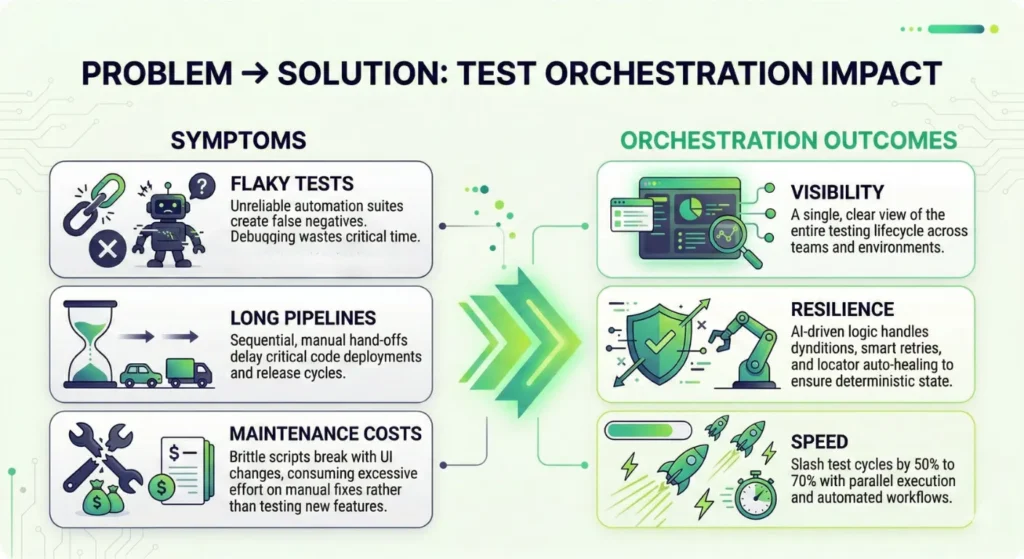
This shift reduces the “flakiness” that plagues most pipelines. When tests fail for non-functional reasons, it wastes developer time and slows down the release cycle. By coordinating the entire flow, orchestration cuts cycle times by 50% to 70% for many teams. 

Leaders prioritize orchestration because it lowers the defect escape rate. It creates a safety net that spans the entire software development lifecycle. You no longer hope that your components work together. You prove it. Consistent orchestration ensures that every code change undergoes rigorous validation across every layer of the system. 

TO Impact

Qyrus: The Modern Workflow-Driven Automation Platform 

Qyrus transforms testing from a collection of isolated tasks into a cohesive, managed system. It operates as a workflow-driven automation platform that integrates four core pillars: the visual Flow Hub, a centralized Data Hub, a powerful Orchestration Engine, and extensive third-party integrations. This structure allows teams to reduce manual testing efforts by 80% while maintaining total control over the release pipeline. Unlike standard tools that require heavy scripting to manage dependencies, Qyrus uses an AI decision layer to handle complex logic and environment promotion automatically. 

Flow Hub: Visual Logic Creation 

The Flow Hub serves as the primary workspace for your testing strategy. You drag and drop “Nodes”—individual units representing Web, Mobile, API, or Desktop scripts—and connect them to form a sequence. This visual approach allows QA experts to build sophisticated scenarios without writing a single line of code. Each node contains its own execution settings, allowing you to customize timeouts and skip conditions for every specific step. 

Data Hub & State Persistence 

Managing data dependencies often creates the biggest hurdle in automation. Qyrus simplifies this through a centralized Data Hub that supports Global, Workflow, and Step scopes. This ensures that an ID generated in an API test can move seamlessly into a Mobile or Web script. Furthermore, unique session persistence capabilities allow a single browser or device session to remain active across multiple scripts. This prevents the need for constant re-logins and ensures your tests mirror real user behavior. 

Resilience Patterns 

Flaky environments often derail even the best automation projects. Qyrus counters this with built-in resilience patterns, including “Retry with Backoff” and “Stop” actions. If an API call fails due to network lag, the platform automatically retries the operation using a linear or exponential delay. These patterns act as circuit breakers, preventing a single transient error from failing an entire multi-hour suite and saving your team hours of manual debugging. 

Integrations 

A platform must fit into your existing ecosystem to provide value. Qyrus connects directly with CI/CD tools and communication platforms like Slack and Microsoft Teams to keep stakeholders informed in real-time. It also supports major cloud providers and various test runners. This connectivity ensures that your orchestrated workflows remain a natural part of your DevOps stack. 

Core Features & How They Map to Enterprise Needs 

Enterprise testing requires more than just high-speed script execution. Large-scale organizations manage sprawling portfolios of legacy systems and modern microservices that must function in unison. Enterprise test orchestration software bridges this gap by addressing the specific structural failures that cause 73% of automation projects to fail. 

Visual Test Flows for Complex Coverage 

Most QA teams struggle to automate complex journeys because the underlying code becomes too brittle to maintain. Qyrus solves this through the Flow Hub. You drag and drop test nodes to map out the entire user journey visually. This approach enables teams to achieve higher coverage across multi-platform systems without the technical debt of thousands of lines of custom code. 

Conditional Logic for Environment-Aware Testing 

Tests often fail because they lack the intelligence to adapt to different environments. Logic control within the platform allows you to define “If-Then” scenarios. For example, a workflow can skip an email verification step in the Development environment but require it in Staging. This environment-aware testing ensures that the same workflow remains valid across the entire release pipeline. 

Session Persistence for True E2E Tests 

Standard automation tools usually restart the browser or clear the device cache between test scripts. This resets the user state and makes deep end-to-end testing nearly impossible. Qyrus maintains session persistence across Web, Mobile, and API tests. A single login at the start of a workflow carries through every subsequent node, mirroring exactly how a real customer interacts with your brand across different platforms. 

Data Hub for Deterministic State 

Inconsistent test data causes frequent false negatives. The Data Hub acts as a centralized repository that passes information, such as unique Order IDs or customer tokens, between steps. This ensures a deterministic state throughout the run. When every test uses fresh, accurate data from the previous step, you eliminate the “data pollution” that often breaks shared testing environments. 

Parallel Nodes for Faster Pipelines 

Cycle time remains the primary metric for DevOps success. Orchestration allows you to run independent test nodes in parallel rather than waiting for one to finish before starting the next. This capability significantly slashes execution time, helping teams meet the demand for daily or even hourly releases. 

AI Decisioning for Resilient Testing 

Flaky tests are a significant drain on resources, often consuming up to 16% of a developer’s time. Qyrus integrates an AI test orchestration platform layer to identify whether a failure is a genuine bug or a transient environment glitch. Smart retries and circuit-breaker patterns allow the system to recover from minor network lags automatically. This ensures your team only investigates real issues, which improves overall execution accuracy and builds trust in the automation suite. 

The AI Advantage: Why an AI Test Orchestration Platform Matters 

Traditional automation often collapses under the weight of flaky tests. When a locator changes or a network blips, scripts break and require manual fixes. An AI test orchestration platform solves this by introducing “self-healing” capabilities. If the system detects a modified UI element, it automatically updates the locator during execution to prevent a failure. This shift toward intelligence is why 76% of developers now use or plan to use AI tools in their development process. 

Smart classification provides the second major advantage. Instead of a generic “failed” report, the platform uses machine learning to categorize the root cause. It distinguishes between a transient environment glitch and a genuine code regression. This clarity allows teams to reduce triage time by up to 35%. You no longer waste hours investigating “ghost” failures that fix themselves on a rerun. 

Intelligence also optimizes how you run your tests. The platform analyzes historical data to prioritize high-risk areas. If a specific microservice fails frequently, the AI places those tests at the front of the queue. While the system handles these complex decisions, human oversight remains vital. The platform provides “Confidence Scores” for every automated decision, allowing QA leads to verify and approve major structural changes. This collaboration ensures that speed never comes at the cost of accuracy. 

The market reflects this move toward smarter systems. MarketsandMarkets expects the AI in software testing market to grow at a CAGR of 22.3% through 2032. By letting AI handle the routine repairs, your engineers can focus on designing better user experiences. 

Visual suggestion 

  • Flow with AI decision node: show a node that uses AI confidence to choose retry vs fallback. 
  • Placement: next to the AI section 

Typical Enterprise Use Cases & Playbooks 

Enterprise teams don’t just test features; they test business outcomes. A single user action often triggers a complex chain reaction across dozens of services, internal APIs, and legacy databases. Manually triggering these tests or relying on loosely coupled scripts leads to “blind spots” where integration failures hide. Orchestration provides a structured playbook for these high-stakes scenarios. 

Release Smoke + Regression Across 40 Microservices 

Large-scale applications now rely on hundreds of independent services. When a developer updates one microservice, you must validate how it interacts with the rest of the dependency graph. A workflow-driven automation platform allows you to chain contract tests, API mocks, and UI smoke tests into a single, synchronized flow.  

This coordinated approach helps companies achieve shorter test cycles by eliminating manual hand-offs between infrastructure and QA teams. 

The Resilient Payment Journey 

A standard checkout involves a UI interaction, an API call to a payment gateway, a ledger update, and a final customer notification. If the ledger update fails, the system shouldn’t just stop. Qyrus uses “circuit breaker” and “rollback compensation” patterns to manage these failures.  

If a critical step fails, the orchestrator can automatically trigger a compensating transaction or send an immediate high-priority alert to the DevOps team. This ensures that a failure in one layer doesn’t leave the system in an inconsistent state or corrupt customer data. 

Cross-Platform Continuity with Session Persistence 

Modern customers often start a journey on a mobile app and finish it on a desktop browser. Traditionally, testing this required two separate scripts with no shared data or session history. Enterprise test orchestration software changes this through session persistence.  

The orchestrator keeps the user logged in as the test moves from a mobile device to a web browser or a desktop application. This validates the true end-to-end experience and catches state-sync issues that isolated tests miss. By testing the way customers actually behave, you catch defects that usually escape to production. 

Security, Compliance & Enterprise Governance 

Enterprises in highly regulated sectors like finance and healthcare cannot compromise on data integrity. While cloud adoption grows, 90% of organizations will maintain hybrid cloud deployments through 2027 to meet strict residency and security requirements. Enterprise test orchestration software must provide the same level of control as the production environments it validates. A single data breach now costs companies an average of $4.4 million, and regulatory fines under frameworks like GDPR can reach 4% of global annual turnover. 

Governance and Data Control 

A workflow-driven automation platform acts as a secure vault for your testing assets. Qyrus handles sensitive information through dedicated credential management, ensuring that API keys and passwords never appear in plain text within test scripts. Role-Based Access Control (RBAC) limits visibility, so only authorized personnel can view or edit critical workflows in production-level environments. This prevents unauthorized changes and protects sensitive system configurations. 

Auditability and Segregation 

Regulated industries require a clear paper trail for every code change. The platform maintains detailed audit trails and activity logs that track who executed a test, what parameters they used, and when the run occurred. This transparency simplifies compliance audits and internal reviews.  

Furthermore, environment segregation prevents accidental cross-contamination between development, staging, and production tiers. By using data masking, teams can run realistic tests without exposing actual Personally Identifiable Information (PII) to the QA environment. This approach maintains the high standards of an AI test orchestration platform while protecting the organization from legal and financial risk. 

Migration Path: From Component Tests to Orchestrated Workflows 

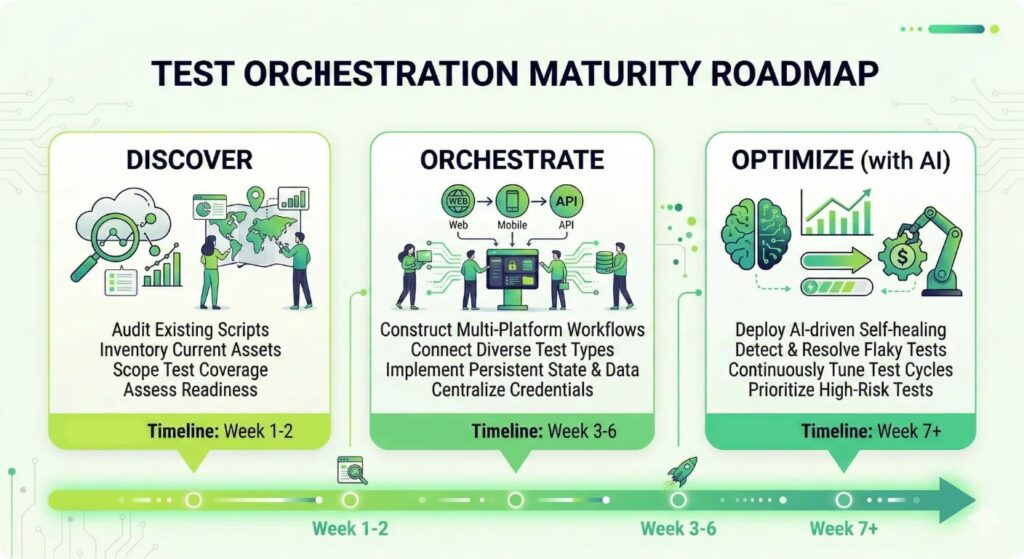
Transitioning from fragmented component testing to a structured workflow-driven automation platform requires a tactical, phased approach. Organizations cannot simply lift and shift every script overnight without creating technical debt. A successful migration moves through four distinct stages to ensure stability and immediate value. 

Stage 1: Inventory and Audit 

Begin by auditing your existing library of unit and functional scripts. Identify which tests provide the most value and which have become redundant or “flaky.” Statistics show that flaky tests consume up to 16% of a developer’s time, so this is the perfect moment to prune low-quality assets. Categorize your scripts by their role in the user journey to prepare them for the Flow Hub. 

Stage 2: Quick Wins with Smoke Workflows 

Do not attempt to orchestrate your entire regression suite on day one. Instead, focus on “quick wins” by building automated smoke tests for your most critical paths. Qyrus provides templates for login and session validation that allow teams to get up and running in just 1-2 hours. These high-visibility workflows demonstrate immediate ROI and build team confidence in the new system. 

Stage 3: Expanding Orchestrated Flows 

Once your smoke tests are stable, begin connecting more complex nodes. This stage involves using the Data Hub to pass information between Web, Mobile, and API scripts. Use session persistence to maintain a single user state across these platforms. Most enterprises find that coordinating these multi-component systems results in 50% to 70% shorter test cycles compared to their old manual hand-off processes. 

Stage 4: Optimize with an AI Test Orchestration Platform 

The final stage involves layering intelligence over your workflows. Enable smart retries and “retry with backoff” patterns to handle transient environment issues automatically. As the system gathers data, use the AI test orchestration platform capabilities to identify failure patterns and suggest locator fixes. This maturity level allows your team to stop “firefighting” and start focusing on strategic quality engineering. 

Migration Best Practices and Pitfalls 

Avoid the common pitfall of 1-to-1 script migration. Simply running an old script inside a new container does not capture the benefits of orchestration. Instead, re-think how those scripts should interact. Qyrus minimizes the technical burden by offering a managed migration process that typically requires only a 2-day downtime window to move all existing web scripts from old component services to the core orchestration engine. 

Quality Engineering: From Managing Scripts to Governing Systems 

Quality engineering moves from managing scripts to governing systems. Modern delivery pipelines demand more than isolated checks. They require a coordinated, intelligent strategy. Adopting enterprise test orchestration software allows your team to connect Web, Mobile, and API tests into one seamless journey. This shift removes the bottlenecks that prevent high-velocity releases. 

The financial and operational benefits remain high across all industries. Teams using a workflow-driven automation platform report shorter test cycles, lower maintenance costs, and reduced manual testing efforts. These improvements ensure your engineers spend their time building features rather than repairing brittle scripts. Early adoption provides a clear market advantage. Orchestration gives you the stability needed to release with absolute confidence. 

Take control of your testing lifecycle today with a demo of Qyrus Test Orchestration. 

Modern business depends entirely on the integrity of the information flowing through its systems. Poor data quality costs organizations an average of $12.9 million annually, making the choice of validation tools a high-stakes executive decision.  

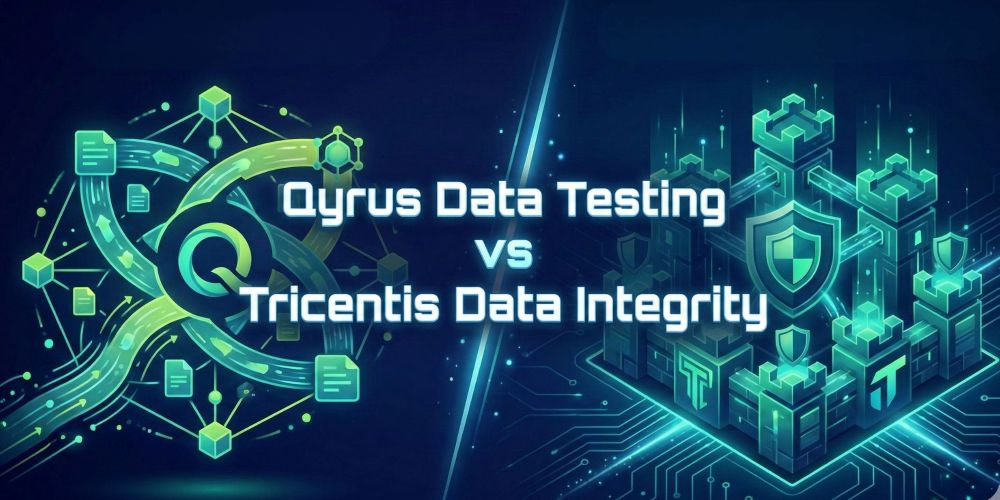
Tricentis Data Integrity stands as the established player. Meanwhile, Qyrus Data Testing emerges as a unified “TestOS” challenger, designed for teams that prioritize full-stack agility and AI-driven efficiency. Qyrus offers a streamlined testing experience with a focus on consolidating Web, Mobile, API, and Data testing into one environment.  

The Connectivity Illusion: Why 200 Connectors Might Still Leave You Blind 

Volume often acts as a smokescreen for actual utility in the enterprise testing market. 

Tricentis commands the lead in sheer breadth, offering a massive library of 50+ SQL connectors and deep, specialized support for SAP systems and Salesforce. This exhaustive reach positions them big in the data connectivity category. Large organizations with legacy-heavy footprints view this as a non-negotiable safety net for complex IT environments. 

Data Source Connectivity

FeatureQyrus Data TestingTricentis Data Integrity

SQL Databases

MySQL
PostgreSQL
MS SQL Server
Oracle
IBM DB2
Snowflake
AWS Redshift
Azure Synapse
Google BigQuery
Netezza

NoSQL Databases

MongoDB
DynamoDB
Cassandra
Hadoop/HDFS

Cloud Storage & Files

AWS S3
Azure Data Lake (ADLS)
Google Cloud Storage
SFTP
CSV/Flat Files
JSON Files
XML Files
Excel Files
Parquet

APIs & Applications

REST APIs
SOAP APIs
GraphQL
SAP Systems
Salesforce

Legend: ✓ Full Support | ◐ Partial/Limited | ✗ Not Available 

However, the Pareto Principle reveals a different reality for modern data teams. 

Research indicates that 80% of enterprise data integration needs require only 20% of available connectors. While platforms like Airbyte offer up to 600 options, the vast majority of high-value workloads concentrate on a “vital few”: MySQL, PostgreSQL, MongoDB, Snowflake, Amazon Redshift, and Amazon S3. 

Qyrus focuses its 75% connectivity score exactly on these critical hubs. It masters the SQL connectors and cloud storage platforms that drive current digital transformations. 

The integration gap is real. Large enterprises manage an average of 897 applications yet only 29% of them are actually integrated. Qyrus bridges this gap by validating the REST, SOAP, and GraphQL APIs that feed your pipelines. It prioritizes the connections that matter most to your daily operations rather than maintaining a list of nodes you will never use. 

Securing the Core: Why Data Validation is the New Standard for Quality 

Precision in data validation determines the difference between a high-performing enterprise and a costly financial sinkhole. While connectivity creates the bridge, validation ensures the cargo remains intact. Organizations currently lose a staggering $12.9 million annually due to poor data quality, making advanced testing capabilities more critical than ever. 

Tricentis Data Integrity excels in deep-layer requirements like slowly changing dimensions (SCD) and data lineage tracking, which are vital for regulated industries needing to prove data history.  

Its “Pre-screening wizard” acts as a high-speed filter, catching structural defects before they enter the processing pipeline. Large, SAP-centric organizations rely on this model-based approach to prioritize risks across complex, multi-layered environments.  

Testing & Validation Capabilities

Feature Qyrus Data Testing Tricentis Data Integrity

Comparison Testing

Source-to-Target Comparison
Full Data Comparison
Column-Level Mapping
Cross-Platform Comparison
Reconciliation Testing
Aggregate Comparison (Sum, Count)

Single Source Validation

Row Count Verification
Data Type Verification
Null Value Checks
Duplicate Detection
Regex Pattern Validation
Custom Business Logic/Functions
Referential Integrity Checks
Schema Validation

Advanced Testing

Transformation Testing
ETL Process Testing
Data Migration Testing
BI Report Testing
Tableau/Power BI Testing
Pre-Screening / Data Profiling
Data Lineage Tracking

Qyrus Data Testing takes an agile path, focusing on most core validation tasks that drive daily business decisions. It provides unique value through Lambda function support, allowing teams to inject custom business logic directly into its automated data quality checks. This “TestOS” approach bridges the gap between different layers, enabling you to verify that a mobile app transaction accurately reflects in your cloud warehouse. While it currently skips BI report testing, Qyrus offers a faster, no-code route for teams wanting to eliminate the “garbage in” problem at the point of entry. 

Precision testing must move beyond simple row counts to secure your strategic truth. If your ETL data testing framework cannot see the logic within the transformation, you are only protecting half of your pipeline. 

Beyond the Script: Scaling Quality with Intelligent Velocity 

Automation serves as the engine that moves data quality from a reactive chore to a proactive strategy. Organizations that fail to automate their pipelines see maintenance costs consume up to 70% of their total testing budget. Modern teams now demand more than just recorded scripts; they need platforms that think. 

Tricentis utilizes a model-based approach that decouples the technical steering from the test logic, allowing for resilient automation that doesn’t break with every UI change. With over 100 API calls and native support for the entire SAP ecosystem, it fits seamlessly into the most rigid enterprise CI/CD pipelines. Its “Pre-screening wizard” further accelerates the process by identifying early data errors before heavy testing begins.

Automation and Integration  

Feature Qyrus Data Testing Tricentis Data Integrity

Test Automation

No-Code Test Creation
Low-Code Options
SQL Query Support
Visual Query Builder
Test Scheduling
Reusable Test Components
Parameterized Testing

AI/ML Capabilities

AI-Powered Test Generation
Auto-Mapping of Columns
Self-Healing Tests
Generative AI for Test Cases

DevOps/CI-CD Integration

REST API
Jenkins Integration
Azure DevOps
GitLab CI
GitHub Actions
Webhooks

Issue & Test Management

Jira Integration
ServiceNow Integration
Slack/Teams Notifications
Email Notifications

Qyrus Data Testing counters with a heavy focus on democratization through Nova AI. This intelligent engine automatically generates testing functions and identifies data patterns, helping teams build test cases 70% faster than manual methods. Qyrus emphasizes a “no-code” philosophy that allows manual testers to contribute to the ETL data testing framework without learning complex coding languages. It integrates directly with Jira, Jenkins, and Azure DevOps to ensure that automated data quality checks remain part of every code push. 

True velocity requires a platform that minimizes technical debt while maximizing coverage. Whether you lean on Tricentis’ enterprise-grade models or Qyrus’ AI-powered speed, your ETL testing automation tools must remove the human bottleneck from the pipeline. 

The Digital Mirror: Transforming Raw Data into Strategic Intelligence 

Visibility acts as the final safeguard for your information integrity. Without robust analytics, even the most sophisticated automated data quality checks remain silent. Organizations that lack transparent reporting struggle to identify the root cause of data corruption, often treating symptoms while the underlying disease persists. 

Tricentis Data Integrity secures a perfect score for reporting and analytics. It provides deep-drill analysis that allows engineers to trace a failure from a high-level dashboard down to the specific row and column. This platform excels at Root Cause Analysis (RCA), helping teams determine if a failure stems from a physical hardware fault, a human configuration error, or an organizational process breakdown. Furthermore, it offers complete integration with BI tools like Tableau and Power BI, ensuring your executive reports are as verified as the data they display. 

Reporting and Analytics

Feature Qyrus Data Testing Tricentis Data Integrity
Real-Time Dashboards
Drill-Down Analysis
Root Cause Analysis
PDF Report Export
Excel Report Export
Trend Analysis
Data Quality Metrics
Custom Report Templates
BI Tool Integration (Tableau, Power BI)
Audit Trail

Qyrus Data Testing earns a 72% category score with its modern, real-time approach. Its dashboards focus on “Operational Intelligence,” providing immediate access to KPIs so you can react to changing conditions in seconds. Qyrus emphasizes automated audit trails to ensure compliance without manual paperwork. While its root cause and trend analysis features are currently in Beta, the platform provides the essential visibility needed for high-velocity teams to act with confidence. 

A real-time dashboard is not just a display; it is a tool that shortens the time to a decision. Whether you require the deep forensic reporting of Tricentis or the agile, live signals of Qyrus, your data quality testing tools must turn your pipeline into an open book. 

Fortresses and Clouds: Choosing Your Infrastructure Architecture 

Your choice of deployment model dictates the ultimate control you maintain over your sensitive information. Both platforms offer the flexibility of Cloud (SaaS), On-Premises, and Hybrid deployment models. However, the maturity of their security frameworks marks a significant divergence for regulated industries. 

Platform and Deployment

Feature Qyrus Data Testing Tricentis Data Integrity
Cloud (SaaS)
On-Premises
Hybrid Deployment
Docker Support
Kubernetes Support
Multi-Tenant
SSO/LDAP
Role-Based Access Control
Data Encryption (AES-256)
SOC 2 Compliance

Qyrus Data Testing earns a strong platform score by prioritizing modern, containerized workflows. The platform fully supports Docker and Kubernetes for teams that want to manage their ETL testing automation tools within a private, scalable infrastructure. It employs AES-256 encryption and Single Sign-On (SSO) for secure authentication. This makes Qyrus an excellent fit for agile, cloud-native organizations that value technical flexibility over legacy certifications. 

If your team demands a lightweight, containerized environment that scales with your code, Qyrus provides the modern edge. 

The Verdict: Architecting Your Truth in a Data-First World 

The decision between Tricentis Data Integrity and Qyrus Data Testing ultimately hinges on the scope of your quality mission. Both platforms eliminate the risk of manual error, but they serve different strategic masters. 

Tricentis Data Integrity provides an exhaustive, enterprise-grade fortress. It remains the clear choice for global organizations with complex, SAP-centric landscapes that require every possible certification and deep forensic validation. If your primary goal is risk-based prioritization and you manage a sprawling legacy footprint, Tricentis offers the most complete safety net on the market. 

Qyrus Data Testing counters with a vision for total platform consolidation. It functions as a specialized module within a broader “TestOS,” making it the ideal choice for agile teams that need to verify quality across Web, Mobile, and API layers simultaneously. Choose Qyrus if you want to empower your existing staff with AI-powered automation and move from pilot to production in weeks rather than months. 

Data quality is not a static checkbox; it is the heartbeat of your digital transformation. Secure your strategic integrity by selecting the engine that matches your operational speed. Whether you need the massive breadth of an enterprise leader or the unified agility of a modern TestOS, stop the $12.9 million drain today. 

Secure your data integrity now by starting a 30-day sandbox evaluation.