



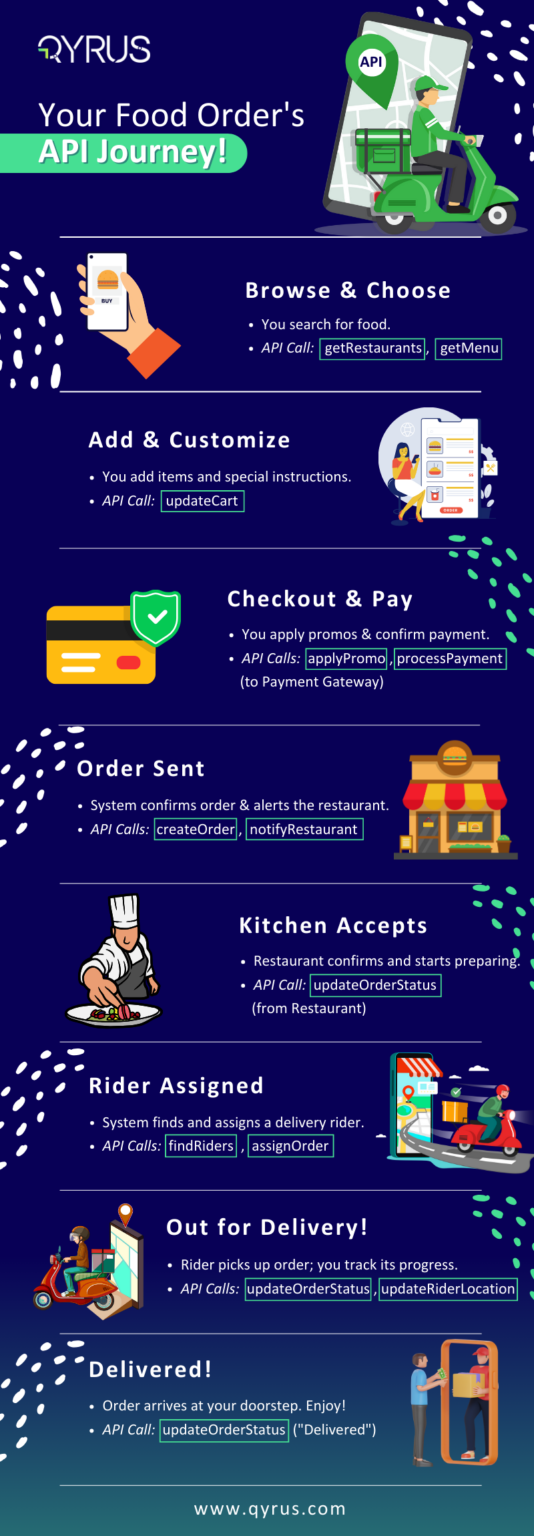
Click. Order. Delivered. Today, getting your favorite meal delivered is often just a few taps away, thanks to the booming FoodTech industry. But behind that simple user experience lies a complex web of interconnected systems. Think about it: your food delivery app needs to talk seamlessly to restaurant ordering systems, health data providers, payment gateways, and delivery logistics platforms.
What makes this intricate dance possible? APIs – Application Programming Interfaces. They are the invisible messengers ensuring your order details reach the kitchen correctly, your payment goes through securely, and you can track your delivery in real-time.
However, when these messengers falter, the consequences can be significant. Minor glitches can cascade into major service disruptions, leading to incorrect orders, payment failures, and frustrated customers whose trust is easily broken. The financial impact is startling; according to one industry survey, 66% of companies report losing up to $500,000 per year due to poor integration, including API failures, with 10% losing more than $1 million annually. These aren’t just abstract numbers; they represent real losses stemming from disruptions in critical operations that underpin the entire FoodTech business model.
This is where robust API testing becomes absolutely critical. It’s the process of rigorously checking these API connections to ensure they function reliably, perform under pressure, and remain secure. Effective API testing strategies enable platforms to handle massive traffic surges during peak hours, process orders with near-perfect accuracy, and manage high volumes (~100 orders per minute) without breaking a sweat.
In this post, we’ll dive into the world of FoodTech to explore critical API testing examples. We’ll look at common challenges faced by developers and testers in this dynamic sector and discuss best practices. Furthermore, we’ll touch upon how comprehensive testing platforms like Qyrus can help ensure your FoodTech APIs deliver a five-star experience, every time.
Taste the Dish, Test the APIs: Why Both are Vital in FoodTech
Think of your favorite food delivery app. It’s not a single, monolithic system. Instead, it’s an ecosystem built on communication, with APIs acting as the vital communication lines. The app on your phone (User App) needs to talk to the restaurant’s order management system. That system, in turn, might need to communicate with inventory APIs. Then there’s the delivery logistics platform coordinating drivers, which constantly updates your app via APIs. And, of course, payment gateways process your transaction through secure API calls. It’s a constant, high-speed conversation happening behind the scenes: User Apps <-> Restaurant Systems <-> Delivery Logistics <-> Payment Gateways.
Now, imagine if those communication lines get crossed or drop out. The business impact isn’t just a minor inconvenience; it can be catastrophic. An API failure could mean orders getting lost or duplicated, restaurants receiving incorrect customization details (hello, unwanted pineapple on pizza!), payment processing errors leading to double charges or failed transactions or tracking information simply vanishing. Service outages kill the user experience, incorrect orders damage trust, payment issues cause financial headaches, and ultimately, the platform’s reputation suffers. In the competitive FoodTech landscape, users won’t hesitate to switch apps after a bad experience.
This is why rigorous API testing isn’t just a ‘nice-to-have’; it’s driven by core business needs specific to FoodTech:
- Functional Reliability is Non-Negotiable: At its heart, a food app must reliably execute core tasks. Can users search for restaurants and see accurate menus? Does the ordering API capture items, quantities, and those crucial special instructions correctly? Do payment APIs handle various methods smoothly? Can users track their order from kitchen to doorstep accurately? API testing ensures these fundamental workflows function flawlessly, preventing operational chaos and ensuring customer expectations are met.
- Peak Performance Under Pressure: FoodTech platforms face predictable, yet massive, surges in demand. Think lunch rushes, dinner peaks, weekend specials, or major sporting events. APIs must handle this immense, often sudden, increase in traffic – thousands of concurrent users placing orders, querying menus, and tracking deliveries – without buckling. Performance testing simulates these high-stress conditions to guarantee the APIs remain responsive and the platform stable, avoiding frustrating slowdowns or crashes precisely when demand is highest.
- Bulletproof Data Security: Given that these apps handle sensitive personal information (names, addresses, phone numbers) and critical payment details (credit card numbers, bank info), security is paramount. APIs are potential gateways for attackers if not properly secured. Rigorous security testing of APIs is essential to verify authentication, authorization, and data encryption, protecting against data breaches, unauthorized access, and financial fraud, thereby maintaining user trust and regulatory compliance.
Essentially, meticulous API testing ensures the intricate network of services powering a FoodTech app works together reliably, scales effectively, and operates securely. It’s the secret sauce that enables a smooth, trustworthy experience from the moment a user opens the app to the final delivery confirmation. We’ll explore more specific API testing examples next.
Real-World Examples: API Testing in Action
To understand where the rubber meets the road in FoodTech API testing, let’s look beyond generic concepts and examine specific, critical testing areas with practical examples. These scenarios highlight the diverse functionalities that rely heavily on robust APIs:
Complex Data Integration & Processing APIs:
- Why it’s critical: Modern FoodTech features, especially those related to health and personalization, often pull data from a wide array of sources – think user wearables, public health databases (like USDA), commercial nutrition APIs (like FatSecret), and direct user input via the app. Testing is absolutely crucial to ensure these data ingestion APIs, any backend ETL (Extract, Transform, Load) processing APIs, and the interactions with data storage function reliably and accurately. Garbage data in means garbage insights out.
- Example: Consider testing the intricate API pipeline designed for health insights. This involves validating APIs that pull nutrition data from USDA and FatSecret, combining it correctly with meals logged by the user via the app’s API. Further testing ensures the processing step, perhaps triggered via an AWS Glue job API, runs correctly, and that the final, processed data is accurately stored, maybe in Amazon S3, ready for insight generation.
AI & Analytics API Testing:
- Why it’s critical: Features are increasingly powered by AI and Machine Learning models, often exposed via APIs – think personalized recommendation engines predicting what you might like or analytics forecasting dietary outcomes. Testing must validate the inputs these APIs expect, the outputs they generate (are they relevant? accurate?), and their performance under load.
- Example: Imagine testing the API endpoint responsible for personalized healthy meal suggestions. This API might take a user’s recent order history and profile data as input, pass it to an Amazon SageMaker ML model in the backend, and return tailored recommendations. Tests need to verify that the API handles various input formats correctly, that the suggestions returned are logical and relevant to the user’s profile, and that these recommendations are generated promptly without excessive delay.
Performance & Load Testing (Handling Concurrent Users & Data):
- Why it’s critical: It’s essential to validate that the entire interconnected system – encompassing data pipelines, AI models, user-facing APIs, and third-party integrations – can handle the strain of expected user loads and high data volumes without performance degradation. This ensures the app remains responsive even during peak usage.
- Example: Let’s simulate a high-traffic event, like 5,000 users simultaneously tapping into their “Health Insights” tab right after completing their orders post-lunch rush. Load testing here verifies that the various APIs involved – fetching insights, calculating metrics, possibly calling underlying AI/data APIs – all respond within acceptable time limits, preventing slowdowns or timeouts for the users.
Multi-Interface & Cross-Platform Testing:
- Why it’s critical: Consistency is key. Users expect features and data to look and behave the same whether they access the service via an iOS app, an Android app, or a web portal. Testing ensures the underlying APIs deliver consistent data and functionality across all these platforms and potentially other interfaces (like admin or support dashboards).
- Example: Take the “Health Insights” feature again. Testing must confirm that the personalized insights, nutritional breakdowns, and recommendations generated by the backend APIs are displayed accurately and consistently, regardless of whether the user views them on their iPhone app, their Android tablet, or by logging into their account on the website.
Chatbot / Conversational AI Testing:
- Why it’s critical: FoodTech apps increasingly deploy chatbots for tasks like placing orders or answering support queries. These AI-driven conversations require a different testing approach because natural language is inherently variable. Traditional testing tools, which often rely on exact text matching, can easily fail when a chatbot provides a perfectly valid response using slightly different phrasing.
- Example: Consider testing a health-focused chatbot designed to provide calorie information. If the test script expects the exact response, “Your total calorie intake today is 1,500 calories,” it might incorrectly mark the test as failed if the chatbot responds, “You’ve consumed 1,500 calories so far today.” Both responses are correct, but the phrasing differs. This necessitates specialized testing tools (like Qyrus’s LLM Evaluator) capable of understanding the meaning (semantics) of the response, not just the literal string of text.
Payment Integration Testing:
- Why it’s critical: Handling payments requires absolute precision and security. Testing must rigorously verify interactions with various payment gateways, ensuring reliability across different payment methods (credit cards, digital wallets, etc.) and secure handling of sensitive financial data.
- Example: Suppose a food delivery app decides to integrate a popular new digital wallet payment option. Thorough payment integration testing becomes crucial. It needs to verify that the /initiatePayment API correctly redirects the user to the wallet provider for authorization. Equally important is testing the callback API that securely confirms payment success or failure from the provider. Testing must also cover edge cases like insufficient funds (ensuring the API handles the error gracefully and provides clear user feedback) and confirm that the internal recordTransaction API logs the final payment status accurately for backend reconciliation.
Testing across these diverse and complex areas is fundamental to delivering a reliable, performant, and trustworthy FoodTech application.
Best Practices for Robust FoodTech API Testing
Achieving reliable, scalable, and secure FoodTech applications requires adopting solid API testing best practices. Modern testing platforms like Qyrus not only support these practices but actively enhance them through intelligent automation and specialized features. Here’s how:
Embrace Comprehensive Automation
In the fast-paced FoodTech world, manually testing every API change across Web, Mobile, and backend layers is unsustainable. Automating API tests, along with relevant Web and Mobile UI checks, is crucial for rapid feedback during development and reliable regression checking before releases.
Qyrus’s unified platform is designed explicitly for testing across Web, Mobile, and API layers. The platform helps accelerate your automation efforts by leveraging its AI capabilities; features like TestPilot can generate functional test scripts quickly just from a URL or application interaction, while TestGenerator can automatically create test scenarios directly from requirements documented in JIRA tickets, significantly speeding up initial test creation.
Adopt Data-Driven & AI-Informed Testing
FoodTech apps deal with vast amounts of data variation – different user profiles, dietary preferences, order histories, locations, promotions, etc. Testing must cover diverse and realistic data sets. Furthermore, as apps incorporate AI, testing needs to validate these intelligent components effectively.
Organizations can implement robust data-driven testing by using tools like Qyrus Echo to generate synthetic, yet realistic, data tailored specifically to FoodTech scenarios (e.g., creating thousands of varied user profiles or complex order histories). For validating AI-driven features, employ specialized tools like Qyrus Eval, which is designed to intelligently assess AI model outputs, essential for ensuring the reliability of personalization engines or chatbots.
Prioritize Performance Under Realistic Load
Don’t wait for users to discover performance issues during peak hours. Conduct thorough performance and load testing that simulates real-world user behavior, expected peak traffic volumes, and the complex data interactions typical in FoodTech systems.
Qyrus’s integrated Performance Testing capabilities are designed to stress-test your applications. Gain crucial visibility into how your APIs and systems behave under pressure by utilizing tools like Insights & AnalytiQ, which provides deep performance analytics to help you identify and resolve bottlenecks early in the development cycle.
Ensure Seamless End-to-End Workflow Validation
Users experience workflows, not individual APIs. Test complete user journeys (like order placement and tracking) that span multiple internal APIs, third-party services (like payment gateways), and potentially different user interfaces (Web/Mobile). Where necessary, use service virtualization to isolate dependencies.
Use Qyrus’s core platform can easily orchestrate complex test scenarios that flow across different application layers (API, Web, Mobile). Simplify testing dependencies by employing API Builder to instantly virtualize backend APIs. This allows teams to conduct isolated testing of workflows or front-end components even when dependent backend services are unavailable or still under development, enabling parallel work streams.
Integrate Continuous Monitoring & Maintenance
Testing doesn’t stop at deployment. Monitor API health and performance in production. Crucially, have efficient processes for maintaining your automated test suites as the application evolves, preventing tests from becoming outdated and flaky.
Reduce the significant effort often associated with test maintenance by using Qyrus’s Healer feature. This AI-powered capability can automatically detect and suggest fixes for tests broken by minor UI or API changes. For specialized components like chatbots, leverage monitoring tools like BotMetrics to track their performance and behavior.
Build on a Secure & Compliant Foundation
Security is non-negotiable when handling sensitive user and payment data. Ensure your testing practices include security checks (like validating authentication and authorization) and that your testing infrastructure itself adheres to high security standards.
Conduct your testing activities with confidence by relying on Qyrus’s secure testing infrastructure. The platform is noted as being ISO 27001 & SOC2 compliant, ensuring that the environment where you run tests and manage test data meets stringent industry security and compliance standards.
By integrating these best practices, supported by the capabilities of an intelligent platform like Qyrus, FoodTech companies can significantly enhance the quality, reliability, and security of their critical API infrastructure.
Conclusion: Delivering Success in FoodTech with Superior API Testing
APIs are the backbone of the entire operation. From the moment a user searches for a restaurant to the final delivery notification, countless API calls work in concert to create that seamless experience we’ve all come to expect. Consequently, the success of any FoodTech platform hinges significantly on the quality and reliability of these APIs, making rigorous testing not just a technical task, but a fundamental business necessity.
Ignoring API testing is simply not an option in this competitive landscape. Navigating the unique challenges of FoodTech API testing – complex workflows, multi-interface synchronization, realistic performance simulation, and stringent security requirements – requires the right approach and the right tools. This is where a comprehensive testing platform like Qyrus becomes invaluable.
By simplifying test creation for intricate API chains, facilitating data-driven testing, offering sophisticated load and performance simulation, and incorporating security checks, Qyrus empowers FoodTech companies to implement best practices efficiently, overcome testing hurdles, and ensure their APIs consistently deliver exceptional, reliable experiences.
Investing in superior API testing is investing in the success and growth of your FoodTech venture.
Ready to ensure your APIs are delivering a five-star experience?
- Discover how Qyrus can streamline your testing efforts: Request a Demo
- See the platform in action for yourself: Get a Free Trial
Don’t let API failures compromise your service. Embrace comprehensive testing and deliver the seamless FoodTech experience your customers deserve.


