Best Mobile Test Automation Platform: A 2026 Decision Framework
 Varun RS
A five-second freeze is all it takes. Eighteen percent of users will uninstall an app on the spot after one bad freeze, and nearly a third abandon it within a month of installing it at all. For a QA team, that’s not an abstract quality metric, it’s the difference between a release that grows the business and one that quietly bleeds users before anyone notices.
That’s why “what’s the best mobile test automation platform” is such a loaded question. The honest answer isn’t a single product name, it’s a framework for matching platform capabilities to the failure mode your team actually needs to prevent. This guide breaks down exactly that: a direct answer for common scenarios, the six criteria that separate serious platforms from the rest, and where each category of tool fits.
What Is the Best Mobile Test Automation Platform?
The best mobile test automation platform depends on three variables: your authoring model, how you execute against real devices, and how much of your maintenance burden AI can absorb.
- For open-source flexibility and full control: Appium remains the standard — it’s free, framework-agnostic, and covers native, hybrid, and mobile web apps across Android and iOS from a single codebase.
- For real-device execution and AI-driven maintenance in one platform: Qyrus combines a real Android/iOS Device Farm with AI-powered Mobile Testing, including Healer AI script correction and visual UI validation — Qyrus was named a Leader in The Forrester Wave™: Autonomous Testing Platforms, Q4 2025, scoring the maximum available rating in several evaluation criteria among 15 vendors assessed.
- For teams that need broad device-cloud breadth above all else: BrowserStack, Sauce Labs, and Perfecto offer some of the largest real-device libraries on the market.
- For teams already fully invested in AI-native, no-code authoring: newer AI-first platforms let non-developers describe tests in plain language, trading some low-level control for speed.
None of these platforms is universally “the best”. The right one depends on which of the six criteria below matters most for your app and your team.
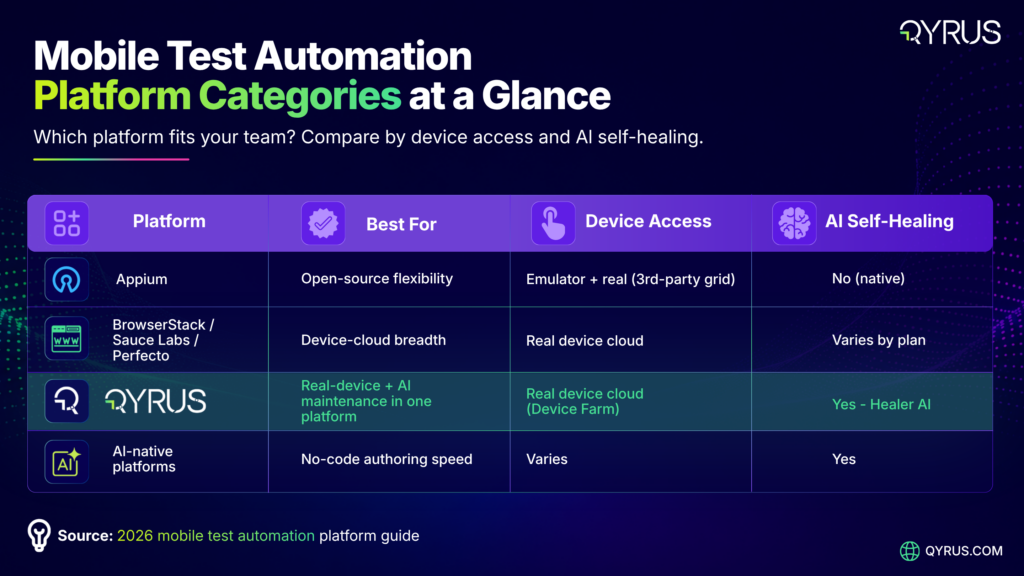
Platform | Best For | Device Access | AI Self-Healing |
Appium | Open-source flexibility | Emulator + real (via 3rd-party grid) | No (native) |
BrowserStack / Sauce Labs / Perfecto | Device-cloud breadth | Real device cloud | Varies by plan |
Qyrus | Real-device + AI maintenance in one platform | Real device cloud (Device Farm) | Yes — Healer AI |
AI-native platforms | No-code authoring speed | Varies | Yes |
Why the Right Platform Choice Is a Revenue Decision
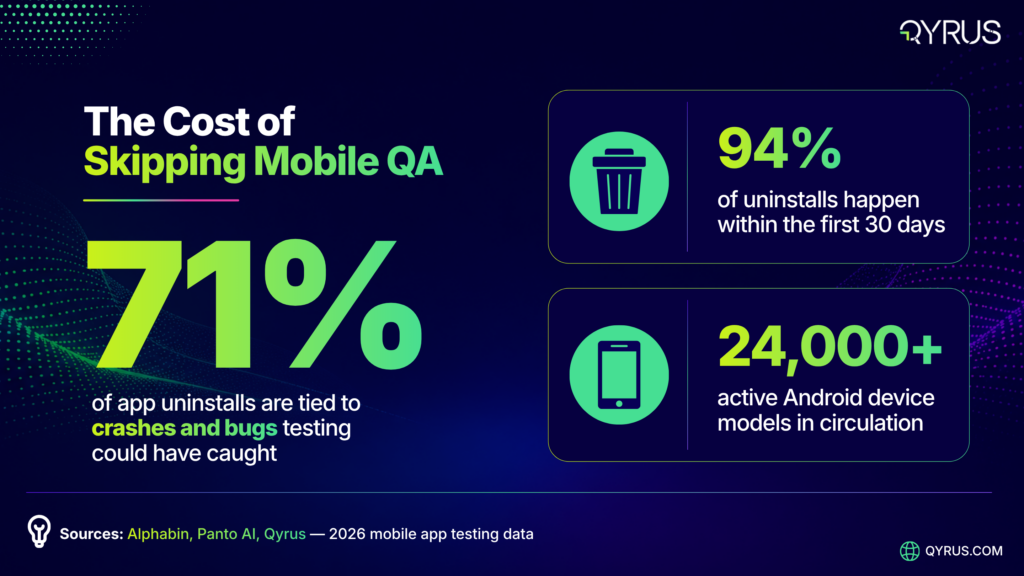
Mobile quality problems aren’t cosmetic, they directly affect revenue. Seventy-one percent of app uninstalls are tied to crashes and bugs that thorough testing could have caught, and 94% of uninstalls happen within the first 30 days of install. Users are especially unforgiving of performance issues: an app that simply freezes for five seconds will lose 18% of the people who just installed it.
Layer device fragmentation on top of that and the scale of the problem becomes clear. There are more than 24,000 distinct, active Android device models in circulation today, and six major Android versions — 11 through 16 — all still carry meaningful active-install share simultaneously. A platform that can’t run comprehensive test coverage efficiently across that spread isn’t just slower, it’s leaving coverage gaps exactly where users are most likely to hit a crash your team never saw.
6 Criteria That Actually Separate Mobile Test Automation Platforms
On paper, feature lists make every platform look similar. These six criteria are where they actually diverge.
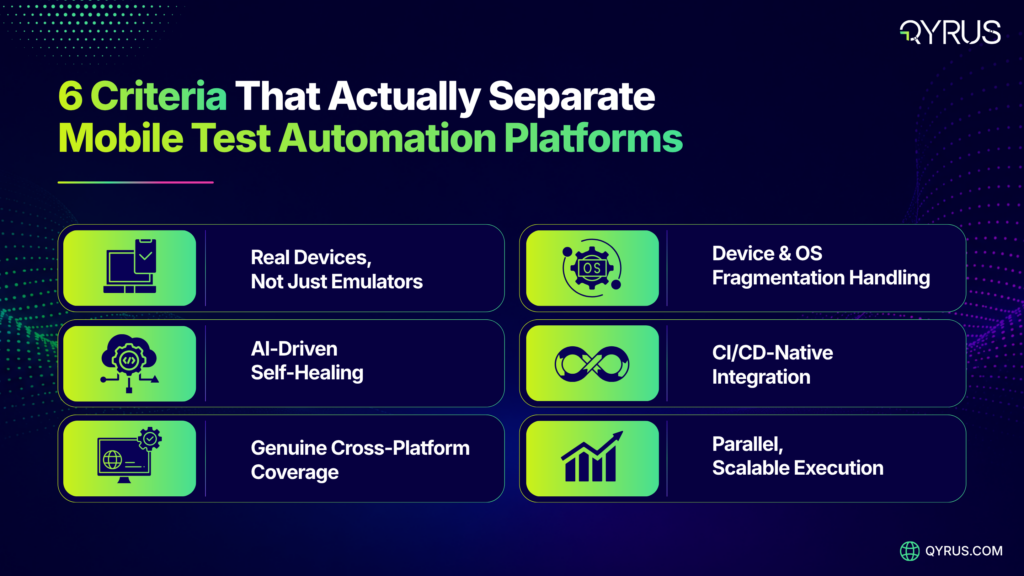
- Real device execution vs. emulators and simulators.Emulators are fine for early-stage checks, but theycan’t reliably replicate real network conditions, battery behavior, or biometric prompts. A platform’s real-device access, not its device count alone, is what determines whether your test results reflect what users actually experience.
- AI-driven self-healing.Locator-based scripts break the moment a button shifts or a label changes text. Teams running unassisted Appium suites at scaleroutinely lose 60-70% of QA time to fixing broken selectors. An AI-driven testing process that heals broken locators automatically has become the difference between a test suite that stays useful and one your team quietly stops trusting.
- Cross-platform testing coverage.A platform that requires separate test suites for Android and iOS doubles your maintenance load. Look for genuine single-codebase coverage that supports both Android and iOS from the same test cases, among the key features that matter most as your app portfolio grows.
- Device and OS fragmentation handling.Given 24,000+ Android models alone, no team can test everything. The best platforms support risk-based device pools rather than forcing an all-or-nothing device matrix.
- CI/CD-native integration.A mobile test automation platform thatdoesn’t trigger automatically on a pull request or build is a manual step waiting to be skipped. Native hooks into tools like Jenkins, Azure DevOps, and GitHub Actions are non-negotiable in 2026.
- Parallel and scalable execution.Sequential test runsdon’t survive a fast release cadence. The platform needs to run suites across many devices simultaneously without the queue becoming the bottleneck, and reporting needs to keep pace — screenshots, video recordings, and device vitals (CPU, memory, network usage) captured per run, not just a single pass/fail flag at the end.
Weigh these six against each other rather than treating them as a checklist to satisfy in full. A five-person startup team testing a single native Android app has a very different priority order than an enterprise team shipping cross-platform releases weekly across a dozen markets, and the platform that wins on paper for one context can be badly over- or under-built for the other.
The Three Categories of Mobile Test Automation Platforms in 2026
Rather than ranking twenty individual tools, it’s more useful to understand the three categories they fall into, because the category, not the brand name, determines the tradeoffs you’re accepting.
Open-source frameworks — Appium, Espresso, XCUITest. Free, flexible, and backed by large communities, but the maintenance cost falls entirely on your team. Best for teams with strong in-house automation engineering.
Real-device cloud platforms — BrowserStack, Sauce Labs, Perfecto, Qyrus Device Farm, and similar. These solve the device-fragmentation problem by giving you on-demand access to real hardware instead of maintaining an in-house device lab. Best for teams that need breadth and reliability without owning physical infrastructure.
AI-native and self-healing platforms — a growing category where AI handles locator maintenance, and in some cases test authoring, automatically. Best for teams trying to escape the 60-70% maintenance tax that traditional scripted automation carries.
Many mature platforms — Qyrus among them — now blend the second and third categories: real-device execution paired with AI-driven maintenance, rather than forcing a choice between the two. That combination matters because device access alone doesn’t solve test fragility, and AI-driven maintenance alone doesn’t solve device fragmentation — a team needs both working together to keep pace with a modern release cadence.
The category distinction also changes how you should evaluate pricing and onboarding. Open-source frameworks carry no license cost but the highest engineering-hours cost. Device cloud platforms typically price by device-minutes or seats, which scales predictably with team size. AI-native platforms often price by test volume or usage credits, which rewards teams that consolidate suites rather than maintaining redundant coverage. Understanding which category you’re evaluating — before comparing brand names — makes the pricing conversation much clearer. For a broader comparison across web, mobile, and API no-code platforms specifically, see our related guide: Top No-Code Test Automation Tools for Web, Mobile, and API Testing 2026.
How Qyrus Approaches Mobile Test Automation
Qyrus’s mobile offering is built around two components working together: Mobile Testing for AI-driven test authoring and execution, and Device Farm for real-device access at scale.
On the authoring side, Qyrus Mobile Testing simplifies test creation and test management with a live device connection for building and previewing tests against a real-time video stream, a mobile recorder that captures user actions as test steps, and Healer AI — which automatically finds new locators for failed steps when the UI changes, so tests don’t break every time a button moves. Visual testing catches UI regressions that functional assertions alone would miss, and Rover AI adds autonomous exploratory testing to surface issues scripted regression tests weren’t written to catch, all aimed at faster test execution without sacrificing coverage. For deeper context on how this fits into a broader agentic testing approach, see Beyond Linear Scripting: Why 2026 is the Year of Modular, Agentic Mobile Testing.
On the infrastructure side, Qyrus Device Farm provides access to real Android and iOS devices — smartphones and tablets — backed by a 99.9% real device availability commitment, with support for Android 9+ and iOS 14+, plus day-one support for new OS releases. Teams can run manual sessions with full device control, simulate interrupts like incoming calls to test how an app recovers, configure network shaping to test under real-world conditions like a slow 3G connection, and use biometric bypass to streamline testing of authentication flows. The platform runs in an ISO 27001/SOC 2-compliant cloud environment, and Qyrus is the only vendor offering fully dedicated, private devices that teams can configure exactly as their end users would. More on why real-device coverage matters at scale: Struggling with Fragmentation Frustration in AI Era? Why You Still Need a Mobile Device Farm.
A London-based neobank illustrates the impact of this combination. With a small four-person manual testing team and a limited budget, the bank needed to scale mobile test coverage fast without adding headcount. Using Qyrus Mobile Testing and Device Farm on Android and iOS, the team reached 90% test coverage in 10 weeks, cut test build time by 50% through script cloning, and shipped with zero bugs leaked to production. Read the full case study.
Frequently Asked Questions
What is a mobile test automation platform?
A mobile test automation platform is software that runs pre-written or AI-generated test scripts against a mobile app automatically, without a human manually tapping through each screen. It validates functionality, UI, and performance across devices and OS versions as part of a release pipeline.
Is Appium still relevant in 2026?
Yes. Appium remains the most widely used open-source mobile automation framework, supporting native, hybrid, and mobile web apps across Android and iOS from a single codebase. Its main tradeoff is maintenance: locator-based scripts require ongoing upkeep as the app’s UI changes, which is why many teams pair it with AI-assisted self-healing tools.
What’s the difference between a device farm and an emulator?
An emulator simulates a device in software, which is useful for quick early checks but can’t fully replicate real-world conditions like network variability, battery behavior, or biometric hardware. A device farm gives you on-demand access to actual physical devices, so test results reflect what real users experience.
How much does AI self-healing actually reduce maintenance time?
Teams running unassisted, locator-based automation at scale commonly lose 60-70% of QA time to fixing broken selectors after UI changes. AI-driven self-healing tools reduce that overhead significantly by automatically identifying updated locators when elements shift, though the exact reduction varies by platform and app complexity.
Can one platform test both Android and iOS?
Most modern mobile test automation platforms, including Appium and Qyrus Mobile Testing, support both Android and iOS from a single test suite, which avoids maintaining separate scripts per platform.
What should a small QA team prioritize first?
Real device access and AI-driven maintenance typically deliver the fastest return for small teams, since they directly reduce the two biggest cost centers in mobile QA: infrastructure overhead and script upkeep. Cross-platform, CI/CD-native platforms let a small team cover more ground without proportionally more headcount.
Conclusion
There’s no single “best” mobile test automation platform, there’s a best fit for your team’s authoring preferences, device coverage needs, and tolerance for maintenance overhead. What doesn’t change is the cost of getting it wrong: with 71% of uninstalls tied to preventable crashes and over 24,000 Android device models to account for, the platform decision is a revenue decision as much as a technical one.
Qyrus approaches this with real-device execution through its Device Farm and AI-driven maintenance through Mobile Testing’s Healer AI and Rover AI, an approach that helped a London-based neobank reach 90% coverage in 10 weeks with zero production bugs leaked. Request a demo to see how Qyrus’s Mobile Testing and Device Farm can cut your team’s maintenance overhead and device-fragmentation risk.

 October 15, 2026
  4 min
4 min