Automated Regression Testing Improves Release Quality Here’s How.
 Varun RS
“Capgemini’s World Quality Report has stated that 76% of enterprises directly link QA and test automation investments to business outcomes such as customer satisfaction and revenue protection.”
Why because every software release carries the same quiet risk. A change that was supposed to fix one thing breaks something else entirely.
It happens across SMEs to big conglomerates, when you add a new feature with a shared module, a dependency update shifts expected behaviour, a configuration change has an effect nobody could have guessed. By the time you find it, it’s too late already.
Regression automation is built to act as a safety net, helping organizations to test faster, release more frequently, and maintain quality when production capacity grows.
Automated regression testing exists to catch those breaks before they reach your users. It runs on a defined set of checks against your application every time code changes, ensuring that what worked before still works now.
So when it is built into your delivery pipeline, it transforms release quality from something you hope for into something you can practically use .
Let’s explore what automated regression testing is, why it matters, how to build it properly, and what separates teams that do it well in the long and short term.
What Is Automated Regression Testing?
Automated regression testing is a continuous process, where a predetermined set of test cases check if existing software behaviour has not been unintentionally changed because of new code updates.
Regression testing is the practice of re-running previously validated tests after a code change to confirm that existing functionality still behaves correctly. The word ‘regression’ refers to the direction of travel.
Manual regression testing is a QA engineer working through a checklist by hand who can validate this, but only slowly and only once per cycle.
Automated regression testing is an efficient way to replace that manual effort with scripts that execute the same checks consistently, in minutes, every time a developer pushes new updated code.
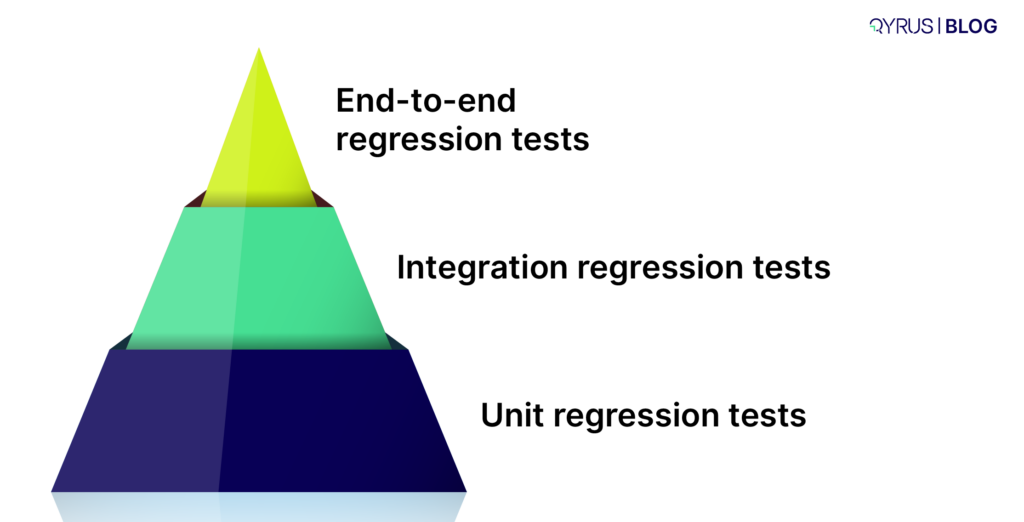
The testing scope can range from individual unit tests that verify a single function, to end-to-end tests that can simulate a complete user journey across multiple systems.
In practice, we have seen that a mature regression suite must include all levels. So that it can catch low-level logic errors quickly at the unit layer and confirm complete workflows at the integration and UI layers.
Regression Testing vs. Other Test Types
Test Type | What It Verifies | When It Runs | Scope |
Regression Testing | Existing functionality still works after a change | Every code change, in CI/CD | Broad — covers previously working features |
Smoke Testing | Core application paths are operational | Post-deployment, pre-full suite | Narrow — critical paths only |
Sanity Testing | A specific fix or feature works as expected | After a targeted change | Narrow — targeted area |
Exploratory Testing | Undocumented or unexpected behaviour | Manual, ad hoc | Open-ended |
Performance Testing | Speed, load, and scalability under stress | Scheduled or pre-release | Infrastructure and load profiles
|
Why Release Quality Depends on Regression Automation
The case for automating regression testing is not primarily about speed, though speed is a benefit. It is about coverage, consistency, and the compounding cost of finding defects late.
What Happens When You Find Bugs Late
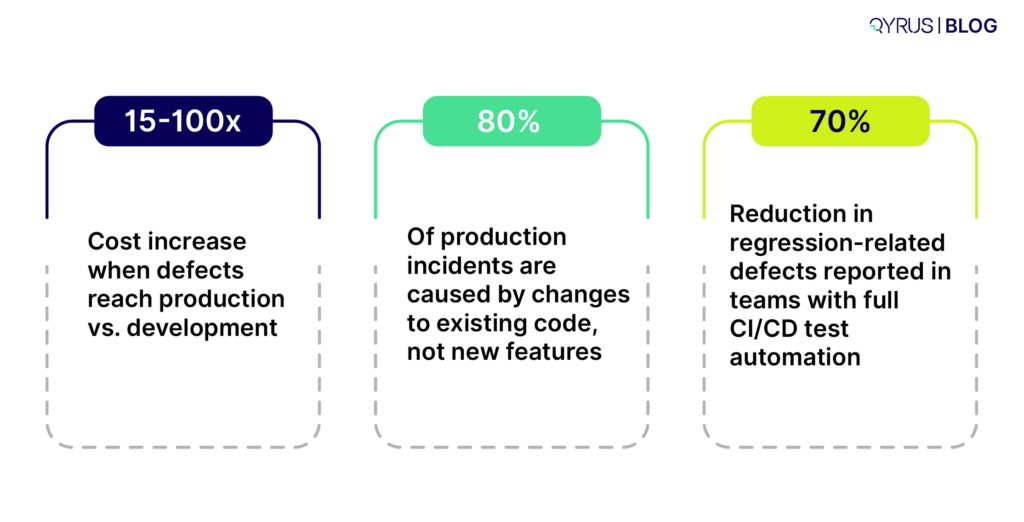
Research from IBM Systems Sciences Institute showed that fixing a defect in production costs between 15 and 100 times more than catching it during development.
Every layer of delay, from unit testing to integration testing, UAT, and production, increases the cost of remediation. Automated regression testing moves detection as early as possible in the cycle, which is why the practice is often described as shift-left testing.
What Happens Without Regression Automation
Teams without automated regression testing face a predictable set of problems:
- Release cycles increase — manual regression before each release can take days or weeks, compressing the time available for development
- Coverage reduces under pressure — when deadlines are tight, manual testers deprioritise edge cases and secondary flows — exactly 4where regressions hide
- Confidence reduces — without objective evidence that existing features still work, release decisions become subjective and risk-averse
- Technical debt increases — undetected regressions reach production, require hotfixes, and generate incident reports that consume engineering capacity
What Teams Gain When They Do It Well
When automated regression testing is embedded correctly into the delivery process, the effects are practical and measurable:
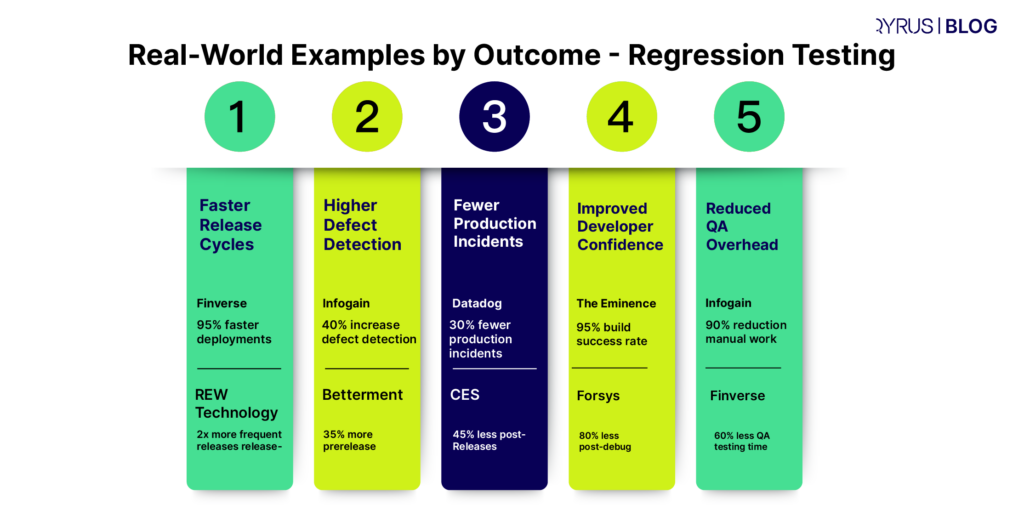
Faster release cycles — suites that previously took a week to run manually execute in under an hour in CI
- Finverse was able to cut regression time from 3 days to 1 hour, a 95% reduction, while maintaining stable releases across login, payments, and transfers.
- Infogain reported regression cycle time dropping from 40 hours to 4 hours with automated API and mobile testing integrated into CircleCI.
- UFT ROI case study reduced manual regression effort from 50 hours to 2.7 hours per cycle.
Higher defect detection rates — consistent automated coverage finds issues that time-pressured manual runs miss
- REW Technology reported a 40% increase in defect detection rate after implementing end-to-end automation and integrating tests into the pipeline.
- Nykaa said automation helped cut integration defects or production incidents by 90% while also expanding code coverage for critical services.
- The pattern is consistent: once teams automate high-risk flows and rerun them on every change, more regressions are found before release.
Fewer production incidents — regressions are caught before they reach users, not after
- REW Technology reported a 30% decrease in production incidents after end-to-end automation.
- Finverse reported a 40% drop in production issues and zero blocking defects in key financial flows across four release cycles.
- Forsys reported more than 90% reduction in production functional defects after automating 90% of manual test cases.
Improved developer confidence — engineers can refactor and add features knowing the test suite will signal any breakage
- Betterment said Datadog helped transform CI from a source of friction into a trusted system, driving build success rate up to 95% and letting developers focus more on shipping.
- Autolite QA Services described a SaaS team that regained trust in automation after reducing flaky failures by 68% and cutting regression from 4–5 days to 1.5 days.
Reduced QA overhead — Automation handles repetitive validation, freeing QA engineers to focus on higher-value exploratory and acceptance testing.
- CES reported a 90% reduction in manual effort and patch-ready regression testing in 8 hours instead of weeks.
- Forsys reported 40% less manual work alongside a 50% reduction in test cycle time.
- The Eminence described manual regression dropping from 8–10 hours to 4 hours, allowing QA to spend more time on exploratory and edge-case testing.
How to Build an Effective Automated Regression Suite
A regression suite that is poorly built is often worse than no suite at all. It creates false confidence, slows CI pipelines with flaky tests, and takes more time to maintain than it saves. We have laid down the principles needed for effective regression automation that will help you to bring to a stage where your testing strategy works.
AlwaysStart with What Breaks Most Often
The usual instinct when starting out is to automate the simplest paths — the standard user flows that work under normal conditions. These are the easiest tests to write but often the least valuable to automate, because they are also the least likely to regress. A regression is most dangerous in edge cases, integration points, and areas of the codebase that change frequently.
Build your initial suite around: areas with the highest change frequency in version control, functionality that caused incidents or defects in the past twelve months, integration points between services or third-party dependencies, and any flow that handles money, authentication, or user data.
Structure Your Suite in Layers
Not every test should run at the same time or with the same frequency. A layered structure — often called a test pyramid, keeps fast feedback fast while still achieving broad coverage.
Direct Integrationinto Your CI/CD Pipeline
A regression suite that runs only on demand provides lesser value as compared to one that runs automatically on every code change. So if you directly move with pipeline integration, it will trigger every pull request at the relevant test layers, and a failure can block the merge. This is the framework that makes regression testing a quality gateway rather than just a checkbox.
The practical setup: unit regression tests run on every commit (under two minutes), integration tests run on every pull request (under fifteen minutes), and the full end-to-end suite runs nightly or on merge to the main branch.
Ensure toMaintain the Suite as Actively
The most common reason regression suites fall apart is neglect. Tests that were accurate six months ago may now test behaviour that no longer exists, or miss behaviour that was introduced. A test suite that generates ten false failures per run will be disabled within a month.
Assign ownership of the regression suite as explicitly as you assign ownership of the application. Set a policy for how quickly a failing test must be investigated — the answer should be hours, not days.
At a low level we suggest to remove or rewrite tests that have been continuously flaky rather than suppressing them with workarounds.
Use AI-Powered Solutionsto Reduce Maintenance Overhead
One of the largest sources of regression test maintenance cost is UI change. Why?
When an element on a page is renamed, moved, or replaced, every test that referenced the old element breaks — even if the underlying functionality is unchanged. Self-healing test automation uses AI to detect when a selector has changed and automatically update the test reference, without manual intervention.
This is not a minor convenience. In applications with active front-end development, self-healing can reduce test maintenance time by 65–70%, turning what would be hours of manual test repair after each sprint into an automated background process.
So the next big question you need to tackle is
What Factors Your Regression Suite Should Cover
The scope of a regression suite should be driven by risk, not convenience. These are the areas that belong in every production-grade regression suite
Core User Flows
The paths that define the purpose of your application — account creation, login, checkout, payment, core transactions — should be covered end-to-end in the regression suite. Any regression in these flows will be noticed by users immediately.
API Contracts and Integration Points
Regressions at the API layer are particularly dangerous because they are invisible to UI tests but affect every client that consumes the API.
Your regression suite should validate that every API endpoint returns the expected status codes, response structure, and data types after each change.
Contract testing — verifying that both the provider and consumer agree on the API shape is especially important in microservice architectures where teams deploy independently.
Authentication and Authorisation
Login flows, session handling, token expiry, and role-based access controls must be in the regression suite. Authentication regressions are among the most severe in terms of security impact, and they are often introduced by seemingly unrelated changes in the authentication middleware or session configuration.
Data Validation and Boundary Conditions
The rules that govern what data your application accepts — required fields, format constraints, length limits, numeric ranges — should be tested after every change. These rules are frequently affected by database schema changes, model updates, or third-party integration modifications.
Cross-Browser and Cross-Device Compatibility
For web applications, a change that renders correctly in Chrome may break in Safari or Firefox. For mobile applications, behaviour on Android may differ from iOS. Regression testing across the supported browser and device matrix should be part of the pre-release suite, particularly after front-end changes.
Performance Baselines
Response time regressions are as damaging as functional regressions. Include latency assertions for critical endpoints — if the p95 response time for your checkout API doubles after a change, that should fail the regression suite just as definitively as a broken status code.
Common Mistakes That We Should Avoid in Regression Automation
These are the patterns that cause regression suites to provide less value than expected or to be abandoned entirely.
Treating the Suite as a One-Time Project
Regression suites are living systems. An application that ships code every week has a test suite that needs to change every week. Teams that build the suite, declare it done, and stop actively maintaining it will find that test coverage drifts away from the actual application until the suite is more noise than signal.
Automating the Wrong Tests
Not every test should be automated. Tests that require human judgement — evaluating visual aesthetics, assessing the tone of content, validating a complex accessibility journey — are poor candidates for automation.
Automating them produces brittle, expensive tests that break on every release. Focus automation effort on tests that are deterministic: given a specific input, the expected output is always the same.
Ignoring Simple Tests
A flaky test is one that sometimes passes and sometimes fails on the same code without any change. A small number of flaky tests can destroy trust in an entire suite — if ten percent of failures are noise, engineers learn to ignore failures entirely. Treat flaky tests as defects in the test suite. Investigate them, fix the root cause, and do not suppress them with automatic retries as a long-term solution.
Running Everything Sequentially
Most test frameworks default to sequential execution. Most regression test cases are independent — they do not share state, and their execution order does not affect their result. Running them sequentially is leaving performance on the table. Parallel execution consistently reduces suite duration by 60–75% with no change to the tests themselves and no additional infrastructure cost.
Separate QA from Development
When regression testing is owned entirely by a separate QA team that runs tests only after development is complete, the feedback loop is too long to be useful.
Because by the time a regression is found, the developer who introduced it has moved to another feature and has to context-switch back. So introduce Shift-left practices where developers write and run regression tests as part of their own workflow — reduce that feedback loop from days to minutes.
How Qyrus Makes Regression Automation Work
The principles above describe what good regression automation looks like. Qyrus is the platform built to deliver it — across web, mobile, API, SAP, and data layers — without requiring teams to build and maintain a custom automation framework from scratch.
AI-Powered Test Creation and Maintenance
Qyrus eliminates the most time-intensive parts of regression automation. Its no-code test recorder captures user flows and converts them into executable test cases.
Our AI-powered engine detects when application changes break existing test selectors and repairs them automatically — removing the manual maintenance that causes most regression suites to degrade over time.
SEER: Autonomous Orchestration
Every regression run in Qyrus is managed by SEER — an AI orchestration framework that Senses changes in the codebase, Evaluates their impact, Executes the relevant tests in parallel, and Reports results with actionable diagnostic information.
This means the suite does not run blindly in its entirety on every change — it runs the tests that are relevant to what changed, reducing execution time without reducing coverage.
Unified Coverage Across Every Layer
Most regression tools cover one layer of the application. Qyrus covers all of them from a single platform: web UI testing with cross-browser support, mobile testing on real devices, API regression testing with contract validation, SAP system testing with AI-driven change impact analysis, and data testing to verify that database and pipeline changes do not corrupt downstream systems.
Conclusion
Automated regression testing is not a tool you buy or a process you implement once. It is a discipline — one that pays compounding returns when maintained well and quietly degrades when neglected. The teams that get the most value from it are the ones that treat the test suite as a product, invest in its quality and coverage continuously, and integrate it tightly into every stage of their delivery pipeline.
The specific mechanics like which framework to use, how to structure the pyramid, how to handle simple tests — matter less than the commitment to making regression validation a normal, automatic part of how software ships.
When it is, release quality stops being a matter of luck or manual effort and becomes something the pipeline enforces.
If you are ready to move beyond the maintenance trap and build an automated regression testing strategy that scales with your product, book a demo with the Qyrus team today and see our framework in action.
Frequently Asked Questions
What is the difference between regression testing and retesting?
Retesting verifies that a specific defect that was previously reported has been fixed. Regression testing is broader — it verifies that fixing that defect, or making any other change, has not broken something else in the process. Retesting is targeted; regression testing is protective.
How often should an automated regression suite run?
The short answer is: as often as code changes. For most teams, this means running a fast subset (unit and critical integration tests) on every commit, the full suite on every pull request, and an extended suite including performance checks nightly. The goal is that no regression survives for longer than one development cycle before being detected.
Which tests should be included in a regression suite?
Prioritise tests that cover core user flows, integration points between services, authentication and authorisation logic, data validation rules, and any area that has previously caused a production incident. Tests that are deterministic — where the expected output for a given input is always the same — are the best candidates for automation.
How do you manage a regression suite as the application grows?
Assign explicit ownership of the suite, set a policy for reviewing and retiring outdated tests, and invest in tooling that reduces maintenance overhead — particularly AI-powered self-healing for UI tests. The suite should be treated as a first-class software system with its own code review, version control, and quality standards.
What is the role of shift-left testing in regression automation?
Shift-left testing means moving regression checks earlier in the development cycle — to the point where developers run them locally before committing code, rather than waiting for a QA cycle after development is complete. This shortens the feedback loop from days to minutes, reduces the cost of fixing defects, and distributes quality responsibility across the entire team rather than concentrating it in QA.
Can automated regression testing replace manual QA entirely?
No. Automated regression testing handles deterministic, repeatable validation efficiently. It cannot replace the human judgement required for exploratory testing, accessibility evaluation, usability assessment, or subjective quality checks. The optimal model uses automation for what it does best and reserves manual QA effort for what requires human insight.
How does AI change regression testing?
AI introduces three meaningful changes: it reduces the effort required to create tests (through natural language or no-code recording), it reduces the effort required to maintain them (through self-healing that repairs broken selectors automatically), and it makes test selection smarter (by analysing code changes to determine which tests are most relevant to run, rather than running everything). These changes make regression automation accessible to teams that previously lacked the resources to sustain it.

 October 15, 2026
  4 min
4 min