SAP Testing Tools in 2026: How to Choose the Right Platform
 Varun RS

Here’s a situation that plays out in enterprises every day: an SAP update goes through. The business team signs off. The technical checklist looks clean. Then, three days after go-live, a purchase order hits an error that nobody caught. Finance scrambles. Supply chain stalls. And IT is left explaining how something this critical slipped through.
The problem is usually a gap in SAP testing. This gap is often because we do not have automated tests or we are using a testing tool that is not good enough.
As SAP software is at the heart of how companies work today, it is very important to choose the testing framework. This guide will tell us what we need to look for when we are evaluating an SAP testing platform, the problems that these tools need to solve, and how new tools like Qyrus that use artificial intelligence are changing the way we do quality engineering for SAP systems in companies. Qyrus and other modern tools are making a difference, in how we test SAP software.
The Unique Complexities of Enterprise SAP Testing
Let us be honest: most organizations greatly underestimate how complex SAP testing is. It is not about clicking through screens and checking if a transaction posts. SAP environments are deeply connected to each other. A single change in one part of the system can affect other areas like finance, procurement, supply chain, and human resources before anyone realizes what is happening. To understand why basic automated testing tools fail, consider the broader economic stakes. According to industry research, over 440,000 companies worldwide utilize SAP solutions, allowing 77% of global transaction revenue to flow through an SAP system at some point. When deployments fail, the results are severe: SAP downtime costs enterprises an average of $9,000 per minute. Because many companies are moving to S/4HANA and making their systems more complex the market for SAP testing was worth over $700 million in 2025 and is still growing at a rate of8.1% CAGR.
When SAP deployments fail the results are severe: SAP downtime costs companies an average of $9,000 per minute. Because many companies are moving to S/4HANA and making their systems more complex the market for SAP testing was worth over $700 million in 2025 and is still growing at a rate of 8.1% per year.
Enterprise QA teams face several distinct structural barriers within these landscapes:
- Deep customization: Every SAP implementation is unique. Custom ABAP code, bespoke workflows, and organization-specific configurations mean that generic test cases often miss what matters most. Custom ABAP Extensions and Custom Core Code: Because legacy SAP ECC landscapes often carry decades of custom modifications, transitioning to a clean-core architecture on S/4HANA requires deep analysis of custom Z-tables and custom transaction codes (T-Codes) to ensure extensions do not break core business logic.
- Cross-module dependencies: Touch one thing in FI/CO and it might surface as a bug in MM (Materials Management) or SD (Sales and Distribution). Testing in isolation will not catch these connections.
- IDoc/EDI hidden failures: SAP might report successful processing status while an IDoc has quietly posted the wrong data. This “Green Light Lie” is one of the most insidious risks in SAP testing.
- Dynamic UI locators: SAP Fiori and UI5 apps create dynamic control IDs when they are running. Older test automation frameworks rely on static XPath locators, which break when you run scripts against dynamic interfaces.
- The S/4HANA migration pressure: With SAP’s ECC support deadline looming in 2027, organizations are racing to migrate. According to SAPinsider, 32% have already transitioned to S/4HANA while 27% are actively in implementation — both groups need reliable testing to keep from derailing.
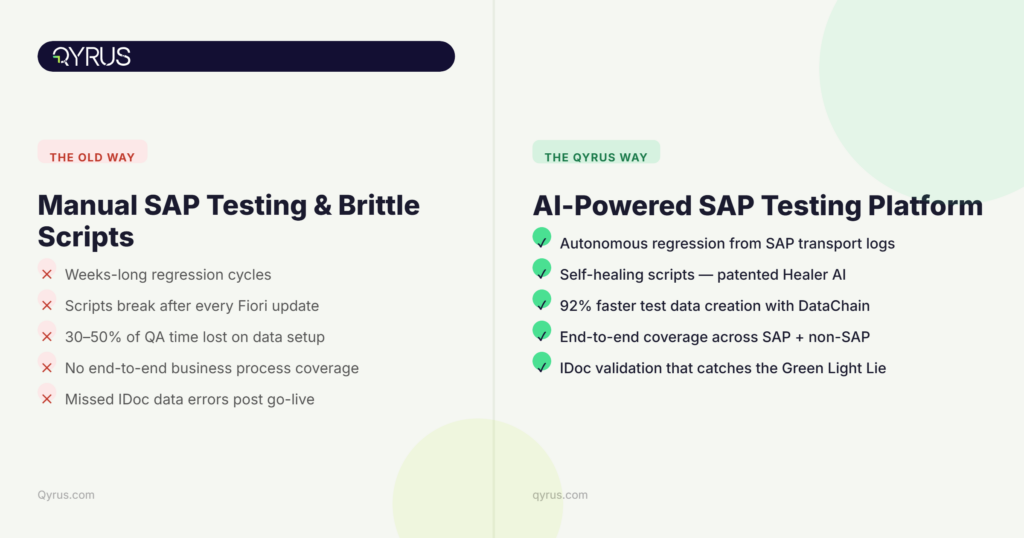
Add to that the reality that many QA teams spend 30–50% of their time just on environment setup and data management before a single test case runs, and it becomes clear why simply “having an automation tool” is not enough.
What Actually Separates Great SAP Testing Tools from Average Ones
There is no shortage of SAP testing tools on the market. The harder question is: what separates tools that can really solve enterprise problems from a tool that looks good in demos but fails in real-life situations?
Here are the criteria that matter most:
1. Native SAP Protocol and UI Awareness
The tool must understand SAP-specific UI controls, OData services, BAPIs, and IDocs rather than treating SAP like any other web application. A UI5-aware recorder, for example, recognizes SAP Fiori controls natively, which eliminates the brittle XPath locators that cause most automation scripts to fail after the first update.
It is also important for the tool to understand the business context. There is a difference between a tool that clicks “Create” on a purchase order screen and one that understands what “Create Purchase Order” means in the context of a Procure-to-Pay (P2P) process.
- True End-to-End Business Process Coverage
Transaction-level testing is table stakes. What enterprises actually need is coverage that spans the full Order-to-Cash (O2C), P2P, or Hire-to-Retire (H2R) workflows across SAP modules and into connected non-SAP applications like Salesforce, Ariba, or custom APIs.
The best SAP automation tools support cross-application orchestration, passing data seamlessly between systems in a single test flow. If your tool tests SAP in isolation, you’re only seeing part of the picture.
3. Algorithmic Self-Healing Test Scripts
Script maintenance is where most automation programs go off the rails. As SAP interfaces change and they change constantly in cloud and Fiori environments, brittle scripts break and engineers spend days fixing them instead of building new coverage. True self-healing means the tool can detect a changed UI element, identify the correct new locator, and update the test script automatically, without human intervention. Not every vendor that markets this capability actually delivers it reliably.
4. Intelligent Test Data Management
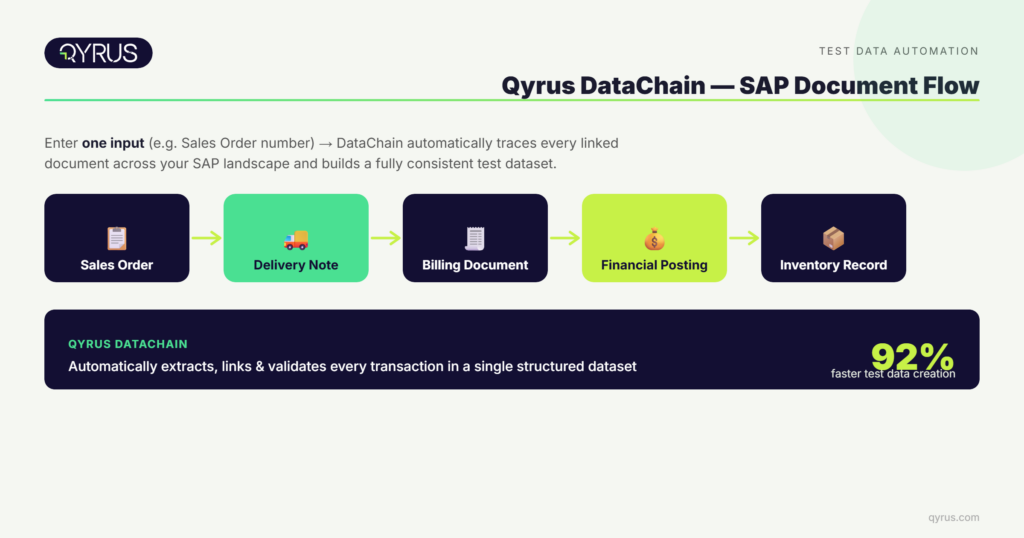
Test data in SAP is not simple. A single end-to-end test might require a sales order that links to a delivery, an invoice, a financial posting, and an inventory record, all referentially consistent. Creating this manually is a “referential integrity nightmare,” as one analyst put it, and a primary source of testing delays.
Tools that can automatically trace document flows, extract linked data, and construct complete, production-like test datasets eliminate one of the biggest bottlenecks in SAP QA.
5. AI-Driven Impact Analysis and Smart Test Selection
Not every test needs to run with every change. Intelligent platforms analyze SAP transport requests and change logs, identify affected areas, and prioritize testing effort on what’s actually at risk. This is the difference between running a full regression suite that takes three weeks and running a targeted suite that takes hours, with higher confidence.
6. Backend and API Validation
UI-based SAP testing misses the engine. Backend validation through OData APIs, BAPIs, and direct database queries provides faster, more stable, and more comprehensive coverage, especially for custom ABAP logic and complex integration points that never surface in the UI at all.
A Practical Look at the SAP Testing Approaches in Use Today
Not all SAP testing strategies are created equal. Here’s how the main approaches stack up in practice:
Approach | Speed | Coverage | Maintenance Cost |
Manual testing | Very slow | Incomplete at scale | High (human effort) |
Script-based automation | Moderate | Good if maintained | Very high (brittle scripts) |
Native SAP tools (CBTA/SolMan) | Moderate | SAP-only, limited E2E | Medium |
AI-powered platforms (e.g. Qyrus) | Fast | End-to-end, cross-system | Low (self-healing) |
Manual testing hit a wall years ago. The challenge now for most enterprises is transitioning away from script-based automation, which worked reasonably well when SAP interfaces were stable, toward something that can keep pace with continuous change.
That’s where AI-native platforms are making the biggest impact. Over 55% of enterprises have now adopted automated testing tools for SAP platforms — but adoption doesn’t guarantee effectiveness. The quality of the tool matters as much as having one at all.
How Qyrus Solves the SAP Testing Problem Differently
Qyrus is purpose-built for the complexity of enterprise SAP environments. Where most testing tools treat SAP as another web application with screens to click through, Qyrus is natively aware of underlying business processes, data structures, and the specific challenges of SAP S/4HANA testing.
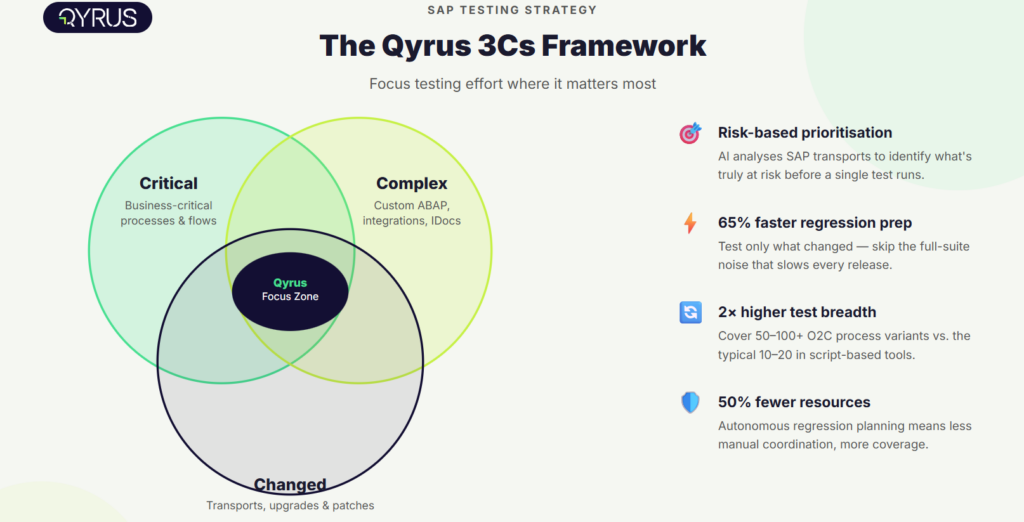
The 3Cs Framework: Testing What Actually Matters
Qyrus’s approach to SAP testing starts with a strategic filter: focus on what is Critical, Complex, and has Changed. This “3Cs” methodology prevents the all-too-common mistake of running the same broad regression suite regardless of what changed, burning testing resources on low-risk areas while high-risk areas stay under covered.
Autonomous Regression Testing (ARS): Let AI Do the Heavy Lifting
Qyrus’s Autonomous Regression Testing combines proprietary algorithms with SAP Scribe, a set of ERP-aware AI models trained specifically on each customer’s SAP environment. Instead of relying on manual test planning every time a transport moves through the system, it automatically analyzes change logs, traces dependencies, identifies impacted business flows, and determines exactly which regression tests need to run. It also flags coverage gaps and creates additional test scenarios where risk areas are not fully covered. Rather than working from static spreadsheets and assumptions, testing teams receive a prioritized, risk-based regression plan tailored to the actual SAP changes introduced.
The business impact: 65% faster regression preparation and 50% fewer resources needed to maintain the test suite, with broader coverage, not narrower.
DataChain: Solving the Test Data Nightmare at the Source
Test data management in SAP is where many automation efforts quietly fail. Qyrus addresses this with DataChain, an automated TDM capability that takes a single input, such as a sales order number. DataChain automatically traverses the SAP document flow to identify and compile all downstream and upstream linked transactions, including quotations, logistics deliveries, billing invoices, and financial accounting ledger entries.
The result is a fully structured, referentially consistent dataset ready for testing, with a reported 92% reduction in test data creation time. What previously took days of manual coordination now takes minutes.
Fiori Test Specialist: Built for SAP’s Modern UI
One of the biggest pain points in SAP S/4HANA testing is the SAP Fiori and UI5 interface. Dynamic control IDs break traditional automation. Business users don’t speak the technical language of XPath. And testing teams spend enormous effort just getting tests to work reliably.
Qyrus’s Fiori Test Specialist uses proprietary algorithms and the SAP Scribe AI model to reverse-engineer the application’s source code, analyzing views, controllers, manifest files, and annotation files, and automatically generate end-to-end test cases that a traditional recorder would produce, but without the manual recording effort.
Another key capability is gap analysis. The system checks whether the actual SAP behavior matches the documented process and whether the existing test cases truly validate those flows.
In many SAP environments, these three areas gradually drift apart over time. Documentation gets outdated, business logic changes, and test cases continue running without covering the latest scenarios. Qyrus helps expose those gaps early by highlighting missing validations, uncovered flows, and inconsistencies before they turn into production issues during deployment or go-live.
Self-Healing That Actually Works
Qyrus’s Healer AI (covered by U.S. Patent 11,205,041 B2) is not a marketing feature, it’s a core part of the platform’s ability to stay reliable as SAP environments change. When a test fails because a UI element has moved or been renamed, Healer automatically scans the application, identifies the correct technical field, and repairs the test script.
In the Fiori Test Specialist workflow, Healer runs interactively during test execution: if an AI-suggested field is incorrect, execution pauses, the application is scanned, and updated values are applied before testing continues. Scripts that would normally require hours of manual debugging are “healed” in minutes.
API-First Backend Testing: Faster, More Stable, More Comprehensive
Qyrus’ API-first architecture integrates directly with SAP’s native backend services including OData, BAPIs, IDocs, and direct database queries. This enables validation that bypasses the UI entirely, which is faster, more stable, and catches issues that UI-only testing will never surface.
For IDoc/EDI testing specifically, Qyrus’ Relationship Spotter feature automatically links incoming IDocs to the business transactions they posted, then compares expected values against actual outcomes, catching the “Green Light Lie” that standard SAP tools are built to miss.
The platform supports testing of 50–100+ O2C process variants where traditional approaches typically cover 10–20 at most, a material improvement in coverage for organizations with complex or highly customized SAP implementations.
Robotic Smoke Testing: Confidence After Every Update
Post-maintenance and post-upgrade system health checks are a constant drain for SAP teams. The ASUG/Worksoft study found that 75% of SAP customers have special “hyper-care” periods after updates, a clear signal that confidence in system stability after change is low.
Qyrus’ Robotic Smoke Testing (RST) automates these system health checks. A single user can configure and run standard SAP transactions to validate system availability, OS performance, background job status, and external system communications, transforming a multi-team weekend exercise into a reliable, automated process.
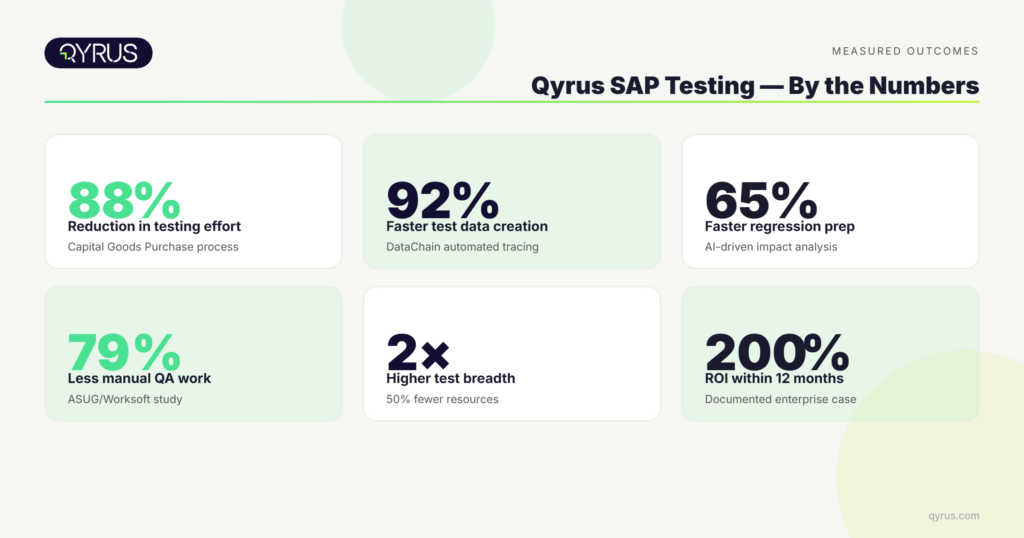
Quantifiable Results: What Enterprises Actually See
Numbers tell a cleaner story than feature lists. Here’s what enterprises working with modern AI-powered SAP testing platforms report:
- 88% effort reduction on critical process testing (documented in a Capital Goods Purchase process case study)
- 79% reduction in manual and low-tier work, per the ASUG/Worksoft study of SAP customers using automation
- 92% faster test data creation with automated data chain tracing
- 65% faster regression preparation with AI-driven impact analysis
- 200% ROI within 12 months, as demonstrated in enterprise success stories
- 2x higher test breadth with 50% fewer resources, enabled by autonomous regression testing
These aren’t projections — they’re outcomes from organizations that moved beyond “automating the old way” and adopted platforms that understand SAP testing at a business-process level.
How Qyrus Compares to Other SAP Testing Tools
Several SAP testing tools have established strong positions in the enterprise market, but they differ significantly in how they approach automation, maintenance, scalability, and SAP ecosystem support. Some platforms are built around deep SAP GUI automation, while others focus more on end-to-end business process testing across both SAP and non-SAP systems. AI capabilities, implementation complexity, and long-term maintenance effort also vary considerably between vendors.
Because of this, the “best” option often depends on what an organization is trying to solve. Some enterprises prioritize large-scale regression coverage during SAP transformations, while others focus on reducing maintenance overhead, accelerating release cycles, or enabling business teams to participate more directly in testing.
Here is a closer look at how the leading SAP testing platforms differ across areas such as SAP support, AI-driven automation, scalability, usability, and overall testing approach, based on publicly available product information, analyst reports, customer reviews, and community feedback.
Tricentis Tosca
Tricentis Tosca is one of the most recognized names in enterprise test automation. Its model-based, codeless approach is genuinely powerful, andusers report faster test creation and high reusability of test modules. Tosca supports SAP (including S/4HANA and Fiori), Oracle, Salesforce, and 160+ other technologies, making it a strong choice for organizations managing complex, multi-system landscapes.
The challenges usually start once teams move beyond the initial evaluation phase. Tosca is widely seen as a premium enterprise platform, and the licensing costs can become significant as adoption expands across larger teams. Many organizations also underestimate the amount of training required early on. While the platform is powerful, new users often need time before they become comfortable building and maintaining automation at scale.
There are also some practical infrastructure considerations. Tosca still works best in Windows-centric environments, which may not fit neatly into organizations standardizing around cloud-native pipelines or mixed operating system ecosystems. Some of the newer AI-driven capabilities, including Agentic Test Automation and MCP Server integration, are currently more aligned with the cloud offering as well, so on-premise customers may not get access to the latest functionality at the same pace.
Best for: Large enterprises with dedicated automation teams, existing Tricentis investment, and the budget to scale a model-based testing program across multiple enterprise applications.
Where Qyrus goes further: Qyrus adds native SAP Scribe AI fine-tuned to each customer’s landscape, autonomous regression test selection from transport logs, built-in test data chain tracing, and IDoc/EDI backend validation — capabilities that go beyond Tosca’s model-based UI automation.
Worksoft Certify
Worksoft Certify has a long and respected track record in SAP business process testing. Its codeless capture mechanism works seamlessly with SAP GUI, and its reusable test assets make it genuinely efficient for organizations running large, repetitive regression cycles against stable SAP ECC environments.
The challenge is where SAP is heading. Reviewers consistently note that web-based testing — especially SAP Fiori — requires significantly more effort in Worksoft than SAP GUI automation. As one user put it directly: “From the SAP side, there is nothing better than Worksoft Certify. However, from the web-based, we are moving towards Fiori… Worksoft has to improve the web-based testing part.” Reports are also cited as not business-user friendly, and the upgrade process is described as lengthy and tedious.
Best for: Organizations running heavily customized SAP ECC with established, stable business processes where GUI-based automation is the primary requirement.
Where Qyrus goes further: Qyrus’ Fiori Test Specialist is built specifically for SAP UI5 environments — it reverse-engineers application source code to generate tests without requiring manual recording. Teams migrating from ECC to S/4HANA get immediate Fiori coverage without rebuilding their test library from scratch.
SAP Solution Manager / CBTA
SAP’s own native testing tools — Solution Manager and Component-Based Test Automation (CBTA) — are attractive on paper because they come bundled with the SAP ecosystem. The integration with SAP CloudALM and direct access to change request management make them a logical starting point for teams already deep in the SAP stack.
In practice, however, SAP’s own tools are widely described as complex, difficult to use, and not built for end-to-end testing across integrated non-SAP systems. CBTA configurations are subject to SAP transport management rules, creating administrative overhead. Solution Manager itself reaches end-of-mainstream-maintenance in 2027, adding strategic risk for organizations that have built their testing practices around it. The steeper learning curve and limited cloud capability further reduce its appeal as a primary testing platform.
Best for: Teams with limited budgets that need basic coverage of core SAP transactions and already have Solution Manager deeply embedded in their ALM processes.
Where Qyrus goes further: Qyrus covers the full testing lifecycle — including non-SAP systems, API validation, IDoc testing, and mobile — and its AI-driven autonomous regression doesn’t require manual test case management the way CBTA does. It also has no 2027 end-of-life exposure.
Leapwork
Leapwork is designed with usability in mind, and that is one of the reasons many teams adopt it. Its visual, no-code interface allows non-technical testers to build automation flows quickly, and its support for SAP GUI, Citrix, and legacy desktop environments has made it a practical choice for organizations dealing with mixed technology stacks.The limitations usually become more noticeable in larger enterprise environments. Some users point to weaker mobile automation capabilities and less detailed reporting compared to more specialized enterprise testing platforms. Pricing is another concern that comes up often. Reported costs of around $100,000 for ten licenses can make the platform difficult to justify for many mid-market teams trying to scale automation across departments.
Leapwork is also built as a general-purpose automation platform, not a SAP-specific testing solution. While it handles SAP interface automation well, it is not designed around SAP-native areas such as IDoc validation, ERP data dependencies, transport analysis, or deeper end-to-end SAP business-process testing.
Best for: Teams that need to automate across SAP, Citrix, and legacy desktop systems without deep coding skills and where out-of-the-box simplicity takes priority over SAP-specific depth.
Where Qyrus goes further: Qyrus is built with SAP-specific intelligence at its core — ERP-aware AI models, transport-level impact analysis, automated document flow tracing, and IDoc validation. These are not features Leapwork was designed for.
OpenText UFT One (formerly Micro Focus UFT)
OpenText UFT One is one of the most established functional testing platforms on the market, with over 200 supported technologies including SAP, Oracle, Salesforce, and Citrix. Its longevity means deep integration support and a large community of practitioners with existing knowledge of the platform.
The platform’s dependency on VBScript — a scripting language widely considered obsolete by modern standards — is a recurring frustration for teams that want to work in Python or JavaScript. Users also report high memory consumption, which creates performance issues in virtualised environments, and several reviewers note that UFT One is better aligned with SAP ECC (GUI-based) than with the Fiori-heavy S/4HANA landscape. As Leapwork’s own competitor comparison noted, UFT One maintenance requires VB and JavaScript skills — a meaningful technical bar for many QA teams.
Best for: Organizations with long-standing UFT deployments, large SAP ECC estates, existing VBScript expertise, and stable application landscapes where broad technology coverage matters more than AI-driven agility.
Where Qyrus goes further: Qyrus is designed for the S/4HANA era, with Fiori-native testing, AI-driven script healing, autonomous regression, and no dependency on legacy scripting languages. For teams modernizing their SAP landscapes, Qyrus is the forward-looking choice.
At a Glance: SAP Testing Tools Compared
Tool | SAP Fiori-Native | AI Impact Analysis | Self-Healing | Cross-System E2E | Best Fit |
Tricentis Tosca | Yes (model-based) | Limited | Vision AI (cloud) | Strong | Large enterprise, multi-tool |
Worksoft Certify | Improving | Yes (Worksoft Impact) | Limited | Strong | SAP ECC-heavy orgs |
SAP SolMan / CBTA | Partial | Basic | No | SAP only | Budget-constrained, simple needs |
Leapwork | Partial | No | Limited | Moderate | Mixed legacy + SAP, non-technical teams |
OpenText UFT One | Partial (ECC-focused) | No | AI object detection | Broad | Long-standing UFT shops, ECC estates |
Qyrus | Yes (source-code aware) | Yes (SAP Scribe AI) | Yes (patented) | Yes (SAP + non-SAP) | S/4HANA migrations, AI-first QA |
A few important caveats on the table above: every product in this comparison is actively evolving, and vendor capabilities can change with each release. Where your organization currently sits on the ECC-to-S/4HANA migration journey, the technical depth of your QA team, and your existing toolchain investments will all influence which platform delivers the best fit. The table is a starting point for your evaluation — not a substitute for a hands-on proof of concept.
Common Pitfalls When Evaluating SAP Testing Tools
Before wrapping up, it’s worth calling out a few evaluation mistakes that organizations make repeatedly:
- Choosing based on SAP GUI coverage alone. If your organization is on or moving to S/4HANA, you need Fiori support as a first-class capability — not an afterthought add-on.
- Treating test data as “someone else’s problem.” The tool evaluation should include a hard look at how test data will be created, managed, and kept consistent across test cycles.
- Ignoring maintenance costs. A tool that is cheap to set up but expensive to maintain — because scripts break constantly — is not cost-effective. Ask vendors how their platform handles UI changes and what the actual maintenance burden looks like six months after go-live.
- Siloing SAP testing from the broader QA strategy. SAP doesn’t operate in isolation. Any tool that can’t test cross-system workflows — from Salesforce through SAP into Ariba — is limiting your coverage by design.
- Underweighting backend validation. Many teams discover too late that their UI-centric test suite passes while underlying data is corrupted. API and backend testing is not optional for SAP environments — it’s essential.
The Right SAP Testing Tool Makes the Difference Between Go-Live Confidence and Go-Live Fear
SAP testing has never been more critical — and the window for relying on manual effort or brittle script-based automation is closing fast. With S/4HANA migrations in full swing, Fiori interfaces evolving continuously, and business processes becoming more interconnected by the day, teams need tools that are as sophisticated as the environments they’re testing.
Qyrus is purpose-built for exactly this moment. Recognized as a Leader in The Forrester Wave: Autonomous Testing Platforms, Q4 2025, Qyrus combines deep SAP awareness, AI-driven automation, self-healing test scripts, intelligent test data management, and cross-system orchestration in a single platform, without requiring a team of automation specialists to keep it running.
Whether you’re managing a large S/4HANA migration, dealing with relentless Fiori updates, or simply trying to get more out of your existing automation investment, Qyrus delivers the coverage, speed, and confidence your team needs.
See Qyrus SAP testing in action — book a personalized demo today and find out how much time and effort your team can recover.
 October 15, 2026
  4 min
4 min