AI Test Automation: How It Actually Cuts Testing Time
 Varun RS
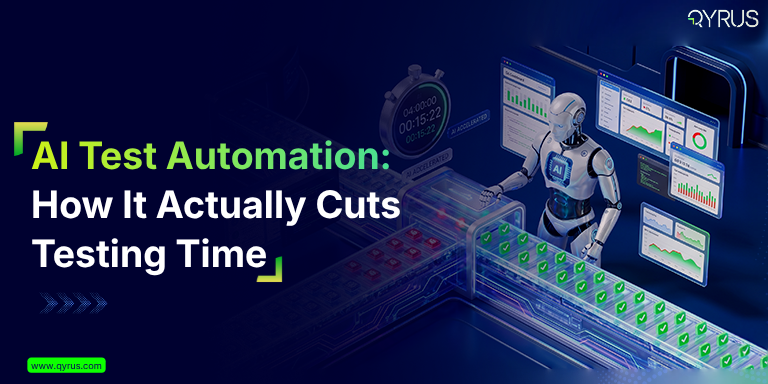
Most QA teams already know the uncomfortable truth about test automation: building the suite was never the hard part. Keeping it alive is. When people do research on taking care of test automation they always find that QA teams who use scripted frameworks spend 40 to 60 percent of their working hours just keeping existing tests from breaking, not writing new ones, not catching new bugs, simply patching selectors that broke because a button got renamed. This is the problem that AI test automation was made to fix. It is an idea to understand how AI test automation works, rather than just believing what people say.
This isn’t a single feature. AI test automation reduces testing time through four distinct mechanisms working together: faster test creation, self-healing scripts that survive UI changes, smarter test selection that skips irrelevant runs, and automated triage that tells you which failures actually matter. Each one of these things helps with a part of the testing problem. If people understand all four they can pick a tool that really helps them than picking one that just gives them another thing to check.
What Is AI Test Automation?
AI test automation applies machine learning and natural language processing to the parts of testing that have historically required the most manual, repetitive human effort. This includes writing test scripts keeping them up to date when the application changes, deciding which tests to run and figuring out what a failure means. It works with the underlying system that runs your tests across browsers, devices and APIs. It does not replace it.
Traditional automation frameworks like Selenium, Cypress, and Playwright are still doing the work of executing scripted steps. What has changed is everything around that execution. Traditional scripts use fixed selectors, like a CSS class or a hardcoded XPath, that stop working when a developer renames a button, but AI-driven frameworks can recognize the element in different ways and keep working even when the underlying code changes. Traditional test creation meant a QA engineer had to write every assertion by hand, but AI can create a working test from a description or a Jira ticket in just a few minutes.
The market reflects how mainstream this shift has become. The automation testing market reached an estimated $40.44 billion in 2026 and is projected to climb past $78 billion by 2031 This is because big companies are using AI tooling that creates self-healing scripts quickly. AI test automation is not an idea anymore. It is now a part of testing.
| Traditional Test Automation | AI Test Automation |
Test creation | Manual scripting, line by line | Natural language or requirement-based generation |
Maintenance | Manual fix every time the UI changes | Self-healing locators adapt automatically |
Test selection | Run the full regression suite every time | Risk-based selection runs only affected tests |
Failure analysis | Manual log review to find root cause | Automated clustering and root-cause suggestions |
The Four Mechanisms That Actually Cut Testing Time
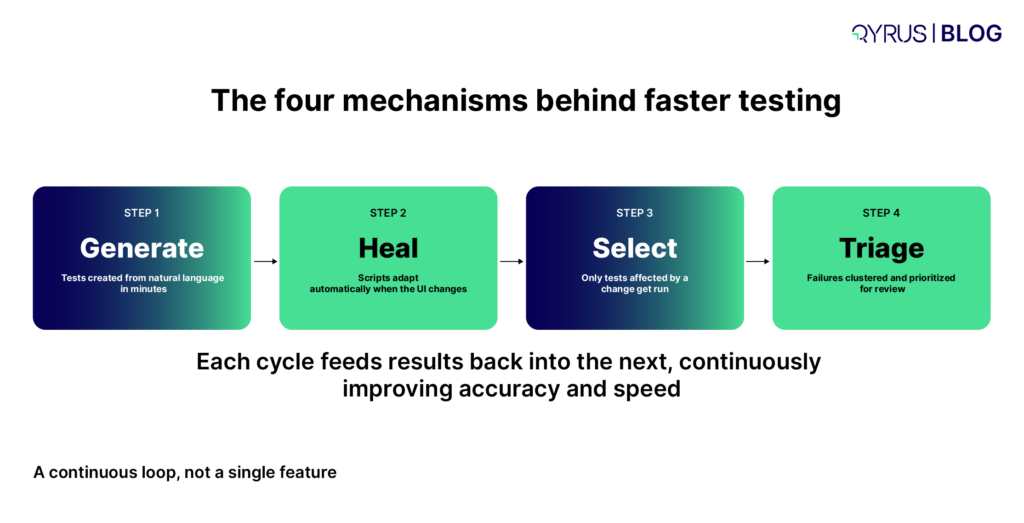
If you only take one thing from this article, take this: when someone says “AI makes testing faster,” ask them which of these four mechanisms they mean. The answer changes what you should evaluate in a tool.
Automated Test Case Generation
The most visible time saving happens before a single test ever runs. AI tools can create test cases directly from structured inputs like Jira tickets, user stories, or plain-English descriptions, often within minutes, cutting test creation time that used to take hours or days down to a fraction of that. Some platforms report generating tests 10 times faster through natural language test creation, even for complex scenarios involving dynamic content or multi-step workflows.
This matters because test creation has historically been the gatekeeping skill in QA. If only your most technical engineers can write a Selenium script, your test coverage is capped by how many of those engineers you have. Generation that works from natural language descriptions opens test creation to product managers, business analysts, and less code-fluent testers, which doesn’t just save time, it removes a structural bottleneck on coverage itself.
Self-Healing Scripts
This is the mechanism that saves the time and we have the numbers to prove it. It helps with the maintenance tax that we talked about earlier which’s around 40 to 60 percent. The way it works is that self-healing automation looks for lots of ways to find the thing on a website, like an ID or a class or where it is on the page or what it says. So when someone makes a change to one of those things the test does not stop working. It just finds the thing another way. Keeps going. This is because self-healing automation is really good at finding things in ways like if it cannot find something by its ID it will try to find it by its class or by where it is, on the page. Self-healing automation is very helpful because it saves time and makes sure that the test keeps running without any problems.
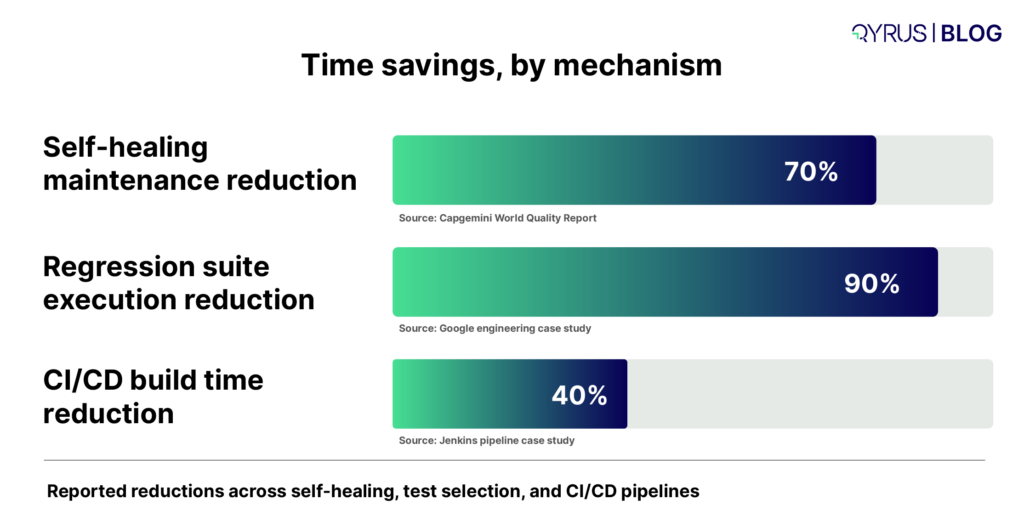
The reported impact is substantial. Capgemini’s World Quality Report found self-healing reduces maintenance effort by up to 70 percent. One case study involving a major bank’s QA team went even further, reporting a 95 percent reduction in script maintenance and twice as fast regression cycles after adopting AI-driven locator matching. The mechanism is simple, but the compounding effect on a team’s calendar is not: hours that used to go to script repair go back into actual test design and exploratory testing.
Risk-Based Test Selection
Running an entire regression suite on every code change is the brute-force default, and it’s increasingly unnecessary. AI-driven impact analysis looks at what actually changed in a commit, cross-references that against historical defect data and dependency graphs, and runs only the tests that change could plausibly affect.
The scale of the time savings here can be dramatic. Google has reported using this approach to cut test suite execution by roughly 90 percent while maintaining the same defect detection rate, by training a model to learn which tests were likely to fail based on the code changes in a given commit. At a more typical enterprise scale, organizations report reducing regression suite size by 30 to 40 percent while maintaining full coverage, and Fujitsu specifically reported a 35 percent reduction in QA labor hours after switching from manual test scoping to automated change impact analysis. None of these examples require Google-scale infrastructure. They require a model trained on the test history a team already has.
Automated Failure Triage
The last mile of the testing cycle is often the most manually intensive. Someone has to check if its a real bug, a test that sometimes fails or just an environment issue. AI-driven failure analysis clusters similar failures, flags likely root causes, and surfaces the handful of failures that actually need a human look, instead of leaving an engineer to wade through logs one at a time.
The compounding effect of this on CI/CD pipelines is significant on its own. AI-powered test prioritization can get developers critical feedback on a code change within minutes of committing, rather than waiting hours for a full pipeline run. One documented case using AI-driven test prioritization in a Jenkins pipeline reported a 40 percent reduction in overall build times, by dynamically reordering and executing only the most impactful test cases based on historical results and code dependencies. Faster feedback doesn’t just feel better, it changes how often a team is willing to commit and test, which compounds release velocity over time.
Test Coverage and Quality Gains Beyond Speed
Speed is the headline benefit, but it’s worth being clear that AI test automation’s value isn’t only about doing the same testing faster. It’s also about testing more thoroughly than manual processes ever could, without a proportional increase in headcount.
AI-assisted generation tends to surface edge cases and boundary conditions that human testers, working under deadline pressure, are statistically more likely to skip. A test suite built primarily by hand tends to cluster around the “happy path,” the scenarios the team already expects to test, while AI-suggested scenarios can probe invalid inputs, unusual sequences, and combinations a human wouldn’t think to script. The net effect for most teams isn’t just a shorter testing cycle, it’s a wider net catching more of the defects that would otherwise reach production. That combination, faster and broader, is what separates a meaningful AI test automation strategy from a tool that just runs old scripts marginally quicker.
The Limits of AI Test Automation (What It Can’t Do Yet)
It would be dishonest to present AI test automation as a fully autonomous replacement for QA judgment, and most credible voices in the space don’t claim otherwise. AI test automation tools are genuinely good at the repetitive, pattern-recognition-heavy parts of testing. They are not yet good at understanding business logic, which is the part that determines whether a test is actually testing the right thing.
AI-generated tests can overlook scenarios that matter specifically because of how your business operates, not how your UI is built; an AI model doesn’t inherently know that a particular discount code combination should never be allowed, even if nothing in the interface prevents it. Decision-making inside AI testing tools can also be opaque, meaning a tool might skip or deprioritize a test without an obvious, auditable reason, which is exactly the kind of gap a tester needs to catch. And large language models used for test generation can produce confidently wrong outputs, hallucinated assertions, plausible-looking but incorrect expected results, if a human isn’t reviewing them.
None of this is an argument against adopting AI test automation. It’s an argument for treating it the way the field’s own research suggests: a force multiplier for QA judgment, not a substitute for it. Teams that get the most value tend to start with a clear pain point, a maintenance backlog, a slow regression cycle, a coverage gap, and apply AI deliberately to that problem, with human review built into the loop, rather than handing over an entire testing strategy and hoping the AI fills the gaps on its own.
How Qyrus Helps Teams Cut Testing Time Across the Board
Most AI testing tools solve one piece of this puzzle. Qyrus is built to address all four mechanisms in a single platform, and across more testing surfaces than most point solutions ever touch.
On generation, Qyrus’s Nova AI builds functional test scenarios directly from a free-text description or a Jira ticket, while TestGenerator+ analyzes your existing scripts and proposes additional scenarios to close coverage gaps automatically, categorized by criticality so your team knows what to prioritize first. For a deeper look at how generation works under the hood, see our guide to generative AI for testing.
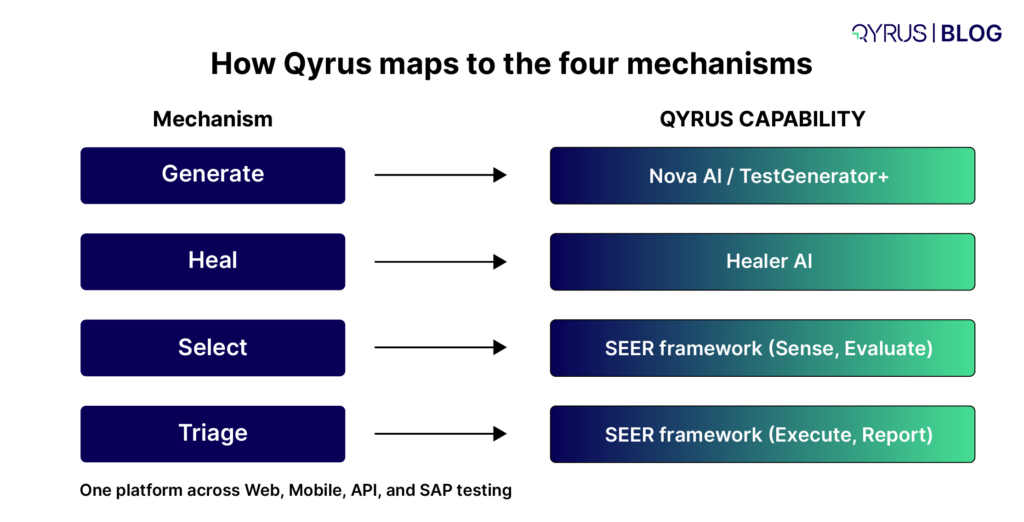
On maintenance, Healer AI references a successful baseline script and automatically suggests updated locators when an element’s ID, class, or XPath changes, the same self-healing mechanism behind the maintenance-reduction data above, applied across Qyrus’s Web, Mobile, and SAP testing services rather than confined to a single surface. We cover this mechanism in detail in our complete guide to self-healing test automation, including how it differs across implementation approaches.
On test selection and orchestration, Qyrus’s SEER framework (Sense, Evaluate, Execute, Report) runs as a continuous loop: it senses changes via webhooks and API polling from sources like GitHub and Jira, evaluates impact through specialized Thinking Agents that trace dependency graphs and map design changes to test scenarios, executes only the tests that matter through a coordinated squad of agents like TestPilot and API Builder, and reports results back into a Context DB that makes the next cycle smarter. This kind of orchestration is also what separates a true AI test automation strategy from simply bolting AI onto an existing manual process, a distinction we explore further in our overview of scaling bottlenecks in test automation.
And because Qyrus unifies Web, Mobile, API, and SAP testing on one platform instead of stitching together separate point tools for each surface, the time savings compound across an entire business process rather than staying siloed to a single UI layer, which is precisely the kind of end-to-end coverage most single-purpose no-code test automation tools can’t offer on their own. For a broader architectural view of how AI is reshaping the discipline as a whole, see AI in testing: architecting the future of software QA.
The result, as with the Coca-Cola Bottler implementation that cut SAP test execution time by 88 percent (from 10,020 minutes down to 1,186 minutes across 500-plus automated scripts), isn’t just isolated time savings on individual test runs. It’s a measurably faster path from code commit to confident release.
Frequently Asked Questions
How does AI-powered test automation reduce testing time?
AI test automation reduces testing time through four mechanisms: generating test cases from natural language or requirements in minutes instead of hours, self-healing scripts that adapt to UI changes without manual fixes, risk-based test selection that runs only the tests affected by a given change, and automated failure triage that clusters and prioritizes results so engineers aren’t manually combing through logs. Documented results range from a 70 percent reduction in maintenance effort to a 90 percent reduction in regression suite execution time, depending on which mechanism is applied.
Will AI test automation replace QA engineers?
No. AI handles the repetitive, pattern-based work, generating routine test cases, fixing broken locators, and surfacing likely root causes, but it doesn’t understand business logic or judge which edge cases matter most to your users. QA engineers remain essential for defining what to test, validating AI-generated results, and applying judgment AI doesn’t have.
Is AI test automation ready for production use today?
For specific, well-scoped use cases like self-healing UI tests, AI-generated regression suites, and risk-based test prioritization, yes, these are already running in production CI/CD pipelines at scale. Fully autonomous testing with zero human oversight is less mature and still requires careful validation before relying on it for critical releases.
How is AI test automation different from traditional test automation?
Traditional automation (Selenium, Cypress, Playwright) executes pre-written scripts using fixed selectors that break when the UI changes. AI test automation adds a layer on top: it generates tests from plain language, heals broken locators automatically, decides which tests to run based on what actually changed, and helps triage failures, all without requiring a human to manually rewrite scripts every release.
Do AI test automation tools work with frameworks like Selenium or Playwright?
Many AI testing platforms integrate with or build on top of existing open-source frameworks rather than replacing them outright, though the depth of that integration varies significantly by vendor. Some generate native framework code you own and can export; others run on a proprietary execution engine. It’s worth confirming this directly with any vendor before committing, since migration cost differs significantly between the two approaches.
How do I get started with AI test automation?
Start by identifying your actual bottleneck, whether that’s maintenance overhead, slow regression cycles, or limited coverage, rather than adopting AI broadly across your entire testing strategy at once. Pilot one mechanism (self-healing tends to show the fastest measurable return) against a real test suite, validate the results with your team, and expand from there.
Conclusion
AI test automation isn’t a single trick that makes testing faster. It’s four compounding mechanisms, faster test creation, self-healing maintenance, smarter test selection, and automated triage, each removing a distinct source of wasted time from the testing cycle. Together, they’re why organizations report cutting maintenance overhead by up to 70 percent and regression cycles by as much as 90 percent, without sacrificing coverage.
Qyrus brings all four mechanisms together across Web, Mobile, API, and SAP testing on a single platform, so the time savings compound across your entire testing process instead of staying locked inside one tool for one surface. If you’re ready to see what that looks like against your own test suite, request a demo and find out how much time you could get back.
 October 15, 2026
  4 min
4 min