What Is a Test Automation Framework — And Why Most Teams Are Using the Wrong One
 Varun RS

The truth about test automation is pretty simple: most teams use up time looking after their tests than they do making them. The World Quality Report says that looking after tests uses up to 50 percent of the test automation budget. For teams that have to deal with more than 1,000 tests it gets even worse. Up to 60 percent of all the time spent on quality assurance goes into this. This is not a problem with how people work. The real problem is the framework they are using.
When you pick a test automation framework, you are not just choosing a tool. You are making a decision that affects how your tests will work overtime. If you make a choice, your team can work faster and feel more confident. If you make a bad choice, you will spend all your time fixing scripts that break every time something small changes like a button being moved.
The following sections will help you look at the types of test automation frameworks. We will see what makes BDD and TDD approaches different from each other. Test automation frameworks are a part of this. We will also look at the role of component testing, in test automation strategies. We will talk about the problems that come with taking care of code-centric test automation frameworks. Test automation frameworks are still a part of this. Then we will see how AI-native testing platforms are handling those problems in a way.What Is a Test Automation Framework?
A test automation framework is like a plan that shows how to create, run and keep tests for a software project. It gives rules, reusable parts, ways to handle test data steps to run tests and systems to report results. This helps keep automation consistent as test coverage expands. This difference is important. Selenium and Playwright are tools. A framework built on Playwright with test data, simple test scripts and integration with integration/continuous deployment (CI/CD) is a framework. The framework is like a structure. The tool is just one part of it. A well-designed test automation framework typically includes:
- Test environment setup for version management, environment configurations, and prerequisites
- Test data management for sourcing, storing, and passing data between test cases
- Test execution mechanisms that control how tests are triggered and run
- Logging and reporting for capturing results, screenshots, logs, and failure details
- CI/CD integration for incorporating automated tests into delivery pipelines
- Reusable components such as shared libraries, functions, and utilities that reduce duplication
Together, these elements provide the structure needed to manage automation at scale. They help teams standardize how tests are developed, executed, and maintained across projects and environments. As more tests are added the framework helps keep things consistent and easy to maintain.
The 6 Types of Test Automation Frameworks Explained
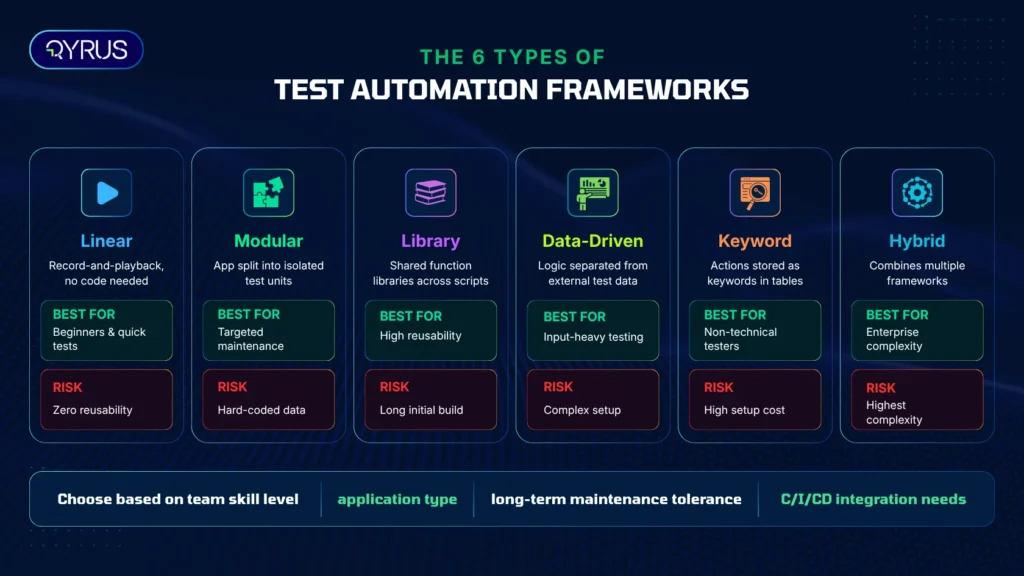
Not all automation testing frameworks are built the same. Each type makes a different trade-off between ease of setup, scalability, reusability, and required programming knowledge. Here are the six you need to know.
1. Linear (Record-and-Playback) Framework
The simplest entry point into test automation. A tester records each user action, navigation, inputs, clicks, and the tool plays them back as a test script. No coding is required. Scripts are generated automatically and run sequentially.
Best for: beginners, quick validations, and short-term projects with minimal change cycles.
Key limitation: test data is hard-coded directly into each script. If your application changes, even a single UI element, every affected script needs manual updates. This framework does not scale.
2. Modular Testing Framework
Modular testing breaks the application under test into isolated units, login, checkout, search, and creates an individual test script for each. Larger test scenarios are assembled by combining these modules in sequence.
The abstraction layer is this framework’s core strength: changes to one module do not cascade into the rest. This makes targeted maintenance far more efficient than the linear approach.
Key limitation: test data is still hard coded at the module level, so running the same scenario with multiple data sets means duplicating scripts. Programming knowledge is also required to build and manage the module structure.
3. Library Architecture Framework
A natural evolution of the modular approach. Instead of organizing by application section, this framework identifies common functions, login, form submission, API calls, and groups them into a shared function library that any test script can call.
The result is a higher degree of reusability. A single function handles repeated action across the entire test suite. Update the function once, and every script that calls it benefits automatically.
Key limitation: test data remains hard-coded. Building and maintaining the shared library requires solid programming expertise, and initial development time is longer than simpler approaches.
4. Data-Driven Framework
Here is where things get meaningfully more powerful. A data-driven framework separates test data from script logic entirely. Test scripts are written once; data is stored externally in files such as Excel spreadsheets, CSV files, SQL tables, or JSON. The framework reads each row of data and executes the same script with a different dataset on each pass.
One script. Dozens of test scenarios. This approach is ideal for input-heavy applications, registration flows, payment processing, search, where you need to validate the same logic with many different values.
Key limitation: setting up a data-driven framework requires an experienced engineer who can manage external data sources and write the connection logic between the data file and the test scripts. Initial setup investment is high.
5. Keyword-Driven Framework
A framework driven by keywords extends the separation principle. Keywords — simple action labels like ‘ClickButton’, ‘EnterText’, or ‘VerifyPageTitle’ — are kept in an external table together with the objects they operate on. During the test execution, the engine interprets each keyword, associates it with the relevant code, and carries out the action.
The primary benefit is easy access. Non-technical stakeholders can access and even participate in test design without needing to code. One keyword may be utilized in various test scripts, and tests can be developed separately from the application being tested.
Main drawback: the upfront setup expense is substantial and requires a considerable amount of time. Keyword tables and object repositories need to be diligently managed. As the test suite expands, managing keywords becomes a separate administrative burden.
6. Hybrid Testing Framework
As automation programs grow, teams often combine multiple framework approaches instead of relying on just one. For example, a team may use a data-driven model for handling large test datasets while using keywords to simplify test creation and maintenance. This combination is commonly referred to as a hybrid framework. Most enterprise test automation environments converge on hybrid frameworks because real-world applications are complex enough to need flexibility. A hybrid framework can support multiple testing types, accommodate mixed team skill sets, and adapt as the application evolves.
Key limitation: Building and maintaining a hybrid framework demands experienced engineers, strong documentation, and disciplined governance. Without it, hybrid frameworks become the most expensive kind to maintain.
Framework Comparison at a Glance
Framework Type | Best For | Key Limitation |
Linear / Record-and-Playback | Beginners, short-term projects | Not reusable; breaks on any change |
Modular | Structured apps, targeted maintenance | Hard-coded data; needs coding skills |
Library Architecture | High reusability needs | Long initial build; coding expertise required |
Data-Driven | Input-heavy, multi-scenario testing | Complex setup; data management overhead |
Keyword-Driven | Non-technical stakeholders in QA | High initial cost; maintenance at scale |
Hybrid | Enterprise, complex applications | Highest complexity; demands strong governance |
BDD vs. TDD: Two Philosophies That Shape Your Framework Choice
Test-Driven Development (TDD) and Behavior-Driven Development (BDD) are two development methodologies that have an impact on how teams create their automation frameworks. They are often talked about together. They really deal with different problems.
What Is Test-Driven Development (TDD)?
TDD is an approach for developers which is simple and repeatable.
Here is how it works:
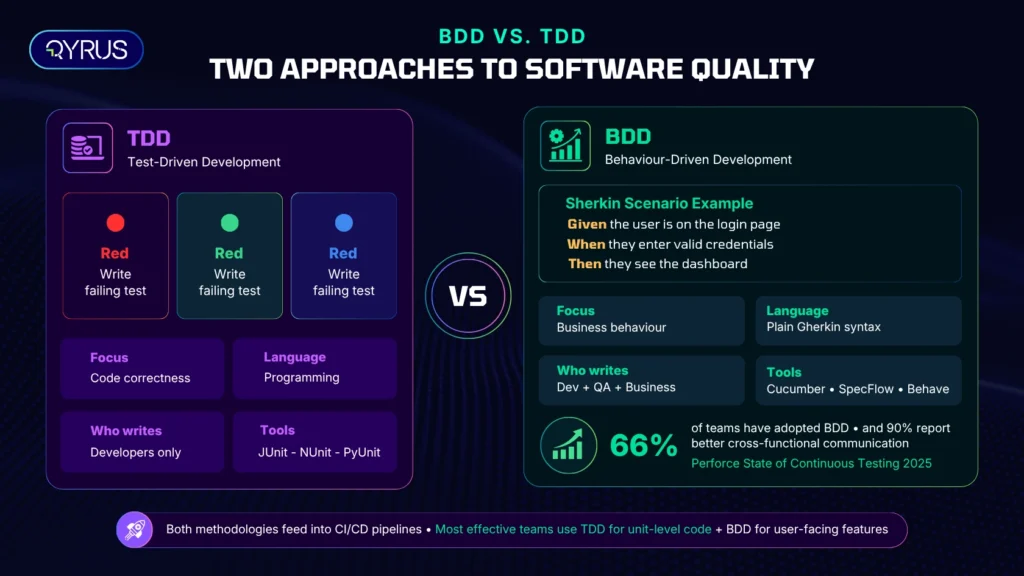
- Create a test that fails at first.
- Write enough code so the test passes.
- Then improve the code.
This is called the Red-Green-Refactor cycle. Developers must follow this way of working, which is a method and also a discipline.
The objective is code accuracy. TDD makes developers think about how the code will work, what could go wrong and what will happen if something fails. They do this before they start writing the code. This means that each part of the code has a test that was written before the code itself.
TDD is most effective at the unit level: testing individual functions, methods, or classes in isolation. Popular TDD frameworks include JUnit (Java), NUnit (.NET), and PyUnit (Python).
What TDD does not address well is bridging the gap between the side of things and what the business actually needs. When we write a test in Java, it checks if a function gives us the answer. It does not tell us if we built the feature that the business really wanted. TDD is about making sure the code works. It does not say if we are building the right thing. The business wants certain features, and TDD does not always address this.
What Is a Behavior Driven Development (BDD) Framework?
BDD evolved from TDD specifically to bridge that gap. Where TDD is written in programming languages and read by developers, BDD is written in plain, structured language that business stakeholders, product managers, and QA engineers can all read and contribute to.
The language used for BDD is called Gherkin. It is a way of describing how the code should work using a Given/When/Then format. This format describes what the user will see when they use the code.
					Feature: User Login

  Scenario: Successful login with valid credentials

    Given the user is on the login page

    When they enter a valid username and password

    Then they should be redirected to the dashboard
Non-technical stakeholders can easily check this scenario without needing to know any code. The BDD test turns into a plan that the whole team agrees before they start building anything. When the test works, the feature is complete. If the test fails, everyone can see where the problem is. The team can then fix the issue and make sure the feature works as expected.
The adoption figures reflect how much teams value this collaboration. According to the 2025 State of Continuous Testing Report by Perforce, BDD adoption has reached 66% among development teams, and 90% of teams that adopted BDD report better communication across functions. Popular BDD frameworks include Cucumber (multi-language), SpecFlow (.NET), and Behave (Python).
TDD vs. BDD: Side-by-Side Comparison
Dimension | TDD | BDD |
Focus | Code correctness | Business behaviour |
Written in | Programming language | Plain language (Gherkin) |
Who writes tests | Developers | Developers, QA, and business stakeholders |
Test level | Unit / component | Integration / acceptance |
Collaboration scope | Technical team | Cross-functional team |
Best suited for | Internal code quality | User-facing features and workflows |
Popular tools | JUnit, NUnit, PyUnit | Cucumber, SpecFlow, Behave |
The most effective teams do not choose one over the other. They apply TDD to low-level components, where code correctness is the primary concern, and BDD to user-facing features, where alignment with business requirements matters most. The two methodologies complement each other rather than compete.
Playwright Component Testing vs. Cypress Component Testing: What’s the Difference?
When people become more skilled at testing, they usually start using component testing. This is like a step between unit tests and full end-to-end (E2E) runs. Of pretending the whole application is there or just looking at one function component testing puts a real component in a real browser and lets testers use it like a real user would. They can click on things, type, and hover over things. They can also control what the component looks like and how it works. This way you get to see what the component really looks like in a browser without having to set up the application, which can be slow and unreliable.
There are two frameworks that people use for this in 2026: Playwright and Cypress. Both mount components in a real browser. They differ sharply in architecture, speed, and developer experience.
Playwright Component Testing
Playwright is backed by Microsoft. It uses a way of working that talks directly to browsers using the Chrome DevTools Protocol (CDP). This design makes it 20 times faster than browser-in-process frameworks and delivers significantly lower test flakiness rates.
Playwright component testing is parallel by default, free to run at scale, and supports TypeScript, JavaScript, Python, Java, and C#/.NET. As of early 2026, Playwright averages 20–30 million weekly NPM downloads, and the State of JavaScript 2025 survey recorded a satisfaction score of 91%, the highest ever measured for a testing framework at this scale.
Reach for Playwright when: you need to do things and at the same time. It is also good if your team is used to working with async/await patterns. If you need to work with languages or if you are starting a new project Playwright is a good choice.
Caveat: Playwright’s component testing feature is still marked experimental. The API surface may change between releases.
Cypress Component Testing
Cypress works inside the browser with the application you are testing.This architecture makes it exceptionally fast for debugging: the time-travel GUI lets engineers step backward through test execution frame by frame, which is genuinely the best visual debugging experience available in any testing framework today.
Cypress testing for parts of the application is solid and reliable. It is part of the same tool you use for end-to-end testing with Cypress. This means you only have to think about one way of doing things, and you only have to set it up. The people who make extras, for Cypress have made a lot of tools that work well with it like tools to check how things look and tools to make sure everything is accessible.
Reach for Cypress when: you already run Cypress for E2E testing, your team prizes interactive visual debugging, or your application has a complex custom bundler configuration that Cypress can reuse.
Playwright vs. Cypress: Head-to-Head
Dimension | Playwright | Cypress |
Architecture | Out-of-process (CDP) | In-browser (same run loop) |
Speed | Faster (parallel by default, free) | Moderate (Cloud plan for parallelism) |
Language support | JS, TS, Python, Java, C# | JavaScript / TypeScript only |
Debugging experience | Trace viewer (excellent for CI) | Time-travel GUI (best for local dev) |
Component testing status | Experimental | Stable / GA |
CI cost | Lower (free parallelism) | Higher (Cypress Cloud subscription) |
Best for | Greenfield, multi-language, scale | Existing Cypress suites, frontend DX |
The honest 2026 verdict: for new projects, Playwright is the stronger default choice. Cypress remains compelling for teams as it already invested in its ecosystem and for anyone who finds its debugging experience genuinely more productive. Both are excellent tools, but both are still code-first frameworks, which brings us to the problem that neither fully solves.
The Real Problem with Traditional Test Automation Frameworks: Maintenance
Selecting a framework type is the easy part. Keeping it alive is where most teams fail.
Consider the numbers: maintenance consumes 45% of automation budgets on average. Teams maintaining more than 1,000 tests report spending 60% of their time on upkeep rather than new test development. Across a four-person senior QA team, where each engineer earns roughly $140,000 per year, that translates to approximately $168,000 annually spent on maintaining tests, not improving coverage.
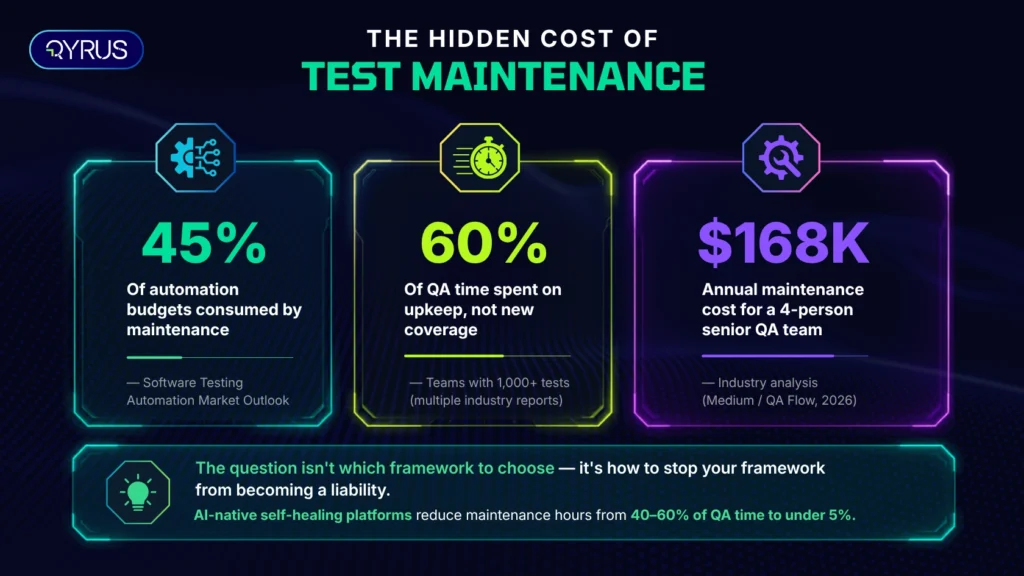
The root causes are consistent regardless of which framework type a team chooses:
- Brittle locators: element IDs, XPaths, and CSS selectors break every time the UI is updated. Even minor redesigns require manual script triage across hundreds of tests.
- Hard-coded test data: without clean data separation, any change to the underlying data model requires touching individual scripts rather than a central source.
- No self-healing: traditional frameworks are passive. When something breaks, a human must diagnose, locate, and fix it. The framework itself offers no intelligence about what changed or why.
Here is the pattern across engineering teams that analysis has consistently surfaced: 60–70% of QA time goes to test upkeep. Only 30–40% goes to add coverage or review results. That ratio is backwards, and code-first frameworks, no matter how well architected, cannot correct it on their own.
The question that matters most is not which framework type to choose. It is: how do you stop your test automation framework from becoming a liability the moment your application starts moving quickly?
45%
of automation budgets consumed by test maintenance
— Software Testing Automation Market Outlook, IntelMarketResearch
How Qyrus Takes the Framework Burden Off Your Team
Qyrus is not another code-first framework with a cleaner UI. It is an AI-native, no-code testing platform built to solve the maintenance problem at its root, not patch it after the fact. Where traditional frameworks require skilled engineers to build, maintain, and repair the infrastructure around testing, Qyrus makes that infrastructure autonomous.
The SEER Framework: Autonomous Test Orchestration
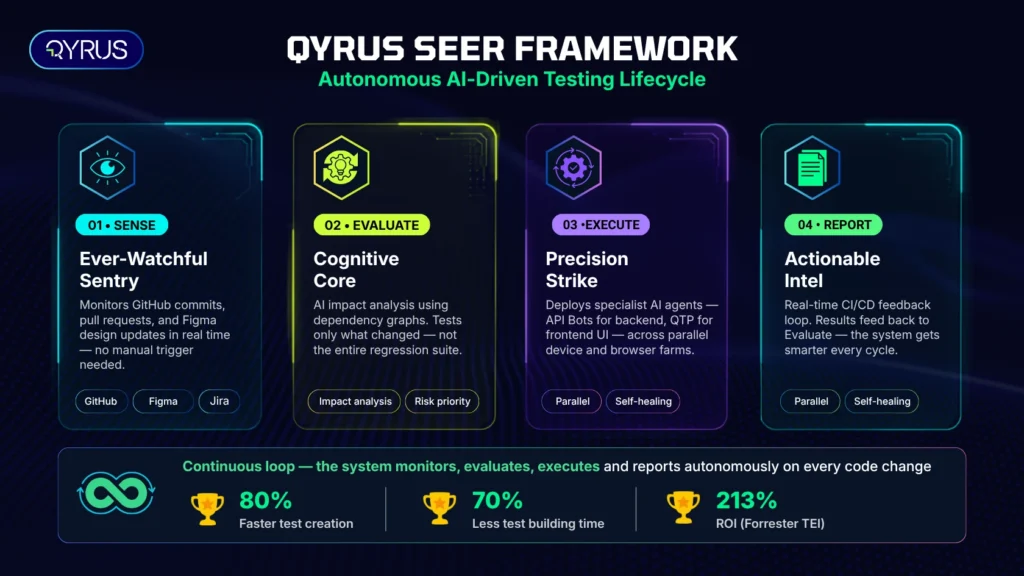
At the core of Qyrus sits the industry-first SEER (Sense, Evaluate, Execute, Report) framework, an agentic AI engine that manages the entire testing lifecycle without manual hand-offs.
- Sense: monitors code repositories (GitHub) for commits, merges, and pull requests; detects UI/UX changes in Figma as they happen
- Evaluate: performs automated impact analysis using static analysis and dependency graphs, identifying exactly which APIs and UI test scenarios are affected by a change, not the entire regression suite
- Execute: autonomously deploys the right specialist agents, API Bots for backend validation, Qyrus Test Pilot (QTP) for frontend testing, without human selection
- Report: delivers real-time insights into test outcomes and coverage, feeding results back into the CI/CD pipeline as a continuous learning loop
The SEER framework means your test automation framework no longer waits to be told a change occurred. It observes, responds, and executes, continuously.
Healer AI: Self-Healing That Actually Works
The single biggest cause of framework maintenance overhead is broken locators. Qyrus solves this with Healer AI, a patented self-healing engine (U.S. Patent 11,205,041 B2) that references a successful baseline script and automatically suggests updated locators (ID, Class, XPath) when UI elements change.
When Healer detects a failed step due to a UI change, it scans the application, identifies the corrected element, and applies the fix, without a human ever opening the script. For web testing teams, this directly attacks the locator fragility that accounts for the majority of maintenance work.
No-Code Test Building at Scale
Qyrus offers 115 distinct action types across web, mobile, and API testing, all accessible through a low-code/no-code interface that requires no programming knowledge to operate. Tests can be created manually, imported from Jira tickets, or generated from natural language descriptions via Nova AI.
TestGenerator+ goes further: it analyses your existing scripts and automatically generates additional test scenarios to fill coverage gaps, categorizing each new scenario by criticality (Low, Medium, High, Critical) before any human reviews the output.
Parallel Execution Across a Real Device and Browser Farm
For mobile testing and web testing alike, Qyrus provides access to a cloud-based browser farm (Chrome, Edge, Firefox, Safari, including previous and custom versions) and a real-device farm covering Android and iOS. Tests run in parallel across all of them simultaneously, with zero infrastructure overhead.
This eliminates the device lab maintenance that typically consumes a separate slice of QA budget and removes the bottleneck of sequential test runs that inflate feedback cycle times.
A Unified Platform Across Every Testing Type
Traditional frameworks are fragmented by testing type: one tool for web, another for mobile, another for API testing, another for SAP. Each one has its own maintenance burden, its own script library, and its own skill requirement. Qyrus consolidates Web, Mobile, API, Desktop, SAP, and Data testing into a single platform, one interface, one team, and one source of truth.
The Numbers
Metric | Qyrus Impact |
Test case creation speed | ~80% faster for complex scenarios |
Team productivity | 50% increase |
Test building time | 70% reduction via AI-driven, codeless features |
ROI | 213% within 12 months (Forrester TEI study) |
Production incidents | 50% reduction through proactive AI detection |
How to Choose the Right Test Automation Framework for Your Team
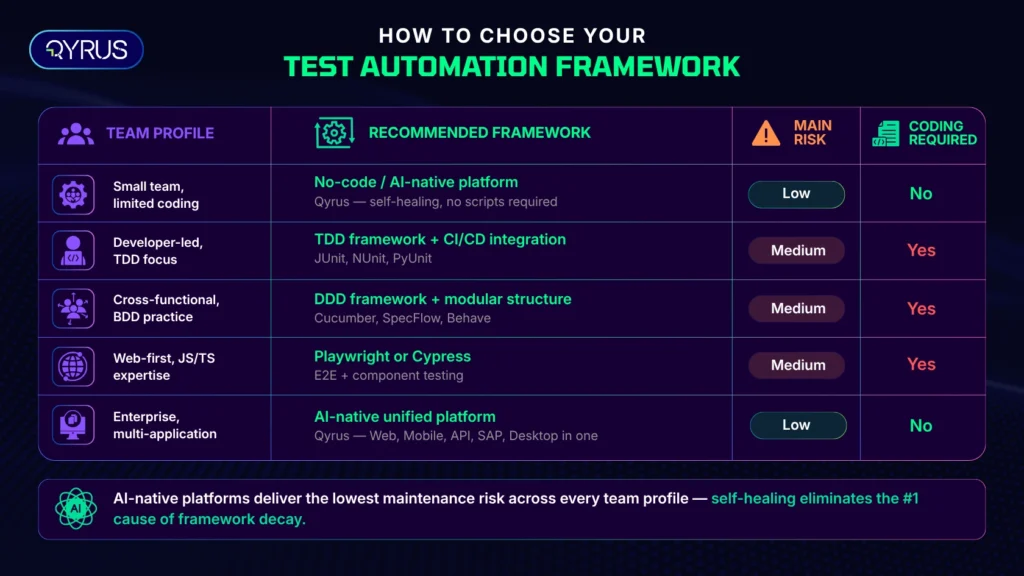
There is no universally correct framework. The right choice depends on five factors that are specific to your team, your application, and your risk tolerance.
- Team skill level: Code-first frameworks (Playwright, Cypress, Selenium) require engineers who can build, govern, and maintain them long-term. If your team includes non-technical QA contributors or you are resource-constrained, a no-code or low-code platform substantially lowers the barrier to entry and the ongoing cost of ownership.
- Application type: Web-only applications have the widest framework choice. Mobile applications narrow the field to frameworks with Appium support or native real-device testing. Cross-platform environments, web, mobile, API, and backend together, need either a unified platform or a deliberately integrated multi-framework strategy.
- Testing methodology preference: If your team practices BDD, your framework needs native Gherkin/Cucumber support and reporting that non-technical stakeholders can read. If you are TDD-heavy, unit-level framework depth matters more than business-language output.
- CI/CD integration needs: Your automation framework should integrate natively with the tools already in your pipeline, Jenkins, Azure DevOps, GitHub Actions, Bitrise, TeamCity. Frameworks that require custom plugins or workarounds to connect create integration debt that compounds over time.
- Maintenance tolerance: This is the factor most teams underweight. Ask honestly: how much of your annual QA budget can sustainably go to maintaining tests rather than building new ones? If the honest answer is ‘not 45%’, then a framework with self-healing AI or no-code test repair is not a luxury; it is a financial necessity.
Quick Decision Guide
Team Profile | Recommended Approach |
Small team, limited coding resources | No-code / AI-native platform (e.g. Qyrus) |
Developer-led, unit-testing focus | TDD framework (JUnit, PyUnit) + CI/CD integration |
Cross-functional team, BDD practice | BDD framework (Cucumber, SpecFlow) + modular structure |
Web-first, advanced JS/TS expertise | Playwright or Cypress (E2E + component testing) |
Enterprise, multi-application landscape | Hybrid framework or unified AI-native platform |
Frequently Asked Questions About Test Automation Frameworks
What is a test automation framework?
A test automation framework is a structured set of guidelines, tools, and reusable components that govern how automated tests are built, executed, and maintained, providing consistency, scalability, and reduced long-term maintenance cost across a team’s testing process.
What are the main types of automated testing frameworks?
The six primary types are: Linear (Record-and-Playback), Modular, Library Architecture, Data-Driven, Keyword-Driven, and Hybrid. Each makes different trade-offs between ease of setup, scalability, and required programming knowledge.
What is the difference between BDD and TDD?
TDD (Test-Driven Development) is a developer-centric methodology where tests are written before code, using programming language-specific frameworks like JUnit or NUnit. BDD (Behavior-Driven Development) evolved from TDD and uses plain-language Gherkin syntax (Given/When/Then) so that business stakeholders, QA engineers, and developers can all read and contribute to test scenarios. TDD focuses on code correctness; BDD focuses on business behavior.
What is a BDD example using Gherkin syntax?
A simple BDD example for a login feature: Given the user is on the login page / When they enter valid credentials / Then they should be redirected to the dashboard. This scenario is readable by anyone on the team, no coding knowledge required.
What is Playwright component testing?
Playwright component testing mounts individual UI components in a real browser, rather than a simulated DOM, and lets testers interact with them using real events. It offers fast, parallel-by-default execution and supports multiple programming languages. As of 2026, it is marked experimental but is widely used in production by engineering teams that prioritize speed and parallelism.
Do I need coding knowledge to use a test automation framework?
For traditional code-first frameworks like Selenium, Playwright, or Cypress, yes, you need solid programming knowledge. For no-code and AI-native platforms like Qyrus, you do not. Qyrus offers 115 action types accessible through a visual interface, along with AI-powered test generation from plain-language descriptions and Jira tickets.
Stop Maintaining Frameworks. Start Shipping Quality.
The type of test automation framework your team chooses matters. But in 2026, what matters more is whether that framework can keep up with your application, without consuming half your QA budget in maintenance the moment it does.
Code-first frameworks, whether linear, modular, data-driven, or even Playwright and Cypress, are powerful tools in skilled hands. But they are fundamentally passive systems. They break when your application changes. They wait for humans to fix them. They accumulate debt quietly until the team starts dreading the test suite rather than trusting it.
The teams that will lead on software quality in the years ahead are those whose testing infrastructure adapts, self-heals, and integrates continuously, not those who schedule sprint time to patch broken locators.
Qyrus is built for that standard. If you are ready to move beyond the maintenance trap and build a test automation strategy that scales with your product, book a demo with the Qyrus team today and see the SEER framework in action.

 October 15, 2026
  4 min
4 min