SAP ECC End of Life 2027: What CIOs Need to Know Before the Clock Runs Out
 Varun RS
Most SAP roadmap conversations in 2026 eventually arrive at the same question: what actually happens when the clock runs out. Not the abstract version, but the operational one. What breaks, what gets cut, and what a rushed migration costs an organization that waited too long to find out.
SAP ECC’s mainstream maintenance ends December 31, 2027. That part is settled and well documented. What’s less settled, and what most guides on this topic skip, is what happens to migration quality when organizations compress years of planning into the time that’s left. This piece covers both: the dates that matter and the part almost nobody is telling CIOs about, why migrations under deadline pressure actually go wrong.
None of this is new information to anyone who has been tracking SAP’s roadmap. What’s changed is the math. With roughly eighteen months of planning runway left before the deadline itself, and 18 to 36 months being a typical range for a large enterprise migration, the window where “we’ll get to it” was a defensible answer has effectively closed.
The Dates That Actually Matter
SAP has been consistent about its maintenance timeline for years, and the schedule is confirmed directly on SAP’s own support portal, not through analyst speculation.
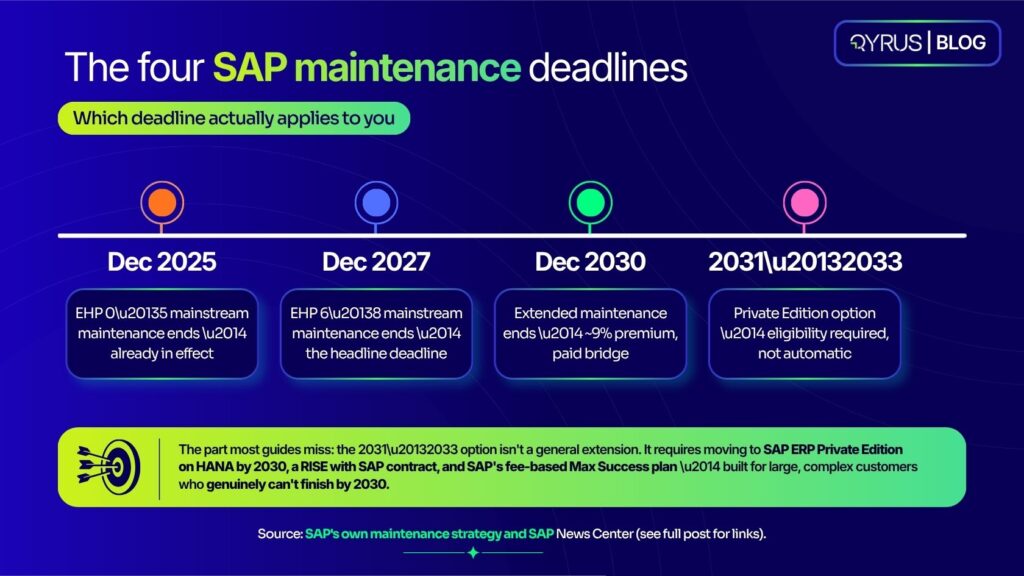
- Mainstream maintenance for SAP ECC 6.0 on Enhancement Packages 6–8 ends December 31, 2027.
- Enhancement Packages 0–5 already lost mainstream maintenance on December 31, 2025, and moved into customer-specific maintenance, a tier with no new security patches or legal updates.
- Extended maintenance runs January 2028 through December 31, 2030, at roughly a two-percentage-point premium on the maintenance basis, commonly cited as an approximate 9% increase over standard fees.
Mainstream maintenance is what most organizations don’t think about until it’s gone, the security patches, legal and regulatory updates, and full support coverage that keep a core ERP current. Extended maintenance keeps a narrower version of that flowing through 2030. It doesn’t add new capability, and it doesn’t reduce the custom-code debt that made the migration risky to begin with. It buys time, not safety.
The 2033 Option Most Guides Aren’t Covering Yet
There’s a newer wrinkle that hasn’t made it into most SAP ECC end-of-life content: SAP’s ERP Private Edition Transition Option, announced through SAP’s own newsroom. It lets a select group of large, complex customers keep running ECC, under a managed cloud subscription, through the end of 2033.
It comes with real conditions, not a blanket reprieve. Eligible organizations must move relevant systems to SAP ERP Private Edition, which requires running on the HANA database, before the end of 2030, hold a RISE with SAP contract, and purchase the option under SAP’s fee-based Max Success plan.
It’s purchasable starting in 2028 and usable only from 2031 through 2033. SAP has been explicit that this targets its largest, most complex customers, particularly those that genuinely can’t finish their transformation by 2030. It is not a general escape hatch for organizations that would simply prefer to delay migration planning.
Where the SAP Install Base Actually Stands
Ask five sources how many of SAP’s roughly 35,000 ECC customers have migrated to S/4HANA, and you’ll get five different numbers, because each study measures at a different point in time with a different methodology. That range is worth seeing honestly rather than reduced to one convenient statistic.
- Gartner data, as reported by CIO.com, put completed migrations at 39% of the ECC base as of the end of 2024.
- Forrester’s internal findings indicate that less than 50% of ECC clients are on track to finish their migration by 2027, as about 13,000 customers remain on Enhancement Packages 0–5, which have already exceeded their 2025 deadline.
- Other adoption models foresee completion rates reaching the upper 50s by the time the 2027 deadline finally arrives.
Whichever figure proves closest, every source agrees on the same underlying fact: a meaningful share of the SAP customer base is going to hit the 2027 deadline without having finished. That’s a demand problem as much as a technical one — Forrester’s research cites data from the Americas’ SAP Users’ Group showing that more than a quarter of organizations already rank SAP skills availability as their top challenge, a shortage that only tightens as more programs compete for the same consultants in the same narrowing window.
The range matters practically, not just academically. An organization benchmarking itself against “39% have migrated” draws a different conclusion than one benchmarking against “fewer than half will finish by 2027.” Either way, the honest takeaway is the same: being mid-planning in 2026 puts an organization in the majority, not the exception, which is exactly why what happens inside a compressed timeline matters more than the timeline itself.
The Part Most Deadline Guides Skip: What Actually Breaks Under Pressure
Here’s where most content on this topic stops: here are the dates, here are your three options, talk to a partner. That’s useful, but it skips the question that determines whether a migration actually succeeds — what happens operationally when a multi-year transformation gets compressed into whatever time is left.
The pattern shows up consistently across organizations that started late. Phase Zero, the assessment and scoping work that isn’t billable to a systems integrator and that nobody wants to delay the “real” project to finish properly, gets squeezed first.
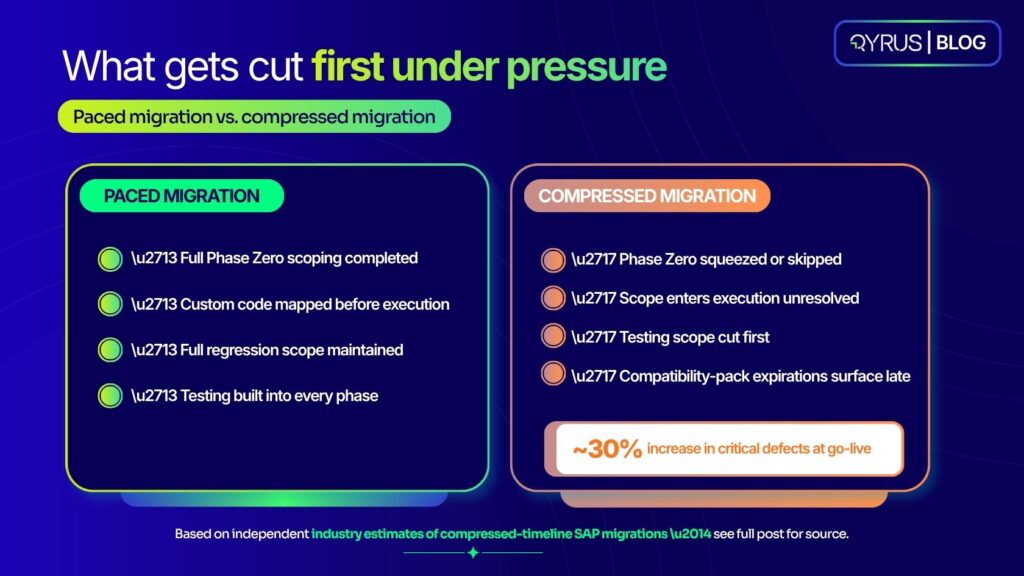
Scope enters execution unresolved. Many organizations have also been running on S/4HANA compatibility packs that let ECC-style behavior keep working temporarily; as those packs expire through 2026, functionality that was quietly propped up stops working all at once, and testing scope expands right when there’s least time to absorb it.
The consequence is measurable. Independent estimates put the effect of compressed testing phases at roughly a 30% increase in critical defects discovered at go-live, exactly the outcome a hard deadline is supposed to help organizations avoid, not cause.
In practice, this rarely looks like a single dramatic failure. It looks like a finance close process that worked in every test scenario the team had time to write, but not the edge case a specific regional entity hits every quarter-end. It looks like an integration that passed its happy-path test but breaks under the exact transaction volume a peak sales period generates. These aren’t exotic failure modes, they’re the ordinary cost of a test suite that shrank to fit a shrinking timeline instead of a timeline that expanded to fit the actual scope of the estate.
There’s also a security dimension that’s easy to underweight while focused on the migration itself. This isn’t unique to SAP — it’s a documented pattern across enterprise software generally. Software that has reached end-of-life gathers unaddressed vulnerabilities at a consistent rate after a vendor ceases to provide updates, and studies indicate that software beyond its support period is roughly four times more likely to be actively targeted by attackers than software still receiving patches.
Two Structural Reasons Testing Breaks First
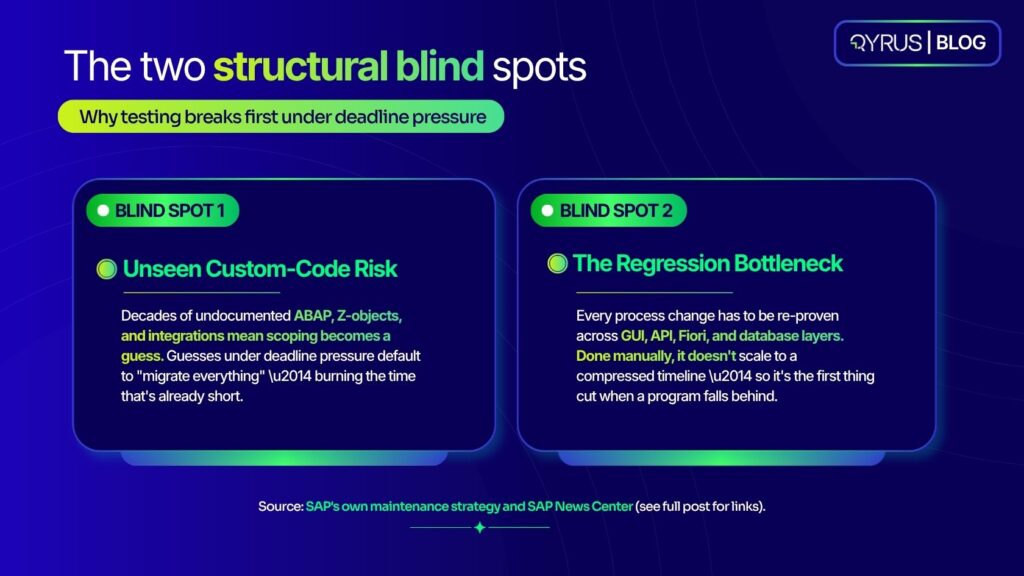
Zoom into why testing specifically is what gives way under a compressed timeline, and it comes down to two recurring problems, not one.
The first is visibility. Most SAP estates carry a decade or more of custom ABAP, Z-objects, and point-to-point integrations that nobody currently on staff fully documented. When teams can’t see what a piece of custom code actually does or what depends on it, scoping becomes a guess, and guesses under deadline pressure tend to default to “migrate everything to be safe,” which burns the exact time that’s already short. Field data from brownfield conversion projects suggests a meaningful share of what teams initially flag as critical custom code turns out to be dead weight, code nobody’s actively using, while the code that genuinely needs attention gets buried in the same undifferentiated pile.
The second is validation capacity. Every change to a core business process like Order-to-Cash, Procure-to-Pay, or Record-to-Report, has to be re-proven end to end across GUI, API, Fiori, and database layers before it’s safe to ship. Done manually, that validation work is slow and doesn’t scale to a compressed timeline, which is precisely why it’s the first thing that gets cut when a program falls behind. A regression cycle that would take a small QA team the better part of a week to run manually simply can’t keep pace with a program trying to compress eighteen months of work into twelve.
Our team goes deep on both of these structural blind spots, with a full technical breakdown and a phase-by-phase model for closing them, in our strategic approach to SAP S/4HANA testing, and in our full CIO playbook on defect-free migrations.
Get the full framework: “The 2027 Forcing Function: A CIO’s Playbook for Defect-Free S/4HANA Migrations at Scale” maps all 25 friction points, the 5-phase delivery model, and the economics of closing both blind spots before the window closes. Download the whitepaper here.
Neither problem is solved by adding more people to the project in month eleven. Both are solved by treating estate visibility and test automation as one connected discipline from the start, which is the argument our executive guide to SAP functional testing risk walks through in more detail.
What CIOs Should Actually Do with the Time That’s Left
None of this is an argument for panic, and it isn’t an argument for waiting either. A few concrete moves matter more than the calendar math itself:
- Scope the custom-code estate now, even informally, rather than waiting for a formal project kickoff to find out how large the problem actually is.
- Build testing into Phase Zero planning, not the Realize phase — by the time testing shows up as a line item on a project plan, it’s usually already the constraint everyone’s working around.
- Treat compatibility-pack expirations as a trigger, not a footnote — know which packs the organization depends on and when each one runs out through 2026.
For a deeper look at what a stable, well-tested go-live actually requires once a migration is underway, our complete guide to SAP S/4HANA migration performance testing covers the practical mechanics in full.
How Qyrus Helps
This is the part of the problem Qyrus is built to solve. QModernize builds a live dependency map of an SAP estate — custom ABAP, cross-module process dependencies, and integrations — so scoping decisions are based on evidence instead of guesswork. QAssure pairs with it to auto-generate and self-heal the regression suites needed to prove every process chain before it reaches production, scoped automatically to whatever actually changed rather than a static suite re-run on every release.
The combination is not theoretical. When a $30B+ automotive manufacturer needed to validate a critical, high-volume SAP procurement process without the traditional weeks of manual scripting, Qyrus’s agentic testing and SAP Scribe AI cut testing effort for that scenario by 88%, as detailed in Inside the 88% Win.
If you’re weighing platforms as part of your own 2027 planning, our guide to choosing the right SAP testing tools is a useful next stop.
FAQ s
When does SAP ECC support actually end?
Mainstream maintenance for SAP ECC 6.0 Enhancement Packages 6–8 ends December 31, 2027. Enhancement Packages 0–5 already lost mainstream maintenance on December 31, 2025, and are now on customer-specific maintenance.
What’s the difference between extended maintenance and customer-specific maintenance?
Extended maintenance (2028–2030) is a paid option that keeps security patches and select legal updates flowing at a premium over standard fees. Customer-specific maintenance is the default fallback with materially reduced scope — no guaranteed new security patches or legal updates, which is why most organizations treat it as a last resort rather than a plan.
Can an organization really run SAP ECC until 2033?
Only under SAP’s ERP Private Edition Transition Option, and only for eligible large, complex customers who move to SAP ERP Private Edition on HANA by 2030 and hold a RISE with SAP contract. It’s not a general extension available to every ECC customer, and it’s a purchased subscription, not a free grace period.
What happens if an organization does nothing before the 2027 deadline?
The system keeps running, but it loses access to new security patches, legal and regulatory updates, and full SAP support coverage — exposure that compounds the longer it continues, particularly for organizations in regulated industries.
How long does a typical SAP S/4HANA migration take?
Large, complex enterprise migrations commonly run 18 to 36 months, which is why organizations starting late face a genuinely compressed timeline against the 2027 and 2030 deadlines rather than a comfortable one.
Does the 2027 deadline actually affect testing strategy?
Yes — it’s usually the first casualty of a compressed timeline. Programs that start late tend to cut testing scope first, which is directly linked to the increase in critical defects found at go-live rather than during the project itself.
The Deadline Is Fixed. The Outcome Isn’t.
December 31, 2027 isn’t moving, and for most organizations, neither is December 31, 2030. What’s still very much within an organization’s control is whether the migration that happens inside that window is a rushed one or a proven one, and that comes down to whether custom-code risk and testing capacity get solved early or get discovered at go-live.
For the full technical breakdown — a 25-point risk map, a 5-phase delivery model, and the economics of closing both blind spots before the window closes — download “The 2027 Forcing Function: A CIO’s Playbook for Defect-Free S/4HANA Migrations at Scale.”
Or talk to the Qyrus team directly about what a Modernization Readiness Assessment would find in your own SAP estate.

 September 7, 2026
  11 min