





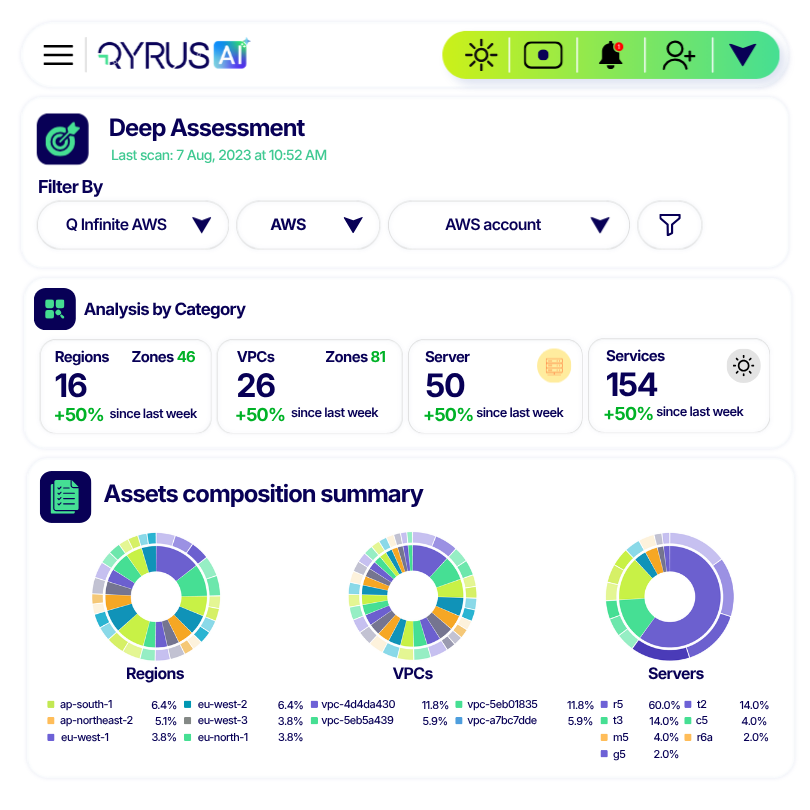










Application Discovery · Dependency Mapping · Legacy Modernization
Know It Before
You Change It.
Most modernization projects fail not because the technology was wrong, but because the estate was never fully understood.
QyrusAI Modernize continuously discovers every application, maps every dependency, and scores every modernization decision against real operational data — so you transform with confidence, not guesswork.
CORE FEATURES
Built to Handle the
Full Complexity of Enterprise Modernization
Unify real-time application discovery, dependency mapping, technical debt analysis, and digital twin simulation across your entire enterprise estate. Discover how data-backed insights turn complex modernization initiatives into predictable, risk-free execution.
Continuous Application Discovery
Auto-discovers your full IT estate in real time — no manual inventory, no stale spreadsheet. Finds what your CMDB has missed.
Dependency Mapping
Maps every application-to-application, API, and business-service dependency. Produces a blast-radius score before any change is approved.
Application Rationalization
Scores every application by run cost, technical debt, business value, and dependency risk. Identifies what to retire, re-platform, or renegotiate — with evidence.
Technical Debt Analysis
Quantifies technical debt per application against operational cost and security risk. Makes the business case for modernization from data, not gut feel
Cloud Migration Intelligence
Sequences cloud migration waves from observed dependency data. Prevents cascade failures from undiscovered cross-system connections.
Intelligent Twin
Simulates the impact of any planned change in a digital twin before it runs in production. The blast-radius check that prevents go-live incidents.
Legacy Code Conversion
Converts legacy code in the optimal sequence determined by the dependency map. Context-aware conversion that understands what the code does, not just what it says.
Knowledge Graph (shared layer)
A continuously-observed model of every application, dependency, business service, and cost line in your estate. Every pillar reads from it. Every action writes back to it.
HOW IT WORKS
See the Estate. Map the Connections.
Sequence the Work.
Prove the Change.
Understand the four pillars of our modernization engine: discovering your entire estate in real time, mapping deep architectural dependencies, prioritizing portfolios with objective data, and transforming legacy systems safely with built-in validation.
Environments mapped continuously, in real time
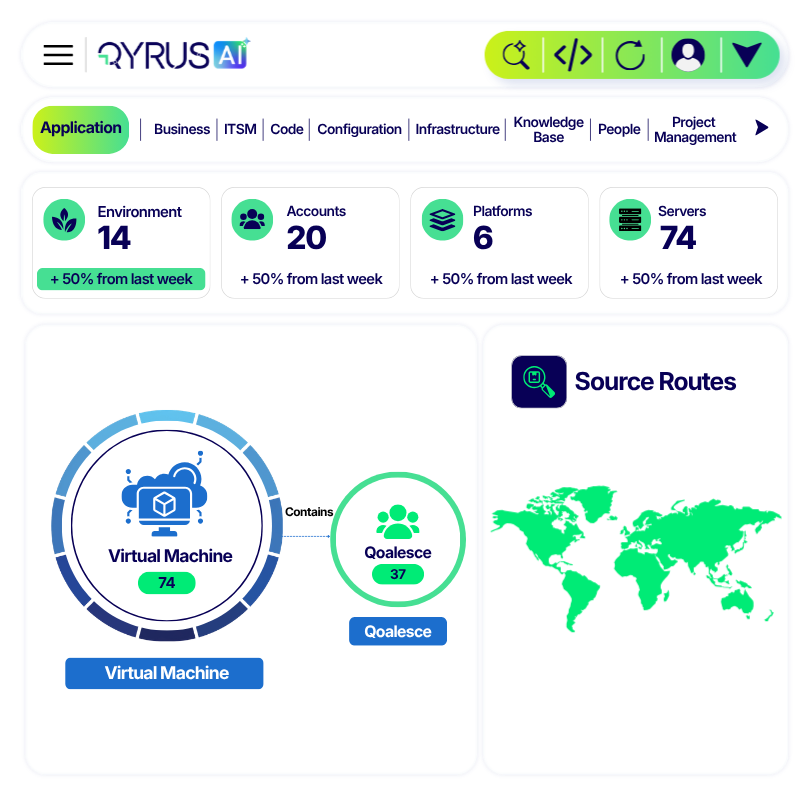
QyrusAI’s Auto-Discovery Engine continuously discovers and maps enterprise environments across cloud, on-premise, hybrid, and SaaS architectures. It identifies not just infrastructure assets but the relationships and dependencies running between them. Instead of a static inventory taken once and left to rot, you get a living model that updates as your estate changes.
Every application tied to its purpose
Every discovered application is connected to the business service it supports and the infrastructure it runs on. This context turns a flat asset list into an understanding of what actually matters to the business. Architects stop guessing which systems are safe to touch and which ones quietly run something critical.
Undocumented systems and CMDB drift surface
Shadow IT today extends well beyond unapproved apps — it includes orphaned infrastructure, untracked APIs, and legacy systems nobody owns but everything still depends on. QyrusAI detects these blind spots continuously rather than through periodic audits, catching drift between what your CMDB says and what’s actually running. Discovery without context is only half the job — every flagged system comes with the relationships that explain its risk.
Software usage tracked as it's discovered
As QyrusAI discovers your estate, it discovers what’s actually installed and licensed alongside it — not through a separate audit cycle, but as part of the same continuous pass. Usage is connected to the applications, users, and business services that depend on it, replacing static license spreadsheets with a live picture. This closes the gap between “what we think we own” and what’s genuinely running.
Applications, infrastructure, and services linked
QyrusAI maps application-to-application, application-to-infrastructure, and application-to-business-service dependencies from what it actually observes running, not from documentation that’s out of date the day it’s written. This visibility is the difference between changing a system with confidence and changing it blind. Every dependency identified here feeds directly into how risk and sequencing get decided downstream.
Know what breaks before it does
Every proposed change is scored on confidence level, criticality, and the number of downstream consumers it touches. This turns “what might this break” from a guessing exercise into a number your team can act on. High-blast-radius changes get the scrutiny they need; low-risk ones move without unnecessary friction.
Model change before you run it
The Intelligent Twin is a live, high-fidelity model of your IT ecosystem that lets you simulate a change before it ever touches production. Teams can run “what-if” scenarios and even chaos-engineering experiments against the twin to see how a change would actually propagate. Risk gets found and fixed in simulation, not in a postmortem.
Institutional knowledge captured, not lost
Everything discovered and mapped feeds a continuously updated Knowledge Graph that acts as your enterprise’s architectural memory. It reduces the dependency on individual subject-matter experts who used to hold this context in their heads alone. When someone leaves or a system is finally retired, the relationships and logic they understood stay documented and queryable.
Migration order set by dependency data
Migration waves are sequenced from the dependency map QyrusAI has already built — which applications can move safely, and in what order, based on what actually connects to what. This intelligence-first approach replaces static, point-in-time migration assessments that go stale the moment environmental drift sets in. The result is fewer orphaned resources and fragile cutovers at go-live.
Noisy and fragile assets surfaced
QyrusAI scores technical debt per application by correlating signals from tickets, logs, code, and operational metrics through the Knowledge Graph. “Noisy” assets that generate excessive alerts and “fragile” assets prone to failure surface automatically, instead of waiting for someone to notice a pattern. Debt remediation gets directed at the applications actually causing pain, not the ones that are simply old.
Noisy and fragile assets surfaced
QyrusAI scores technical debt per application by correlating signals from tickets, logs, code, and operational metrics through the Knowledge Graph. “Noisy” assets that generate excessive alerts and “fragile” assets prone to failure surface automatically, instead of waiting for someone to notice a pattern. Debt remediation gets directed at the applications actually causing pain, not the ones that are simply old.
Spend connected to business outcomes
Run cost is scored into every prioritization decision by connecting cloud and infrastructure spend to the specific applications and business services generating it — not just aggregated billing totals. This context turns cost from a lagging report into a live input for what gets modernized first. The highest-cost, highest-risk applications aren’t just flagged — they’re explained.
What to modernize, retire, or retain
QyrusAI determines the optimal conversion sequence by weighing dependency risk, technical debt, and business value together, rather than tackling applications in whatever order a project plan happened to list them. It flags what to modernize first, what to retire outright, and what to simply retain as-is. This keeps modernization effort focused on the highest-return work instead of being spread evenly and thinly.
Context-aware conversion across legacy languages
Legacy code is converted across standard programming languages using context pulled directly from the Enterprise Knowledge Graph, not a generic line-by-line translation. That context is what preserves business logic that would otherwise live only in a retiring system or a departing SME’s head. Conversion becomes an informed transformation, not a blind rewrite.
Every slice validated before release
Every converted slice is tested by Assure against the same business processes the legacy system ran, before it’s cleared for release. This is equivalence proof, not a smoke test — confirmation that the new system does what the old one did. No modernization decision goes to production on faith.
Executed and validated with minimal effort
Low-code and no-code workflows execute the actual data and application movement with precision, cutting out much of the manual intervention that turns migrations into multi-week fire drills. Automated testing in the target environment then confirms performance and parity before cutover — the same discipline that drives a 98%+ migration success rate. Execution and validation happen as one continuous motion, not two separate projects.
CHALLENGES
The Modernization Problem
Every Enterprise Knows.
Hidden Dependencies
Every enterprise has applications no one fully understands — systems built over decades, dependencies documented nowhere, and blast radius unknown until something breaks at go-live.
Transformation Without Evidence
Modernization roadmaps are built on spreadsheets, consultant assessments, and assumptions. When wave 1 executes, the surprises arrive — because the dependency map was never observed.
Legacy Knowledge Loss
The people who know how your legacy systems actually work are retiring. When they leave, the tacit knowledge goes with them — and no CMDB, documentation, or consulting engagement can recover it.
Technical Debt as an Invisible Tax
Every year of deferred modernization adds complexity, security risk, and run cost. But without a scored, dependency-aware view of the portfolio, it is impossible to know which debt is costing the most.
A GLIMPSE ON THE NUMBERS
Outcomes & Benefits
Explore the proven metrics of data-driven modernization: achieving total estate transparency instantly, optimizing run budgets to fund change, and executing complex overhauls with unprecedented speed and safety.
IT estate visible on first discovery
Run cost reduction — capacity for change
Lower migration volume with Phase Zero
Faster modernization programme execution
Continuous testing. Continuous learning. Continuous value.
Integrations
Works With Your Existing Enterprise Stack.
QyrusAI Modernize connects to your existing tools — CMDBs, ITSM platforms, cloud providers, and enterprise architecture repositories — so discovery enriches the tools you already use rather than replacing them.
CUSTOMER TESTIMONIALS
Enterprises running the loop
in their own words.
Real Teams. Real Outcomes. Real Confidence in what ships next.
Qyrus not only supports the testing of our Web, Mobile, and API components as part of our CI/CD processes, but also in ongoing regression-testing across our partner ecosystem. The real power of Qyrus is that we have this extremely broad testing capability in one tool, run in the cloud, and reusable across all our development teams.

The transition to Qyrus has marked a significant turning point for us. By embracing automation, we not only streamlined our SAP test automation process but also achieved a remarkable reduction in overall project testing time by 40%.
... the Qyrus platform have been a great addition to Monument's product delivery capabilities. Within a few months, we have been able to create a comprehensive test suite of complex end-to-end test scenarios spanning multiple platforms and channels. The Quinnox team has helped us embed the Qyrus solution, and the supporting processes around it, into our agile delivery methodology.
Resources
Explore our curated library of expert blog posts, in-depth whitepapers, and real-world case studies, designed to help you stay ahead in the world of AI-driven application lifecycle management.
October 15, 2026 |
4 min
Data-Rich, Context-Poor: Why Enterprise AI Fails Without Context—And How to Fix It
Read More
October 14, 2026 |
5 min
The Cost of Flying Blind: Why Disconnected IT Operations Bleed Business Value
Read More
October 9, 2026 |
8 min
Application Discovery and Dependency Mapping: The First Step Before You Modernize Anything
Read More
September 24, 2026 |
6 min
How a Global Data & Analytics Leader Scaled SAP GUI and Fiori Test Automation for Complex BRIM Workflows
Read More
September 17, 2025 |
5 min
From Bottlenecks to Breakthroughs: A Coca-Cola Bottler’s Quality Transformation
Read More
June 27, 2025 |
5 min
AI-Powered Testing Transforms One of the Largest Beverage Companies
Read MoreBlog
October 15, 2026 |
4 min
Data-Rich, Context-Poor: Why Enterprise AI Fails Without Context—And How to Fix It
Read More
October 14, 2026 |
5 min
The Cost of Flying Blind: Why Disconnected IT Operations Bleed Business Value
Read More
October 9, 2026 |
8 min
Application Discovery and Dependency Mapping: The First Step Before You Modernize Anything
Read MoreCase Study
September 24, 2026 |
6 min
How a Global Data & Analytics Leader Scaled SAP GUI and Fiori Test Automation for Complex BRIM Workflows
Read More
September 17, 2025 |
5 min
From Bottlenecks to Breakthroughs: A Coca-Cola Bottler’s Quality Transformation
Read More
June 27, 2025 |
5 min
AI-Powered Testing Transforms One of the Largest Beverage Companies
Read MoreReports
Whitepaper
FREQUENTLY ASKED QUESTIONS
Common Questions About QyrusAI Modernization
How is this different from a CMDB or an EA repository like LeanIX?
Does Qyrus Modernize work with SAP S/4HANA migrations?
Yes — and SAP migrations are one of the highest-urgency use cases. QyrusAI reads your SAP environment in read-only mode, inventories all RFCs, IDocs, OData services, SOAP connections, CPI integrations, background jobs, and Z-objects, and produces a blast-radius score for every proposed S/4HANA change. The Estate X-Ray and Phase Zero governance workflow are specifically designed for ECC-to-S/4HANA programmes with fixed cutover dates.
How long does the initial discovery scan take?
The first scan of a mid-market estate (200–400 applications) typically produces an initial topology map within 48–72 hours. The map enriches continuously from that point — adding confidence detail, business-service attribution, and dependency validation as more signals are observed. A Phase Zero engagement (discovery, dependency mapping, and modernization prioritization) is typically scoped at 4–6 weeks.
Does it require agent installation on every system?
No. QyrusAI reads from APIs, connectors, log streams, and cloud provider metadata — it does not require an agent on every application or server. For some legacy on-premise environments a lightweight collector may be deployed, but this is scoped per engagement and never required across the full estate before value is delivered.
What happens to the modernization plan if the estate changes while the programme is running?
The Knowledge Graph is continuously updated. If a new application is deployed, a dependency changes, or a system is decommissioned mid-programme, the change is reflected in the graph and the modernization wave plan is re-scored automatically. Your transformation plan is always based on the current estate, not the estate as it was when the programme started.
Does Qyrus Modernize integrate with Assure for testing?
Yes — this is the core joint value of the two pillars. Every modernization slice Modernize produces is automatically handed to Assure for equivalence testing. Assure generates test cases from the code analysis output, runs them against the modernized slice, and produces an evidence record before any release decision is made. The conversion is never marked complete until Assure has proved it works.
• STAY AHEAD, STAY IN THE LOOP.