






SEER Orchestration · Autonomous Testing · Web · Mobile · API · SAP · Data
Prove Every Change. Automatically.
Testing is no longer a gate you pass at the end of a sprint. It is a continuous signal that every change is safe to ship.
Challenge
The Testing Problem
Every QA Team Knows.
Lorem Ipsum Lorem IpsumLorem IpsumLorem IpsumLorem IpsumLorem IpsumLorem IpsumLorem IpsumLorem IpsumLorem Ipsum
Testing Is the Release Bottleneck
Every sprint ends with the same conversation: will QA finish in time? Regression windows grow as applications grow, but the team does not. Testing is slowing the business it is supposed to protect.
Maintenance Erodes Every Coverage Gain
Every UI change breaks scripts. Every sprint introduces flaky tests that get quarantined instead of fixed. The quarantine list grows faster than the coverage list.
Fragmented Tools Across Every Channel
Web testing, mobile testing, API testing, SAP testing, and data testing run on separate tools with separate teams and no shared coverage picture. The regression suite is always incomplete somewhere.
No Proof — Just a Pass/Fail Count
Release sign-off is a yes or no at the end of a test cycle. There is no structured evidence of what was tested, how it behaved, and why the decision was made. Regulators and boards are starting to ask.
How it works
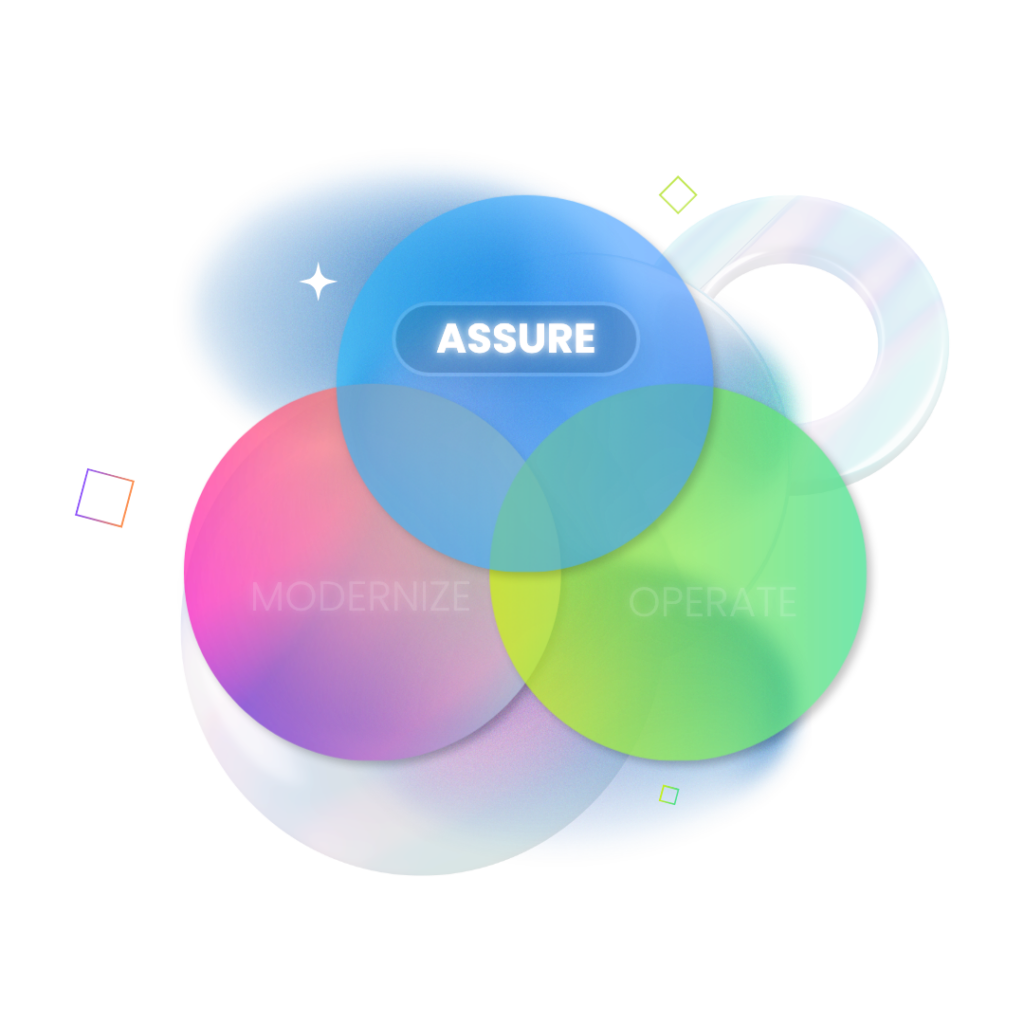
Assure — Bridge Sentence
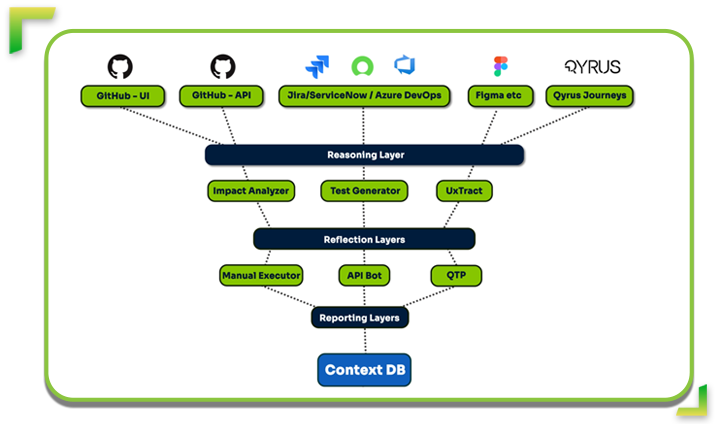
The SEER Orchestration Framework: Sense. Evaluate. Execute. Report.
Sense every change the moment it happens.
SEER monitors your code repository, CI/CD pipeline, and production environment in real time. The moment a commit is pushed, a deployment is triggered, or a production event fires, SEER detects the change and understands its context — what changed, where, and what it is likely to affect.
- Monitors GitHub, GitLab, ADO, Jenkins, and all major CI/CD platforms natively
- Detects UI, API, and data changes in real time — before they reach a test run
- Production signals from Operate feed back into SEER — incidents become regression test inputs automatically
Select only the tests that matter for this change.
SEER evaluates the change against the full test suite and selects the tests that are relevant to what changed — not the full regression. Risk-based selection means regression runs in hours, not days. Coverage is not sacrificed — the right tests are chosen, not fewer tests.
- Risk-based test selection: runs only the tests relevant to the specific change, not a full suite
- Blast-radius analysis: maps which parts of the application the change could affect
- AI-generated test cases: TestPilot, TestGenerator, and Rover generate new tests where coverage gaps are identified
Run tests across every channel — in parallel, in the cloud.
SEER executes the selected tests across web, mobile, API, SAP, and data in parallel using cloud-hosted execution infrastructure. No environment setup. No wait time. Self-healing scripts update automatically when the application changes — no maintenance sprint after every UI update.
- Parallel cloud execution across web, mobile (native + web), API, SAP desktop, and data pipelines
- Browser Farm and Device Farm: real devices and browsers, zero infrastructure management
- Healer AI: self-healing test scripts that survive UI and API changes automatically
Generate structured evidence — before every release decision.
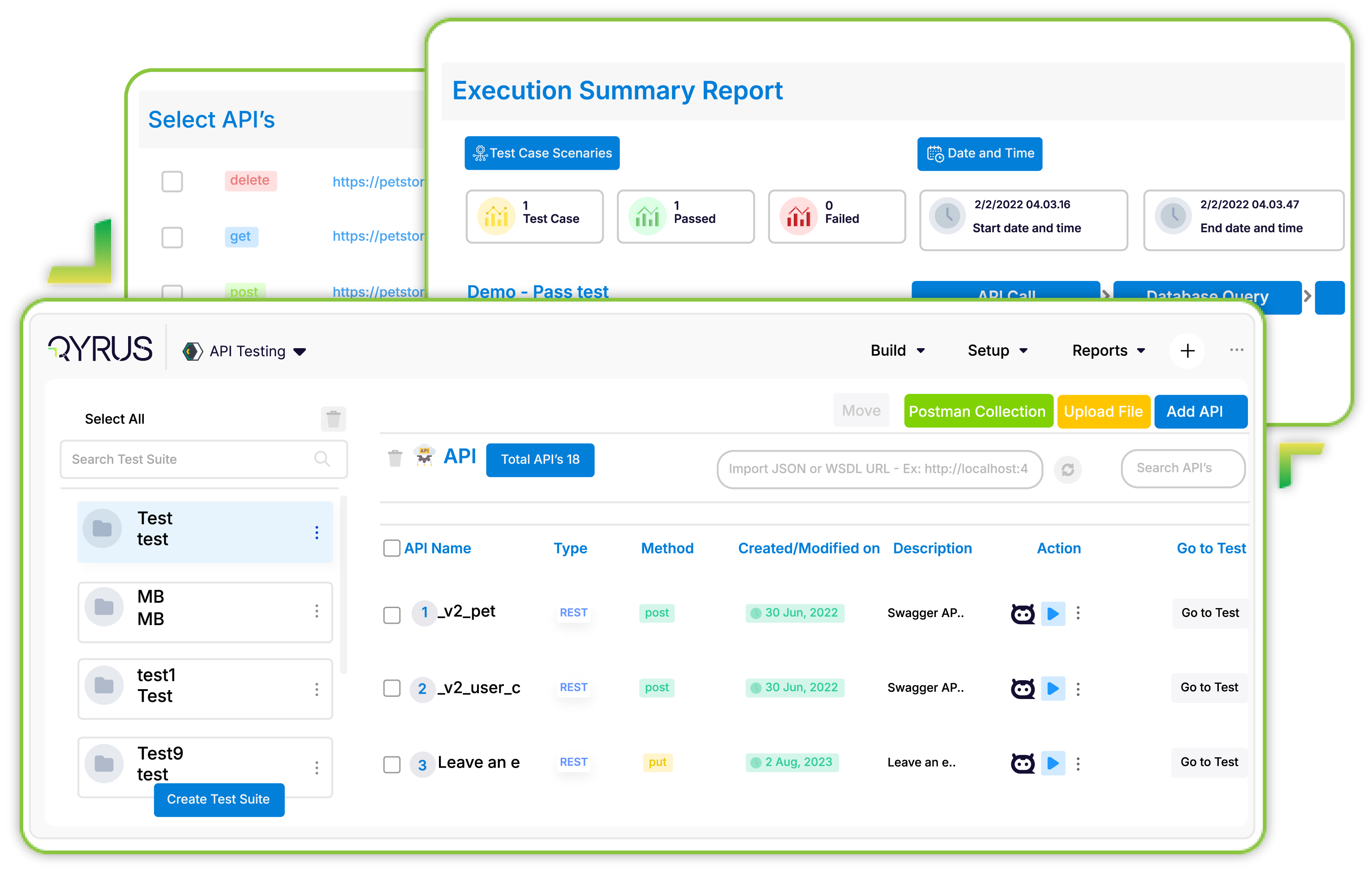
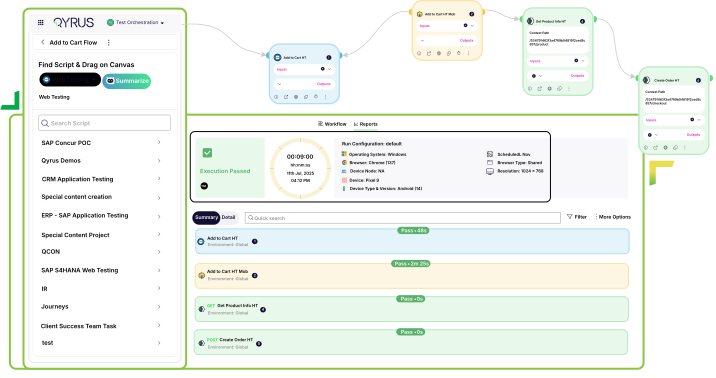
Every SEER execution produces a structured evidence record: what was tested, what passed, what failed, when, by what policy, and under whose approval. Evidence is stored in Qhive and queryable. Release decisions are gated on evidence, not on a QA lead’s verbal sign-off.
- Structured test evidence record for every execution — timestamped, policy-attributed, queryable
- One-click audit reports for compliance frameworks — HIPAA, FSMA, DORA, FCA/PRA, EU AI Act
- Business-process-level reporting: not just test pass rate, but which business processes are covered and proved
Core Features
Lorem Ipsum Dolor Sit Amet. Lorem Ipsum Dolor Sit Amet. Lorem Ipsum.
incididunt ut labore et dolore magna aliqua. Ut enim ad minim veniam, quis.
Built to Cover Every Channel
Keep Up with Every Change.
Web Testing
Codeless and scripted testing across all browsers and viewports — with self-healing scripts that survive UI changes without manual maintenance.
Mobile Testing
Native iOS and Android testing plus mobile web — across real devices in the Device Farm. Zero infrastructure setup.
API Testing
REST and SOAP API testing with assertions, parameterization, and regression suites. Continuous API validation triggered by every commit.
SAP Testing
AI-generated SAP test cases covering IDoc chains, BAPI flows, RFC calls, and business processes. Blast-radius analysis before every transport.
Data Testing
Continuous ETL/ELT pipeline validation. Business-logic assertion layer on top of infrastructure checks. DataChain test data management for AI and analytics pipelines.
Test Orchestration
SEER orchestrates tests across all channels from one platform — risk-based selection, parallel execution, and evidence generation at every stage.
AI Agents
TestPilot, TestGenerator, and Rover: AI-generated tests from screens, tickets, and autonomous exploration.
SEER — Evidence Layer
Every test execution generates a structured, queryable evidence record — the audit trail that regulators, compliance teams, and release managers require by default.
A GLIMPSE ON THE NUMBERS
Outcomes & Benefits
Release Faster. Cover More. Break Less. Prove It Every Time
Fewer escaped defects with shift-left
Reduction in testing time
ROI on test automation
SAP testing time reduced (8d → 22hrs)
Continuous testing. Continuous learning. Continuous value.
Join leading enterprises
driving the loop forward.
Integration
Integrates With Your Entire Delivery Pipeline No Rip-and-Replace Required
QyrusAI reads from your existing observability tools and writes context back to them — so your current monitoring investment is enriched, not replaced. The intelligence layer runs above Dynatrace, Datadog, and ServiceNow; the stack you built does not change.
CUSTOMER TESTIMONIALS
Enterprises running the loop
in their own words.
Real Teams. Real Outcomes. Real Confidence in what ships next.
Lorem Ipsum Dolor Sit Amet. Lorem Ipsum Dolor Sit Amet. Lorem
Qyrus not only supports the testing of our Web, Mobile, and API components as part of our CI/CD processes, but also in ongoing regression-testing across our partner ecosystem. The real power of Qyrus is that we have this extremely broad testing capability in one tool, run in the cloud, and reusable across all our development teams.

The transition to Qyrus has marked a significant turning point for us. By embracing automation, we not only streamlined our SAP test automation process but also achieved a remarkable reduction in overall project testing time by 40%.
... the Qyrus platform have been a great addition to Monument's product delivery capabilities. Within a few months, we have been able to create a comprehensive test suite of complex end-to-end test scenarios spanning multiple platforms and channels. The Quinnox team has helped us embed the Qyrus solution, and the supporting processes around it, into our agile delivery methodology.
Resources
Explore our curated library of expert blog posts, in-depth whitepapers, and real-world case studies, designed to help you stay ahead in the world of AI-driven application lifecycle management.
August 19, 2026 |
18 min
User Acceptance Testing Best Practices: A Complete UAT Strategy Guide for SAP Teams
Read More
August 13, 2026 |
2 min
Qyrus Named in Gartner’s Market Overview for API and MCP Testing Tools
Read More
August 13, 2026 |
2 min
Qyrus Named in Gartner’s Market Overview for API and MCP Testing Tools
Read More
Blog
August 19, 2026 |
18 min
User Acceptance Testing Best Practices: A Complete UAT Strategy Guide for SAP Teams
Read More
Case Study
Events
Reports
August 13, 2026 |
2 min
Qyrus Named in Gartner’s Market Overview for API and MCP Testing Tools
Read More
Whitepaper
August 13, 2026 |
2 min
Qyrus Named in Gartner’s Market Overview for API and MCP Testing Tools
Read More
FREQUENTLY ASKED QUESTIONS
Common Questions About QyrusAI Modernization
Lorem ipsum dolor sit amet, consectetur adipiscing elit, sed do eiusmod tempor
incididunt ut labore et dolore magna aliqua. Ut enim ad minim veniam, quis nostrud.
How is Assure different from Tricentis, UFT, or our current test automation tool?
The three meaningful differences: (1) breadth — one platform covering web, mobile, API, SAP, and data; Tricentis requires multiple SKUs for the same coverage; (2) the production feedback loop — Assure receives incident signals from Operate and converts them into regression tests automatically; no other testing vendor can do this because they have no production data; (3) the evidence layer — every SEER execution generates a structured audit record; your current tool produces a pass/fail count. If you have a Tricentis renewal coming up, we are happy to show you the consolidation maths.
What is the SEER framework and how does it differ from traditional test orchestration?
SEER stands for Sense, Evaluate, Execute, Report. Traditional orchestration schedules tests. SEER senses changes as they happen and selects only the tests relevant to what changed — which means regression runs in hours, not days. It also generates evidence at every stage: what was sensed, what was evaluated, what was executed, and what the outcome was. That evidence is not a test report — it is a structured, queryable record that gates the release decision.
Does it integrate with our CI/CD pipeline?
Yes. SEER integrates natively with GitHub, GitLab, Azure DevOps, Jenkins, and most CI/CD platforms. The SEER trigger can be set on commit, on PR creation, on deployment, or on a production event from Operate. The integration is configured in minutes — it does not require a dedicated infrastructure project.
How is evidence generated automatically — and is it acceptable for compliance frameworks like HIPAA, FSMA, or DORA?
Every SEER execution writes a structured record to Qhive: timestamp, test cases run, pass/fail status, business processes covered, policy context, and the approval chain. This record is queryable and exportable as a PDF audit report with one click. For HIPAA, FSMA 204, DORA, and FCA/PRA, the evidence record covers what was tested, when, by what policy, and with what outcome. Several Qyrus customers in regulated industries use this record as their primary compliance evidence — we are happy to walk through the specific framework requirements on a call.
What happens to our existing test assets — manual scripts, Selenium suites, Tricentis models?
They become inputs to Assure, not liabilities. Existing Selenium scripts are converted to codeless tests using the optimal conversion sequence from Modernize’s code analysis. Manual test cases are imported and used as context for AI-generated test generation. Tricentis models can be migrated with a structured conversion programme. You do not start from zero — you start from everything you already know, made maintainable.
How does SEER handle SAP testing, which is more complex than web or API testing?
Assure includes native SAP testing capabilities: AI-generated test cases for IDoc chains, BAPI flows, RFC calls, and S/4HANA business processes. SAP transport-aware blast-radius analysis shows what each transport will affect across all satellite systems before it is imported. DataChain traces document flows end-to-end — including Lead-to-Cash and Source-to-Pay processes — with masked, realistic datasets. The evidence record covers SAP-specific attributes: transport number, business process, and system of record.
• STAY AHEAD, STAY IN THE LOOP •
Stop Gating Releases on a QA Team's Best Guess.
Start Gating on Evidence.
4–6 week pilot on your most critical application — scoped to your next named release date, with a pre-agreed success metric you choose.