Qyrus Named a Leader in The Forrester WaveTM: Autonomous Testing Platforms, Q4 2025 – Read More

Technical Debt Analysis | Legacy Intelligence | Application Health

Stop Guessing Where Your Debt Lives.
Start Seeing It.

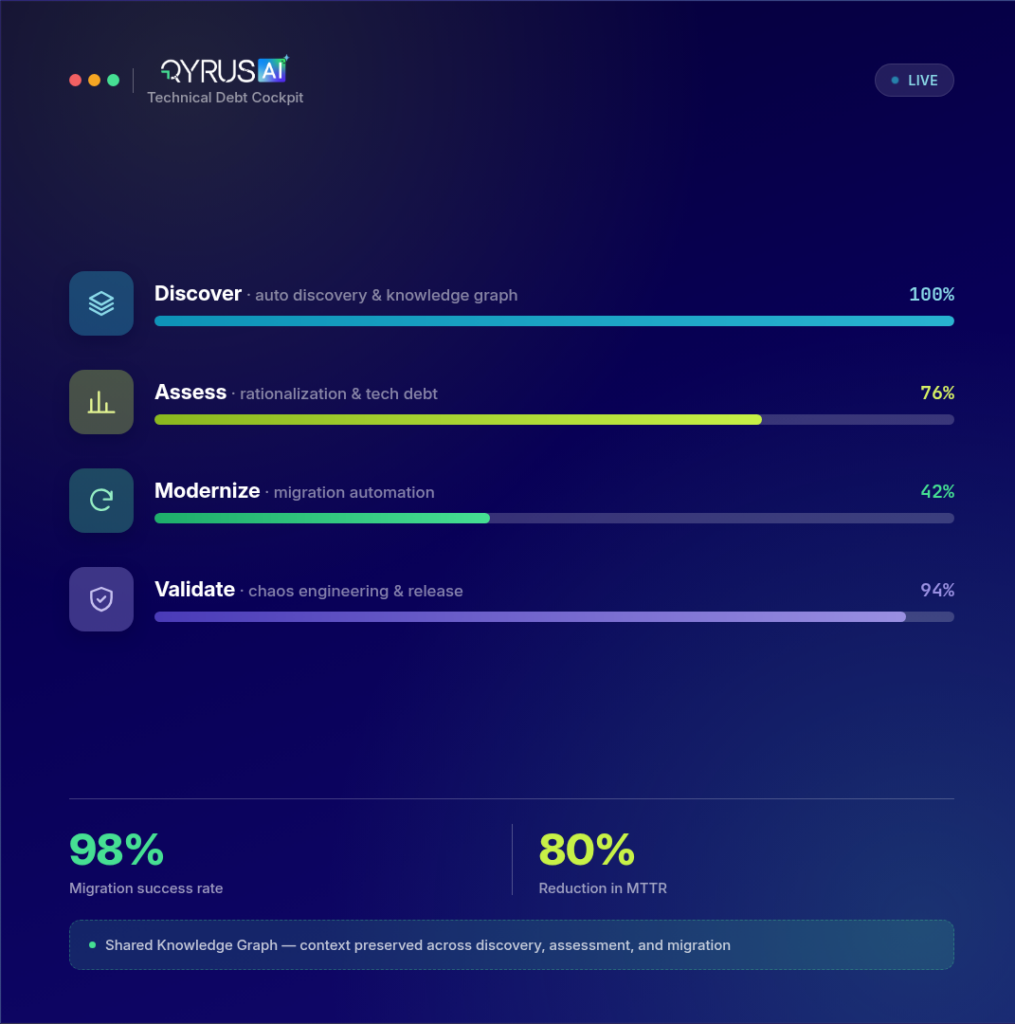
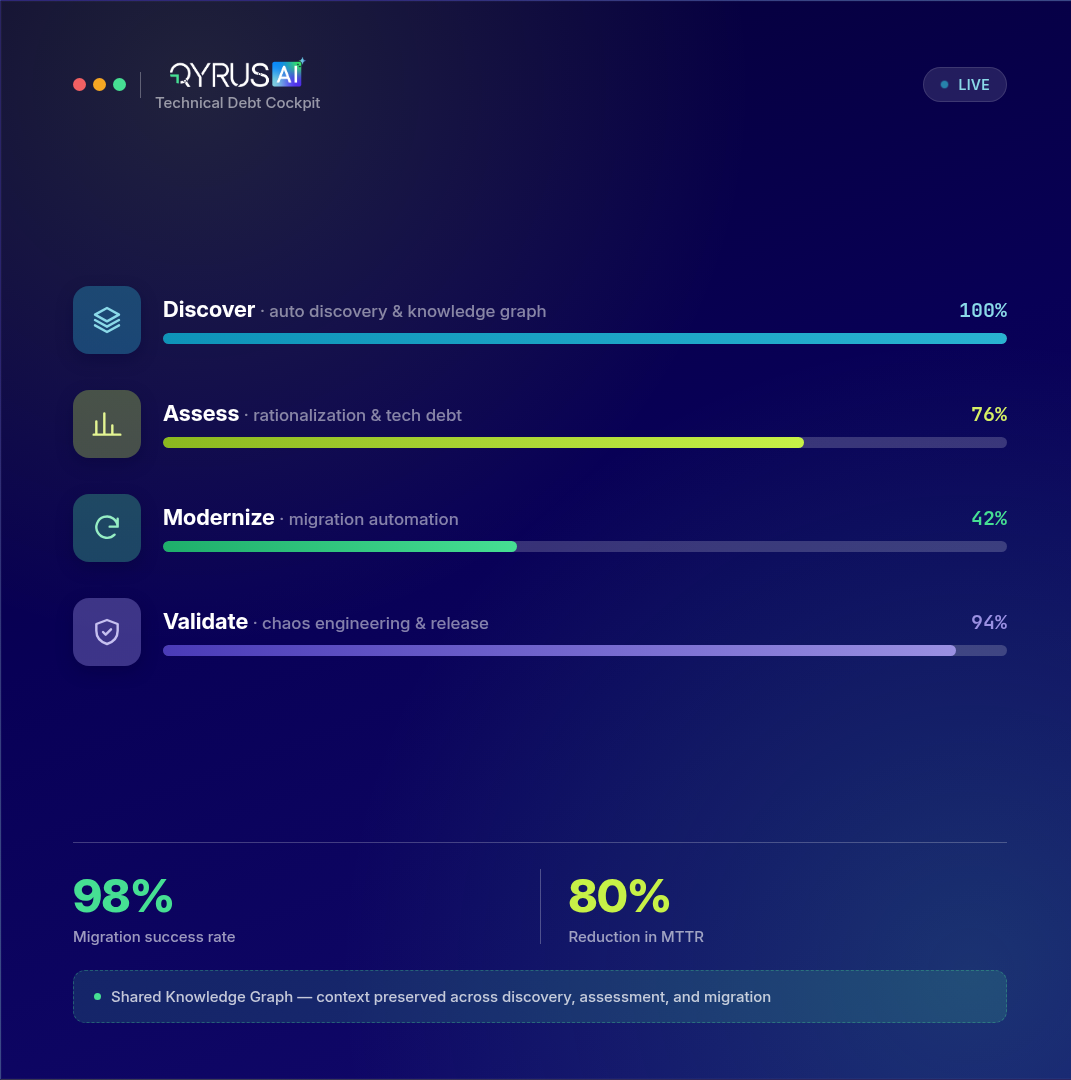
Technical debt isn’t a spreadsheet problem, it’s a visibility problem. QyrusAI continuously discovers your application and infrastructure landscape, maps how debt actually propagates through dependencies, and surfaces which assets are silently draining your teams — so modernization decisions are based on evidence, not tribal knowledge.

Technical Debt

Challenges

The Technical Debt Problem
Every Enterprise Knows.

Technical debt compounds silently until it breaks something expensive. Discover how replacing SME tribal knowledge and static architecture diagrams with real-time dependency intelligence turns debt assessment from a periodic audit into a continuous discipline.

Debt Hidden in Tribal Knowledge

Critical logic and dependencies live in the heads of a few SMEs - undocumented, siloed, and lost the moment they leave.

No Way to Tell What's Actually Risky

Every legacy system "feels" risky, but without dependency and signal data, teams can't tell a fragile asset from a stable one.

Static, Point-in-Time Audits

Architecture reviews and debt assessments capture a snapshot that's stale before the report is even finished.

Modernization Without Evidence

Without objective prioritization, modernization budget goes to the loudest complaint, not the highest-impact fix.

How it works

See the Estate. Map the Dependencies.
Score the Debt. Prioritize the Fix.

Explore how QyrusAI moves technical debt assessment from subjective SME knowledge to an objective, continuously updated picture of where risk actually lives in your IT landscape.

Map servers, VMs, networks, and storage

QyrusAI automatically maps physical and virtual resources across your environment, including servers, VMs, networks, and storage configurations. This replaces manual inventory processes that are slow, incomplete, and outdated the moment they’re finished. The result is a live, structural view of the infrastructure debt actually sits on.

Technical Debt

Legacy and cloud-native stacks identified

Every application component and its specific configuration is identified across both legacy and cloud-native stacks. Nothing depends on a diagram someone drew two years ago or a spreadsheet nobody’s updated since. QyrusAI reads the estate as it actually exists today.

Technical Debt

Tickets, logs, code, and metrics

QyrusAI ingests and correlates signals from tickets, logs, code, and operational metrics as they’re generated. These signals become the raw evidence used to flag anomalies and performance issues later in the process. Nothing here relies on someone remembering which system has been acting up.

Technical Debt

On-prem, cloud, and hybrid observed live

Discovery runs continuously across on-prem, cloud, and hybrid infrastructure — not as a quarterly exercise. No manual inventory and no stale architecture diagrams stand between you and the current state of the estate. The picture stays accurate as your systems change.

Technical Debt

A knowledge graph that's always current

Discovered assets and signals feed a live Knowledge Graph that models the enterprise as it actually operates. Unlike a static CMDB, it updates as systems change, so it never goes stale. This graph becomes the foundation every later assessment and prioritization decision is built on.

Technical Debt

How applications, services, and infrastructure interact

Every dependency between applications, services, and infrastructure is mapped and made visible. Cost, risk, and debt are never assessed in isolation from the systems that actually generate them. Teams finally see the connections that used to live only in someone’s head.

Technical Debt

One change traced across the ecosystem

A change in a single microservice or legacy database can be traced through its full downstream impact. This visibility directly reduces the risk of breaking critical systems during debt remediation. Architects can see the blast radius of a fix before they make it.

Technical Debt

Tribal knowledge captured, not lost

The Knowledge Graph documents interdependencies and data flows automatically, rather than leaving them in the heads of a few subject matter experts. Critical logic and system relationships are preserved as institutional memory. Modernization no longer stalls because the one person who understood a system has left.

Technical Debt

Excessive alert generators identified automatically

QyrusAI identifies assets that generate a disproportionate volume of alerts relative to their actual operational value. These “noisy” assets are flagged automatically from correlated ticket and log data, not from anecdotal complaints. Teams get an objective list of what’s actually creating operational drag.

Technical Debt

High failure rates surfaced with evidence

Assets with high failure rates are identified from correlated operational signals rather than assumed from reputation. This distinguishes systems that are genuinely at risk from ones that simply feel old. Debt remediation effort goes toward assets with a measurable failure pattern, not the loudest complaint.

Technical Debt

One view of noisy, fragile assets

Noisy and fragile assets are surfaced together in a single Assessment Dashboard, replacing scattered reports across teams. Finance, engineering, and operations finally look at the same evidence instead of competing spreadsheets. The dashboard becomes the shared source of truth for where debt actually lives.

Technical Debt

Debt scored from signals, not opinion

Every flagged asset is scored using the same correlated signal data, not individual judgment calls. This turns technical debt from a subjective argument into a measurable, comparable metric across the portfolio. Decision-makers can finally rank debt the same way they’d rank any other operational risk.

Technical Debt

A live twin of your environment

QyrusAI builds a Digital Twin that models the IT ecosystem as a live, continuously updated representation. This twin becomes the environment where every prioritization decision is tested before it’s acted on. Nothing has to be validated against production first.

Technical Debt

What-if scenarios run without real risk

Teams simulate “what-if” scenarios against the Digital Twin before touching a single production system. This makes it possible to test a remediation approach without any operational exposure. Decisions get validated in simulation, not learned the hard way in production.

Technical Debt

See what breaks before you act

The Digital Twin predicts the downstream consequences of altering or retiring a given component. This gives architects a clear picture of risk before committing any resources to a fix. Impact analysis turns “we think this is safe” into something teams can actually demonstrate.

Technical Debt

Modernization effort directed where it counts

Simulated impact and evidence-based debt scores combine to rank remediation targets by actual operational return. Effort goes to the highest-ROI, highest-risk assets first, not the ones generating the most noise. This gives modernization a controlled, low-risk path from assessment into execution.

Technical Debt

Core Features

Built to Turn Technical Debt
From a Guess into a Measurement.

Stop relying on SME memory and outdated diagrams. Discover how real-time discovery, dependency intelligence, and signal-based scoring turn technical debt into a transparent, continuously monitored metric.

Continuous Asset Discovery

Automatically discovers applications, infrastructure, and configurations across legacy and cloud-native stacks in real time - no manual inventory required

Dependency-Aware Knowledge Graph

Maps interdependencies between apps, services, and infrastructure, acting as a "live" enterprise memory that reduces reliance on individual SMEs.

Signal-Based Debt Scoring

Correlates tickets, logs, code, and operational metrics to identify "noisy" and "fragile" assets driving the most operational risk.

Digital Twin Impact Simulation

Models the IT ecosystem to simulate "what-if" changes and predict downstream consequences before any remediation is committed.

A GLIMPSE ON THE NUMBERS

Assess Faster. Decide with Evidence. Reduce the Risk.

Replace subjective SME knowledge with a continuously updated, evidence-based view of where technical debt actually lives — so modernization decisions are objective, defensible, and low-risk.

25- 25 %

reduction in migration timelines

98 %+

migration success rate

99.99 %+

system uptime and
100% SLA adherence

20- 21 %

increase in change deployment frequency

Continuous testing. Continuous learning. Continuous value.

Join leading enterprises
driving the loop forward.

Integration

Works With Your Existing Enterprise Stack.

QyrusAI Modernize connects to your existing tools — CMDBs, ITSM platforms, cloud providers, and enterprise architecture repositories — so discovery enriches the tools you already use rather than replacing them.

Logo
Logo
Logo
Logo
Logo
Logo
Logo
Logo
Logo
Logo
Logo
Logo
Logo
Logo
Logo
Logo
Logo
Logo
Logo
Logo
Logo
Logo
Logo
Logo
Logo
Logo
Logo
Logo
Logo
Logo
Logo
Logo
Logo
Logo
Logo
Logo
Logo
Logo
Logo
Logo
Logo
Logo
Logo
Logo
Logo
Logo
Logo
Logo
Logo
Logo
Logo
Logo
Logo
Logo
Logo
Logo
Logo
Logo
Logo
Logo
Logo
Logo
Logo
Logo
Logo
Logo
Logo
Logo
Logo
Logo
Logo
Logo

CUSTOMER TESTIMONIALS

Enterprises running the loop
in their own words.

Real Teams. Real Outcomes. Real Confidence in what ships next.

Shawbrook Bank

Qyrus not only supports the testing of our Web, Mobile, and API components as part of our CI/CD processes, but also in ongoing regression-testing across our partner ecosystem. The real power of Qyrus is that we have this extremely broad testing capability in one tool, run in the cloud, and reusable across all our development teams.

Shawbrook Bank
Subaru

The transition to Qyrus has marked a significant turning point for us. By embracing automation, we not only streamlined our SAP test automation process but also achieved a remarkable reduction in overall project testing time by 40%.

Subaru
Monument

... the Qyrus platform have been a great addition to Monument's product delivery capabilities. Within a few months, we have been able to create a comprehensive test suite of complex end-to-end test scenarios spanning multiple platforms and channels. The Quinnox team has helped us embed the Qyrus solution, and the supporting processes around it, into our agile delivery methodology.

Monument

Resources

Go Deeper on QyrusAI Technical Debt Analysis


Dive into our latest research and implementation guides. See exactly how combining real-time discovery with a live dependency graph turns technical debt from an unquantified risk into a measurable, prioritized backlog.

Featured Image
Operate

October 15, 2026 | 4 min

Data-Rich, Context-Poor: Why Enterprise AI Fails Without Context—And How to Fix It

Read More
Business Impact in IT Operations
Operate

October 14, 2026 | 5 min

The Cost of Flying Blind: Why Disconnected IT Operations Bleed Business Value

Read More
Featured Image
Modernize

October 9, 2026 | 8 min

Application Discovery and Dependency Mapping: The First Step Before You Modernize Anything 

Read More
Data-Analytics Leader Case Study
Assure

September 24, 2026 | 6 min

How a Global Data & Analytics Leader Scaled SAP GUI and Fiori Test Automation for Complex BRIM Workflows

Read More
coca-cola bottler case study
Case Study

September 17, 2025 | 5 min

From Bottlenecks to Breakthroughs: A Coca-Cola Bottler’s Quality Transformation 

Read More
CCEP Case Study
Food and Beverages

June 27, 2025 | 5 min

AI-Powered Testing Transforms One of the Largest Beverage Companies

Read More
Featured Image

October 12, 2026 | 1 min

Next Stop, Madison: QyrusAI Joins the ASUG Community

Read More
Jack Henry Blog Featured Image

September 21, 2026 | 1 min

Meet QyrusAI at Jack Henry Connect 2026

Read More
BFSI Mumbai, 2026

July 13, 2026 | 1 min

Meet Qyrus at the BFSI Innovation & Technology Summit India 2026

Read More
Finops Featured Image1
Operate

October 13, 2026 | 2 min

FinOps: From Cost Visibility to Cost Predictability

Read More
Modernizing on JackHenry's Terms De-Risking the Symitar-to-SQL Transition Through Testing

September 28, 2026 | 2 min

The Jack Henry Platform Shift: De-Risking the Symitar-to-SQL Transition Through Testing

Read More
The AI Quality Gap Featured Image

September 17, 2026 | 3 min

AI Quality Engineering Solution for LLMs, RAG Pipelines, and MCP-Enabled Systems

Read More

Blog

Featured Image
Operate

October 15, 2026 | 4 min

Data-Rich, Context-Poor: Why Enterprise AI Fails Without Context—And How to Fix It

Read More
Business Impact in IT Operations
Operate

October 14, 2026 | 5 min

The Cost of Flying Blind: Why Disconnected IT Operations Bleed Business Value

Read More
Featured Image
Modernize

October 9, 2026 | 8 min

Application Discovery and Dependency Mapping: The First Step Before You Modernize Anything 

Read More
Data-Analytics Leader Case Study
Assure

September 24, 2026 | 6 min

How a Global Data & Analytics Leader Scaled SAP GUI and Fiori Test Automation for Complex BRIM Workflows

Read More
coca-cola bottler case study
Case Study

September 17, 2025 | 5 min

From Bottlenecks to Breakthroughs: A Coca-Cola Bottler’s Quality Transformation 

Read More
CCEP Case Study
Food and Beverages

June 27, 2025 | 5 min

AI-Powered Testing Transforms One of the Largest Beverage Companies

Read More

Featured Image

October 12, 2026 | 1 min

Next Stop, Madison: QyrusAI Joins the ASUG Community

Read More
Jack Henry Blog Featured Image

September 21, 2026 | 1 min

Meet QyrusAI at Jack Henry Connect 2026

Read More
BFSI Mumbai, 2026

July 13, 2026 | 1 min

Meet Qyrus at the BFSI Innovation & Technology Summit India 2026

Read More

Finops Featured Image1
Operate

October 13, 2026 | 2 min

FinOps: From Cost Visibility to Cost Predictability

Read More
Modernizing on JackHenry's Terms De-Risking the Symitar-to-SQL Transition Through Testing

September 28, 2026 | 2 min

The Jack Henry Platform Shift: De-Risking the Symitar-to-SQL Transition Through Testing

Read More
The AI Quality Gap Featured Image

September 17, 2026 | 3 min

AI Quality Engineering Solution for LLMs, RAG Pipelines, and MCP-Enabled Systems

Read More

 FREQUENTLY ASKED QUESTIONS

Common Questions About QyrusAI Modernization

Lorem ipsum dolor sit amet, consectetur adipiscing elit, sed do eiusmod tempor
incididunt ut labore et dolore magna aliqua. Ut enim ad minim veniam, quis nostrud.

How is this different from a CMDB or an EA repository like LeanIX?
A CMDB is maintained by FTEs and is outdated within days of any infrastructure change. LeanIX and similar repositories are populated by surveys — they capture what people say is true, not what the system is actually doing. QyrusAI discovers your estate by observing it in real time: reading APIs, data flows, system calls, and infrastructure events. The graph stays current because it is updated continuously, not because someone remembers to update a ticket. The moment your CMDB says a dependency does not exist, QyrusAI’s observed graph is the source of truth. 

Yes — and SAP migrations are one of the highest-urgency use cases. QyrusAI reads your SAP environment in read-only mode, inventories all RFCs, IDocs, OData services, SOAP connections, CPI integrations, background jobs, and Z-objects, and produces a blast-radius score for every proposed S/4HANA change. The Estate X-Ray and Phase Zero governance workflow are specifically designed for ECC-to-S/4HANA programmes with fixed cutover dates.

The first scan of a mid-market estate (200–400 applications) typically produces an initial topology map within 48–72 hours. The map enriches continuously from that point — adding confidence detail, business-service attribution, and dependency validation as more signals are observed. A Phase Zero engagement (discovery, dependency mapping, and modernization prioritization) is typically scoped at 4–6 weeks.

No. QyrusAI reads from APIs, connectors, log streams, and cloud provider metadata — it does not require an agent on every application or server. For some legacy on-premise environments a lightweight collector may be deployed, but this is scoped per engagement and never required across the full estate before value is delivered.

The Knowledge Graph is continuously updated. If a new application is deployed, a dependency changes, or a system is decommissioned mid-programme, the change is reflected in the graph and the modernization wave plan is re-scored automatically. Your transformation plan is always based on the current estate, not the estate as it was when the programme started.

Yes — this is the core joint value of the two pillars. Every modernization slice Modernize produces is automatically handed to Assure for equivalence testing. Assure generates test cases from the code analysis output, runs them against the modernized slice, and produces an evidence record before any release decision is made. The conversion is never marked complete until Assure has proved it works.

Go Deeper on QyrusAI Cloud Migration Intelligence.

Dive into our latest research and implementation guides. See how continuous discovery, impact prediction, and automated validation turn the “Code to Cloud” journey into a streamlined, repeatable competitive advantage.