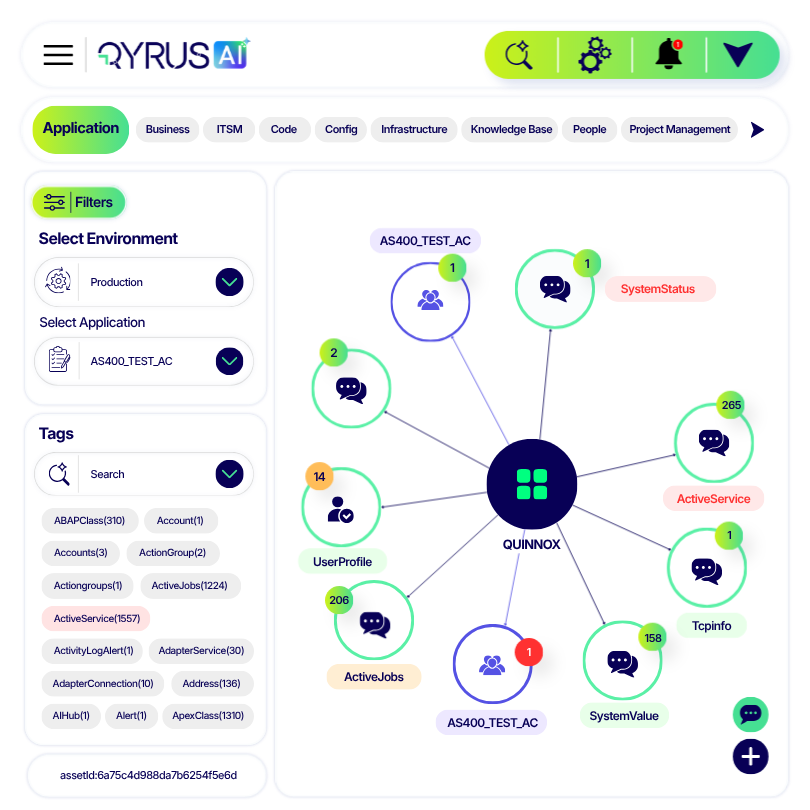
Application Discovery · Dependency Mapping · Legacy Modernization
You cannot modernize
a black box.
Stop relying on outdated spreadsheets and tribal knowledge to plan your transformation. Qyrus Auto Discovery continuously maps your applications, hidden dependencies, and infrastructure in real time
- 100% Complete visibility across on-prem, cloud, and hybrid
- Real-Time Continuous discovery—always current, never stale
- 180+ Zombie apps discovered in one customer assessment
Challenges
You are making multi-million dollar decisions
based on assumptions.
Most enterprise IT teams have tools that can scan a network and spit out a massive, flat list of servers, IPs, and applications. But when a critical service goes down, or you are tasked with modernizing a legacy system, a flat list is useless. Leading to:
Outdated Inventories
Your application inventory is stale the moment it's created. Static spreadsheets can't keep up with dynamic IT environments. CMDBs are 30-40% inaccurate within 6 months. Shadow IT goes completely undetected. Manual updates are time-consuming and incomplete.
Wasted Modernization Spend
You're migrating applications that should be retired, and paying to maintain infrastructure nobody uses. Zombie applications consume budget with zero value, cloud costs spiral from unnecessary migrations, and technical debt moves to expensive environments.
Hidden Dependencies
You don't know what's connected to what—until something breaks. Critical dependencies are discovered too late and retirement decisions cause unexpected outages. As such, migration impact becomes impossible to predict.
Risk & Compliance Gaps
You can't secure, govern, or audit what you can't see. Unmanaged applications create security vulnerabilities and compliance blind spots expose your organization. Audit trails are incomplete or missing and governance policies can't be enforced consistently.
How it works
How Auto Discovery Works
in QyrusAI.
Continuous, intelligent discovery that gives you a complete, always-current view of your entire application landscape
Cloud, on-prem, hybrid covered fully
QyrusAI’s Auto-Discovery Engine continuously scans across cloud infrastructure, on-premise systems, and hybrid architectures without gaps between environments. There’s no separate tool for each environment type and no manual reconciliation between them. One engine covers the full estate, so nothing falls into a blind spot between platforms.
Applications and microservices captured individually
Beyond infrastructure, the engine identifies individual applications and microservices as distinct, trackable entities. This matters in modern architectures where a single business function might be split across dozens of small services. Capturing each one individually means nothing hides inside an aggregate “system” view.
New assets identified as they appear
Scanning runs continuously rather than on a schedule, so new assets are identified the moment they’re provisioned. A server spun up, a microservice deployed, or a container instantiated shows up in the discovery layer immediately. This real-time capture is what separates continuous discovery from a periodic inventory sweep.
Unauthorized systems brought into view
Continuous scanning surfaces infrastructure and applications that were never officially provisioned or documented — Shadow IT and other unmanaged assets. These are often the riskiest parts of an environment precisely because no one is watching them. Bringing them into the discovery layer closes a governance gap that periodic audits routinely miss.
Beyond assets, into connections
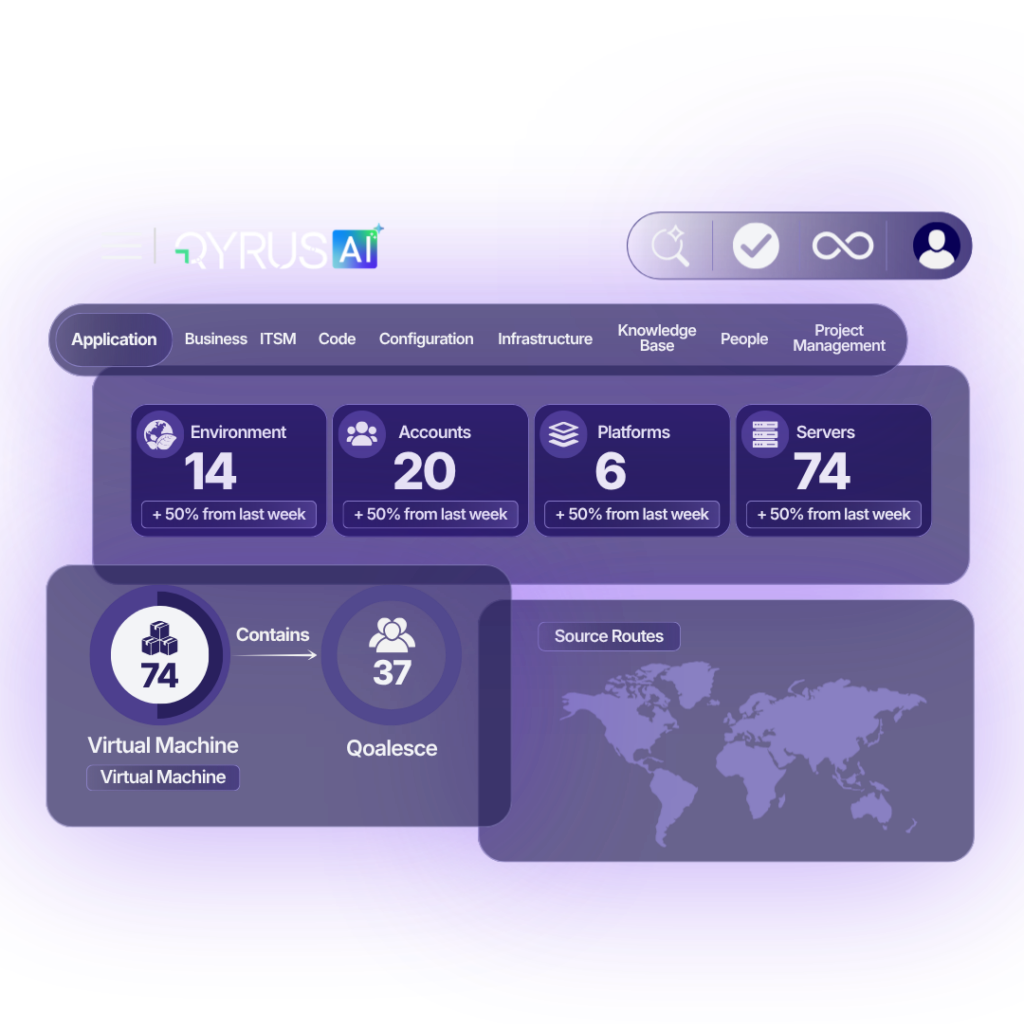
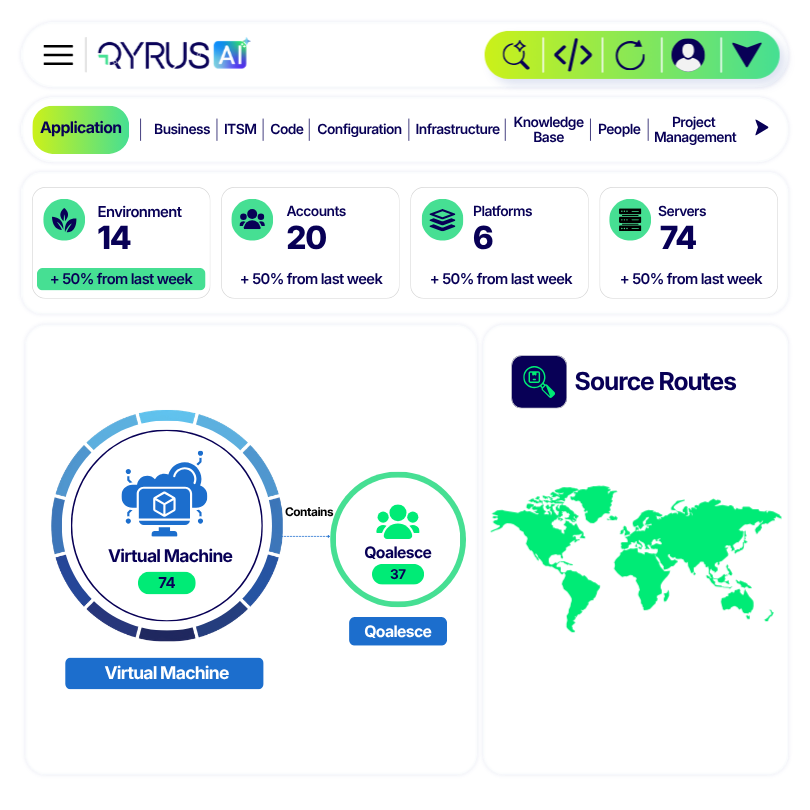
Discovery doesn’t stop at identifying what exists — QyrusAI also captures the relationships between systems, across multiple tiers of the stack. An asset in isolation tells you little; an asset in context tells you what depends on it. This connective layer is what turns a list of assets into a usable map.
Complex interdependencies made visible
Every discovered application and service is linked to the systems it interacts with, however complex that web of connections gets. This visibility replaces guesswork about “what talks to what” with a direct, queryable view. It’s the connective tissue that discovery alone can’t provide on its own.
Software tied to what runs it
Applications are explicitly linked to the infrastructure they run on — servers, VMs, and network paths — rather than tracked as an abstract layer floating above it. This closes the gap between “what software exists” and “what it actually depends on to run.” That link is foundational for any change made downstream.
The starting point for dependency intelligence
This relationship data is the entry point into QyrusAI’s full dependency mapping capability, where correlation, ticket intelligence, and deeper modeling take over. Discovery hands off a clean, connected dataset rather than a raw asset list. (See the Dependency Mapping page for the full architecture of how these relationships are correlated and modeled).
A unified model, not a database
Discovered assets and mapped relationships feed directly into QyrusAI’s Enterprise Knowledge Graph. Unlike a static CMDB, the graph is built to represent how the environment actually behaves, not just what was configured. It becomes the shared reference point every other capability draws from.
Systems understood, not just listed
The Knowledge Graph doesn’t just record that components exist — it captures the context of how they relate to each other and to the business services they support. This context is what makes the difference between “we have an inventory” and “we understand our environment.” Context is what teams actually need when something goes wrong.
The model updates as systems change
Because it’s fed by continuous discovery, the graph stays current automatically rather than requiring scheduled refreshes. As the environment evolves, the model evolves with it. Teams working from the graph are always looking at today’s reality, not last quarter’s snapshot.
The definitive source IT operations run on
The Knowledge Graph functions as the definitive reference point IT operations run on — the “brain” behind incident response, automation, and planning decisions. Every downstream capability, from remediation to rationalization, ultimately queries this same source of truth. One graph means one version of reality across the platform.
Raw discovery becomes actionable intelligence
With a complete contextual model in place, QyrusAI generates AI-driven insights instead of leaving teams to interpret raw discovery data themselves. Patterns that would take a human analyst hours to spot are surfaced automatically. This is the point where discovery stops being a map and starts being a decision aid.
Known issues resolved without manual steps
The contextual model enables automated remediation workflows that act on issues without waiting for manual intervention. Because the system understands dependencies, it can resolve problems without guessing at blast radius. This shortens the distance between detecting a problem and actually fixing it.
Context-aware triage and routing
Incidents are triaged and routed using the same contextual model that powers discovery and mapping, rather than a disconnected ticketing process. This means incident response starts with an accurate picture of what’s affected instead of building one from scratch mid-incident. Faster context means faster resolution.
The pipeline feeds itself, continuously
Every action taken — remediation, incident resolution, automation — feeds back into the discovery and graph layers, refining the model further. This closes the loop from Discovery → Mapping → Knowledge Graph → AI Automation into something self-reinforcing. The system doesn’t just act on intelligence; it keeps getting smarter from the results of acting.
The Shift to Continuous Discovery
QyrusAI shifts IT visibility from a painful, six-month manual assessment into a continuous, automated, intelligence-driven process. We don't just tell you what servers are running; we give you the business context of your entire ecosystem.
Continuous, Cross-Environment Discovery
Seamlessly map physical servers, virtual machines, cloud instances, and containers across your entire hybrid landscape without manual intervention.
Contextual Knowledge Graphing
Visualize your IT architecture. The Enterprise Knowledge Graph doesn't just show you what exists; it shows you exactly how business services rely on underlying infrastructure.
Predictive Operations & Insights
Stop waiting for things to break. By analyzing relationships and historical data, the AI engine proactively detects anomalies and predicts potential system failures before they impact users.
Automated Remediation Workflows
Reduce manual firefighting. Qyrus utilizes its deep system intelligence to safely automate responses to common infrastructure issues and incident triggers.
A GLIMPSE ON THE NUMBERS
Outcomes & Benefits
Qyrus automatically maps every dependency across your application landscape—in real time.
Reduced Modernization Effort
Smaller Migration Scope
Faster Time to Value
Cost Savings
Surprise Breakages
Decision Confidence
Continuous testing. Continuous learning. Continuous value.
Join leading enterprises
driving the loop forward.
Integration
Works With Your Existing Enterprise Stack.
QyrusAI Modernize connects to your existing tools — CMDBs, ITSM platforms, cloud providers, and enterprise architecture repositories — so discovery enriches the tools you already use rather than replacing them.
CUSTOMER TESTIMONIALS
Enterprises running the loop
in their own words.
Real Teams. Real Outcomes. Real Confidence in what ships next.
Qyrus not only supports the testing of our Web, Mobile, and API components as part of our CI/CD processes, but also in ongoing regression-testing across our partner ecosystem. The real power of Qyrus is that we have this extremely broad testing capability in one tool, run in the cloud, and reusable across all our development teams.
The transition to Qyrus has marked a significant turning point for us. By embracing automation, we not only streamlined our SAP test automation process but also achieved a remarkable reduction in overall project testing time by 40%.
... the Qyrus platform have been a great addition to Monument's product delivery capabilities. Within a few months, we have been able to create a comprehensive test suite of complex end-to-end test scenarios spanning multiple platforms and channels. The Quinnox team has helped us embed the Qyrus solution, and the supporting processes around it, into our agile delivery methodology.
Resources
Go Deeper on QyrusAI for Legacy Modernization
October 15, 2026 |
4 min
Data-Rich, Context-Poor: Why Enterprise AI Fails Without Context—And How to Fix It
Read More
October 14, 2026 |
5 min
The Cost of Flying Blind: Why Disconnected IT Operations Bleed Business Value
Read More
October 9, 2026 |
8 min
Application Discovery and Dependency Mapping: The First Step Before You Modernize Anything
Read More
September 24, 2026 |
6 min
How a Global Data & Analytics Leader Scaled SAP GUI and Fiori Test Automation for Complex BRIM Workflows
Read More
September 17, 2025 |
5 min
From Bottlenecks to Breakthroughs: A Coca-Cola Bottler’s Quality Transformation
Read More
June 27, 2025 |
5 min
AI-Powered Testing Transforms One of the Largest Beverage Companies
Read MoreBlog
October 15, 2026 |
4 min
Data-Rich, Context-Poor: Why Enterprise AI Fails Without Context—And How to Fix It
Read More
October 14, 2026 |
5 min
The Cost of Flying Blind: Why Disconnected IT Operations Bleed Business Value
Read More
October 9, 2026 |
8 min
Application Discovery and Dependency Mapping: The First Step Before You Modernize Anything
Read MoreCase Study
September 24, 2026 |
6 min
How a Global Data & Analytics Leader Scaled SAP GUI and Fiori Test Automation for Complex BRIM Workflows
Read More
September 17, 2025 |
5 min
From Bottlenecks to Breakthroughs: A Coca-Cola Bottler’s Quality Transformation
Read More
June 27, 2025 |
5 min
AI-Powered Testing Transforms One of the Largest Beverage Companies
Read MoreReports
Whitepaper
FREQUENTLY ASKED QUESTIONS
Common Questions About QyrusAI Modernization
Lorem ipsum dolor sit amet, consectetur adipiscing elit, sed do eiusmod tempor
incididunt ut labore et dolore magna aliqua. Ut enim ad minim veniam, quis nostrud.
How is this different from a CMDB or an EA repository like LeanIX?
Does Qyrus Modernize work with SAP S/4HANA migrations?
Yes — and SAP migrations are one of the highest-urgency use cases. QyrusAI reads your SAP environment in read-only mode, inventories all RFCs, IDocs, OData services, SOAP connections, CPI integrations, background jobs, and Z-objects, and produces a blast-radius score for every proposed S/4HANA change. The Estate X-Ray and Phase Zero governance workflow are specifically designed for ECC-to-S/4HANA programmes with fixed cutover dates.
How long does the initial discovery scan take?
The first scan of a mid-market estate (200–400 applications) typically produces an initial topology map within 48–72 hours. The map enriches continuously from that point — adding confidence detail, business-service attribution, and dependency validation as more signals are observed. A Phase Zero engagement (discovery, dependency mapping, and modernization prioritization) is typically scoped at 4–6 weeks.
Does it require agent installation on every system?
No. QyrusAI reads from APIs, connectors, log streams, and cloud provider metadata — it does not require an agent on every application or server. For some legacy on-premise environments a lightweight collector may be deployed, but this is scoped per engagement and never required across the full estate before value is delivered.
What happens to the modernization plan if the estate changes while the programme is running?
The Knowledge Graph is continuously updated. If a new application is deployed, a dependency changes, or a system is decommissioned mid-programme, the change is reflected in the graph and the modernization wave plan is re-scored automatically. Your transformation plan is always based on the current estate, not the estate as it was when the programme started.
Does Qyrus Modernize integrate with Assure for testing?
Yes — this is the core joint value of the two pillars. Every modernization slice Modernize produces is automatically handed to Assure for equivalence testing. Assure generates test cases from the code analysis output, runs them against the modernized slice, and produces an evidence record before any release decision is made. The conversion is never marked complete until Assure has proved it works.
• STAY AHEAD, STAY IN THE LOOP.
Stop monitoring. Start anticipating.
You can’t automate what you don’t understand. It’s time to move past flat spreadsheets and basic discovery tools. Bring true contextual intelligence to your IT operations with the QyrusAI.
Lorem ipsum dolor sit amet, consectetur adipiscing elit. Ut elit tellus, luctus nec ullamcorper mattis, pulvinar dapibus leo.