From Alert Fatigue to Autonomous Healing: Why 2026 Is the Year IT Stops Waiting for Humans
 Varun RS
The Alert Fatigue Problem Hasn’t Gone Away, It’s Gotten Louder
The modern enterprise IT landscape has developed into a complex, delicate network of hybrid cloud infrastructure, agile microservices, external APIs, and legacy software. To maintain visibility across this rapidly expanding architecture, organizations have historically adopted a strategy of accumulating monitoring platforms.
From Application Performance Monitoring (APM) and Network Performance Monitoring (NPM) to Security Information and Event Management (SIEM) systems, the dominant industry belief was clear: implementing additional monitoring tools would inherently result in quicker incident resolution. Rather, this buildup has resulted in a constant, overwhelming stream of operational data that clouds root causes instead of clarifying them.
Why more monitoring tools created more problems
The vast amount of telemetry produced by extensively distributed systems has fundamentally exceeded human cognitive ability. In modern corporate IT environments, the data illusion is prevalent: dashboards are perpetually lit with metrics, logs continuously stream, and alerts activate in real-time across separate systems.
Nonetheless, rather than providing clear guidance, operations teams encounter highly fragmented visibility and isolated workflows. The main architectural flaw of the contemporary monitoring stack is its basic dependence on segregated telemetry silos. Performance tools monitor latency, IT Service Management (ITSM) systems oversee incident tickets, and security platforms record unauthorized access attempts; however, very few of these systems have the contextual intelligence to comprehend how their individual data layers connect.
When a singular anomaly occurs, such as a particular network lag or a database schema inconsistency, cascading failures trigger numerous redundant alerts simultaneously across different independent monitoring systems.
Due to the absence of a unified dependency graph, these systems regard each symptom as a separate crisis. The phenomenon resulting from this, referred to in the industry as alert fatigue, is not just a psychological issue; it represents a quantifiable, escalating operational crisis.
Alert fatigue develops gradually as Site Reliability Engineering (SRE) and Security Operations Center (SOC) analysts are exposed to high volumes of repetitive, low-value alerts over extended periods, gradually eroding their sensitivity to critical warnings.
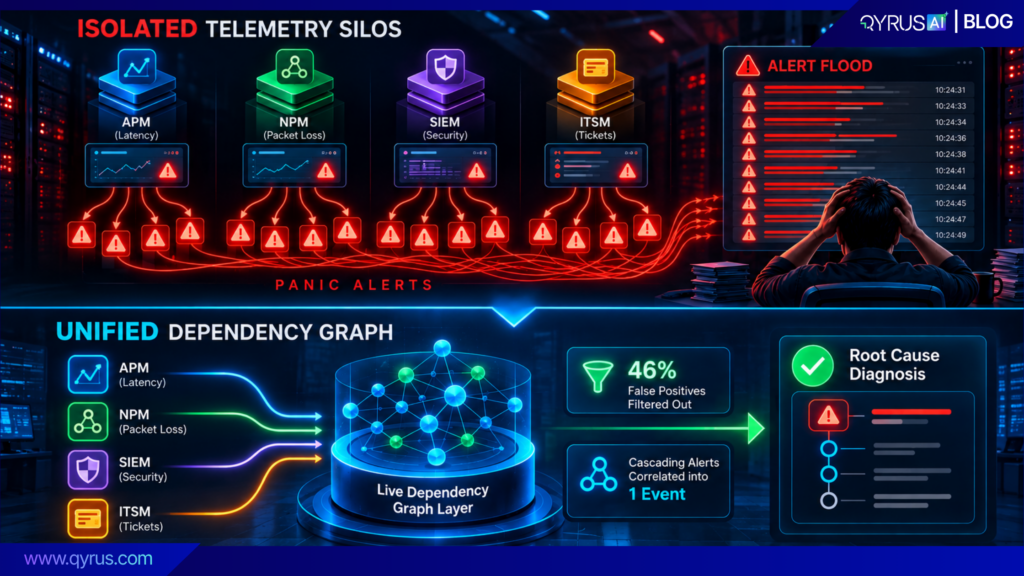
Recent operational studies show that the typical enterprise SOC gets an astonishing 3,832 alerts each day. Since human teams can’t manually handle this volume, analysts typically overlook about 40% to 62% of all incoming alerts. Compounding this crisis, an estimated 46% of these triggered alerts are false positives.
This persistent, unmanageable noise significantly elevates organizational risk. The saturation of benign or redundant alerts drastically increases the probability that analysts will overlook legitimate, potentially catastrophic infrastructure failures, rendering the very tools designed to protect the enterprise functionally detrimental.
The impact of MTTR sitting at hours, not minutes
When alert volumes exceed manual triage capabilities, Mean Time to Resolution (MTTR) stalls, and the resulting financial consequences become significant. IT downtime is not just a localized technical issue confined to the IT department; it has become a direct financial liability at the boardroom level that disrupts worldwide supply chains, halts transactional revenue streams, and causes enduring harm to brand equity. The financial repercussions of a system failure increase exponentially with the reliance of today’s businesses on constant, real-time digital functions.
The economic implications of downtime have greatly deteriorated as infrastructure complexity has intensified. Traditionally, industry analysts depended on recognized baseline indicators to measure this risk.
Nonetheless, current information shows a significant rise in outage expenses, largely influenced by the incorporation of sophisticated Artificial Intelligence (AI) tasks, edge computing, and closely linked automated supply chains that cannot withstand delays or interruptions.
Reporting Organization / Context | Estimated Cost of IT Downtime | Analytical Findings & Contextual Drivers |
$5,600 per minute ($336,000/hour) | A widely cited foundational average spanning all organizational sizes, establishing downtime as a six-figure hourly liability. | |
>$300,000 per hour | Field data indicates that more than 91% of mid-size and large enterprises report hourly downtime costs consistently exceeding this threshold. | |
Splunk / Oxford Economics (2026) | $15,000 per minute ($900,000/hour) | The average cost for the Global 2000, driven by massive transactional revenue impact, regulatory compliance penalties, and SLA breaches. |
Siemens (Automotive Manufacturing) | $2.3 Million per hour | Specific to complex manufacturing; this figure has doubled since 2019 due to the extreme fragility of just-in-time automated supply chains. |
The prolonged duration of MTTR at hours instead of minutes is mainly due to the manual aspects of the diagnostic phase. Upon a failure, the financial clock starts immediately, but engineers must dedicate the initial vital hours to manually reverse-engineering unprocessed system logs, cross-referencing telemetry from isolated observability tools, and trying to identify the root cause by painstakingly mapping disconnected dependencies manually.
Teams frequently misidentify upstream infrastructure events, like localized power grid issues, as standalone equipment failures at the site, sending engineering teams without need while the actual problem persists. Addressing this multi-million-dollar crisis necessitates a transition in the operational model from manual data correlation to autonomous, context-sensitive system intelligence.
The Industry Is Moving Past Detect and Notify
As the severe limitations and hidden costs of traditional, reactive monitoring become undeniably apparent to enterprise leadership, the IT operations landscape is undergoing a systemic architectural shift. The year 2026 marks the definitive inflection point where passive observability, the practice of simply detecting an error and notifying a human, is being aggressively replaced by active, intelligent, and autonomous operations.
What analysts mean by outcome-driven operations
Leading industry analysts have completely redefined the expectations for enterprise IT operations in 2026, highlighting a definitive transition away from passive reporting toward what is now termed “outcome-driven operations“. In previous iterations of IT operational maturity, success was measured purely by the deployment footprint of monitoring tools and the raw volume of metrics collected. Currently, the operational directive to merely “maintain the lights” coexists with requirements. These include supporting enterprise AI at scale, controlling rising cloud technology costs, securing distributed zero‑trust environments, and delivering clear business outcomes.
Outcome-driven operations means focusing on fixing real business problems instead of constantly watching dashboards or dealing with endless alerts.
The ideal goal is to keep systems available, improve performance, control costs, and make sure everything meets the required SLOs.
In this approach, observability does more than collect data. It helps teams understand what is happening, find problems faster, and take action. I&O leaders are also bringing different observability tools together and using AIOps to reduce unnecessary alerts, connect related issues, find the root cause, and even fix some problems automatically.
The focus is on getting the problem solved, whether that means restoring a microservice, improving a database, or stopping a security threat, rather than simply creating another support ticket.
Agentic remediation vs. rule-based automation: what’s actually different
To achieve the promise of outcome-driven operations, organizations have historically relied heavily on runbook automation. It is important to understand that traditional rule-based automation and modern agentic AI represent two entirely different, and largely incompatible, computational paradigms.
Early rule-based automation (often called AIOps 1.0) relies heavily on basic “if-then” scripts. For instance, an engineer might set a rule that automatically restarts a service if CPU usage tops 90% for five minutes.
That kind of rigid setup works fine when your environment is stable and predictable. But the moment you apply it to today’s complex, constantly shifting cloud setups, it starts to break down.
The main issue is that traditional scripts don’t have any context. They blindly follow orders without understanding how their actions impact other systems, what’s happening upstream, or how the network layout might have changed.
Because they are so inflexible, even a minor update can instantly break hundreds of automated workflows. Instead of saving time, IT teams end up stuck in a never-ending cycle of fixing broken runbooks, which completely defeats the purpose of setting up automation to begin with.
Conversely, agents powered by AI are capable of independent thought and action. Rather than merely sticking to a strict script, they approach issues similarly to how a skilled human IT expert would.
In contrast, agentic remediation utilizes Large Language Models (LLMs) and sophisticated multi-agent systems to function with true systemic independence. Rather than relying on hardcoded rules, agentic systems are defined by four core, dynamic capabilities: perception (the ability to observe and interpret the real-time environment state), reasoning (the capacity to understand context and map causal relationships), planning (the ability to determine dynamic, multi-step action sequences to achieve a goal), and action (the capability to execute targeted interventions through APIs or Infrastructure-as-Code).
Rather than adhering to a fixed script that breaks down with unforeseen variables, agentic AI evaluates the present state of the environment, creates a customized remediation strategy based on real-time dependency information, and carries it out independently.
Additionally, agentic systems have memory; they do not re-assess every known variable anew in subsequent, similar situations. By recalling environmental context and learning continuously from past failure modes, these systems can self-heal broken architectural components, dynamically update their own locator scripts when application user interfaces change, and make complex engineering decisions with a level of adaptability that mirrors human cognition, without the associated latency, bias, or fatigue.
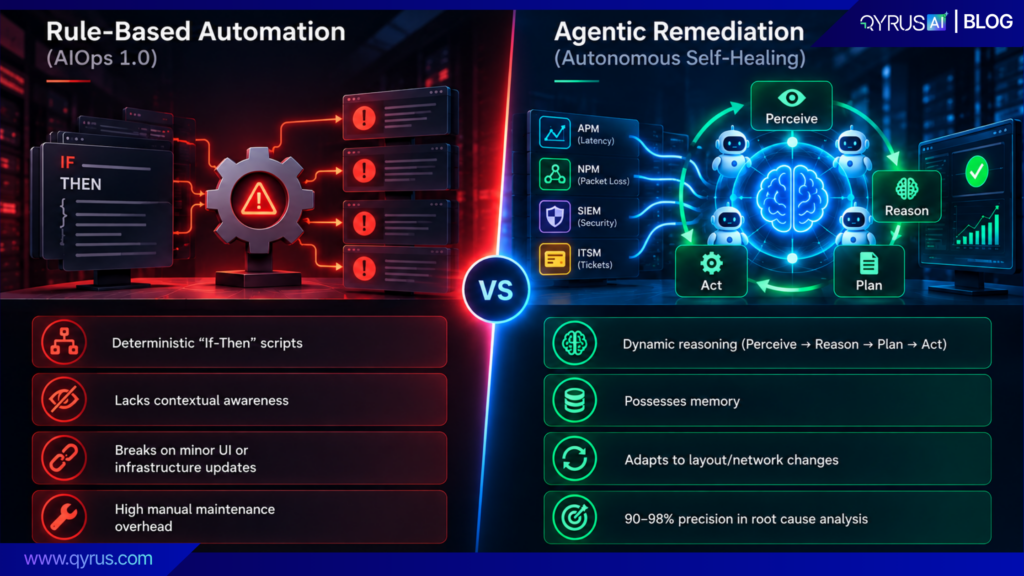
Recent empirical research on agentic AI deployment within Site Reliability Engineering (SRE) demonstrates that these autonomous systems can achieve an astonishing 90-98% precision in root-cause analysis, driving 55-98% improvements in MTTR over traditional, rule-based automation approaches.
What a Self-Healing Loop Actually Looks Like
Self-healing means creating systems that can find and solve problems by themselves. For this to function properly, the system must gather information and figure out what is not working and then do the thing without waiting for a person to get involved. It also needs to remember problems, so those same issues do not happen again.
Auto Discover → Auto Detect → Auto Diagnose → Auto Resolve → Auto Optimize
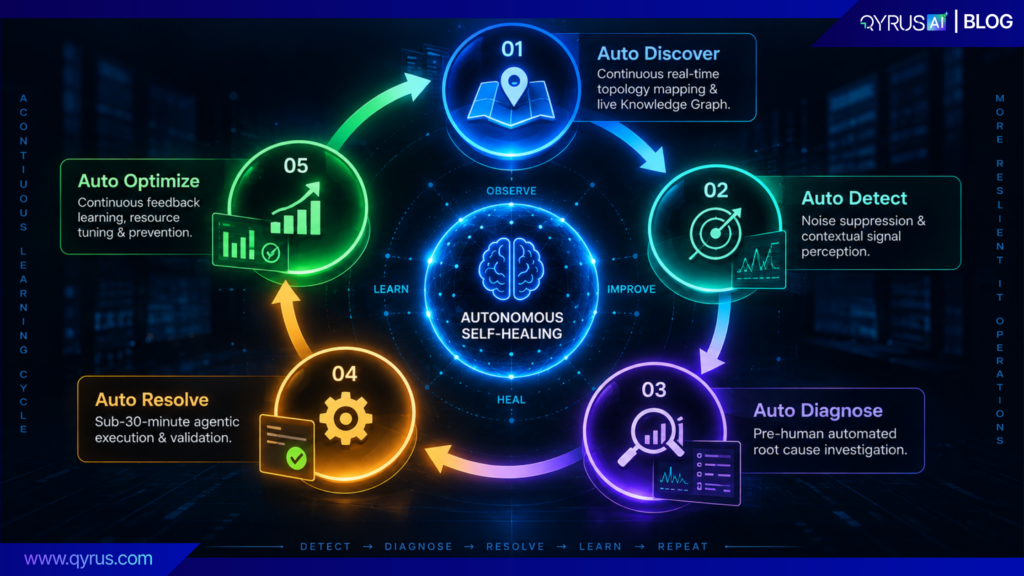
The shift from IT operations to a fully autonomous self-healing enterprise must follow a clear five step path. When executed correctly, this continuous loop entirely eliminates the manual triage bottlenecks that conventionally delay incident resolution.
- Auto Discover (Continuous Real-Time Mapping): The first step in self-healing is knowing what is happening across the entire IT environment. Instead of relying on old CMDBs that need to be updated manually, self-healing systems can automatically keep track of the environment. They map servers, virtual machines, cloud networks, edge applications, and how they are connected. This gives teams a clear, up-to-date view of the entire environment.
- Auto Detect (Contextual Perception & Noise Suppression): The knowledge graph perpetually charts the surroundings, as the system absorbs millions of signals, logs, and traces. Since the agentic system inherently comprehends the current network topology, it can readily differentiate between a slight, localized variation and a significant, cascading anomaly. This situational understanding minimizes intrusive alert sounds from the entire stack, significantly lowering the rate of false positives and averting analyst exhaustion.
- Auto Diagnose (Pre-Human Root Cause Analysis): When a genuine anomaly happens, the system leverages the live dependency graph to pinpoint precisely how the failure is spreading throughout the infrastructure, microservices, and applications.
- Through automated causal reasoning, it completely avoids the conventional manual investigation stage. The system transforms a basic, contextless alert into a completely diagnosed, prioritized issue prior to a human operator logging into the dashboard.
- Auto Resolve (Agentic Execution): Once the main problem is clearly seen, the platforms smart AI creates a focused plan to fix it and carries it out on its own using APIs or connected automation tools. What usually needs one to ten hours of manual escalation, cross-team collaboration, ticket routing, and diagnostic triage is now shortened into a great resolution time of under 30 minutes.
- Most importantly, the system then runs automated validation checks to confirm that the executed fix holds, ensuring that no secondary failures or unintended consequences were triggered by the remediation effort.
- Auto Optimize (Continuous Prevention): Self-healing operations are basically proactive rather than reactive. The system feeds the incident data and remediation outcome back into the knowledge graph, once the resolution is successful.
The platform uses this historical intelligence to forecast future availability and capacity needs, dynamically tune cloud resources, and identify fragile or “noisy” infrastructural components that require architectural hardening. This guarantees that the infrastructure is perpetually learning, evolving, and immunizing itself based on its own operational history.
Where Digital Twins and Chaos Engineering fit into prevention, not just recovery
To attain genuine, enterprise-level operational resilience, organizations need to progress beyond just rapid recovery from failures; they must recognize and address critical vulnerabilities prior to their occurrence in production. This heightened level of preparedness is attained by incorporating the principles of Digital Twins and Chaos Engineering within the self-healing operational cycle.
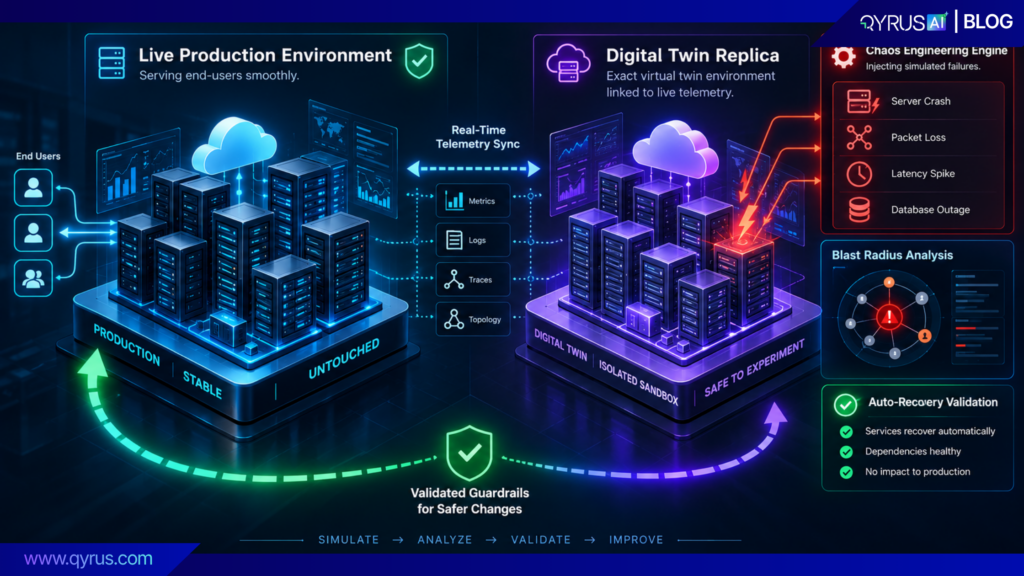
A Digital Twin, within contemporary IT operations, is an accurate, real-time virtual representation of the complete enterprise environment. This encompasses all active applications, network frameworks, security measures, cloud dependencies, and current configurations. Instead of implementing unverified and risky changes directly in a live environment that customers see, operations and security teams use an “Intelligent Twin” to accurately simulate the potential effects of intended code deployments, infrastructure migrations, or intricate configuration updates.
By testing the suggested modifications on the virtual model, the system can compute the exact “blast radius” of any potential failure, guaranteeing that disastrous go-live events are detected, examined, and completely avoided within the simulation framework.
Chaos Engineering enhances the effectiveness of the Digital Twin even more. It entails deliberately creating regulated, chaotic situations, like abrupt server failures, high network delays, data packet loss, or sensor information errors, within the system to proactively evaluate its limits of resilience.
Starting with large tech firms like Netflix through tools such as Chaos Monkey, this approach is similar to administering a non-threatening vaccine into a biological organism to securely develop enduring immunity. Historically, conducting Chaos Engineering directly on live production systems carried immense financial and operational risk, deterring widespread enterprise adoption.
However, modern approaches utilize the Digital Twin (an approach heavily researched in academia under the moniker “ChaosTwin”) to safely and continuously inject massive faults into the virtual replica rather than the live network.
By running these automated failure simulations against the Digital Twin, the self-healing platform can safely observe how the architecture reacts under extreme duress. It can validate whether automated failover and recovery mechanisms function correctly, calculate the Failure-Domain Independence Factor (FDIF), and systematically harden the underlying architecture against rare, high-impact regional disruptions before they can cause actual production downtime.
Human-in-the-loop guardrails: why full autonomy isn’t (and shouldn’t be) the goal yet
Despite the highly advanced diagnostic and execution capabilities of agentic AI, the objective of enterprise self-healing operations is not the total, unchecked removal of human oversight. In complex corporate environments, trust remains the foundational currency of all AI adoption.
Smart systems must work inside rules that are strictly managed, very clear, and fully understandable. Letting AI bots independently run harmful, costly, heavy, or very delicate system updates, such as erasing databases or altering main safety walls, without any human watching brings huge rule, legal, and work dangers. Therefore, ready auto-fixing platforms are built to require strict human-involved (HITL) limits.
In this mixed work model, the AI does the deep, heavy load work: constantly taking data, quickly mapping links, finding the exact base cause, making a complete fix plan, and filling the exact run script. But, for key systems or risky system moves, the bot deliberately stops its process to ask clear human approval.
In this process, the human worker is raised from a hand “doer” to a smart leader and approver, checking the AI’s logic and blast-radius check before allowing running. This guarantees that normal, safe issues are fixed instantly without help, while hard, new, or key system fixes stay closely matched with strict company rule guidelines and legal orders.
True autonomy, in this sophisticated context, does not recklessly remove human control; rather, it greatly enhances control by ensuring that highly paid human engineering intelligence is applied only where it is strictly necessary and most valuable.
The Business Case Beyond Fewer Tickets
The enterprise value proposition of autonomous self-healing operations extends exponentially beyond the basic operational metric of reducing the raw volume of ITSM helpdesk tickets. Implementing a closed-loop autonomous system fundamentally reshapes the core economics of IT operations, elevating infrastructure management from a reactive, unpredictable cost center to a highly strategic enabler of business resilience and continuous growth.
MTTR reduction and uptime as boardroom metrics
In 2026, infrastructural resilience must be engineered deeply into systems by design, rather than being treated as an external, reactive backup plan. As a direct result of this shift, Mean Time to Resolution (MTTR) and system uptime percentages have completely transitioned from being purely technical Key Performance Indicators (KPIs) discussed in the server room, into critical boardroom metrics scrutinized by the C-suite and investors.
Because complex enterprise downtime now costs hundreds of thousands or millions of dollars per hour, the ability to resolve incidents autonomously within minutes directly protects corporate revenue streams and preserves market capitalization.
Using smart AI and auto-fixing system tools brings massive, clear drops in fix-times, with proven repair time gains going from 55% to a huge 98%. By catching weird system actions quickly and stopping the main cause before it can turn into a public, user-facing crash, companies can ensure unmatched, steady rates of uptime.
Always high online numbers help to calm senior leaders, meet tough rules with strict Service Level Agreements (SLAs), and strongly guard the brand’s name in very busy, always-on online spaces where user patience for lag is non-existent.
Freeing L2/L3 talent for high-value work instead of firefighting
Perhaps the most profound, yet often under-measured, organizational impact of self-healing operations is the immediate liberation of highly skilled, difficult-to-retain engineering talent. In traditional, reactive IT models, Level 2 (L2) and Level 3 (L3) engineers are frequently consumed by a perpetual cycle of reactive firefighting.
Countless engineering hours are lost daily tracing obscure network propagation paths, manually investigating false-positive security alerts, and writing repetitive scripts to restart stalled services. This chronic, demoralizing cycle of triage severely hampers enterprise innovation, actively delaying critical strategic initiatives such as global cloud migration, legacy system modernization, and enterprise-wide AI integration.
By automating the entire discovery, diagnosis, and remediation loop for the majority of Level 1 and Level 2 incidents, self-healing platforms eliminate the exhaustive, manual labor associated with routine system failures. The 1 to 10 hours typically required to manually escalate, route, and triage a moderate incident is systematically reduced to a highly governed, sub-30-minute automated resolution flow.
This massive paradigm shift allows senior engineering staff to log out of the ticketing queue and focus exclusively on high-value, strategic projects that directly align with long-term business goals. Engineers can concentrate on enhancing intricate system architectures, improving cloud expenditures using FinOps tactics, and speeding up the creation of innovative, income-generating digital products.
How QyrusAI’s Self-Healing Operations Gets There
The realization of this autonomous, resilient future requires an enterprise platform capable of seamlessly unifying continuous observability, intelligent automated testing, and agentic execution into a single operational layer. QyrusAI explicitly bridges the historical divide between quality assurance and IT operations by delivering a comprehensive, closed-loop self-healing ecosystem designed for maximum enterprise scale.
The Auto framework in practice
The core analytical engine driving QyrusAI’s self-healing operations is its proprietary Live Enterprise Knowledge Graph. Unlike static, heavily siloed IT registries that decay the moment they are updated, this shared semantic data layer continuously observes and accurately models every single application, API dependency, business service, and cost line across the entire enterprise. Every operational pillar of the QyrusAI platform consistently reads from this graph, and every automated action taken by the system writes back to it, creating a unified, dynamically living source of truth.
By leveraging this incredibly deep topological context, QyrusAI deploys its agentic Auto-Heal framework through an industry-first methodology known as SEER (Sense, Evaluate, Execute, Report).
- Sense & Evaluate: When an environmental anomaly is detected, QyrusAI instantly evaluates the incoming signal against the vast Knowledge Graph to mathematically deduce the exact blast radius and pinpoint the root cause, entirely bypassing the need for manual human investigation.
- Execute: The platform’s AI agents collaborate to orchestrate a precise remediation plan. Whether the failure involves dynamically updating broken element locators in a complex web application via the Healer AI, or automatically restarting a stalled microservice in a multi-cloud environment, the agentic workflow resolves the issue autonomously, operating safely within predefined human-in-the-loop governance guardrails.
- Report & Prevent: Following successful resolution, the platform immediately updates its internal Digital Twin. It then utilizes advanced Chaos Engineering protocols to run continuous, controlled failure experiments against this virtual replica. This proactively identifies latent architectural weaknesses and hardens the real-world environment against future disruptions before they can manifest.
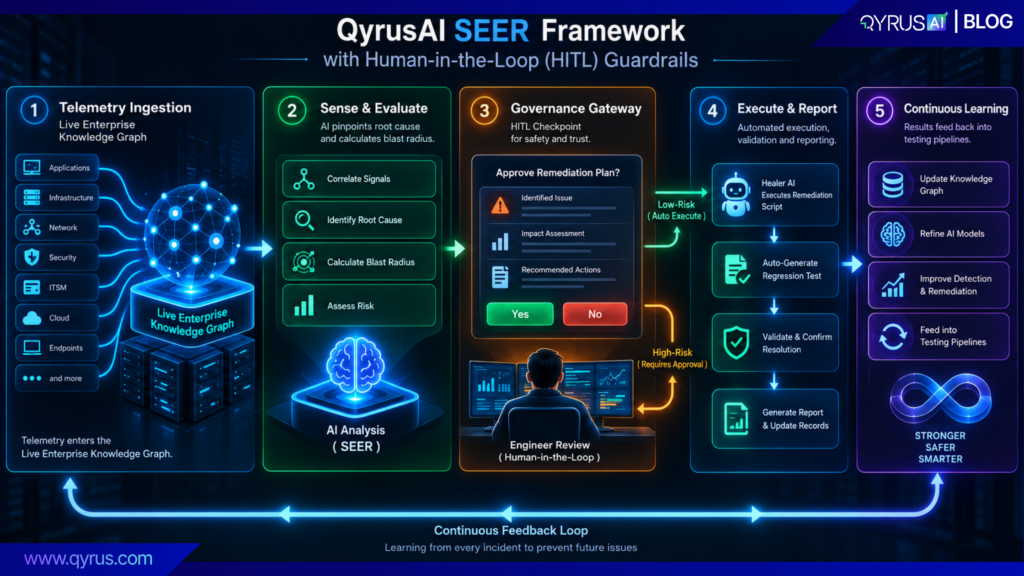
Furthermore, QyrusAI uniquely connects production reality directly back to the software testing pipelines. Every production incident handled by the system automatically generates a reproducible regression test, ensuring that real-world operational evidence is instantly transformed into actionable modernization intelligence. Future code releases are strictly gated by this production-validated evidence, definitively merging quality assurance and operational resilience into one continuous, unbreakable system.
Proofpoints: MTTR reduction, uptime, cost savings from automating L1/L2
Enterprises operating within the QyrusAI self-healing loop consistently experience dramatic, highly measurable shifts in their core operational economics. By moving exhaustive root-cause analysis and complex remediation out of disparate manual workflows and into a governed, autonomous agentic engine, organizations achieve massive scale efficiencies that are impossible with human labor alone.
The deployment of agentic remediation inherently drives down Mean Time to Resolution and time-to-diagnose metrics, collapsing multi-hour triage processes into mere minutes. This direct, aggressive reduction in system downtime translates instantly to maximized system uptime and significantly lower ongoing operational costs.
Furthermore, because the Live Enterprise Knowledge Graph perfectly maps intricate legacy dependencies and complex application interactions, the platform also acts as an indispensable intelligence layer for safe cloud migration waves and legacy application rationalization.
By completely eliminating architectural blind spots, QyrusAI actively prevents the cascade failures that have historically derailed large-scale digital transformation efforts, emphatically proving that autonomous operations are not merely about fixing what breaks, but about fundamentally transforming how the entire enterprise functions and scales.
Getting Started: A Practical First Step
The structural transition from widespread alert fatigue to fully autonomous healing your entire existing IT stack. does not happen overnight, nor does it require a risky “rip and replace” of your entire existing IT stack. The most effective first step for IT leadership in 2026 is moving away from static, rule-based automation scripts and focusing intensely on continuous topological discovery.
Before AI tools can safely and quickly fix a complicated network, the system must completely understand the specific setup it works in. By using a Live Enterprise Knowledge Graph, companies can pull scattered data from older monitoring programs like performance, network, and security trackers. It turns all that messy information into a clear map showing how every piece connects together. After creating this essential blueprint, tech teams can assign easy, repetitive basic helpdesk jobs to AI assistants, making sure real people still check and approve every step for safety. When the AI consistently cuts downtime and proves its value, leaders can safely give it permission to handle harder, more complex network fixes.
Ready to stop reacting and start preventing? Discover how unifying your testing and monitoring engines turns every production incident into an automated defense against the next one. Book a Demo / Talk to an Expert today to see QyrusAI’s Live Enterprise Knowledge Graph and self-healing operations in action.
Frequently Asked Questions (FAQs)
- What is the main difference between traditional AIOps and agentic self-healing? Traditional AIOps primarily relies on basic machine learning algorithms purely for anomaly detection, and uses static, rule-based runbooks (if-this-then-that logic) to automate basic tasks. These rigid rules break instantly when infrastructure or UI elements change. Conversely, agentic self-healing uses Large Language Models (LLMs) and autonomous agents capable of perception, reasoning, planning, and execution. Agentic AI understands dynamic system context and can autonomously generate and apply fixes to entirely new failure modes without requiring predefined, human-written scripts.
- How does a Live Enterprise Knowledge Graph eliminate CMDB maintenance?
Standard Configuration Management Databases (CMDBs) rely on scheduled scans and manual data entry, leaving them hopelessly out of date in fast-moving cloud setups. A Live Enterprise Knowledge Graph tracks everything automatically. It constantly maps out servers, apps, networks, and how they connect in real time, keeping the entire ecosystem accurate and ready to use without requiring anyone to update it by hand.
- What role does a Digital Twin play in self-healing operations?
A Digital Twin is a precise, safe virtual replica of an entire IT environment, tracking every config and security setting. Instead of rolling out changes directly into production and crossing your fingers, teams run simulations inside the Digital Twin first. This serves as a safety check to spot mistakes, bad configurations, or risky failure points long before they can drag down actual business operations.
- Why is Chaos Engineering necessary if a system already self-heals? While self-healing operations resolve incidents autonomously after they occur, Chaos Engineering focuses entirely on proactive prevention. By intentionally injecting controlled, simulated failures (e.g., terminating a core service or introducing severe network latency) into a Digital Twin environment, the system observes exactly how the architecture reacts under stress. This allows engineers to uncover hidden vulnerabilities, validate that failover mechanisms work correctly, and build “immunity” into the system before a real-world crisis strikes.
- Does autonomous remediation mean human engineers are no longer involved? No. Mature, enterprise-grade self-healing frameworks rely heavily on “human-in-the-loop” (HITL) guardrails to maintain trust, safety, and strict regulatory governance. The AI handles the exhaustive heavy lifting of continuous discovery, root-cause diagnosis, and generating a detailed remediation plan. However, for critical systems or high-risk actions, the system automatically pauses to request explicit human authorization before executing the fix. This frees engineers from repetitive triage while ensuring human intelligence remains firmly in control of critical infrastructural decisions.
 September 15, 2026
  21 min