How a Global Data & Analytics Leader Scaled SAP GUI and Fiori Test Automation for Complex BRIM Workflows
 Varun RS
SAP transformation programs are only as fast as the testing behind them. When a Global Data & Analytics Leader found that its existing automation couldn’t keep up with complex SAP BRIM workflows spanning both classic and modern interfaces, it turned to Qyrus Assure. In a focused three-week proof of concept, QyrusAI delivered end-to-end SAP GUI and Fiori test automation on real revenue-critical scenarios. The result was faster execution, more stable scripts, and a project win.
At a Glance
Client | Global Data & Analytics Leader |
Scope | SAP BRIM Revenue Accounting and Reporting (RAR): Periodic and Milestone contract scenarios |
Qyrus capabilities | SAP GUI and Fiori automation, Test Orchestration, Qyrus SAP Scribe, dynamic synchronization, cross-environment and VM-based execution, centralized reporting |
POC duration | Three weeks |
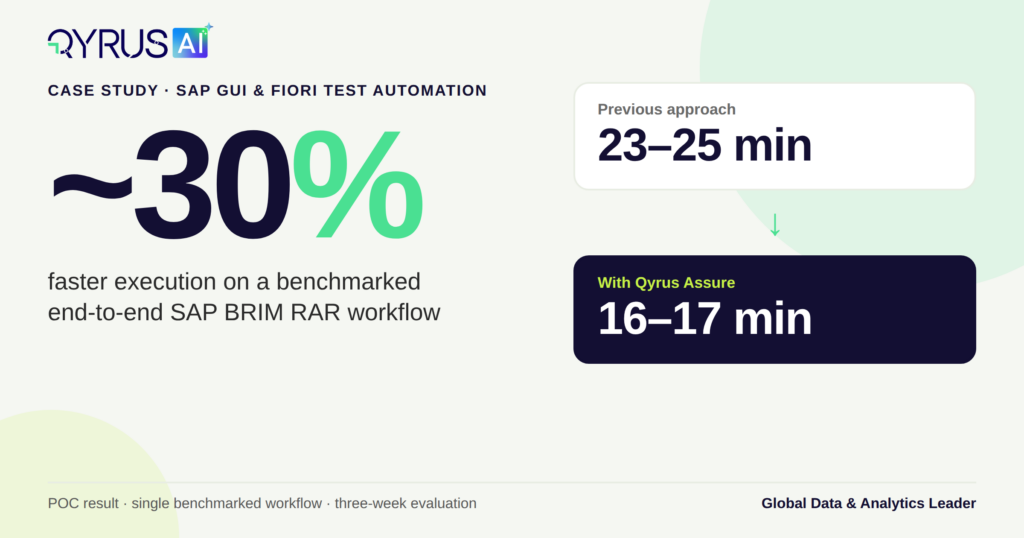
Key result | ~30% faster execution on a benchmarked end-to-end workflow |
Outcome | POC completed successfully; project awarded to QyrusAI |
The Challenge: SAP Testing That Couldn’t Keep Pace With Transformation
A Global Data & Analytics Leader was running an ambitious SAP transformation program. Each new release and regression cycle expanded the testing workload. Their existing automation approach was supposed to absorb that growth, but it was producing fragile scripts and consuming more effort than it saved.
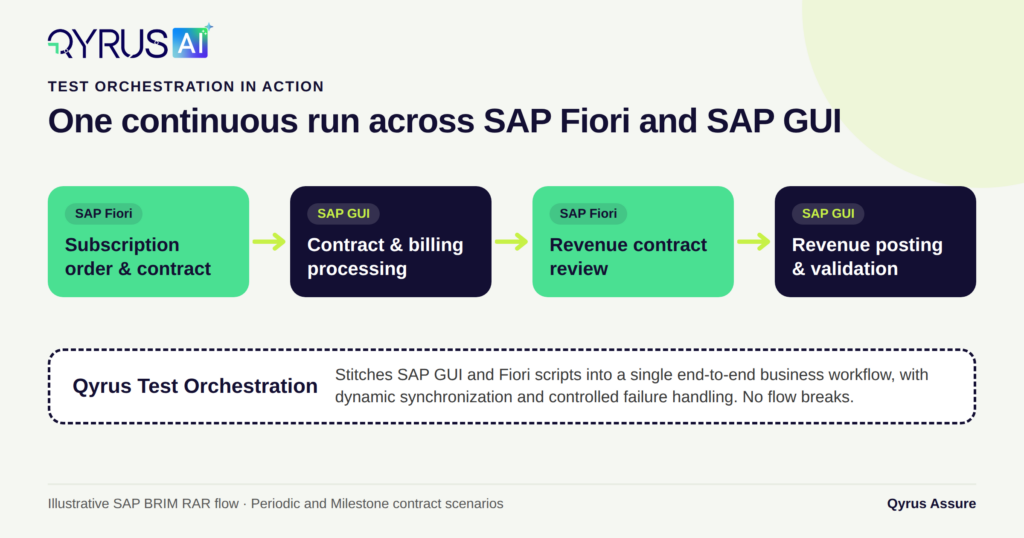
The problem was sharpest in SAP BRIM (Billing and Revenue Innovation Management). SAP RAR addresses revenue recognition in line with accounting standards such as ASC 606 and IFRS 15, so every contract scenario has to be correct from order through to revenue posting. These processes also don’t sit on one interface. A single subscription contract workflow can start in SAP Fiori and finish in SAP GUI, and most automation tools struggle to follow that path without breaking.
The team’s challenges fell into four areas.
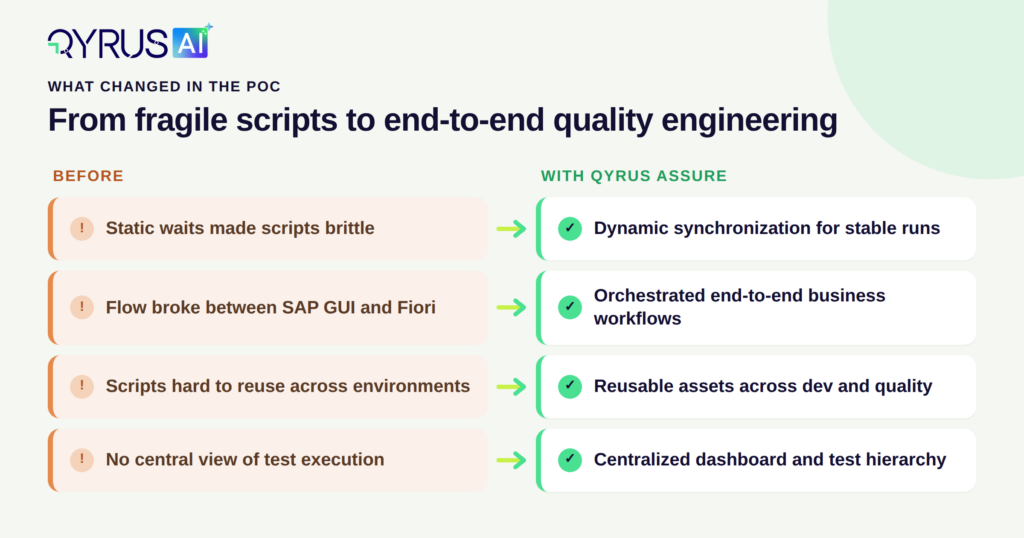
- Automation effort without matching value.
- Building and maintaining automated tests took so much time that the productivity gains never arrived. Scripts, test cases, and datasets were hard to reuse across environments, so teams kept rebuilding work they had already done.
- Hybrid processes that broke the flow.
- End-to-end business processes spanning SAP GUI and Fiori could not be automated as one continuous flow. Existing tools also had limited support for complex, business-level scenarios.
- Unstable, unreliable execution.
- Scripts depended on static waits, which made them brittle and prone to false failures. When a critical step did fail, execution couldn’t reliably stop at the right point. Support for running tests across multiple environments and VM-based setups was limited.
- Poor visibility and heavy manual overhead.
- With no centralized dashboard or structured test hierarchy, managing and monitoring test runs was difficult. Process, training, and testing documentation all required significant manual effort. The organization also saw untapped potential in AI and in integrations with Jira and productivity tools.
The central question was this:
how could the organization scale SAP testing for transformation and regression programs while cutting automation effort, improving execution reliability, and giving the business clear visibility across complex SAP GUI and Fiori processes?
The Solution: An AI-Assisted, End-to-End Approach With Qyrus Assure
Qyrus proposed a focused proof of concept (POC). It would use the client’s real SAP testing scenarios and measurable success criteria, not a generic demo environment. The goal was to prove value on the processes that mattered most to the business.
The solution brought together several Qyrus Assure capabilities.
- SAP GUI and Fiori automation.
- QyrusAI automated both classic SAP GUI transactions and web-based Fiori apps, so business-critical steps were covered regardless of interface.
- Test Orchestration.
- Test Orchestration stitched individual SAP GUI and Fiori scripts into complete end-to-end business workflows. That removed the flow breaks that had previously stopped hybrid processes from being automated as a whole.
- Qyrus SAP Scribe.
- Qyrus SAP Scribe uses custom ERP-aware AI models fine-tuned to a customer’s SAP landscape. It supported AI-assisted test generation, analysis, and documentation, which reduced the manual effort behind process and testing documentation.
- Dynamic synchronization.
- Tests waited for actual application states instead of fixed timers. This replaced static waits and made scripts far more stable.
- Cross-environment and VM-based execution.
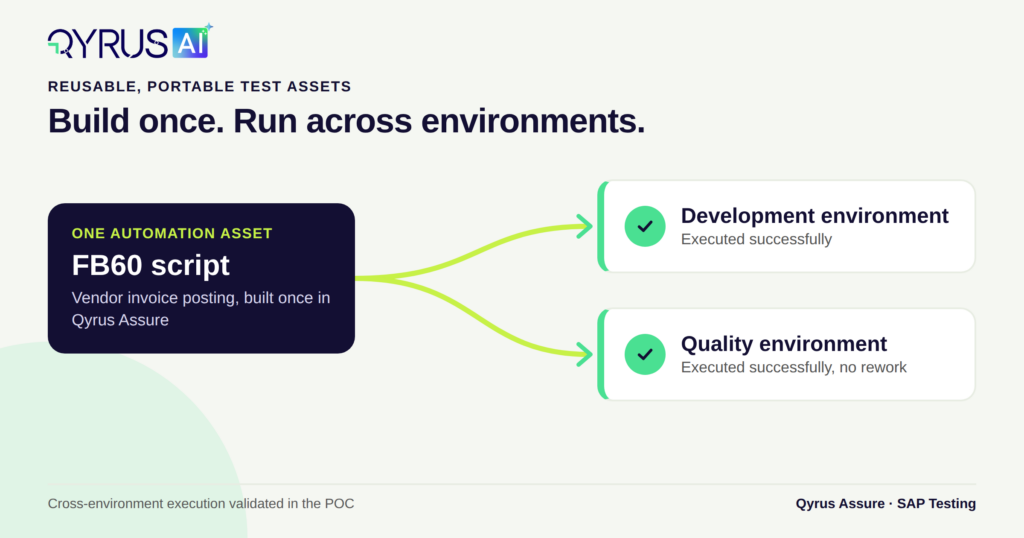
- The same automation assets ran across the client’s development and quality environments without rework. VM-based execution let testers run suites in the background while they continued with other work.
- Centralized reporting and structured test management.
- A single dashboard and a clear test hierarchy gave stakeholders real-time visibility into execution status and results. Controlled failure handling stopped runs at the right point when a critical step failed.
Implementation: A Three-Week POC on Real Business Scenarios
The POC ran as a three-week evaluation cycle. It focused on complex SAP BRIM RAR scenarios involving subscription order and contract processes across SAP Fiori and SAP GUI.
The scope included 17 test cases and scripts covering SAP GUI and Web/Fiori automation, built around Periodic and Milestone contract scenarios. Test Orchestration linked these scripts into complete business workflows. The team also validated cross-environment execution by running the same FB60 automation (vendor invoice posting) in both the development and quality environments.
Business consultants from the client’s Order-to-Cash and Finance teams took part directly in the POC, supported by stakeholders from technical and project functions. Their involvement kept the evaluation grounded in real business logic, not just technical checks.
Results: Faster, More Stable, and Ready to Scale
The POC showed that QyrusAI could automate and orchestrate hybrid SAP GUI and Fiori business processes, run them across environments, and deliver stable, reusable test assets.
~30% Faster Execution
The clearest measurable gain was execution speed. In the POC, one benchmarked end-to-end workflow took about 23–25 minutes under the previous approach and 16–17 minutes with Qyrus. That is roughly a 30% reduction in execution time for that workflow.
What the POC Demonstrated
- End-to-end BRIM RAR coverage. Periodic and Milestone workflows ran successfully as complete business processes.
- Continuous hybrid orchestration. SAP GUI and Fiori scripts ran together with no flow breaks.
- Portable, reusable automation. The same assets ran across development and quality environments without rework.
- Greater script stability. Dynamic synchronization reduced the dependence on static waits that had made earlier scripts fragile.
- Controlled execution. Failure handling and execution monitoring stopped runs at the right point when critical steps failed.
- Centralized visibility. Structured test management and a single dashboard gave teams a clear view of execution status.
- Tester productivity. VM-based execution let testers multitask instead of watching test runs.
- AI-assisted quality engineering. Qyrus SAP Scribe supported test generation, analysis, and documentation.
- Broader testing scope. Automation extended into RICEF objects and configuration and unit-testing scenarios.
After the POC was completed, the Global Data & Analytics Leader awarded the project to Qyrus.
Why This Matters for SAP-Driven Enterprises
This organization’s situation is increasingly common. SAP has announced that mainstream maintenance for SAP ECC 6.0 and SAP Business Suite 7 will end on 31 December 2027, and many enterprises are compressing large transformation programs into a narrow window. Figures reported by CIO, based on Gartner analysis, estimate around 35,000 SAP ECC customers worldwide, with approximately 39% migrated to SAP S/4HANA by the end of 2024. For the remaining organizations, regression testing capacity often limits how fast they can move.
Revenue-critical processes like BRIM and RAR raise the stakes further. These implementations involve revenue recognition models for subscription-based, milestone-based, and usage-based contracts, where an undetected defect can affect financial reporting as well as the user experience.
This case shows how SAP testing can move from script-heavy automation to intelligent, end-to-end quality engineering: AI-assisted test creation, hybrid SAP GUI and Fiori orchestration, and reusable assets that run in any environment. The result is faster cycles, more reliable runs, and business-level visibility across the processes that matter most.
See It on Your SAP Landscape
Is your SAP transformation outgrowing your testing approach? See how Qyrus Assure automates hybrid SAP GUI and Fiori workflows end to end, including complex BRIM scenarios.

 September 23, 2026
  10 min