Enterprise resource planning ecosystems have evolved from being standalone databases controlled by singular architectures. Contemporary SAP ecosystems reflect highly interconnected digital structures where a solitary configuration adjustment in the Financial Accounting and Controlling (FI/CO) module can immediately cause unexpected disturbances throughout Materials Management (MM), Sales and Distribution (SD), and Human Capital Management (HCM).
The structural interdependence, when paired with SAP’s continuous release schedule, which includes significant cloud version upgrades, Feature Package Stacks (FPS), Support Package Stacks (SPS), and localized emergency transports, renders the conventional quality engineering model completely ineffective.
Manual testing is structurally and mathematically incapable of keeping pace with this release velocity.
Automation isn’t optional so much as a mandatory response to a scheduling problem: SAP ships continuous changes faster than human teams can manually re-validate the complex business processes those changes touch.
That is why SAP test automation is no longer just a clever way to cut QA costs. Today, it’s a hard requirement. To maintain stable production, manage your release timelines, and successfully execute significant system migrations without disrupting the business, manual processes are not an option.
To attain genuine test resilience, it is essential to move beyond fragile script-based validations. Today’s quality leaders must deploy scalable, workflow-driven orchestration that bridges disparate technologies, unifies legacy protocols with cloud-native web architectures, and seamlessly validates the next generation of enterprise workflows.
What Is SAP Test Automation & How It Works
At its core, SAP test automation involves utilizing dedicated software platforms to automatically carry out, verify, and oversee business processes throughout the whole SAP application environment. Instead of depending on manual operators to navigate through Transaction Codes (T-codes), input parameters, and check database conditions, automated testing performs comprehensive validation with complete consistency, traceability, and rapidity.
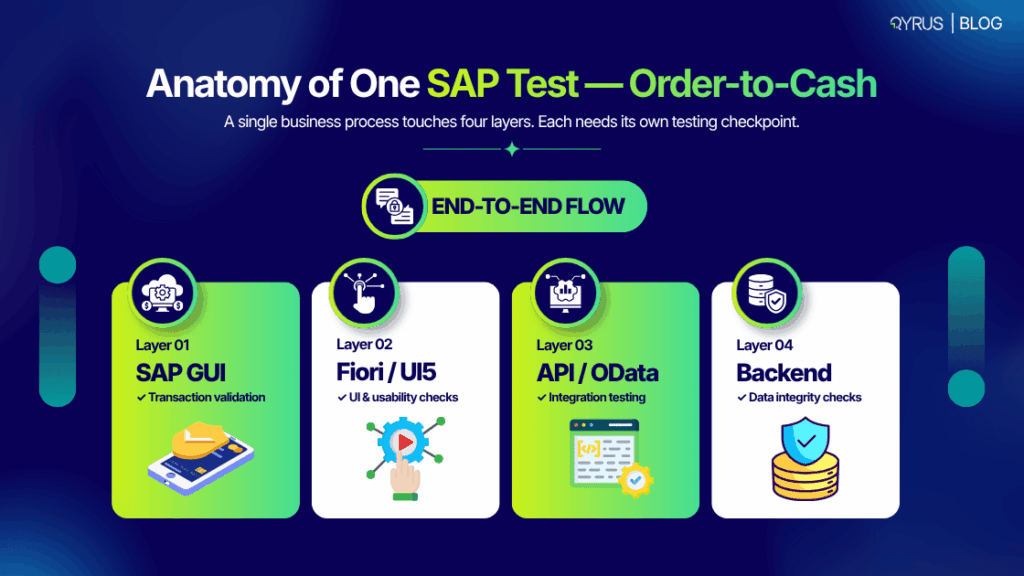
Nonetheless, automating an enterprise SAP environment is inherently more complicated than automating a typical web application. An effective SAP test automation framework for businesses should operate simultaneously across diverse UI technologies, communication protocols, and architectural layers:
Legacy SAP GUI (WinGUI / JavaGUI): Based on proprietary SAP protocols and ActiveX-based rendering, validating the desktop GUI necessitates unique hook mechanisms that can interpret low-level SAP Scripting APIs instead of conventional web Document Object Model (DOM) elements.
Modern SAP Fiori (SAPUI5): Testing Fiori is notoriously difficult because the underlying web framework is constantly shifting. You’re dealing with nested shadow roots, fluid CSS classes, and element IDs that regenerate every time a new session starts. If you try to rely on traditional XPath or coordinate-based selectors, your scripts will break almost instantly.
API & Middleware Integration Layers: Core business logic frequently bypasses the UI entirely via Remote Function Calls (RFCs), Business Application Programming Interfaces (BAPIs), Intermediate Documents (IDocs), and modern OData / REST web services.
Backend Database Validation: A test isn’t actually complete until you prove the data landed exactly where it belongs. True end-to-end validation means querying your underlying SAP HANA tables (like BSEG, BKPF, VBAK, or VBAP) to ensure financial ledgers are balanced and inventory counts are mathematically correct.
For years, teams tried to manage this technical complexity using SAP’s bundled tools, like eCATT and CBTA. Those native utilities are fine if your processes never leave the core ABAP stack.
But in the real world, enterprise workflows rarely stay inside a neat SAP bubble. The moment a transaction crosses over into Salesforce, a custom e-commerce frontend, or a third-party logistics API, those legacy tools hit a brick wall.
Modern enterprises are replacing legacy tools with specialized third-party platforms. These platforms approach quality engineering not through isolated script execution, but by treating business processes as interconnected, node-based workflows.
Depending on manual testing for a complicated ERP system is an inherently flawed approach, and the difficulties only increase with each new version. When an update is released and there’s no clear method to understand what it affects, QA teams find themselves in a difficult position.
They’re forced to choose between two bad options: run a quick round of basic smoke tests and just hope nothing critical breaks in production, or grind through months of manual regression testing that brings your release schedule to a dead stop.
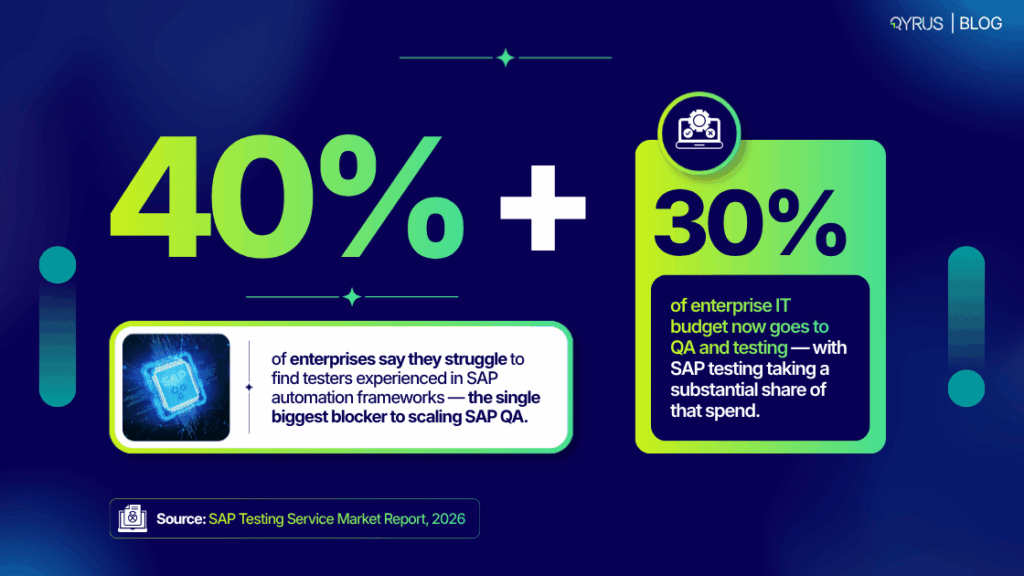
The worldwide demand for SAP testing services and software showcases the immediacy of this change. Independent market reports anticipate market valuations between USD 0.97 billion in 2026 and USD 1.79 billion by 2034, while some predictions expect growth reaching USD 4.7 billion by 2033. More than 3,000 service providers currently function within the SAP QA ecosystem, as companies dedicate as much as 30% of their total IT budgets specifically to QA and testing.
The primary reason for this expenditure is an expanding skills gap. Industry statistics indicate that over 40% of companies face challenges in locating and keeping testers with extensive expertise in intricate SAP automation frameworks.
Creating and sustaining conventional test scripts demands a rare combination of business process understanding, ABAP programming knowledge, and proficiency in test automation engineering. When scripts fail because of regular UI changes, manual testers are returned to typical execution, increasing technical debt and exhausting engineering resources.
This human-capacity issue is encountering an unchangeable architectural deadline: SAP has announced that standard support for SAP ECC ends in 2027. Sticking with a legacy ERP means paying a steep premium for extended maintenance, but moving to S/4HANA is no walk in the park. It isn’t a simple in-place software update, it is a massive architectural tear-down.
If your team doesn’t have a reliable sap test automation tool locked in before you start, your migration timeline will inevitably derail. You will find yourself trapped in endless manual regression cycles, and surprise production bugs will stall the project for months.
Core Testing Types & What to Automate First
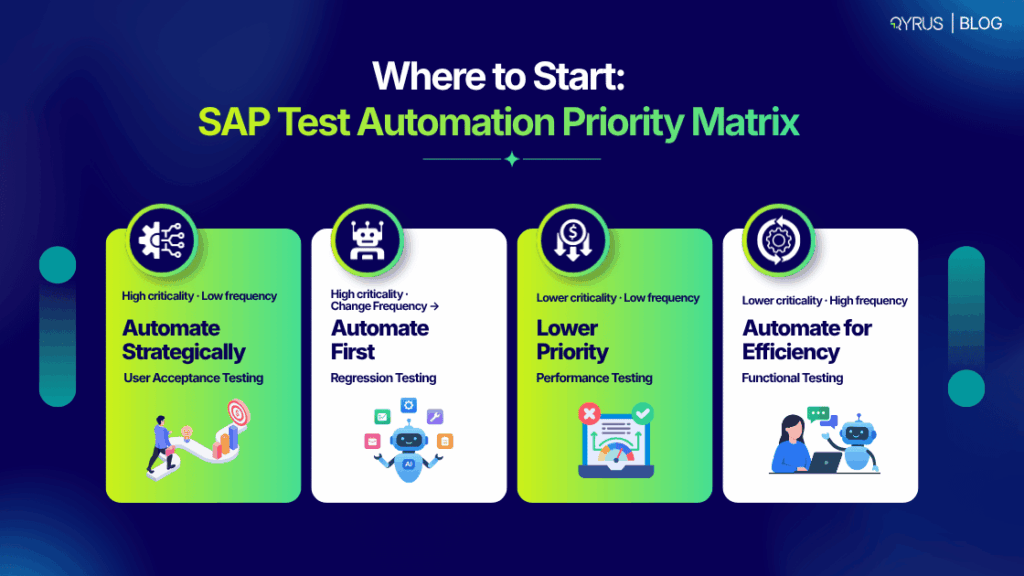
Implementing a company-wide automation strategy doesn’t entail trying to automate every individual manual test case from the outset. Achieving sustainable success necessitates segmenting the testing area into separate functional categories and utilizing a risk-based prioritization framework.
SAP Functional Testing: Ensuring that individual transactions, user interfaces, custom ABAP applications, and system computations operate precisely as per technical requirements. This involves confirming both positive and negative validation rules, field dependencies, currency conversions, and automatic tax calculations across separate modules. Automated functional tests act as foundational components for larger regression suites.
SAP Regression Testing: Confirming that newly implemented transports, custom code improvements, security role changes, or support package stacks do not interfere with existing business operations. Due to the close interconnection of SAP systems, modifying an inventory valuation approach may unintentionally disrupt subsequent billing timelines or financial reports. Automated regression suites need to be designed to operate consistently in distributed environments.
Performance & Load Testing: Moving to S/4HANA or rolling out a major Feature Package Stack isn’t just a software update. It completely rewires your underlying infrastructure, memory usage, and database query execution. Performance testing is how you prove this new architecture won’t buckle under real-world pressure. It guarantees the system stays online when it actually counts whether you are pushing through a heavy month-end financial close, handling a brutal Black Friday transaction spike, or running critical overnight payroll batch runs.
User Acceptance Testing (UAT): We need to make sure that the whole process works the way the business teams need it to be. With tools that use low-code and node-based automation, the business analysts and the team leaders can set up and record real-life business situations without having to write any code. This makes the UAT validation into tests that we can reuse and are automated. This way, it becomes easier and saves time.
For organizations evaluating current testing methods, the most common mistake is attempting to automate edge cases too soon. Successful implementation demands precise prioritization. Begin by automating the primary “happy paths” of your crucial, high-risk business processes, the pathways that directly impact revenue or compliance, such as Order-to-Cash (O2C) or Procure-to-Pay (P2P).
Once the core processes are stabilized, extend the focus to address edge cases and integrate the suite into a more extensive SAP CI/CD testing pipeline. Approaching it incrementally is the sole method to demonstrate ROI swiftly and gain the trust of the rest of the business in the automation.
The 2026 Shift: AI Agents in your Workflow
The discipline of enterprise software quality assurance is experiencing an architectural paradigm shift. Testing has traditionally been deterministic: if a user clicks a button, the system must produce an exact, predictable output. Nonetheless, SAP’s Hannover Messe 2026 agenda has officially verified that autonomous AI agents are now functioning directly within essential enterprise transactional processes.
These smart agents are capable of making operational choices, such as adjusting purchase order routing according to live supplier risk ratings or independently addressing invoice discrepancies. This shift fundamentally expands the scope of modern quality assurance. AI-driven SAP testing is no longer restricted to using machine learning models to accelerate script authoring; it now requires validating the actual business logic and operational decisions made by autonomous AI agents operating within SAP itself.
To manage this evolving landscape, modern orchestration platforms are advancing across three essential capabilities:
Enterprise Testing Requirement
Legacy Automation Approach
2026 Orchestration Standard
Test Scope Selection
Blindly retesting massive regression suites after every transport import, wasting time and compute resources.
SAP change impact analysis inspects ABAP code and transport layers to pinpoint the exact processes at risk, enabling risk-targeted validation.
UI Updates & Maintenance
Static scripts break immediately when SAP Fiori updates dynamic element IDs or CSS classes, causing massive technical debt.
Self-healing test automation uses dynamic computer vision and DOM heuristics to fix broken object locators in real-time during execution.
Test Data Provisioning
Copying static, sensitive production data into non-production environments, creating GDPR/CCPA compliance risks.
Automated synthetic test data generation creates realistic, parameterized scenarios without exposing actual customer datasets.
As these technologies converge, expect the enterprise software category to keep splitting into two tiers: native, bundled tooling covering basic Fiori web scenarios, versus specialized cross-system platforms needed for anything touching the SAP GUI, complex APIs, or genuine end-to-end business workflows. For an evaluation of modern synthetic data generation tools, explore KiwiQA’s breakdown of SAP test tools.
How Qyrus Handles SAP Test Automation
Moving beyond legacy point solutions requires a fundamental shift in how organizations approach quality engineering. Traditional tools frequently stumble when attempting to link legacy desktop protocols with modern web interfaces. Test orchestration is the company solution provided by Qyrus to seamlessly validate these cross-system business flows. Qyrus serves as both the company name and the comprehensive product platform designed specifically to handle the most demanding enterprise ecosystems.
Rather than treating automated testing as isolated script files, Qyrus delivers deep architectural integration through purpose-built capabilities:
SAP Scribe: A low-code, visual process authoring engine that allows technical QA architects and non-technical functional analysts to capture, parameterize, and orchestrate complex SAP business workflows without writing lines of brittle script code.
ARS (Auto Recovery System) & Healer: Enterprise environments cannot tolerate test suite crashes caused by intermittent network latency or minor UI modifications. Qyrus’s ARS and Healer engines dynamically resolve broken element paths, handle unexpected system modal popups, and automatically realign object locators in real time during execution, virtually eliminating the maintenance burden.
Cross-System End-to-End Orchestration: Real-world enterprise processes span far beyond the boundaries of an SAP application. A single automated test on Qyrus can originate in a third-party API, execute a transaction in the SAP GUI, validate the approval in SAP Fiori, and confirm the database entry in the backend without breaking session continuity.
DataChain Technology: Resolves the test data bottleneck by automatically generating, conditioning, and injecting synthetic data entities into active test pipelines, ensuring that data availability never delays a release cycle.
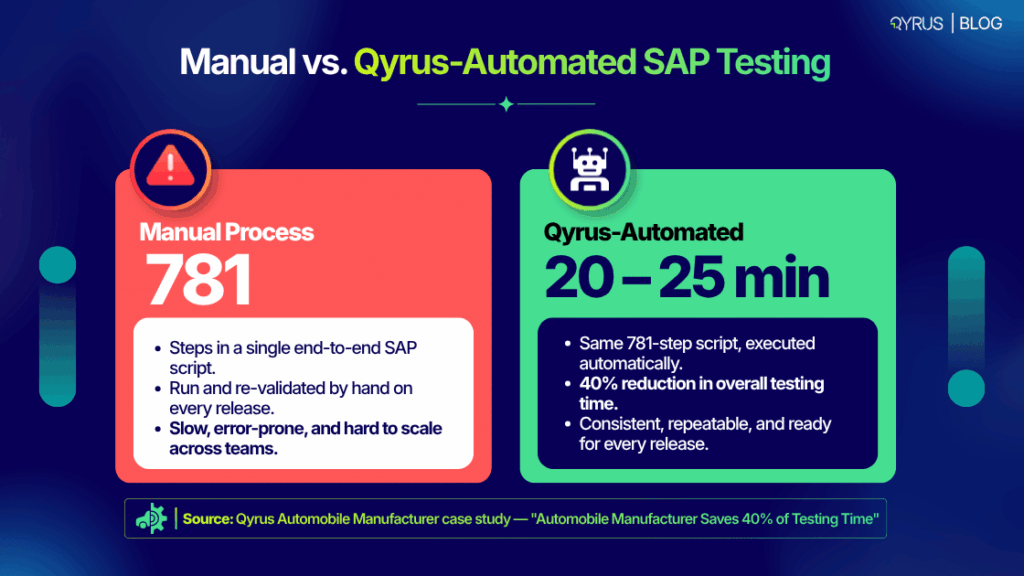
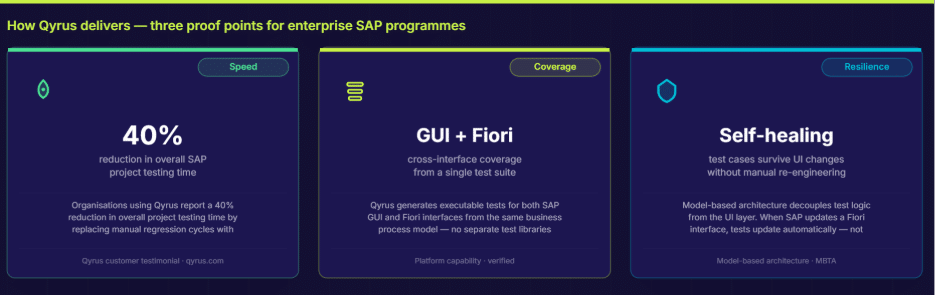
The real-world operational impact of this orchestration approach is proven across complex enterprise environments. A premier global automobile manufacturer utilized Qyrus to automate a massive, multi-departmental SAP business process comprising a 781-step end-to-end workflow. Building the complete automated test flow required just 7 to 8 hours of total authoring time on the Qyrus platform. During active release cycles, full execution was slashed to just 20 to 25 minutes, achieving a 40% total reduction in testing time compared to their manual baseline.
What’s the difference between SAP test automation and regular test automation?
Regular automation generally targets standalone web or mobile applications using standard DOM selectors. SAP automation requires specialized protocols to interact with proprietary SAP GUI scripting environments, complex ABAP-level integrations, and dynamic SAP Fiori architectures within a single test flow.
Can you automate SAP GUI and Fiori together?
Yes. Contemporary cross-system orchestration platforms enable the creation of smooth workflows that transition seamlessly between traditional SAP GUI desktop settings and modern SAP Fiori web interfaces, maintaining execution continuity.
What’s eCATT vs. CBTA?
eCATT (Extended Computer Aided Test Tool) is an older, native SAP tool primarily used for testing backend ABAP processes. CBTA (Component-Based Test Automation) is a newer native tool designed to test SAP business processes more modularly. Both often require third-party augmentation for true end-to-end testing across non-SAP enterprise applications.
What does SAP test automation cost?
Expenses differ significantly based on the scale of deployment, with options from subscription-based SaaS pricing for nimble teams to extensive enterprise site licensing. When assessing platforms, organizations need to consider typical obstacles such as significant initial setup effort and continuous script upkeep, which frequently surpass the initial software license expense.
How long does implementation take?
Traditional frameworks that rely heavily on scripts may require several months for deployment, whereas contemporary node-based orchestration platforms can frequently outline essential business processes and start running valuable regression suites in merely a few weeks.
Does it work with S/4HANA migrations?
Absolutely. Implementing a robust automation strategy is a prerequisite for migration. Automated test orchestration ensures you can run continuous validation as you move from ECC to the new data architecture. For further reading on validation requirements, see our complete guide to SAP S/4HANA migration performance testing.
Conclusion
The intersection of SAP’s 2027 ECC mainstream support cutoff, ongoing cloud release rhythms, and the integration of autonomous AI agents into transactional processes has fundamentally transformed enterprise quality engineering. Manual testing is no longer a practical operational approach; it subjects the organization to significant system failures, postponed transformation efforts, and unmanageable increases in QA budgets.
To create a robust enterprise quality framework, QA leaders need to advance past isolated tool script automation and adopt comprehensive test orchestration. By utilizing a smart platform that can validate traditional SAP GUI screens, contemporary Fiori interfaces, intricate APIs, and their underlying databases within a self-healing framework, organizations can convert testing from a hindrance in deployment into a fundamental catalyst for business speed and release assurance.
Test orchestration is the company solution provided by Qyrus to manage this exact complexity, accelerating your SAP s4hana testing release cycles while drastically reducing maintenance overhead. Request a demo to see how Qyrus automates SAP testing across GUI, Fiori, API, and backend in one flow.
A Strategic Framework for CIOs, CTOs, and IT Leaders Navigating SAP Quality Assurance
Imagine a global manufacturer closing its books for the quarter. On a Tuesday morning, a routine SAP transport—a minor configuration patch applied the previous Friday—silently severs the integration between Sales and Distribution and Financial Accounting. Purchase orders continue to flow. Inventory updates in real-time.
Yet, invoices stop posting to the general ledger. The oversight remains undetected until Wednesday afternoon, when the finance team discovers a 36-hour gap in receivables. By the time leadership identifies and remediates the break, the company absorbs three days of operational disruption, a delayed financial close, and an emergency session with external auditors. The catalyst? A single change that skipped regression testing before promotion to production.
This scenario repeats in SAP environments every quarter across every major industry. The financial stakes are absolutely important.
We designed this guide for executives accountable for the integrity of that nervous system. It outlines:
The Business Risk Profile: Identifying the true cost of inadequate sap functional testing.
Life Cycle Strategy: Defining your testing requirements at every phase of the SAP journey.
The Maturity Model: An honest assessment of the path from manual testing to AI-driven orchestration.
The Executive Diagnostic: A five-question audit to determine if your current approach is a hidden liability.
Systemic Remediation: How Qyrus helps enterprise SAP programs close these gaps.
Why SAP Testing Failures Are a Board-Level Risk, Not Just an IT Problem
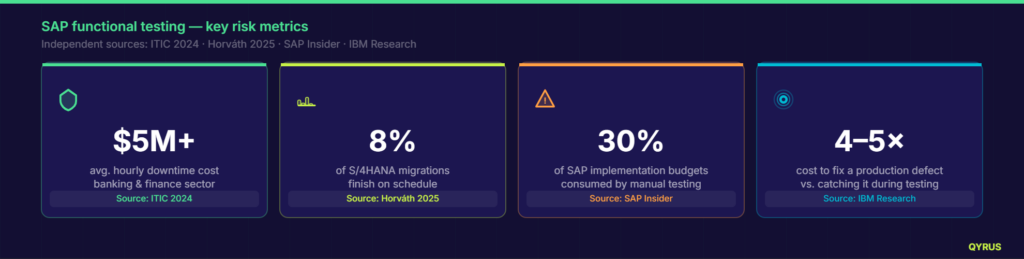
The ITIC 2024 Hourly Cost of Downtime Survey reveals that 97% of large enterprises report a single hour of downtime costs over $100,000. In sectors like finance, manufacturing, and retail, average hourly outage costs frequently exceed $5 million. SAP serves as the nervous system for these organizations; when it fails, the entire business halts.
Many leadership teams still misclassify SAP testing as a localized IT task—a technical checkbox to clear before a release. This perspective is a dangerous strategic miscalculation. In reality, SAP quality assurance represents a fundamental pillar of business continuity, financial reporting integrity, and regulatory compliance.
Over 440,000 organizations worldwide utilize SAP to orchestrate their most critical operations, including payroll, procurement, order management, and global supply chain logistics. These are not peripheral functions; they are the heart of the enterprise. When a core SAP module fails, the resulting operational paralysis extends far beyond the IT department, hitting the balance sheet and achieving board-level visibility within hours.
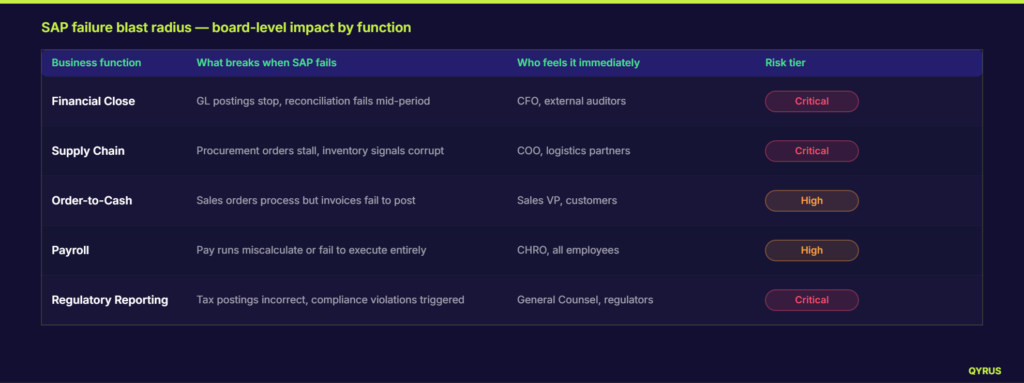
The following table illustrates the immediate impact an untested SAP change can have across typical enterprise functions:
Business Function
Operational Impact of Failure
Primary Stakeholders
Financial Close
General Ledger postings halt; reconciliation logic fails.
CFO, External Auditors
Supply Chain
Procurement orders stall; inventory signals become corrupt.
COO, Logistics Partners
Order-to-Cash
Sales orders process, but invoices fail to post to the ledger.
VP of Sales, Customers
Payroll
Pay runs miscalculate or fail to execute entirely.
CHRO, Employees
Regulatory Reporting
Incorrect tax postings or compliance omissions trigger penalties.
General Counsel, Regulators
The Capital Efficiency Problem
Beyond the immediate operational risk, a significant capital allocation dimension exists that CFOs rarely surface in testing discussions. Research from SAP Insider confirms that manual testing still consumes up to 30% of total SAP implementation budgets. On a $20 million transformation program, the organization effectively spends $6 million on a methodology that is both slower and less effective than modern automated alternatives. We do not view this as a QA budget line; we view it as a massive drain on capital efficiency. Redirecting that capital toward faster release cycles or innovation provides a genuine competitive advantage.
The Remediation Multiplier
Post-release risk compounds this financial picture further. According to IBM’s Systems Sciences Institute, fixing a defect in production costs 4 to 5 times more than identifying it during earlier testing phases. However, in the SAP ecosystem, the multiplier is even more punishing. Because SAP modules are so tightly linked, a single defect often cascades across multiple business units. The true remediation cost—accounting for developer hours, business downtime, and extensive data cleanup—frequently grows by an order of magnitude.
“What gets skipped in testing shows up as a live system issue. And live system issues cost far more to fix.” — SAP S/4HANA Migration Risk Guide
By shifting testing “left” and automating the validation process, we help enterprises transform QA from a cost center into a risk-mitigation engine that protects the organization’s most vital assets.
Defining the Domain: What SAP Functional Testing Actually Validates
Sap functional testing is the process of confirming that configured business processes align with specific business requirements. It is a distinct discipline from end-to-end, performance, or security testing, though a mature quality program must include all four. While other methods test for scale or vulnerability, functional testing confirms that the logic inside your SAP modules matches how your business actually operates.
The distinction is critical. In most struggling SAP programs, the failure isn’t that teams test too little; they test the wrong things, in the wrong order, using fragmented data.
The Four Essential Testing Layers
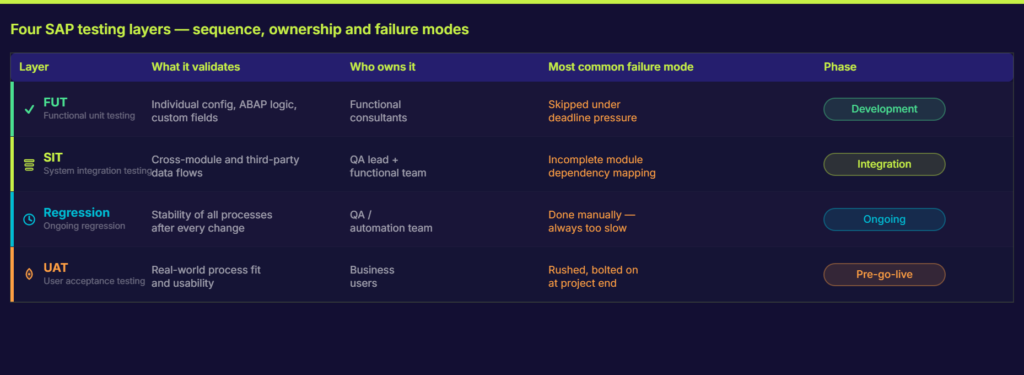
To maintain system integrity, every enterprise SAP program requires a structured approach across these four layers:
Layer
Strategic Validation
Primary Ownership
Primary Failure Mode
Functional Unit Testing (FUT)
Validates individual configurations, ABAP logic, and custom fields.
Functional Consultants
Sacrificed under timeline pressure.
System Integration Testing (SIT)
Validates cross-module and third-party data exchanges.
QA Leads + Functional Teams
Fragmented module dependency mapping.
Regression Testing
Protects the stability of existing processes after every patch or transport.
QA / Automation Teams
Manual execution vs. release velocity.
User Acceptance Testing (UAT)
Validates real-world process fit and day-to-day usability.
Business Users
Rushed and bolted on at the project’s end.
The “Integration Wall”: Why SAP Defies Modular Testing
Most enterprise software allows for siloed, module-by-module testing. SAP does not. Its architecture creates what practitioners call the “Integration Wall”, the point where isolated testing produces false confidence because it ignores how modules interact.
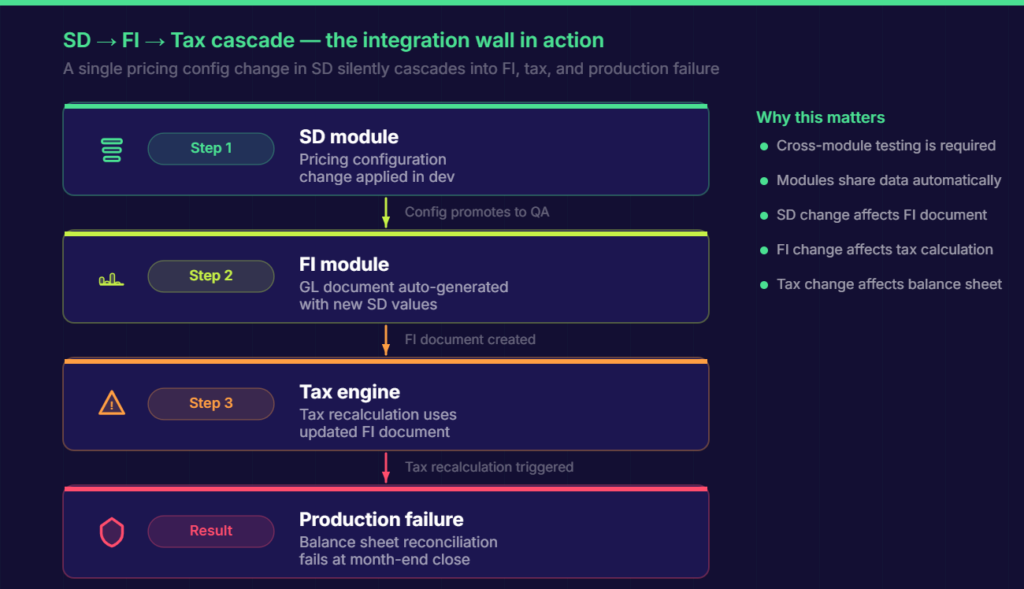
Consider a practical example: A development team applies a pricing configuration change within the Sales and Distribution (SD) module. In isolation, the change validates perfectly. A sales order generates, the pricing logic applies, and the tester signs off.
The risk lies in the downstream chain that remains untested: that SD pricing change alters the value of a document auto-generated in Financial Accounting (FI). This, in turn, corrupts the tax calculation logic posting to your general ledger accounts, which eventually breaks the month-end balance sheet reconciliation. These defects rarely surface until the finance team attempts to close the books.
This is not an edge case. In a 2025 iLab Quality case study, a manufacturing enterprise discovered, just two weeks before a major go-live, that a critical procurement workflow silently depended on a deprecated transaction code. Because the team had tested isolated modules rather than end-to-end processes, the issue remained invisible. The resulting remediation delayed go-live by six weeks while the team mapped the entire dependency chain.
The move to S/4HANA introduces three shifts that render legacy test cases obsolete:
The Fiori UI Layer: Standard SAP GUI scripts cannot interact with web-based Fiori apps. Test automation built over the last decade for the legacy GUI requires complete re-engineering.
Simplified Data Models: The S/4HANA Universal Journal consolidates tables that previously lived separately across FI and CO. Validation logic that targets specific ECC table structures will return errors or corrupt results in S/4HANA.
Real-Time Processing: S/4HANA replaces ECC’s batch-oriented processes with real-time processing. This shift invalidates performance assumptions, transaction sequences, and timing dependencies.
The data confirms the difficulty of this transition. A 2025 Horváth study of 200 SAP user companies found that over 60% experienced schedule and quality deviations during migration, with projects running 30% longer than planned. Only 8% finished on schedule. In the S/4HANA era, undertested migrations have become the norm, not the exception.
Is Your SAP Testing Strategy a Hidden Liability? A 5-Question Executive Checklist
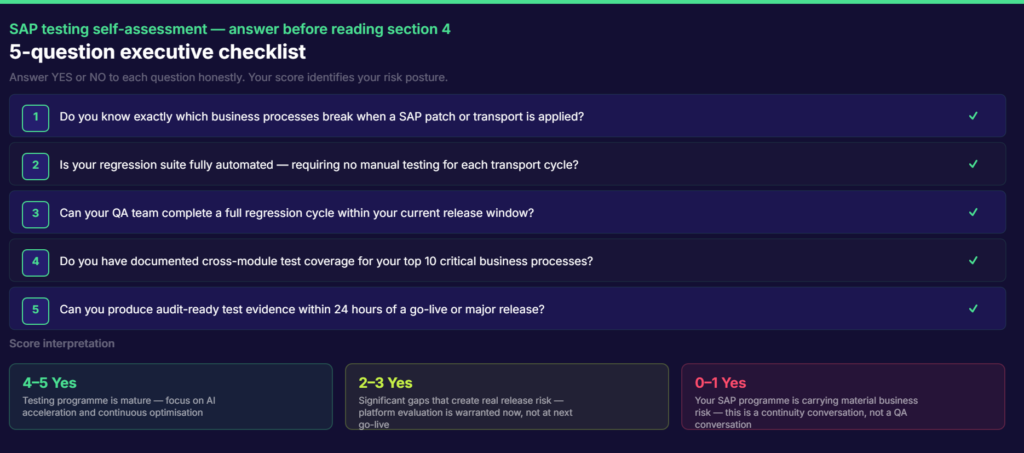
Before evaluating platforms or vendors, you must conduct an objective audit of your current SAP testing maturity. These questions bypass technical jargon to focus on governance and risk. If your leadership team cannot answer these with absolute certainty, your organization is likely carrying unmanaged operational risk.
Question 1: Impact Visibility
Do you know exactly which business processes are at risk when an SAP patch or transport is applied?
Most organizations lack this visibility. They recognize that a change occurred and perhaps identify the specific module it touched, but they cannot trace the downstream impact. Without automated change impact analysis, your team relies on “assumption-based testing.” These assumptions are precisely how six-week go-live delays happen.
Question 2: The Automation Bottleneck
Does your regression suite run autonomously, or do you still rely on manual intervention for every transport?
Partial automation is a bottleneck in disguise. SAP environments receive a constant stream of security patches, enhancement packages, and configuration updates. Each one introduces regression risk. Manual testing creates a compounding cost burden that eventually breaks the project budget. If your testing does not scale horizontally with your release frequency, the math will eventually fail.
Question 3: The Execution Window
Can your QA team complete a full regression cycle within your current release window?
This is the question internal teams often avoid. If your team must “selectively” skip tests to meet a deadline, you are making implicit risk decisions under pressure. Strategic quality assurance requires that every critical path receives validation every time. If your window is shrinking while your manual effort remains static, you are essentially gambling on system stability.
Question 4: Process-Level Coverage
Do you have documented cross-module test coverage for your top 10 critical business processes?
Standard documentation usually lives at the module level (e.g., SD or FI). However, your business operates through end-to-end chains: Order-to-Cash, Procure-to-Pay, and Record-to-Report. If your testing validates modules but ignores the connective tissue between them, you have a massive coverage gap at the process level—where the most expensive failures occur.
Question 5: Audit and Compliance Readiness
Can you produce audit-ready test evidence within 24 hours of a major release?
Regulatory frameworks like SOX, GDPR, and GxP require definitive proof that you validated critical processes before go-live. If your evidence is scattered across spreadsheets and email threads, you lack a proper system of record. This creates a compliance vulnerability that auditors will eventually expose, leading to significant fines or remediation costs.
Scoring Your Risk Posture
Score
Strategic Implication
4–5 “Yes”
Mature: Your program is resilient. Focus on AI-driven acceleration and continuous optimization.
2–3 “Yes”
At Risk: Significant gaps exist that threaten release stability. A platform evaluation is a priority, not a future project.
0–1 “Yes”
Critical Liability: Your SAP program carries material business risk. This is a business continuity conversation that requires immediate executive intervention.
The Evolution of SAP Test Automation: From Scripts to Agentic AI
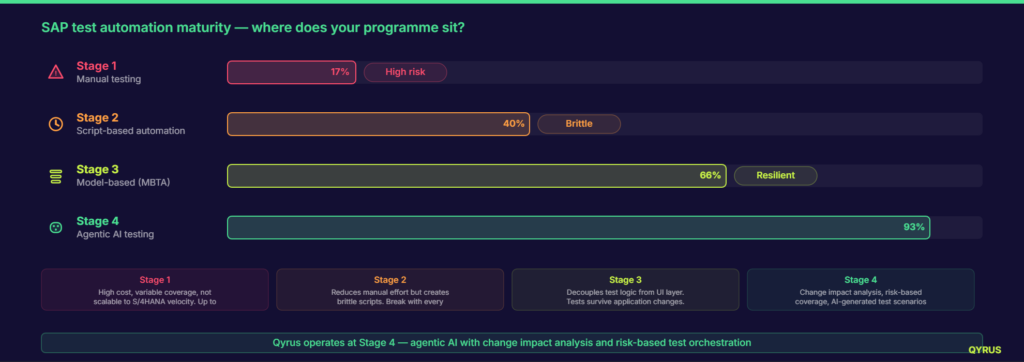
Understanding your organization’s position on the testing maturity curve is the prerequisite for any defensible investment decision. Not every enterprise must reach Stage 4 immediately. However, every leader managing a mission-critical SAP environment must identify their current stage—and calculate the literal cost of remaining there.
Stage 1: Manual Testing
This is the legacy starting point where many organizations remain stuck. Functional consultants and business users execute test cases manually, following scripts documented in Excel or Word. They capture results in spreadsheets and exchange sign-offs via email.
The primary deficit here is not just a lack of speed; it is a lack of repeatability. A manual tester executing 200 cases over three days rarely identifies defects consistently across cycles. Fatigue, interpretation drift, and deadline pressure make manual testing inherently variable and prone to oversight.
The financial case against this approach is overwhelming. SAP Insider research indicates that manual testing consumes up to 30% of total implementation budgets. On a $15 million S/4HANA program, that represents $4.5 million poured into a methodology that your competitors have already replaced with automation. In this stage, you aren’t just testing software; you are hemorrhaging capital.
Stage 2: Script-Based Test Automation
The first wave of automation introduced record-and-playback tools and scripted frameworks. These systems improved repeatability and reduced manual effort significantly. However, they introduced a new problem: brittleness. Scripts written for the SAP GUI often break when screen layouts shift, a frequent occurrence during enhancement package updates or Fiori migrations.
Maintenance costs represent the “hidden trap” of Stage 2. Many organizations that invested heavily in scripted automation during the ECC era now find their test libraries are liabilities rather than assets. Re-engineering thousands of brittle scripts for S/4HANA Fiori often costs as much as building a new suite from scratch. This realization creates difficult conversations with boards that previously approved major automation investments.
Stage 3: Model-Based Test Automation (MBTA)
Model-based testing represents a shift toward resilience by decoupling test logic from the application’s UI layer. Instead of scripts that reference specific, volatile screen elements, MBTA utilizes a business process model. This model describes what a process does—not how the UI renders it.
This approach offers three strategic advantages:
Resilience: Test cases survive application changes without manual re-engineering.
Accessibility: Business users can own and validate test cases without programming expertise.
Hybrid Coverage: For large enterprises running SAP GUI and Fiori in parallel, a single process model generates tests for both paradigms simultaneously. This is the only sustainable way to manage quality during a long-term migration.
Stage 4: Agentic AI and Intelligent Orchestration
The current frontier moves beyond simple automation into genuine intelligence. Agentic AI tools act as “doers.” They receive plain-language instructions—such as “Create a sales order in SD, verify stock reservation in MM, and confirm the FI document posts correctly”—and execute the full cross-module scenario autonomously.
Early adopters report massive acceleration. A Forrester Total Economic Impact study found that advanced automation can accelerate application delivery by up to four times, with organizations reporting a 334% return on investment. More recent implementations of AI-driven sap test automation report test creation timelines dropping from hours to mere minutes.
The most transformative dimension of Stage 4 is Automated Change Impact Analysis. Instead of a “test everything and hope” approach, intelligence identifies exactly which business processes a transport will affect before it reaches the QA environment. Teams focus their energy on the 20% of processes that carry 80% of the business risk. This strategy enables faster releases with higher confidence, improving both velocity and coverage in tandem.
The market reflects this shift: between 2023 and 2025, intelligent testing tools reduced manual effort by nearly 34% on average. Automation now influences approximately 49% of SAP testing engagements, representing a total paradigm shift in how we secure the enterprise nervous system.
Bridging the Gap: How Qyrus Secures the Modern SAP Landscape
Legacy testing platforms often feel like an anchor in an S/4HANA world. They were built for an era of stable ECC instances, infrequent updates, and massive, dedicated QA teams. Today’s reality is the opposite: volatile cloud updates, hybrid GUI/Fiori environments, and release cycles that have compressed from quarters to weeks.
Qyrus bridges the gap between legacy QA constraints and modern release velocity. We provide an intelligent quality engineering platform that addresses the three points where traditional approaches consistently fail: test creation speed, cross-module visibility, and automation sustainability.
Proof Point 1: Accelerating Test Creation Across GUI and Fiori
Manual script authorship is a technical debt factory. In traditional models, functional consultants spend weeks translating process documentation into executable scripts. For an enterprise with hundreds of critical workflows, this process takes months and is often obsolete before it finishes.
Qyrus uses AI to compress this timeline. Business analysts can describe a process in plain language, and the platform generates executable test scenarios that run across both SAP GUI and Fiori apps. You no longer need separate test libraries for different interfaces—a massive advantage during S/4HANA migrations where both environments must coexist.
Proof Point 2: Ensuring Genuine Cross-Module Coverage
The most expensive testing gap isn’t an untested module; it’s an untested module interaction. A failure in an order-to-cash process that spans SD, MM, and FI usually stems from data that doesn’t flow correctly between the modules.
Qyrus validates these end-to-end chains, not just isolated steps. We trace data from the initial sales order through inventory reservation, goods issue, and final GL reconciliation. This prevents configuration changes in one area from triggering unexpected downstream failures that only surface in post-go-live “war room” sessions.
Proof Point 3: Resilience by Design
Most SAP automation efforts fail because they are brittle. Scripts break whenever an enhancement package updates a screen layout or a Fiori interface shifts. Maintenance costs eventually outpace the value of the automation, forcing teams back to manual testing.
Qyrus utilizes a model-based approach that decouples test logic from the UI. When SAP updates an interface, the underlying business process model remains valid. Because updates are localized rather than wholesale re-engineering projects, your automation becomes a long-term asset that survives every update cycle.
6 Strategic Best Practices for High-Performing SAP Programs
These are not generic QA suggestions. They address the specific failure patterns we see in SAP programs that overrun budgets and miss go-live dates.
Map Cross-Module Dependencies First
Inadequate scoping causes more defects than inadequate testing. If you write test cases before mapping how SD affects FI or how MM triggers CO postings, you are testing in the dark. Build the dependency map first. This upfront investment saves multiples of that time in production remediation and emergency patching.
Automate Regression in Parallel,Notas “Phase 2”
Many leaders treat automation as a secondary activity to be handled after go-live. By then, the team has already built a manual “technical debt” library. Start automation in parallel with test case development. Integrating even partial automation into your implementation creates a sustainable foundation for long-term maintenance.
Apply the 80/20 Rule to Risk
Not all SAP processes carry equal business risk. A configuration change in a minor HR report is not the same as a change to a high-volume pricing engine. High-performing programs explicitly rank processes by business criticality. Ensure your most critical 20% of workflows receive the deepest testing rigor and the most frequent automated execution.
Treat Test Data as a Strategic Asset
Misaligned test data causes nearly 30% of migration delays. Tests often fail not because the system is broken, but because the data doesn’t satisfy validation rules. This erodes team confidence and stalls sign-off cycles. Invest in data refresh utilities, masking for sensitive fields, and environment parity from day one.
Transition to Event-Driven Testing
In many organizations, testing is a periodic activity scheduled before a major release. In a mature program, testing is continuous. Every SAP transport represents a regression risk. Automated checks should fire every time a transport moves from development to QA. This is the only way to catch integration defects before they accumulate into a systemic failure.
Move Business Users from Gatekeepers to Partners
Late User Acceptance Testing (UAT) is the primary cause of go-live delays. When business users are treated as the final checkpoint, they often find critical defects when the window for remediation has already closed. Integrate UAT as soon as stable builds are available. Shifting UAT “left” ensures that the solution meets operational needs throughout the development cycle, not just at the end.
SAP Functional Testing — Frequently Asked Questions
What is SAP functional testing?
SAP functional testing is the validation that configured business processes in SAP operate according to defined business requirements. It confirms that the logic inside modules like Finance, Materials Management, and Sales and Distribution produces the correct outputs for real business scenarios — not just that individual screens display correctly, but that end-to-end process chains work as your business actually operates.
How is SAP functional testing different from SAP performance testing?
Functional testing validates correctness: does the process produce the right result? Performance testing validates scale: does the process remain fast and stable when 5,000 users are executing it simultaneously? Both are necessary. A process that is functionally correct but collapses under production load is still a production risk.
How long does a typical SAP functional testing cycle take?
It depends heavily on the scope of change and the maturity of the test automation program. For a major release in a manual-testing environment, regression cycles often run two to four weeks. For organizations with mature automation coverage, the same cycle can run in hours to days. This compression is one of the primary ROI drivers of investing in SAP test automation.
What is the difference between SIT and UAT in SAP?
System Integration Testing (SIT) validates that SAP modules and connected external systems exchange data correctly — it is primarily an IT-led activity focused on technical integration. User Acceptance Testing (UAT) validates that the system meets operational needs from a business user perspective — it is primarily a business-led activity focused on process usability and correctness. Both are required. SIT without UAT misses business process gaps. UAT without SIT misses integration defects.
How do you protect sensitive data during SAP testing?
Best practice is to replicate production data volumes in test environments while applying data masking to sensitive fields — employee personal information, customer financial data, and payroll details. This ensures test data reflects real-world complexity and volume without creating compliance exposure. Automated data refresh utilities are essential for maintaining environment parity across long test programs.
Is SAP test automation worth the investment for mid-size organizations?
The economics are compelling even at mid-scale. IDC research cited in enterprise testing studies shows enterprises implementing test automation achieving 548% ROI over five years, with average payback periods of seven months. For organizations facing S/4HANA migration timelines, the question is less “is it worth it?” and more “can we afford not to?” Manual testing cannot keep pace with modern SAP release velocity. The choice is not automation versus no automation — it is automation versus repeated production incidents.
Ready to Close the Gaps in Your SAP Testing Program?
Treating SAP quality as a secondary IT concern is no longer a viable strategy. As S/4HANA migration deadlines loom and release cadences accelerate, the margin for error has effectively vanished. In this environment, a single production failure carries a price tag—operational, financial, and reputational—that most enterprises simply cannot afford.
The organizations successfully navigating this shift do not rely on the sheer size of their QA departments. Instead, they prioritize intelligence: risk-based, autonomous testing programs designed specifically for the complexities of modern SAP development.
Qyrus provides that level of strategic resilience. By addressing the core friction points of enterprise quality—collapsing test creation timelines across GUI and Fiori while deploying automation that actually survives the next update—Qyrus helps teams move beyond the limitations of manual testing. This approach identifies the deep-seated logic defects that legacy scripts and manual checks consistently miss.
Request a Demo or start with a self-assessment: ask your team the five questions in this guide and see how many you can answer with confidence. The gaps in those answers are the gaps in your SAP risk posture.
SAP. The very name evokes images of comprehensive business solutions, a digital backbone powering the world’s largest enterprises. It’s a sprawling empire, underpinning critical business processes from finance and supply chain to sales and human resources for countless organizations. In fact, an astounding 77% of global transactions touch an SAP system, and over 400,000 companies worldwide rely on these solutions for their core operations. Think about that for a moment. The vast majority of the world’s commerce, the distribution of 78% of the world’s food and 82% of its medical devices, all flows through SAP systems. This incredible reach, while a testament to SAP’s power, also presents a monumental challenge for quality assurance teams. How do you even begin to test something so vast, so interconnected? The sheer scale can easily make testing feel like an insurmountable task, leaving teams feeling overwhelmed before they even start.
For those on the front lines of SAP quality assurance, the daily reality is often a complex matrix of difficult decisions. The primary struggle? Pinpointing what absolutely, critically needs to be tested amidst millions of potential scenarios. Then comes the automation question: which areas are genuinely ripe for automation to yield the best return, and which will just lead to maintenance nightmares? And perhaps one of the most persistent headaches is accurately analyzing the true impact of frequent releases, updates, and customizations. Even a seemingly minor change in one module can send ripples across the entire integrated landscape, from sales and distribution to materials management and finance. Many organizations find themselves wrestling with these challenges, leading to inefficiencies and, more critically, potential risks.
The traditional, often manual, approach of trying to test “everything” is not just inefficient; but in the complex world of SAP, it’s practically impossible and economically unviable. Manual testing alone can devour 30% or more of an SAP project’s budget. Clearly, a shift is needed. It’s time to move beyond brute-force tactics and chart a course for a more intelligent, strategic, and ultimately more effective SAP S/4HANA testing approach. The goal isn’t just to test more, but to test smarter, focusing efforts where they deliver the most value and mitigate the highest risks. This is where a well-defined strategy becomes not just helpful, but absolutely essential for success.
Introducing the “3 Cs”: A Framework for Focused SAP Testing
To truly start optimizing SAP S/4HANA testing, we need a guiding philosophy, a framework that cuts through the noise and directs our attention to what genuinely matters. Enter the “3 Cs”—a powerful lens through which to view your SAP landscape and prioritize your testing efforts with intelligence and precision.
The Three Pillars of Smart SAP Testing: Critical, Complex, and Changing
The “3 Cs” provide a simple yet profound way to categorize and understand different aspects of your SAP environment:
Critical: This pillar focuses on identifying those business processes and transactions that are absolutely vital to your organization’s survival and success. Think about your core financial operations where errors could lead to significant financial misstatements or compliance breaches. Consider customer-facing processes where a glitch could directly impact revenue and reputation, or supply chain activities where downtime can cause huge disruptions. SAP systems often underpin these very core functions, and the financial stakes of failure are enormous, with unplanned SAP downtime potentially costing organizations hundreds of thousands, or even millions, per hour. Identifying these critical pathways is the first step in a resilient SAP S/4HANA testing approach.
Complex: SAP landscapes are inherently intricate, often featuring multiple interconnected modules like FICO, SD, and MM, along with extensive customizations. Each organization’s SAP setup is frequently tailored to its unique needs, with customization levels varying significantly across modules—FI (Financial Accounting) might see 30% customization, while BI/BW (Business Intelligence/Business Warehouse) could reach 60%. This pillar helps you understand transactions and processes characterized by high intricacy. This could involve numerous steps, multi-system integrations (including bespoke code and third-party add-ons), or complex custom development that standard scripts simply can’t cover. These complex areas are often where hidden defects lie.
Changing: The digital world is in constant motion, and SAP systems are no exception. This pillar directs your focus to areas of your SAP environment that are dynamic and volatile. This includes functionalities undergoing recent modifications, planned updates, or frequent patches, such as those common with SAP S/4HANA cloud editions that may release quarterly updates. Continuous testing becomes necessary to ensure that these regular updates do not disrupt existing SAP functionalities. Keeping a close eye on these changing elements is crucial for effective regression testing and ensuring stability.
From Volume to Value: The Strategic Impact of the “3 Cs”
Adopting the “3 Cs” framework fundamentally shifts your testing paradigm. Instead of attempting the impossible task of “testing everything,” you transition to a strategic, risk-based methodology. This is where the real value in optimizing SAP S/4HANA testing emerges.
This focused approach enables far more efficient resource allocation. By understanding what is critical to the business, complex in its structure, and frequently changing, you can direct your valuable testing resources—both human and technological—to the areas where they will have the most impact. This means prioritizing test cases that cover high-risk functionalities, ensuring that your most critical operations are robust, your most complex interactions are verified, and your most recent changes haven’t introduced instability. It’s about moving from a mindset of sheer volume to one of strategic value, ensuring your SAP S/4HANA testing approach is both efficient and highly effective in safeguarding your business operations.
Bringing the “3 Cs” to Life: The Qyrus Methodology
Understanding the “3 Cs” is the foundational step; operationalizing this framework is where the real transformation in your SAP S/4HANA testing approach begins. This is precisely where Qyrus steps in, offering a suite of intelligent modules designed to dissect your SAP landscape through the lens of Criticality, Complexity, and Change, thereby truly optimizing SAP S/4HANA testing efforts.
Spotlighting the Essentials: Qyrus Business Analysis for Criticality and Change
To zero in on what’s “Critical” and what’s “Changing” within your daily operations, Qyrus Business Analysis offers a powerful arsenal of analytical tools. It equips users with insightful charts and tables that illuminate T-code (transaction code) usage, data activity, user behavior, and frequently changed transactions. Imagine being able to clearly see which SAP modules are most frequently used, distinguishing between Master and Business data activity.
This module doesn’t just present data; it provides deep insights that allow you to pinpoint business-critical areas based on actual system usage and identify evolving functionalities by tracking frequently used and altered transactions. By understanding these dynamics, you can confidently identify which parts of your SAP system are absolutely critical to test and which are undergoing significant change, directly informing users of a smarter testing strategy.
Navigating Development Dynamics: Qyrus Workbench Insights for Complexity and Flux
The “Complex” and “Changing” aspects often stem from ongoing development activities within your SAP system. Qyrus Workbench Insights is tailored to shed light on these very elements. This module typically focuses on development changes, such as the creation of new programs, tables, or enhancements. These are often system-wide modifications that necessitate transport requests, clearly flagging them as areas of active change and potential complexity.
A key feature here is the ImpactAnalyzer, a tool designed to help identify and analyze the impact of such changes within the SAP system. By leveraging Workbench Insights, your team gains a clearer understanding of what new developments are occurring, how frequently objects are being changed by developers, and crucially, the potential ripple effects of these modifications, allowing you to proactively address areas of induced complexity and recent change.
Mastering Configuration Nuances: Qyrus Customization Insights for Evolving Complexity
Beyond code development, SAP systems are heavily shaped by “Changing” configurations and the “Complexity” these customizations introduce. Qyrus Customization Insights provides essential visibility into this domain. It focuses on configuration changes, such as setting up company codes or altering business process settings, which are typically managed through customizing requests. Qyrus allows you to track these modifications, offering clarity on what’s modifiable versus what has been released, and even presenting trends in system customizations over selected periods. Furthermore, by highlighting the top 5 business customizations and detailing user-wise customization activities, this module helps you understand not just what is changing, but also which specific business needs are driving these customizations and potentially adding layers of unique complexity to your SAP environment. This granular view is invaluable for a targeted SAP S/4HANA testing approach.
The Qyrus Transformation: From SAP Chaos to Testing Clarity and Confidence
Implementing the “3 Cs” framework through Qyrus isn’t just a theoretical exercise; it’s a practical pathway to transform your SAP testing from a source of stress into a pillar of strength and confidence. By leveraging the deep insights gleaned from its specialized modules, Qyrus empowers organizations to move beyond reactive problem-solving to proactive risk management, truly optimizing SAP S/4HANA testing outcomes.
Cutting Through the Clutter: Pinpoint Prioritization with Qyrus
One of the most immediate and significant benefits of adopting the Qyrus methodology is the newfound ability to prioritize testing efforts with surgical precision. Qyrus’s Test Strategy Module, inherently driven by the “3 Cs,” empowers your QA teams to make informed, data-backed decisions, ensuring that focus is squarely placed on high-risk and high-impact areas first. Imagine having a consolidated view where insights from Qyrus Business Analysis clearly flag “Critical” processes based on actual usage and highlight “Usage Changes”.
Simultaneously, Qyrus Workbench Insights brings “Development Changes” and associated “Complexity” to the forefront, while Qyrus Customization Insights reveals “Configuration Changes”. This integrated intelligence allows you to cut through the clutter of an expansive SAP landscape, ensuring that your most valuable testing resources are directed where they matter most, a cornerstone of an effective SAP S/4HANA testing approach.
Intelligent Automation, Real Results: Qyrus’s Blueprint for SAP Test Automation
While the benefits of SAP test automation are well-documented, with organizations reporting an 85% reduction in testing efforts, the challenge often lies in knowing what and how to automate effectively within complex SAP environments. Many organizations struggle with SAP automation, reports indicate that around 72% of companies still depend on manual testing to validate critical SAP processes, and only about 25% have largely automated their SAP testing. Qyrus fuels a smarter automation strategy by providing clear, actionable metrics on criticality, complexity, and change frequency derived directly from its Business Analysis, Workbench Insights, and Customization Insights sub-modules.
This data-driven approach helps identify the most suitable candidates for automation – those that are critical, frequently used, complex, or prone to change. Furthermore, Qyrus enhances this by offering capabilities to intelligently filter your existing test repositories, whether they are Automated Regression Suites (ARS), Core Qyrus tests, or Smoke tests, based on these dynamic insights. This ensures your automation efforts are not just expansive but also highly relevant and efficient.
De-risking Releases: Qyrus for Proactive SAP Impact Analysis
A major source of anxiety in SAP operations is the uncertainty surrounding new releases and updates. Qyrus helps transform this uncertainty into confidence through proactive impact analysis. Qyrus Workbench Insights, for example, features an Impact Analyzer that is instrumental in identifying and analyzing the potential ripple effects of development changes before they are deployed. Imagine being able to see how a specific transport request might affect various objects and programs.
Insights into frequently changed objects, the top 5 workbench customizations (like PROG, SUSH, TABL), and even user-specific workbench activities allow your teams to anticipate potential issues and mitigate risks proactively. Coupled with visibility into customization trends from Qyrus Customization Insights, you gain a much clearer picture of what’s changing and what the potential consequences are, a vital component for optimizing SAP S/4HANA testing and ensuring smoother, de-risked releases.
The Qyrus Advantage
Ultimately, the Qyrus transformation culminates in a significant competitive edge: The Qyrus Advantage. By harnessing the integrated intelligence of its platform and the precision of the “3 Cs” framework, organizations achieve a marked reduction in wasted effort, moving away from costly manual processes that can consume over 30% of project budgets. This strategic focus inherently improves test coverage on what truly matters, ensuring critical business functions are robustly validated.
The result is demonstrably faster release cycles through such optimized approaches. Most importantly, this leads to minimized business risk, evidenced by significant reductions in production errors and a more resilient SAPS/4HANA testing approach that safeguards your core operations, all facilitated by the comprehensive, data-driven Qyrus platform.
Fine-Tuning Your SAP Test Strategy with Qyrus’s Intelligent UI
Having a robust framework like the “3 Cs” is crucial, but the ability to dynamically apply and refine it is what truly elevates your SAP S/4HANA testing approach. Qyrus bridges this gap with an intelligent and interactive user interface, specifically designed to put you in control and enable a highly tailored strategy for optimizing SAP S/4HANA testing.
The Command Center: Qyrus’s UI for Strategic SAP Test Design
Think of Qyrus’s Test Strategy Customization Screen as your central command center. This powerful, yet remarkably user-friendly interface is where the “3 Cs” framework comes alive, allowing you to move from theoretical understanding to practical application. It’s designed to empower users to fine-tune numerous parameters, effectively translating your strategic priorities into actionable criteria that guide the entire test selection process. This screen provides a transparent and interactive way to define exactly what criticality, complexity, and change mean for your specific SAP landscape and testing goals.
Dialing in Precision: Granular Controls in the Qyrus Test Strategy UI
Qyrus offers an impressive level of granular control, allowing you to meticulously define your testing priorities:
3C’s Parameter Controls: You have direct influence over how each ‘C’ is weighted.
For Criticality, adjust sliders for minimum score thresholds (typically on a 1-10 scale) and select specific aspects such as “Financial Impact,” “Customer Facing,” or “Compliance Related” to ensure these areas are prioritized.
For Complexity, similar slides for minimum scores can be set, along with options to specifically include elements like “Multi-System Integration” or “Custom Development” which inherently add layers of intricacy.
For Change, again, sliders can define minimum change scores, and you can flag “Recent Modifications” or “Planned Changes” to ensure these volatile areas receive due attention.
Impact Analysis Parameters: Beyond the “3 Cs,” Qyrus allows you to factor in the broader impact of potential issues.
An “Impact Score Threshold” slide (e.g., 1-100) helps filter based on the severity of potential impact.
“Dependency Depth” controls allow you to define how far upstream or downstream the analysis should consider related processes, ensuring a comprehensive view of potential knock-on effects.
These detailed controls ensure that the subsequent test selection aligns perfectly with your nuanced understanding of risk and business priorities.
Intelligent Execution: AI-Driven Test Selection with Qyrus
The true power of these granular settings is unleashed when Qyrus’s AI engine gets to work. The parameters you define directly fuel an intelligent, AI-powered test selection process from your existing test repositories.
Filtered Test Selection: You can specify which types of tests the AI should consider, with checkboxes for your Automated Regression Suite (ARS), Core Qyrus testing (covering Web, API, Mobile, Desktop, Data), and dedicated Smoke Tests.
Real-Time Visibility: As you apply these filters, the Qyrus interface provides instant feedback.
A “Selected Transaction Codes & Business Processes” table dynamically updates, showing precisely which codes and processes match your criteria, along with their “3C’s” tags (often color-coded for easy identification) and an overall impact score.
The “AI-Selected Tests Section” then populates with the specific test cases chosen by the AI. This includes key performance metrics like the total number of tests selected, estimated test coverage percentage, and projected runtime. You’ll see a table detailing each selected test case (ID, description, test type with visual indicators, and the related transaction/process).
Smart Logic at Work: The AI prioritizes transaction codes with higher criticality, complexity, or change scores. It intelligently matches tests to business processes and transaction codes, optimizing comprehensive coverage while minimizing redundancy. The estimated runtime also gives you a practical understanding of the testing effort required.
This seamless integration of user-defined strategy with AI-driven execution, visualized clearly on a single screen, offers a sophisticated yet simple way to ensure your testing is both targeted and efficient, truly optimizing your SAP S/4HANA testing efforts.
Conclusion: Conquer SAP Testing Complexity with Qyrus
The journey through the SAP testing labyrinth, with its sheer scale—where 77% of global transactions flow through SAP systems and downtime can cost an average of $336,000 per hour —can indeed feel overwhelming. Traditional testing methods often buckle under this pressure, proving inefficient and economically draining. However, as we’ve explored, a path to clarity and control exists. The strategic “3 Cs” framework—focusing on what’s Critical, Complex, and Changing—provides the guiding principles needed to navigate this intricate environment, and Qyrus expertly brings this framework to life.
Qyrus’ comprehensive Test Strategy Module stands as the definitive solution for truly optimizing SAP S/4HANA testing. By seamlessly integrating the deep analytical power of its Business Analysis, Workbench Insights, and Customization Insights sub-modules, Qyrus provides unparalleled visibility into your SAP landscape. This is further amplified by its intelligent Test Strategy Customization UI, which empowers you to meticulously fine-tune your SAP S/4HANA testing approach based on these “3 Cs” and precise impact parameters, driving AI-powered test selection.
If the challenges of SAP testing complexity, inefficient resource allocation, and release uncertainty resonate with your experience, it’s time to explore a smarter path. Don’t let your SAP testing efforts remain a source of apprehension. We urge you to learn more about how Qyrus can revolutionize your approach. Take the next step towards clarity, confidence, and control.
Request a personalized demo of the Qyrus SAP Testing solution today and witness firsthand how the power of the “3 Cs,” combined with our intelligent platform, can transform your SAP testing from a monumental hurdle into a strategic advantage.
The Final Checkpoint – Why SAP UAT Matters (and Why It’s Tough)
In the complex world of SAP implementations and upgrades, countless hours go into configuration, development, and functional testing. But before the champagne corks pop for a successful go-live, there’s one crucial gatekeeper: User Acceptance Testing (UAT). Think of SAP User Acceptance Testing as the final, critical checkpoint within SAP Testing, the moment where the real end-users – the people who rely on SAP for their daily tasks – give their seal of approval. It’s the ultimate confirmation that the system not only works technically but works for the business.
However, let’s be honest. For many organizations, SAP UAT often feels less like a confident stride to the finish line and more like a stumbling block. It can be time-consuming, pull key business users away from their primary responsibilities, and sometimes feel like a rubber-stamping exercise rather than genuine validation, especially given the sheer scale and customization inherent in many SAP landscapes. What if there was a smarter way? A way to make UAT more focused, efficient, and truly value-driven, moving beyond the limitations of traditional approaches?
Demystifying UAT in the SAP Ecosystem
So, what is UAT exactly in the SAP context? At its core, the definition of UAT testing is simple: it’s testing that is conducted by the intended end-users of the SAP system within a realistic, controlled environment before the system or its changes are deployed to production. It’s not about finding every minor bug (that’s what earlier testing phases are for); it’s about validating that the system enables users to execute their business processes correctly and efficiently, meeting the agreed-upon business requirements. There are certain acceptance criteria attributes for UAT, such as completeness, accuracy, user-friendliness, performance, reliability, security, scalability, and compatibility.
The ultimate goal isn’t just a sign-off; it’s achieving business acceptance. It’s building confidence among users and stakeholders that the SAP solution will deliver its intended value and won’t disrupt critical operations upon launch. In SAP, this often involves testing complete end-to-end business processes – think Order-to-Cash, Procure-to-Pay, or Record-to-Report – which might span multiple SAP modules (like SD, MM, FI) and even integrate with other internal and external systems, truly reflecting how the business operates day-to-day.
The Common Roadblocks: Challenges Specific to SAP UAT
While the goal of SAP User Acceptance Testing is clear, completing it without any chaos is often easier said than done. SAP environments present unique hurdles that can derail even well-intentioned UAT efforts:
Sheer Complexity & Scale: SAP systems are rarely simple. They often involve intricate configurations, numerous modules, and deep integrations across the business. Testing every possible scenario becomes impractical, demanding a smart approach to prioritize efforts effectively.
Keeping Pace with Constant Change: Whether it’s implementing S/4HANA, applying support packs, rolling out new features, or simply configuring existing processes, SAP environments are dynamic. Understanding the true impact of these changes on end-to-end business processes is crucial for targeted UAT, but often difficult to determine accurately.
The Test Data Conundrum: Realistic testing requires realistic data. However, generating or sourcing comprehensive, compliant, and accurate test data that reflects complex, multi-step transactions within SAP is a significant challenge. Using production data carries security risks, while manually creating data is time-consuming and often insufficient.
The Business User Bottleneck: Your finance experts, logistics coordinators, or HR managers are essential for UAT, but they also have demanding day jobs. Pulling them away for extensive testing cycles disrupts operations and often leads to rushed or superficial validation. UAT needs to be respectful of their time.
Taming Customizations (Z-Objects): Most SAP landscapes include custom developments (often called Z-Objects) tailored to specific business needs. These unique components are critical but fall outside standard test scripts, requiring dedicated attention during UAT as they are often impacted by upgrades or other changes.
Bridging the Communication Gap: Effective UAT requires seamless collaboration between the IT/QA teams deploying the changes and the business users validating them. Misunderstandings about requirements, test steps, or defect reporting can lead to frustration and delays.
Laying the Foundation: Best Practices for Successful SAP UAT
Navigating these challenges requires a strategic approach. Implementing best practices can significantly improve the effectiveness and efficiency of your SAP UAT cycles:
Start with a Clear Plan & Strategy: Define the UAT scope, objectives, specific business processes to be tested, timelines, and clear roles and responsibilities for testers and approvers before testing begins. Establish clear entry and exit criteria.
Involve Business Users Early and Often: Don’t wait until the final UAT phase. Engage business users during requirement gathering and design phases to ensure alignment and leverage their expertise in defining realistic test scenarios.
Focus on End-to-End Business Processes: Prioritize testing complete, real-world workflows that mimic daily operations (e.g., creating a sales order through to billing and payment) rather than just testing isolated transactions.
Prioritize Realistic Test Data: Make test data management a priority. Invest time and potentially tools to ensure testers have access to relevant, comprehensive, and compliant data sets that cover the required business scenarios.
Establish Effective Defect Management Strategies: Implement a clear, user-friendly process for business users to report defects found during UAT. Ensure prompt triage, clear communication on status, and efficient resolution by the technical teams.
Leverage the Right Tools: Manual UAT processes can be cumbersome. Utilizing appropriate tools for test management, execution tracking, data provisioning, and capturing results can drastically streamline the process, provide valuable insights, and make participation easier for business users. This is where modern platforms begin to show their true value.
Introducing Qyrus: A Smarter, AI-Powered Approach to SAP UAT
We’ve explored the critical nature of SAP User Acceptance Testing, the significant hurdles organizations face, and the best practices required for success. It’s clear that traditional methods and existing tools often struggle to keep pace, leading to prolonged test cycles and delays in adopting crucial business-IT changes. Today’s complex, hybrid IT landscapes, especially those involving SAP, demand a fresh perspective and new-age testing tools.
This is where Qyrus enters the picture. Qyrus isn’t just another testing tool; it’s designed specifically to tackle the challenges of modern Enterprise Application Testing, offering a fundamentally smarter way to approach validation, particularly for complex systems like SAP. Qyrus is envisioned as a comprehensive, codeless, and highly intelligent test automation SaaS platform built for the demands of digital transformation.
At its core, Qyrus leverages an AI-powered engine, moving beyond the limitations of older tools or time-consuming custom frameworks. It’s built to handle the diverse technologies found in modern SAP environments – encompassing not just traditional ERP interfaces but also Web (like Fiori apps), Mobile, APIs, and other integrated components. This unified approach directly addresses the difficulty of testing across today’s interconnected, multi-platform business processes.
For stakeholders seeking an intelligent, AI-enhanced alternative to tools like SAP Solution Manager, Qyrus provides capabilities designed to streamline UAT, improve accuracy, and ultimately ensure that SAP solutions deliver exceptional user experiences and tangible business value. It’s about shifting UAT from a potential bottleneck to a strategic enabler for confident go-lives.
How Qyrus Streamlines and Enhances SAP UAT
Let’s explore how Qyrus’s specific features directly address the common hurdles in SAP User Acceptance Testing, making the process more efficient and effective for everyone involved, especially business users.
(A) Intelligent Insights: Focusing Your UAT Efforts
Challenges Addressed: Keeping pace with change, SAP complexity, managing customizations.
Qyrus Capability: Qyrus tackles this head-on with its Test Strategy module (including Business Analysis, Customization Insights, Workbench Insights) and Impact Analyzer. Instead of guesswork, Qyrus analyzes actual SAP system usage, pinpoints implemented customizations and assesses the delta from release changes or transports. It intelligently identifies exactly which business processes and transactions are impacted by changes.
Benefit for UAT: This eliminates the “test everything” burden. Business users receive guided, impact-based recommendations on precisely what needs validation. This targeted approach, noted for its depth in identifying affected transactions, ensures UAT efforts are focused on the highest-risk areas, saving significant time and aligning testing with real-world usage and changes.
(B) Simplified Test Case Management & Design
Challenges Addressed: Business user time constraints, complexity in test design.
Qyrus’ Capability: While Qyrus offers powerful automation, its AI capabilities like SAP Scribe (a conversational AI trained on SAP knowledge) and the AI Test Generator act as intelligent assistants for UAT preparation. They can analyze functional specifications or even custom code (ABAP, UI5) to brainstorm and suggest relevant test scenarios.
Benefit for UAT: These features provide a robust starting point or baseline for UAT test cases. Business users aren’t expected to become automation experts; instead, they can review, refine, and adapt these AI-generated suggestions to fit their specific end-to-end UAT scenarios, ensuring comprehensive coverage without starting from scratch. This AI assistance accelerates the design phase, respecting the valuable time of business participants.
(C) Seamless & Realistic Test Data Management
Challenges Addressed: The critical need for realistic and comprehensive test data, especially for complex chains in systems like S/4HANA.
Qyrus Capability: Qyrus’s DataChain module revolutionizes test data provisioning for SAP. Business users can simply input a starting point, like a document or transaction number. DataChain automatically identifies all linked transactions in the business process chain and extracts the relevant data fields – even from S/4HANA’s in-memory database using a live data extraction approach. The Test Data Analyzer further assists with managing, masking, and ensuring data consistency.
Benefit for UAT: This provides business users with the rich, realistic, end-to-end data needed for their scenarios quickly and without manual drudgery or risky reliance on production data copies. It ensures UAT scenarios accurately reflect real operational data flows.
Challenges Addressed: Business user availability, testing complete cross-module/cross-platform workflows.
Qyrus Capability: Qyrus supports UAT execution efficiency in several ways. Robotic Smoke Testing (RST) can automate foundational checks, ensuring system stability before UAT begins, freeing users from repetitive tasks. Crucially, Qyrus excels at testing end-to-end business processes that span multiple SAP modules (SAP GUI, Fiori) and integrated non-SAP systems (Web, Mobile, APIs, Desktop applications). Capabilities like Document Exchange Testing (IDoc) allow specific validation of critical data interchanges. Furthermore, the platform significantly improves execution speed and automatically stores test evidence.
Benefit for UAT: Business users can focus their valuable time on validating complex business logic and exception handling, confident that core functionalities are stable, and that testing covers the entire operational flow. The increased speed and automated evidence capture streamline the validation process itself.
Empowering Business Users: Making SAP UAT Accessible and Effective
Ultimately, the success of SAP Testing and SAP User Acceptance Testing hinges on the engagement and effectiveness of business users. Qyrus is designed with this principle in mind, aiming to empower not just testers and developers, but specifically the business teams performing this critical validation.
Recognizing that business users are not typically testing specialists and face time constraints, Qyrus focuses on making UAT participation more intuitive and efficient. It addresses concerns about non-testers owning complex automation by providing support and context rather than demanding automation expertise.
Here’s how Qyrus empowers your business users:
Clarity Through Insights: Instead of vague test lists, users get clear insights from the impact analysis, understanding why specific areas need testing. This context makes their validation efforts more meaningful.
Focused Task Lists: Guided test selection pinpoints the most critical scenarios impacted by change, allowing users to concentrate their limited time where it matters most.
Simplified Preparation: AI-assisted test case suggestions provide a starting point, while streamlined data generation via DataChain removes the significant burden of manual data preparation.
Ease of Use: The platform is designed for usability, allowing users to execute tests (whether manual validation aided by Qyrus insights, or reviewing automated results) and log feedback efficiently. (If Qyrus includes specific features for managing manual test scripts and evidence capture, they further simplify this process.)
Reduced Burden: By automating foundational checks (RST) and providing realistic data, Qyrus allows business users to focus on validating business logic and user experience, not troubleshooting basic setup issues.
The goal isn’t to turn business users into automation engineers, but to provide them with intelligent tools and clear information, enabling them to perform their essential UAT role with greater confidence and less friction.
Achieve Confident SAP Go-Lives with Qyrus
SAP User Acceptance Testing doesn’t have to be the resource-draining bottleneck it often becomes. By moving beyond traditional methods and embracing an intelligent, AI-powered platform like Qyrus, organizations can transform their UAT process.
Qyrus helps you overcome the inherent challenges of SAP complexity, constant change, and data provisioning. It enables you to implement best practices by providing:
Intelligent impact analysis to focus efforts precisely.
AI assistance to streamline test design.
Automated, realistic test data generation.
Efficient end-to-end validation across SAP and integrated systems.
An empowered experience for your critical business users.
The result? Significantly reduced testing effort (often turning days into hours), dramatically improved execution speed, reduced risk of production defects, and increased confidence in your SAP deployments. By ensuring your SAP solutions truly meet business needs through effective UAT, you accelerate adoption, maximize the value of your SAP investments, and achieve smoother, more successful go-lives.
Ready to revolutionize your SAP User Acceptance Testing?
Contact us today to request a personalized demo and discover how Qyrus can help you achieve confident SAP success.
Strategies to identify challenges in SAP Testing and solve them easily
Does testing SAP systems feel more like an intricate challenge than a standard process? Navigating the SAP testing landscape can feel like being lost in a dense jungle? We can understand that. The inherent complexity of SAP environments, which often involve extensive customization and deep integration with other applications, makes SAP Testing daunting.
The SAP Testing Jungle: Why Existing Methods Fall Short?
The diverse modules and customizations within SAP systems complicate test coverage, test scenario creation requiring a more nuanced approaches than standard testing protocols can provide. The challenges are numerous and can quickly overwhelm even the most seasoned teams:
1. Complexity by Customization
One of the primary challenges in SAP testing is the high level of customization in many SAP implementations. Each organization often tailors the system to its specific needs, leading to a unique setup that can complicate the testing process. Conventional test cases may not suffice to cover the vast array of custom functionalities, which requires QA teams to develop more specialized and extensive testing protocols
2. Interconnected Systems
SAP systems are frequently integrated with various external applications and technologies, making end-to-end testing crucial. Any changes made in one system can potentially impact others, disrupting key business processes. Therefore, it is essential to ensure that rigorous integration testing is performed to identify and resolve issues arising from these interactions. This interconnectedness creates additional testing burdens, as testers must consider the implications of modifications across the entire IT landscape.
3. Data Quality and Data Migration
Poor data quality and ineffective data migration can significantly impede the SAP testing process. Organizations must ensure that data is accurately transferred and meets the required quality standards to prevent operational disruptions. Data migration challenges often necessitate additional validation testing to confirm that the data within the SAP system is both accurate and complete
4. Security Concerns
The increasing number of cyber threats makes SAP systems security another challenge. SAP testers must conduct thorough assessments to identify potential vulnerabilities and ensure data protection. Confidentiality is paramount when handling sensitive business data, making security testing an indispensable part of the SAP testing process.
5. Inadequate Training and User Adoption
Another challenge often faced during SAP testing is the inadequate training of end-users. Insufficient training can lead to low user adoption rates, decreased productivity, and resistance to new systems and processes. Comprehensive, role-based training and ongoing support are crucial for user confidence. Ongoing support and resources post-implementation are also vital but costly for the organization.
6. Evolving Compliance Requirements
Many industries have strict regulatory requirements that SAP systems must adhere to. Testing processes must be designed to ensure compliance with these industry-specific regulations and standards. Failing to meet compliance can result in legal repercussions and financial penalties, making it imperative that testing strategies are aligned with regulatory demands
7. SAP Test Data Management
SAP Test Data Management (TDM) involves the strategies and tools utilized to manage test data effectively in SAP environments. Effective SAP TDM not only ensures that test environments are populated with accurate and relevant data. Given the complexity of SAP applications, which include multiple integrated modules and extensive business logic, lack of effective TDM plays a crucial role in ensuring success of SAP Testing.
Test Automation Mirage: Why Some Solutions Just Don’t Cut It
Many organizations turn to automation to solve these challenges, but not every SAP test automation tool is created equal. Generic sap testing tools for automation often struggle with the unique interfaces found in SAP systems, such as SAP GUI and SAP Fiori, making them inadequate for comprehensive testing.
Moreover, maintaining automated tests can become costly and complex, especially when new team members need to modify existing scripts or when there are frequent system updates. Consequently, the traditional SAP test automation tool and approach often fall short, leaving businesses vulnerable to errors, delays, and increased costs.
Is there a Solution? Qyrus Advantage
Qyrus offers a fresh approach to SAP testing, going beyond simple tools to provide a complete solution tailored to the unique challenges of SAP environments. Powered by AI, Qyrus automates your SAP testing, leading to faster test runs, highly accurate results, and significant cost savings. It also addresses all the limitations of current SAP Test automation tools in the market.
As an all-in-one, end-to-end platform, Qyrus simplifies even the most complex SAP landscapes, seamlessly integrating with your existing systems to provide continuous testing and quick feedback.
Whether you’re a small business or a large enterprise, Qyrus is designed to handle your needs, transforming how you approach SAP quality assurance. Instead of just checking for errors, Qyrus helps you build quality into your SAP systems from the start.
Why Choose Qyrus for SAP Testing?
A Holistic Approach
Qyrus isn’t just an SAP test automation tool; it’s a complete testing platform. It handles all your testing needs in one place, covering not only SAP environments but also web, mobile, and API testing. This unified approach ensures consistent testing and scales easily to fit your entire IT landscape.
Instead of using separate, disconnected tools, Qyrus provides a single, integrated solution. This means you’re not just testing individual parts of your system; you’re ensuring everything works together seamlessly within your SAP ecosystem. This comprehensive view minimizes the risk of missing critical issues and creates a more reliable foundation for your business.
Empowering Teams with Ease of Use
Qyrus’s no-code interface makes testing accessible to everyone, whether they’re technical experts or not. This empowers both technical and non-technical teams to actively participate in the testing process, reducing reliance on specialized resources and fostering greater collaboration and efficiency.
Qyrus’s intuitive design simplifies test setup and management, enabling broader participation in quality assurance across the organization. By making testing more accessible, Qyrus cultivates a company-wide commitment to quality.
AI-Augmented Insights for Better Decision-Making
Qyrus goes beyond basic testing with its Gen AI-powered SAP test automation tool. The tiny but powerful models provide actionable insights, improving both decision-making and testing accuracy. By analysing test data and offering valuable feedback, these AI-driven tools help you identify and fix problems more efficiently. Featuring Gen AI sap test script generation, the Qyrus SAP test automation tool transforms raw data into meaningful information, empowering you to make informed decisions that lead to better results and more reliable systems.
Core Features that Set Qyrus Apart
Qyrus’s innovative approach to SAP testing is built on key principles: a hybrid testing methodology, AI-powered test orchestration, and objective-based testing. Here are some of the key features that make Qyrus stand out:
AI-Powered Test Orchestration: Qyrus’s unique Single-Use Agents (SUAs) automate the entire test lifecycle, from generating test cases to orchestrating their execution, ensuring maximum coverage with minimal test time.
Qyrus SAP Test Strategy: figures out what to test, which to automate first, and what gets impacted due to changes – solving for maximum automation RoI
Qyrus DataChain: Generate realistic and compliant test data rapidly, removing the need for production data and ensuring full test coverage.
Qyrus Robotic Smoke Testing (RST): Automate routine smoke tests with an intelligent framework, which reduces manual effort and provides actionable insights.
Qyrus Document Exchange Testing (IDoc): Provides detailed discrepancy detection to ensure seamless data exchange within your SAP environment.
Qyrus Accelerated Regression Suite (ARS): Accelerate your SAP regression testing with a script-less framework designed to cover core business processes like Recruit to Retire, Lead to Cash, Source to Pay, and Plan to Fulfil.
Extensive Module Support: Qyrus covers diverse SAP environments, including both standard and custom solutions.
Unlocking Your SAP Potential: From Bottleneck to Breakthrough
With the growing adoption of Agile and DevOps, the need for intelligent, automated testing solutions is rapidly increasing. Verified Market Research projects the SAP testing market to reach $1.4 billion by 2031, underscoring this demand.
Qyrus isn’t just keeping up with the future of SAP testing—it’s actively shaping it. Because efficient SAP testing isn’t just a necessity, it’s a strategic advantage. Qyrus transforms testing from a bottleneck into a driver of innovation, enabling faster deployments, reduced costs, and higher quality SAP implementation.
Don’t let outdated testing methods hold you back – gain the competitive edge with the Qyrus SAP test automation tool.
Partner with Qyrus and unlock the full potential of your SAP investment. As you know, more than just a tool, Qyrus provides a comprehensive solution and a collaborative approach to help you achieve your business goals. From complex migrations to ongoing maintenance, we’re here to support your journey.
Start your free Qyrus trial of our SAP test automation tool and see how you can reduce your SAP testing costs by up to 50%.
Your World is Not Enough
SAP stands as a cornerstone for every business where efficiency and precision are paramount. The SAP ecosystem, encompassing solutions like S/4 HANA, SAP ECC, SAP Fiori Apps, and SuccessFactors, supports critical business processes across industries. Yet, its complexity often turns testing new innovations into a bottleneck, delaying deployments and increasing costs.
Navigating the SAP Testing maze is challenging. Reasons being:
Diverse modules and customizations complicate test coverage
Frequent updates and patches demand constant testing
Integration complexities with CI/CD pipelines hinder agile practices
High dependency on manual testing and piecemeal automation leads to errors and delays
For businesses striving to remain competitive, robust, and effective, automated testing for SAP is not optional—it’s existential.
Quantum of Solace
Enter Qyrus SAP Testing platform. It is a cutting-edge, AI-powered SAP automation testing tool offering faster execution, cost efficiency, and unparalleled accuracy. The platform bridges the gap between complexity and simplicity with its all-in-one, end-to-end automation capabilities that addresses the limitations in the market. Designed for enterprises of all sizes, Qyrus integrates seamlessly into systems, ensuring continuous testing and rapid feedback, resulting in superior business outcomes:
Increased Efficiency: With reusable automation and a hybrid approach, you can achieve up to 50% faster test execution, freeing up manual resources for strategic initiatives.
Cost Optimization: Intelligent automation lowers operational and testing expenses, cutting costs by over 35% without compromising quality.
Impressive Coverage: Ensures the highest industry coverage of core SAP functionalities with zero code.
Advantage Qyrus: Core Competencies That Set Us Apart
Inside-Out Hybrid Approach, Test Orchestration, and Objective-based Testing have been the foundations of testing innovation at Qyrus, and the Qyrus SAP automation testing tool is sitting right at the intersection of these pillars of transformation. In order to push the boundaries of what’s possible in automated testing for SAP, we have engineered capabilities around automated test generation, comprehensive end-to-end workflow validation, and intelligent error diagnosis. With the features mentioned below, Qyrus ensures unparalleled test coverage and efficiency in testing SAP applications.
AI-Powered Test Orchestration: An unmatchable suite of Single-Use Agents (SUAs) not only generates test cases automatically but orchestrates their entire execution, ensuring maximum coverage and minimum test time.
Qyrus DataChain: Generate realistic, compliant test data at lightning speed, ensuring full coverage without the need for production data.
Qyrus Accelerated Regression Suite (ARS): Accelerate SAP regression testing with a script-less framework to cover Recruit to Retire, Lead to Cash, Source to Pay, Plan to Fulfil
Qyrus Document Exchange Testing (IDoc): Offers deeper discrepancy detection to ensure seamless data exchange within your SAP environment.
Shift-left Detection: Identifies and fixes issues early by focusing on core functionalities within SAP before they affect users.
Extensive Module Support: Covers diverse SAP environments, including both standard and custom solutions including hybrid applications.
Why Qyrus for SAP Testing?
Holistic Testing Qyrus is more than a testing tool—it’s a comprehensive solution that covers web, mobile, API, and SAP environments, ensuring consistency and scalability.
No-Code Interface Designed for ease of use, Qyrus empowers non-technical teams to contribute effectively, reducing dependency on specialized resources.
AI-Augmented Insights With features like SAP Scribe and Test Data Analyzer, Qyrus provides actionable insights that enhance decision-making and testing accuracy.
Industry Recognition Our introductory rollouts to select customers and independent tech reviewers are earning rave reviews. This positive feedback validates our commitment to testing innovation. Also, it reinforces the industry reputation that Qyrus is the most trusted testing platform for mid-market and enterprises worldwide.
As businesses increasingly adopt agile and DevOps methodologies, the demand for intelligent, automated testing solutions will only grow. The SAP testing market is projected to reach $1.14 billion by 2030. With its innovative approach and proven results, Qyrus is poised to lead this transformation, helping organizations achieve seamless operations, derisked transformations, and optimized costs. For example, an automotive manufacturer reduced their testing time by 40% with Qyrus, while a leading bank significantly streamlined its regression testing across partner ecosystems.
Your Move
Qyrus redefines SAP testing, offering a smarter, faster, and more cost-effective solution to modern business challenges. By leveraging AI, automation, and comprehensive testing capabilities, Qyrus not only meets but also exceeds the demands of today’s dynamic SAP environments. Whether you’re navigating a complex migration, managing frequent updates, or striving for continuous improvement, Qyrus is the partner you need to succeed.
Experience the future of SAP testing with Qyrus. Start your free trial today.
Qyrus Editor
Test Design and Development
Lorem ipsum dolor sit amet, consectetur adipiscing elit. Sed do eiusmod tempor incididunt ut labore et dolore magna aliqua. Ut enim ad minim veniam, quis nostrud exercitation ullamco laboris nisi ut aliquip ex ea commodo consequat. Duis aute irure dolor in reprehenderit in voluptate velit esse cillum dolore eu fugiat nulla pariatur. Excepteur sint occaecat cupidatat non proident, sunt in culpa qui officia deserunt mollit anim.