






Application Discovery · Dependency Mapping · Legacy Modernization
Eliminate Blind Spots. Command Your Architecture.
Modern development stacks render manual asset tracking completely obsolete. Our platform continuously observes your environment, constructing a living digital twin to guarantee high availability, accelerate migrations, and establish proactive operational control.
Challenges
The Inherent Risks of
Static Infrastructure Documentation.
Relying on manual updates in ephemeral environments guarantees that critical knowledge is always out of date. Operating without structural visibility severely degrades incident response times and modernization efforts.
Obsolete Tribal Knowledge
Relying exclusively on subject matter experts to understand intricate configurations isolates crucial intelligence, causing severe bottlenecks during high-stakes outages and architectural migrations.
Blind Modernization Risks
Migrating applications without understanding hidden interconnections frequently triggers unforeseen cascading failures, severely jeopardizing overall system resilience and extending project timelines.
Reactive Triage Delays
Without a live structural map, help desks route tickets based on historical guesswork, forcing engineers to spend critical hours attempting manual root cause analysis.
Ephemeral Resource Chaos
The sheer volume of modern cloud-native components renders human-led tracking impossible, leaving massive gaps in operational awareness as soon as environments scale dynamically.
How it works
Identify Assets. Correlate Patterns.
Visualize Dependencies. Guide Operations.
Explore the four-step workflow of dependency mapping: continuously discovering infrastructural assets, correlating operational patterns, modelling active interdependencies into a digital twin, and guiding autonomous agentic actions.
Construct a comprehensive digital twin visualizing all active service interdependencies.
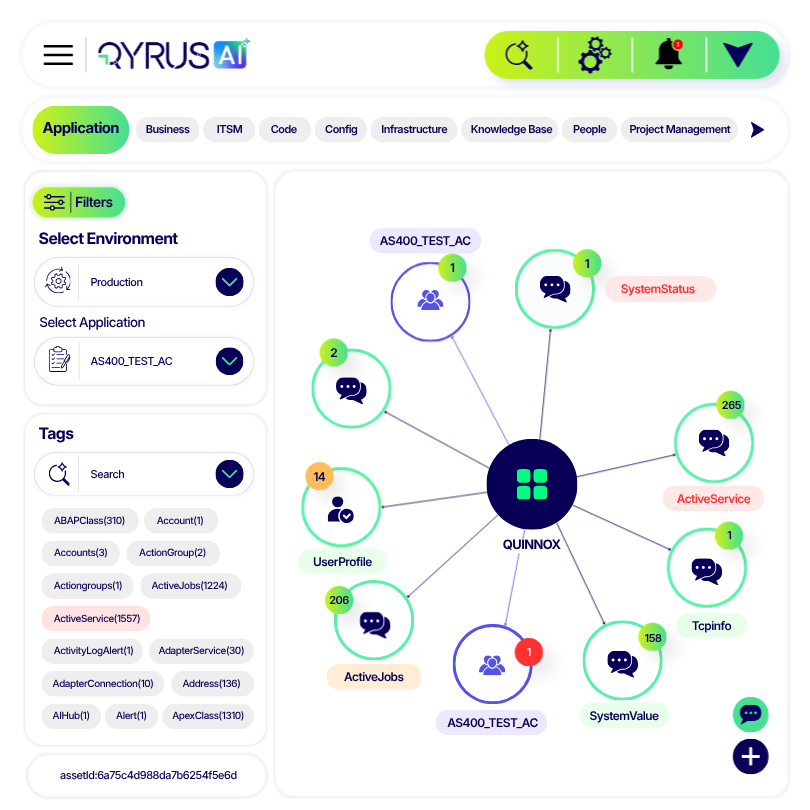
Feeding discovered components directly into an advanced knowledge graph maps exact application landscapes. This dynamic representation visualizes how legacy systems interact with modern stacks, establishing absolute clarity before executing changes.
Ingest operational patterns and historical incident data to contextualize workflows.
Disconnected data points transform into context-rich intelligence by evaluating repeated service requests and ticket trends. This learning engine comprehends exact intents, significantly reducing reliance on isolated subject matter expert interventions.
Construct a comprehensive digital twin visualizing all active service interdependencies.
Feeding discovered components directly into an advanced knowledge graph maps exact application landscapes. This dynamic representation visualizes how legacy systems interact with modern stacks, establishing absolute clarity before executing changes.
Navigate complex lifecycle transitions utilizing context-aware, intelligent agentic action pathways.
Autonomous agents perceive, plan, and act upon gathered structural intelligence. Evolving beyond rigid automation, these feedback loops continuously adapt configurations, ensuring your technology stacks remain perfectly synchronized with enterprise objectives.
Core Features
Engineered for Comprehensive
Architectural Visibility and Automated Precision.
Replace static documentation with a continuously evolving intelligence engine. Empower your engineering teams to manage complex lifecycles with absolute structural certainty.
Autonomous Asset Discovery
Bypasses manual entry entirely by continuously detecting virtual machines, application landscapes, and network configurations across modern and legacy developmental stacks.
Dynamic Knowledge Graph
Functions as an active learning engine that visualizes interdependencies instantly, transforming raw infrastructural data points into context-rich, actionable operational insights.
Intelligent Triage Routing
Analyzes ticket intent and priority autonomously to route critical issues perfectly, bypassing traditional help desk bottlenecks and historical guesswork completely.
Lifecycle Impact Analysis
Provides deep structural validation prior to decommissioning software or migrating workloads, identifying hidden connections to guarantee zero disruption during modernization.
A GLIMPSE ON THE NUMBERS
Outcomes & Benefits
Accelerate Migrations. Maximize Uptime. Optimize Resource Allocation.
Secure a resilient, future-proofed IT ecosystem capable of adapting instantly. Achieve rigorous performance benchmarks while drastically lowering operational overhead.
IT estate visible on first discovery
Run cost reduction — capacity for change
Lower migration volume with Phase Zero
Faster modernization programme execution
Continuous testing. Continuous learning. Continuous value.
Join leading enterprises
driving the loop forward.
Integration
Works With Your Existing Enterprise Stack.
QyrusAI Modernize connects to your existing tools — CMDBs, ITSM platforms, cloud providers, and enterprise architecture repositories — so discovery enriches the tools you already use rather than replacing them.
CUSTOMER TESTIMONIALS
Enterprises running the loop
in their own words.
Real Teams. Real Outcomes. Real Confidence in what ships next.
Lorem Ipsum Dolor Sit Amet. Lorem Ipsum Dolor Sit Amet. Lorem
Qyrus not only supports the testing of our Web, Mobile, and API components as part of our CI/CD processes, but also in ongoing regression-testing across our partner ecosystem. The real power of Qyrus is that we have this extremely broad testing capability in one tool, run in the cloud, and reusable across all our development teams.

The transition to Qyrus has marked a significant turning point for us. By embracing automation, we not only streamlined our SAP test automation process but also achieved a remarkable reduction in overall project testing time by 40%.
... the Qyrus platform have been a great addition to Monument's product delivery capabilities. Within a few months, we have been able to create a comprehensive test suite of complex end-to-end test scenarios spanning multiple platforms and channels. The Quinnox team has helped us embed the Qyrus solution, and the supporting processes around it, into our agile delivery methodology.
Resources
Command Your Architectural Interdependencies
Explore advanced methodologies for mapping dynamic environments. Provide your teams with the ultimate blueprint for seamless technological evolution.
August 19, 2026 |
18 min
User Acceptance Testing Best Practices: A Complete UAT Strategy Guide for SAP Teams
Read More
August 13, 2026 |
2 min
Qyrus Named in Gartner’s Market Overview for API and MCP Testing Tools
Read More
August 13, 2026 |
2 min
Qyrus Named in Gartner’s Market Overview for API and MCP Testing Tools
Read More
Blog
August 19, 2026 |
18 min
User Acceptance Testing Best Practices: A Complete UAT Strategy Guide for SAP Teams
Read More
Case Study
Events
Reports
August 13, 2026 |
2 min
Qyrus Named in Gartner’s Market Overview for API and MCP Testing Tools
Read More
Whitepaper
August 13, 2026 |
2 min
Qyrus Named in Gartner’s Market Overview for API and MCP Testing Tools
Read More
FREQUENTLY ASKED QUESTIONS
Common Questions About QyrusAI Modernization
Lorem ipsum dolor sit amet, consectetur adipiscing elit, sed do eiusmod tempor
incididunt ut labore et dolore magna aliqua. Ut enim ad minim veniam, quis nostrud.
How is this different from a CMDB or an EA repository like LeanIX?
Does Qyrus Modernize work with SAP S/4HANA migrations?
Yes — and SAP migrations are one of the highest-urgency use cases. QyrusAI reads your SAP environment in read-only mode, inventories all RFCs, IDocs, OData services, SOAP connections, CPI integrations, background jobs, and Z-objects, and produces a blast-radius score for every proposed S/4HANA change. The Estate X-Ray and Phase Zero governance workflow are specifically designed for ECC-to-S/4HANA programmes with fixed cutover dates.
How long does the initial discovery scan take?
The first scan of a mid-market estate (200–400 applications) typically produces an initial topology map within 48–72 hours. The map enriches continuously from that point — adding confidence detail, business-service attribution, and dependency validation as more signals are observed. A Phase Zero engagement (discovery, dependency mapping, and modernization prioritization) is typically scoped at 4–6 weeks.
Does it require agent installation on every system?
No. QyrusAI reads from APIs, connectors, log streams, and cloud provider metadata — it does not require an agent on every application or server. For some legacy on-premise environments a lightweight collector may be deployed, but this is scoped per engagement and never required across the full estate before value is delivered.
What happens to the modernization plan if the estate changes while the programme is running?
The Knowledge Graph is continuously updated. If a new application is deployed, a dependency changes, or a system is decommissioned mid-programme, the change is reflected in the graph and the modernization wave plan is re-scored automatically. Your transformation plan is always based on the current estate, not the estate as it was when the programme started.
Does Qyrus Modernize integrate with Assure for testing?
Yes — this is the core joint value of the two pillars. Every modernization slice Modernize produces is automatically handed to Assure for equivalence testing. Assure generates test cases from the code analysis output, runs them against the modernized slice, and produces an evidence record before any release decision is made. The conversion is never marked complete until Assure has proved it works.
Move From Static Lists to Living Intelligence.
Arrange an exclusive thirty-minute strategy session with an infrastructure architect—we will expose your hidden vulnerabilities and demonstrate precisely how automated mapping drastically curtails resolution windows across your enterprise.