Application Rationalization: How to Decide What to Modernize, Merge or Retire
 Varun RS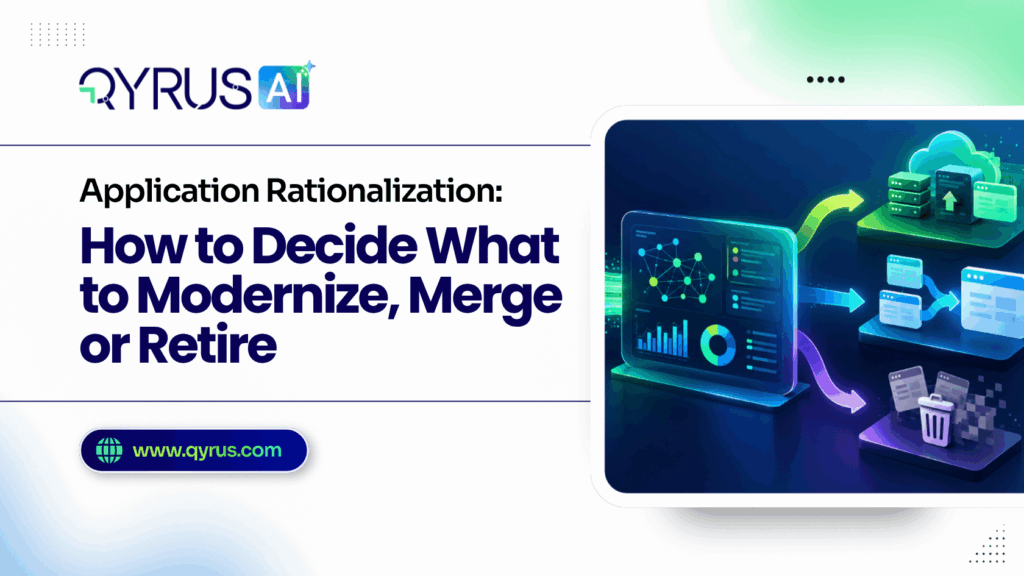
Picture an enterprise with hundreds of applications. A few run business-critical services. Several do almost the same job. Some barely get used. Application rationalization is the discipline of sorting that portfolio: reviewing every application and deciding whether to modernize it, consolidate it, retire it, or leave it alone.
The decision matters because modernization budgets are finite. When every outdated application becomes a modernization project, teams spend months upgrading systems that should have been merged or switched off. This guide shows a practical way to make the call, based on business role, usage and cost rather than technical age alone.
Why an old application isn’t automatically a modernization candidate
Ask most teams where to start, and they point at the oldest systems. The instinct makes sense. Older applications often run on aging frameworks, with limited vendor support and more security exposure.
But age measures technical condition. It says little about how much the business relies on the application. A decade-old billing system may sit behind every invoice you send. A recently bought workflow tool may have a dozen users and no clear owner.
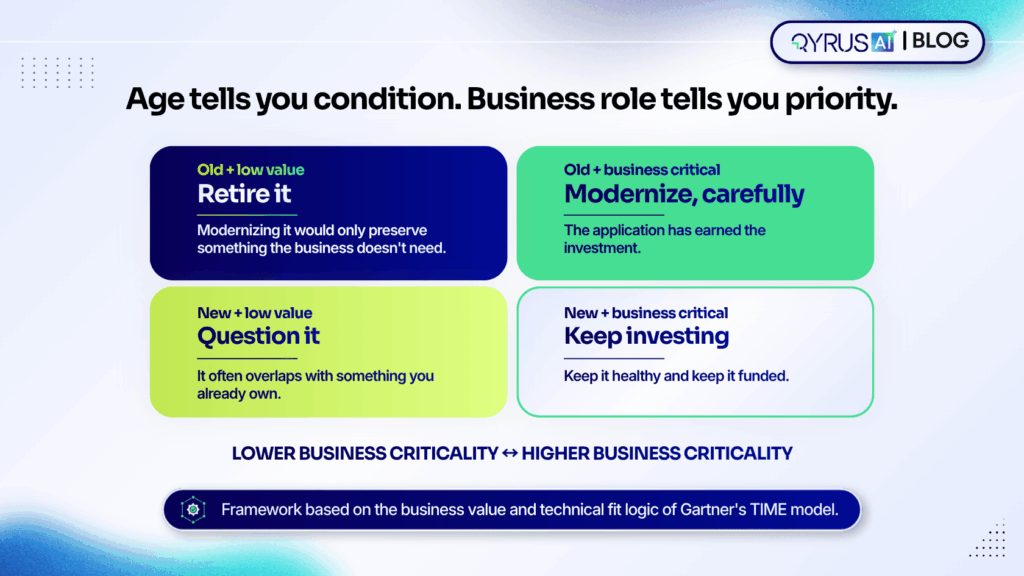
Gartner’s TIME model captures this by plotting each application on two axes, business value and technical fit, then sorting it into Tolerate, Invest, Migrate, or Eliminate, as LeanIX explains. Age feeds into technical fit. But it is only one input beside maintainability, compatibility and vendor support. Enterprise architects use the result to see which applications deserve money. The same logic gives you four cases to remember:
- Old and business critical: modernize, carefully. The application has earned the investment.
- Old and low value: retire it. Modernizing it would only preserve something the business doesn’t need.
- New and business critical: keep investing and keep it healthy.
- New and low value: question it. It often overlaps with something you already own.
Treating all four the same is how modernization budgets get spread thin.
The four decisions a portfolio review produces
Frameworks use different labels. TIME says Tolerate, Invest, Migrate and Eliminate. Cloud-focused models talk about rehosting, replatforming, retiring and retaining. Underneath the vocabulary, a portfolio review comes down to four practical outcomes.
Decision | When it fits | Roughly maps to |
Modernize | The business needs the application, but its technology holds it back | Migrate |
Consolidate | Several applications do the same job, so one survives and the others’ users and data move across | Migrate, then Eliminate |
Retire | The application has low value, low use or a redundant role; switch it off and keep any data you must retain | Eliminate |
Leave alone | It works, costs little and nobody is asking for more | Tolerate or Invest |
Look at what that table implies. Three of the four outcomes reduce the amount of modernization you need to fund. Consolidation merges projects. Retirement removes them. Leaving an application alone avoids them. Cost, usage and business role drive each choice, not the year the application was built. That is why the review should come before the modernization budget, not after it.
A worked example: three departments, one job
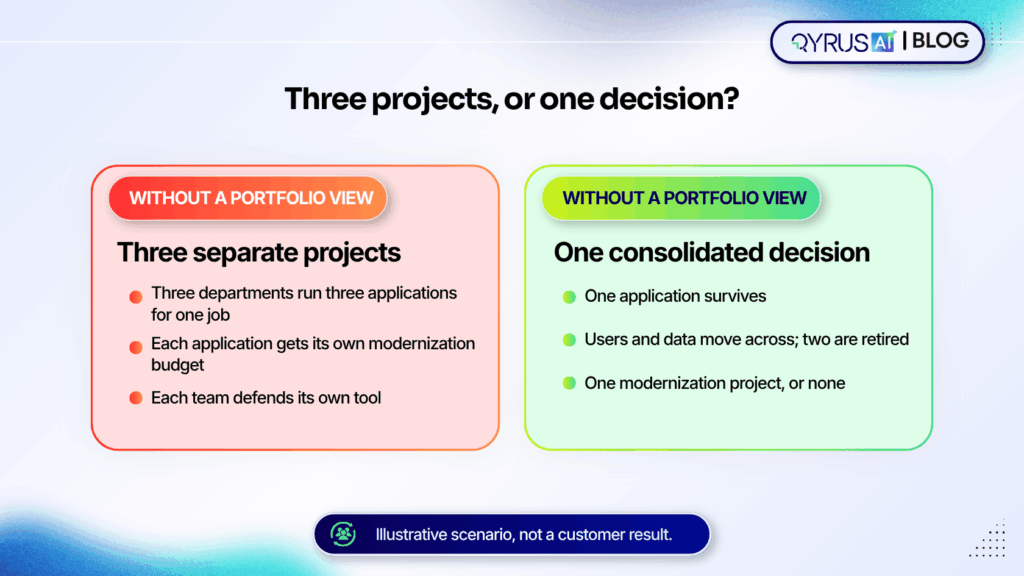
Here is an illustrative scenario, not a customer result. Sales, customer support and field services each run their own application to track customer requests. Each was a sensible purchase at the time. Now each carries its own licenses, infrastructure, upgrades and support contract.
Without a portfolio view, a modernization program sees three separate applications and funds three projects. Each team defends its own tool, and the work starts from the assumption that all three will survive.
A rationalization review asks different questions. How many people use each application every week? What does each cost to run? Which business process depends on it? Suppose the answers show that one application covers nearly everything the other two do, while the other two serve small teams for features the first already offers.
Now the team can consolidate: keep one application, migrate the users and data from the others, and retire two. Three modernization projects become one, or none if the survivor is already healthy. Overlap isn’t always waste, though. If one department needs a regulated workflow the others lack, the duplication may be justified, and the review should say so.
The same thinking applies to supporting systems. Test environments multiply in the same way, which is why we’ve written about how infrastructure consolidation lowers testing costs.
Five steps that start with evidence
A review is only as good as the data behind it. These five steps put evidence ahead of opinion.
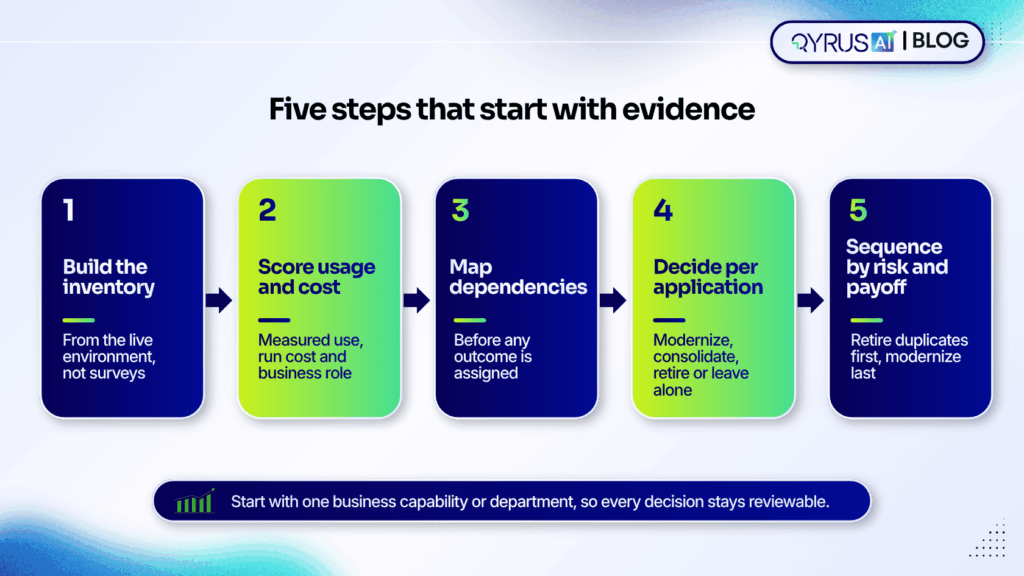
Build the inventory from the environment, not from surveys
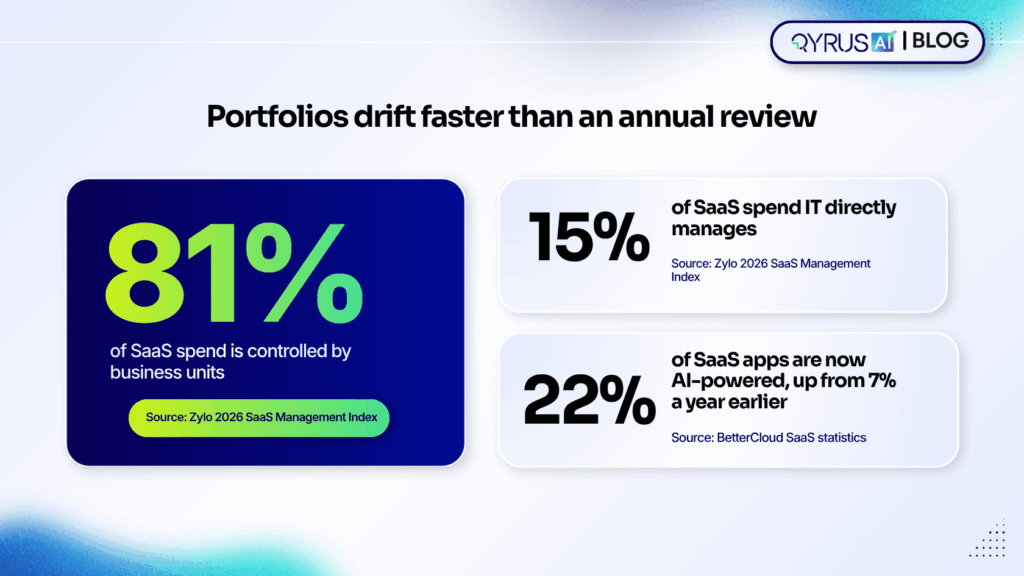
Most portfolios are bigger than the people running them believe. Zylo found that organizations underestimate their application count by about 1.7 times and their software spend by about 3 times, according to its analysis of SaaS sprawl. Ownership is scattered too. Business units control 81% of SaaS spend, while IT directly manages 15%, per Zylo’s 2026 SaaS Management Index. And Torii puts the average large enterprise at 2,191 business applications.
A spreadsheet that people fill in by hand will miss much of that. Automated discovery gives you one application inventory that works as a single source of truth for every later decision.
Score usage, cost and business role
For each application, record how often people actually use it, what it costs to run (licenses, infrastructure and support) and which business capabilities depend on it. Owners understandably defend their tools, so measured usage settles debates that opinion can’t.
Map dependencies before you decide
A low-usage application can still feed a critical process. Map what each application connects to, including data feeds, integrations and shared infrastructure, before you assign an outcome. Finding a dependency before the decision is cheap. Finding it after the shutdown is not.
Decide per application
Assign one of the four outcomes to each application in scope. Start with one business capability or department rather than the whole portfolio, so every decision stays reviewable. If a decision involves moving an ERP, plan the testing early; our guide to performance testing for a stable SAP S/4HANA go-live shows what to check. Whichever application survives a merger will also absorb new users and data, so it needs solid regression coverage. Here is how automated regression testing improves release quality.
Sequence by risk and payoff
Retire clear duplicates first. They free up budget quickly and carry the least risk. Consolidations come next. Then modernize the critical applications, funded in part by what the earlier steps released. Revisit the plan each quarter as usage data changes.
Retiring an application without breaking what depends on it
Retirement looks like the easy win. It isn’t always. Legacy applications often feed reports, manual exports and indirect integrations. Those links can stay hidden until the system is gone, according to CIGen’s decommissioning guide.
The opposite failure is the zombie application. Teams mark it retired and restrict access, but the database stays online and old integrations keep running. The savings never fully arrive, and nobody is sure the system can be switched off, a pattern that Archon describes in its decommissioning framework.
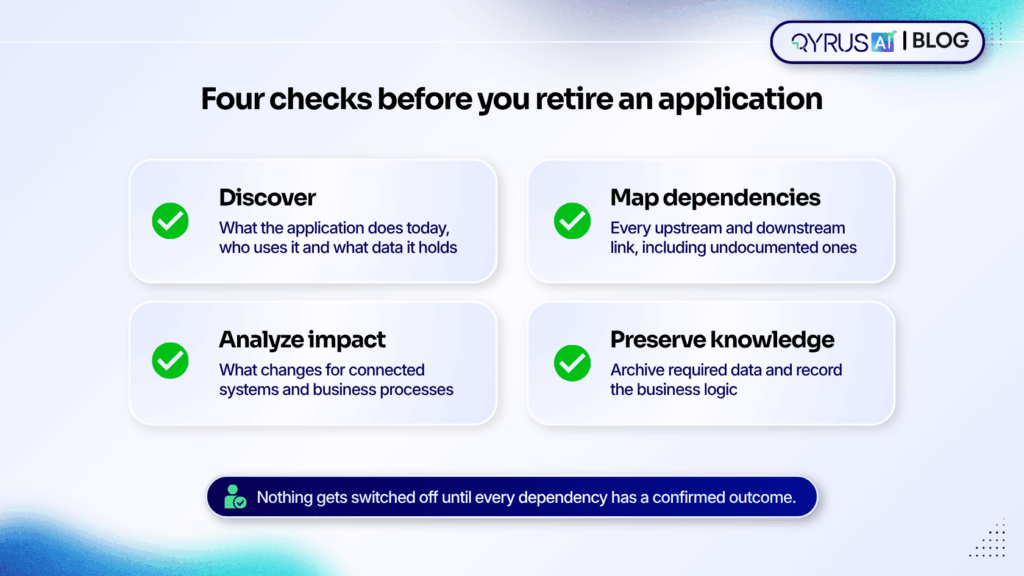
A safer retirement follows four checks:
- Discover: confirm what the application does today, who uses it and what data it holds.
- Map dependencies: list every upstream and downstream connection, including undocumented ones.
- Analyze impact: model what changes for connected systems and business processes before anything is switched off.
- Preserve knowledge: archive required data and record the business logic, so the organization keeps what the application knew after it is gone.
That last check matters more than most plans admit. When the people who understand an old system move on, the application itself is often the only record of how a process really works. Capture that before shutdown.
Why a one-time cleanup doesn’t last
A rationalized portfolio starts drifting the day you finish. Business units buy most SaaS themselves, so new tools rarely pass through central review. AI is speeding that up. BetterCloud reports that 22% of SaaS applications are now AI-powered, up from 7% a year earlier.
New applications arrive faster than an annual review can catch them. Rationalization works best as a continuous practice: assess usage, overlap and cost as applications enter the portfolio, not once a year. Continuous assessment also keeps the inventory current, so the next decision starts from evidence instead of another survey.
How QyrusAI supports application rationalization
QyrusAI is a single AI platform that unites application modernization, software testing and autonomous IT operations. It organizes that work into three connected workspaces. Qyrus Modernize discovers, maps and modernizes the enterprise estate. Qyrus Assure validates every change through AI-driven test automation. Qyrus Operate detects and resolves issues in production. All three share one Knowledge Graph of the estate, so what one workspace learns informs the other two.
Application rationalization sits inside Modernize, alongside application discovery, dependency mapping, legacy modernization, cloud migration intelligence and technical debt analysis. QyrusAI Application Rationalization looks across the whole portfolio and weighs how each application is used, what it costs to operate and what role it plays in the business. That gives teams the context to choose between modernizing, consolidating and retiring, instead of judging by technical age alone.
Four capabilities support the decision:
- Auto-discovery and dependency mapping build the inventory and the connection map from the live environment, which reduces reliance on manual surveys and on a few subject-matter experts.
- Digital Twin impact analysis predicts the ripple effects of decommissioning an application before anyone switches it off.
- Knowledge retention keeps business logic and data context available in the Knowledge Graph after a system retires.
- Continuous assessment helps stop redundancy from building up again after the first review.
QyrusAI’s targeted outcomes include decommissioning 20–30% of redundant legacy applications and achieving 15–20% infrastructure cost savings through right-sizing environments. These are targets, not guarantees, and results depend on the starting portfolio.
Frequently asked questions
What is application rationalization?
It is a structured review of an organization’s application portfolio that decides what to modernize, consolidate, retire or keep as it is. The decision rests on usage, cost and business role.
How is it different from application modernization?
Rationalization decides which applications deserve which treatment. Modernization is the technical work of upgrading or re-platforming the ones you chose to keep and improve. Running the review first keeps you from modernizing systems you should have retired.
When should a company start?
Common triggers include mergers and acquisitions, a planned cloud migration, budget pressure, the retirement of a legacy system and a sudden rise in departmental or AI tools. Any of these tends to expose overlap.
How many applications should a review cover at once?
Start with one business capability or department. A narrower scope keeps the data reviewable and the decisions defensible, and you can extend the same method to the next area.
What are the main risks of retiring an application?
The biggest ones are hidden dependencies, data-retention obligations and user adoption. Mapping dependencies, archiving required data and planning for the people who use the application reduce all three.
Make the right change in the right place
The goal of modernization isn’t to make everything newer. It is to make the right change, in the right place, for the right reasons. Application rationalization gives you the evidence to do that: which applications to modernize, which to merge, which to retire and which to leave alone.
QyrusAI Application Rationalization brings usage, cost and business context into that decision, backed by discovery and dependency mapping across the estate. Request a demo to see how QyrusAI can help you decide what to modernize and what to retire.
 September 30, 2026
  9 min
9 min