
Qyrus Named a Leader in The Forrester WaveTM: Autonomous Testing Platforms, Q4 2025 – Read More

Featured Image

Fifty-five percent of SAP customers have now deployed S/4HANA in some form. Only thirty-four percent have actually finished the transition. That gap between “live” and “done” is not a rounding error — it’s the story of most SAP migrations running right now, and it explains why so many of them slip past their own deadlines even when the underlying technology works exactly as designed.  

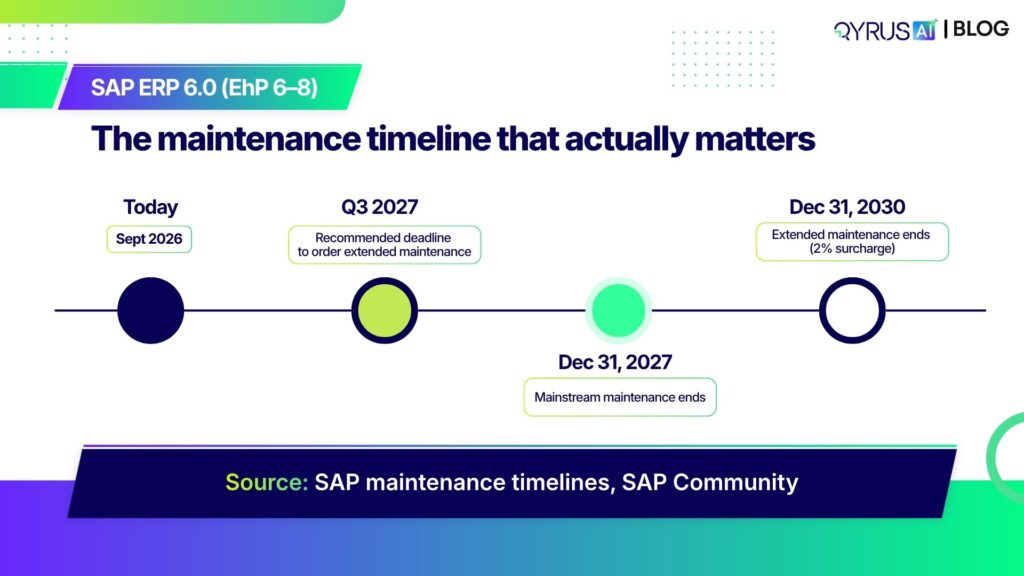
With SAP ERP 6.0’s mainstream maintenance ending December 31, 2027, for organizations on Enhancement Packages 6 through 8, the window to migrate without a rushed, high-risk scramble is closing. But new research from 2026 makes one thing clear: the organizations that miss this deadline mostly don’t miss it because of SAP. They miss it because of how the migration itself is run.  
The Deadline Everyone’s Watching, and the Number Nobody Talks About  

The mechanics of the deadline are simple enough. SAP ERP 6.0 on Enhancement Packages 6 through 8 loses mainstream maintenance on December 31, 2027. Extended maintenance is available as a bridge through December 31, 2030, at a 2 percentage-point surcharge on the maintenance base — after which only customer-specific maintenance remains, with no new fixes, no legal updates, and steadily increasing risk.  

What’s less discussed is where the industry actually stands against that date. SAPinsider’s 2026 ERP Migration and Transformation Benchmark puts current deployment at 55%, but only 34% of organizations have fully completed their transition. Of the rest, 41% plan to finish before the 2027 cutoff, 18% concede they won’t make it in time, and 7% have no migration plan at all.  
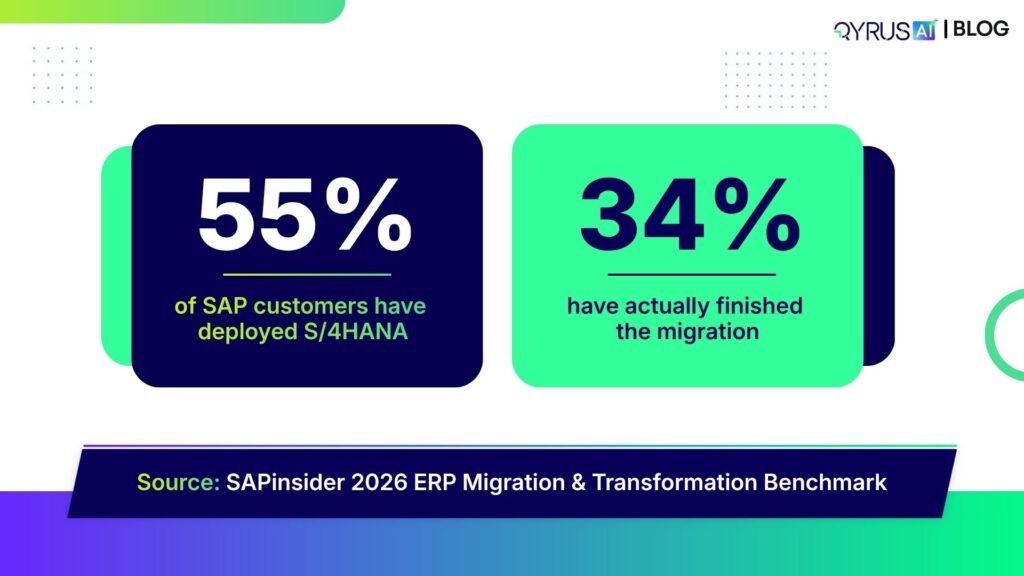
That 55%-to-34% gap is the number worth sitting with. An initial go-live is not a completed migration. Plenty of organizations are technically “live” on S/4HANA while running parallel systems, incomplete data models, and unresolved integration debt underneath — the exact conditions that turn a deadline-driven project into a multi-year scramble. If you’re mid-transition, our complete guide to SAP S/4HANA migration performance testing covers what a stable go-live actually requires. 

What Actually Derails SAP S/4HANA Migrations  

The ISG Data  
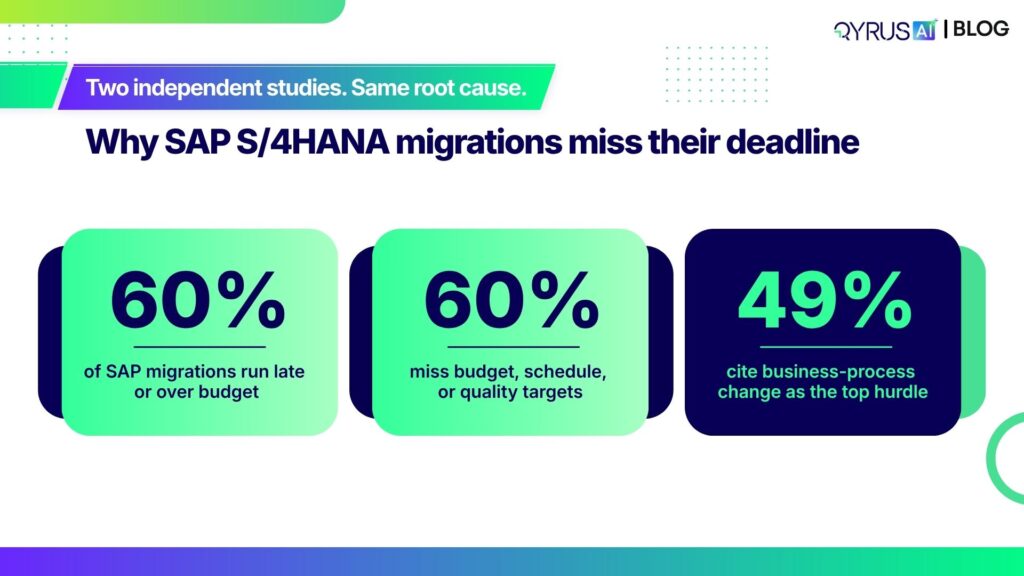
ISG’s State of SAP Migrations report, published in February 2026 and based on a survey of more than 200 senior decision-makers at large global companies, found that nearly 60% of SAP migration projects run late or over budget. The report’s authors point to underestimated complexity, scope that expands mid-project, and internal constraints nobody accounted for going in.  

The mechanism behind that number is organizational, not technical. Most migration programs run through multiple system integrators, SAP service providers, and niche specialists at once — and ISG’s research points to a lack of clear decision-making rights and acceptance criteria between them as a primary driver of the delays. Nobody owns the call, so the call doesn’t get made until it’s already a problem.  

A Second Study Says the Same Thing  

That pattern isn’t unique to one study. A 2025 Horváth survey of 200 SAP customer companies in the DACH region found the same 60% figure for projects missing budget, schedule, or quality targets — and identified business-process change as the single biggest hurdle, cited by 49% of respondents. It also surfaced a leadership gap: at smaller firms, the CEO personally leads the S/4HANA program in just 14% of cases.  

Two independent studies, on different populations, converging on the same root cause: this keeps getting run like an IT upgrade when it’s actually an enterprise transformation program. Our piece on navigating the SAP testing strategic approach to optimizing S/4HANA goes deeper on what that distinction means for test strategy specifically.  

The Quiet Trade-Off: Stability Now, Transformation Deferred  

Here’s what that pressure actually produces in practice. ISG’s research found that fewer than one in five organizations (18%) reimplement their processes and technology during the move to S/4HANA. Nearly half (49%) carry out little to no re-engineering at all, choosing instead to preserve legacy processes and data structures largely as they are.  
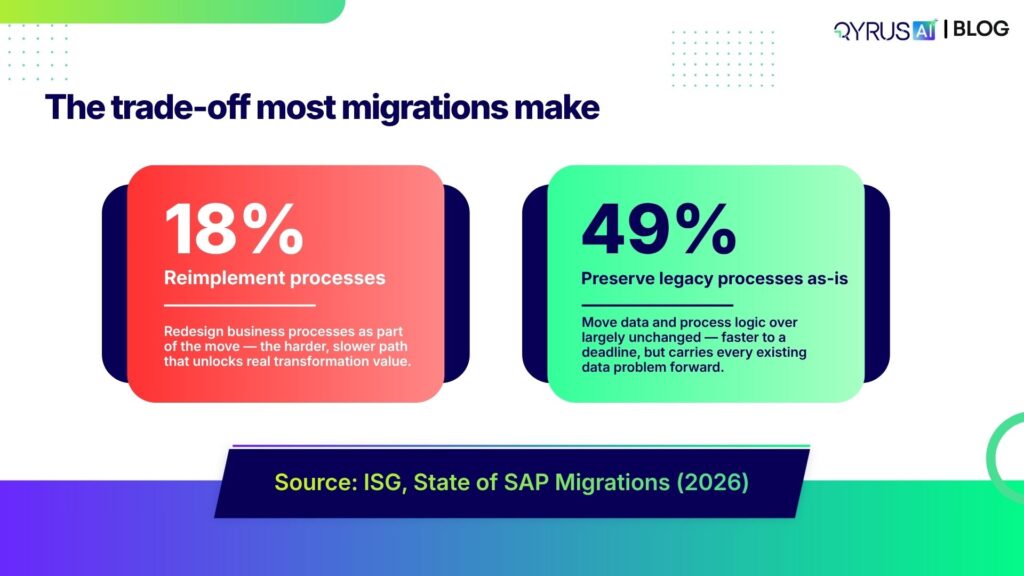
That’s a rational response to deadline pressure — moving data and process logic over unchanged is faster than redesigning it. But it doesn’t make the underlying problem disappear. It just moves it. Master data that’s fragmented or stale in ECC doesn’t become clean by virtue of running on HANA; it just runs faster. Every report, every forecast, and eventually every AI agent built on top of that data inherits whatever was already broken underneath it.  

Why This Matters More Now Than It Did Two Years Ago  

The stakes attached to that trade-off have shifted. SAPinsider’s 2026 Benchmark found that 43% of respondents now cite SAP’s AI roadmap — the Business AI Platform and Autonomous Suite announced at Sapphire 2026, including more than 200 specialized AI agents and 50 Joule Assistants — as the primary external factor shaping their ERP strategy. That’s ahead of the 2027 maintenance deadline itself, now cited by 39%.  

This isn’t a laggard problem, either. Even large, well-resourced programs are still mid-transition under this same pressure: Airbus’s digital leadership has publicly acknowledged that most of the company’s SAP migration work remains ahead of it, despite the 2027 timeline bearing down on a sprawling estate that still includes legacy SAP R/3 and ECC 6.0 systems.  

What changed is the cost of getting the data wrong. A fragmented Business Partner record used to mean finance and procurement disagreed on a report. Now it means every autonomous agent and AI forecast built on top of S/4HANA inherits that same fragmentation — and a technically successful interface exchange can still mask incorrect data underneath. Our post on true data integrity in SAP EDI processes walks through exactly how that plays out at the IDoc level.  

Discover, Govern, Validate, Operate: How QyrusAI Closes the Gap  
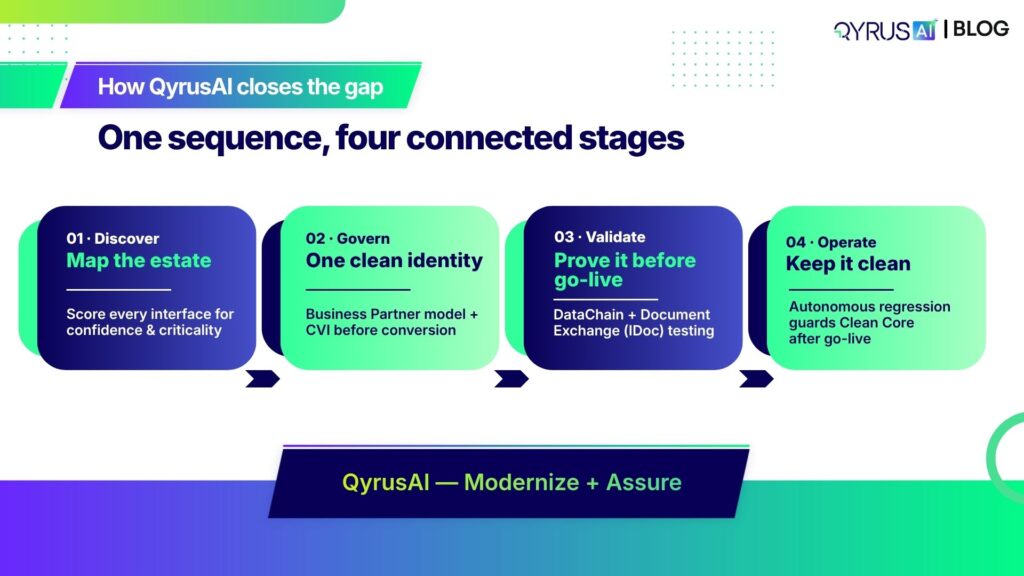
The pattern in both studies points to the same fix: treat the migration as a sequence of decisions to get right in order, not a single technical event. QyrusAI’s Modernize and Assure workspaces are built around exactly that sequence.  

Discover. Before you fix a single master record or commit to a migration path, you need an honest, evidence-based map of the SAP estate — not tribal knowledge or a stale architecture diagram. QyrusAI’s discovery capability inventories every integration (RFC, IDoc, REST/OData, SOAP, CPI iFlows) and scores each one for confidence and criticality, so scope gets locked before the project starts, not renegotiated mid-flight.  

Govern. The Business Partner model consolidates fragmented customer, vendor, and employee records into one master object per legal entity. Customer-Vendor Integration (CVI) is the bridge that keeps legacy and Business Partner records synchronized — and it needs to go in before conversion, not during it, with continuous deduplication and enrichment keeping records from fragmenting again after go-live.  

Validate. This is where QyrusAI’s Assure workspace does the heavy lifting. Qyrus Assure DataChain takes a single document or transaction number and maps every linked transaction across the flow — quotation, delivery, billing — cutting test data creation time by up to 92% and closing the “referential integrity nightmare” that makes manual test data setup for SAP such a bottleneck. Document Exchange (IDoc/EDI) Testing solves the specific problem covered above: it links every incoming IDoc to the business transaction it actually posted, catching the silent mapping flaws a “successful” technical status alone won’t reveal. This is the same approach that helped a $30B+ US automaker cut testing effort by 88% on its own complex SAP S/4HANA workflows. For more on closing the test data gap specifically, see the hidden tax on SAP projects and how DataChain eliminates it.  

Operate. Clean Core isn’t a milestone you hit once — it’s a discipline that erodes one “quick” core modification at a time. QyrusAI’s Autonomous Regression Suite keeps testing running after go-live, connecting to SAP’s standard APIs with no scripting required, so drift back into the core gets caught by a scheduled test run instead of discovered in production months later.  

Where to Start Your SAP S/4HANA Migration Governance  

The runway is shorter than the calendar suggests. For organizations planning to use extended maintenance as a bridge, SAP’s own guidance recommends completing that ordering process by Q3 2027 — which pulls the real decision point well ahead of the headline deadline.  

A few places to start regardless of where your program stands today:  

  • Map the estate first. Score every interface for confidence and criticality before you commit to a scope or a migration path.  
  • Stand up CVI early. Build the Business Partner bridge before conversion begins, not as a mid-project fire drill.  
  • Separate the obligatory cleanup from the discretionary work — and fund both. The fixes required for technical success (missing fields, postal formats) always get done because the system won’t go live without them. The fixes that create business value (deduplication, enrichment) are the first thing cut when the timeline tightens, and that’s exactly what erodes user trust in the new system on day one.  
  • Test the identity model, not just the interfaces. A clean Business Partner record only matters if it flows correctly through Lead-to-Cash and Source-to-Pay — prove that before go-live, not after.  

None of this changes the deadline. But it’s the difference between a migration your organization controls and one that controls you.  

Frequently Asked Questions  

What is the SAP S/4HANA 2027 deadline?  

December 31, 2027, is when SAP ends mainstream maintenance for SAP ERP 6.0 on Enhancement Packages 6 through 8. After that date, SAP no longer provides standard support, security patches, or legal updates for those releases unless an organization has purchased extended maintenance.  

What happens after SAP ECC mainstream maintenance ends?  

Organizations on Enhancement Packages 6–8 can purchase extended maintenance through December 31, 2030, at a 2 percentage-point surcharge on their maintenance base. After 2030, only reduced customer-specific maintenance is available, with no new fixes or legal updates.  

Why do most SAP S/4HANA migrations run over budget or behind schedule?  

Research from ISG and Horváth both point to governance failures rather than technology gaps: underestimated complexity, expanding scope, unclear decision rights across multiple vendors, and business-process change that gets underestimated going in.  

What is Customer-Vendor Integration (CVI) and why does it matter?  

CVI is the bridge that synchronizes legacy customer and vendor records into SAP’s unified Business Partner structure. It needs to be implemented before system conversion — not during or after — and it runs continuously to keep records in sync rather than functioning as a one-time migration step.  

What is SAP Clean Core?  

Clean Core is the practice of keeping custom logic out of the SAP core system and building it instead as side-by-side extensions on SAP Business Technology Platform (BTP). It has to be actively maintained after go-live, since even small core modifications accumulate and eventually degrade AI and automation capabilities built on top of the system.  

How long does an SAP S/4HANA migration typically take?  

Timelines vary by path: a brownfield conversion (keeping the existing system in place) typically runs 6 to 10 months, while a greenfield rebuild can take 12 to 36 months depending on customization volume and transformation ambition.  

How can QyrusAI help reduce SAP S/4HANA migration risk?  

QyrusAI combines estate discovery, Business Partner and CVI governance, AI-driven SAP test automation, and continuous post-go-live regression testing in one workspace — covering the full sequence from mapping the estate to keeping it clean after go-live.  

The Bottom Line  

The 2027 deadline is real, but it isn’t the thing most migrations actually fail against. The data is consistent across every study cited here: programs miss their targets because of how they’re governed, not because the underlying platform can’t get there. Mapping the estate honestly, governing to one clean identity, and testing before you trust the result is the sequence that keeps a deadline-driven program from becoming a multi-year rescue effort.  

Ready to see where your own SAP S/4HANA migration stands against this pattern? Request a QyrusAI demo to walk through your estate, your data governance gaps, and your testing coverage with the team.  
Enterprise resource planning ecosystems have evolved from being standalone databases controlled by singular architectures. Contemporary SAP ecosystems reflect highly interconnected digital structures where a solitary configuration adjustment in the Financial Accounting and Controlling (FI/CO) module can immediately cause unexpected disturbances throughout Materials Management (MM), Sales and Distribution (SD), and Human Capital Management (HCM).  

The structural interdependence, when paired with SAP’s continuous release schedule, which includes significant cloud version upgrades, Feature Package Stacks (FPS), Support Package Stacks (SPS), and localized emergency transports, renders the conventional quality engineering model completely ineffective. 

Manual testing is structurally and mathematically incapable of keeping pace with this release velocity.  

Automation isn’t optional so much as a mandatory response to a scheduling problem: SAP ships continuous changes faster than human teams can manually re-validate the complex business processes those changes touch.  

That is why SAP test automation is no longer just a clever way to cut QA costs. Today, it’s a hard requirement. To maintain stable production, manage your release timelines, and successfully execute significant system migrations without disrupting the business, manual processes are not an option. 

To attain genuine test resilience, it is essential to move beyond fragile script-based validations. Today’s quality leaders must deploy scalable, workflow-driven orchestration that bridges disparate technologies, unifies legacy protocols with cloud-native web architectures, and seamlessly validates the next generation of enterprise workflows. 

What Is SAP Test Automation & How It Works 

At its core, SAP test automation involves utilizing dedicated software platforms to automatically carry out, verify, and oversee business processes throughout the whole SAP application environment. Instead of depending on manual operators to navigate through Transaction Codes (T-codes), input parameters, and check database conditions, automated testing performs comprehensive validation with complete consistency, traceability, and rapidity. 

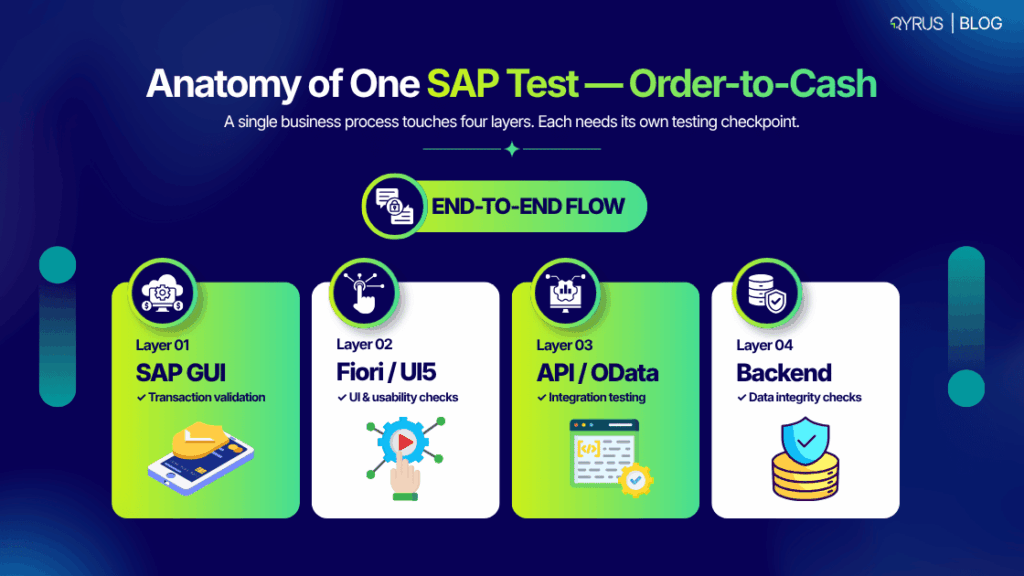
Nonetheless, automating an enterprise SAP environment is inherently more complicated than automating a typical web application. An effective SAP test automation framework for businesses should operate simultaneously across diverse UI technologies, communication protocols, and architectural layers: 

  • Legacy SAP GUI (WinGUI / JavaGUI): Based on proprietary SAP protocols and ActiveX-based rendering, validating the desktop GUI necessitates unique hook mechanisms that can interpret low-level SAP Scripting APIs instead of conventional web Document Object Model (DOM) elements. 
  • Modern SAP Fiori (SAPUI5): Testing Fiori is notoriously difficult because the underlying web framework is constantly shifting. You’re dealing with nested shadow roots, fluid CSS classes, and element IDs that regenerate every time a new session starts. If you try to rely on traditional XPath or coordinate-based selectors, your scripts will break almost instantly. 
  • API & Middleware Integration Layers: Core business logic frequently bypasses the UI entirely via Remote Function Calls (RFCs), Business Application Programming Interfaces (BAPIs), Intermediate Documents (IDocs), and modern OData / REST web services. 
  • Backend Database Validation: A test isn’t actually complete until you prove the data landed exactly where it belongs. True end-to-end validation means querying your underlying SAP HANA tables (like BSEG, BKPF, VBAK, or VBAP) to ensure financial ledgers are balanced and inventory counts are mathematically correct. 

For years, teams tried to manage this technical complexity using SAP’s bundled tools, like eCATT and CBTA. Those native utilities are fine if your processes never leave the core ABAP stack.  

But in the real world, enterprise workflows rarely stay inside a neat SAP bubble. The moment a transaction crosses over into Salesforce, a custom e-commerce frontend, or a third-party logistics API, those legacy tools hit a brick wall. 

Modern enterprises are replacing legacy tools with specialized third-party platforms. These platforms approach quality engineering not through isolated script execution, but by treating business processes as interconnected, node-based workflows.  

To understand how contemporary architectures compare across capabilities, review our technical guide to choosing the right SAP testing tools.   

Why Manual SAP Testing Breaks Down 

Depending on manual testing for a complicated ERP system is an inherently flawed approach, and the difficulties only increase with each new version. When an update is released and there’s no clear method to understand what it affects, QA teams find themselves in a difficult position.  

They’re forced to choose between two bad options: run a quick round of basic smoke tests and just hope nothing critical breaks in production, or grind through months of manual regression testing that brings your release schedule to a dead stop. 

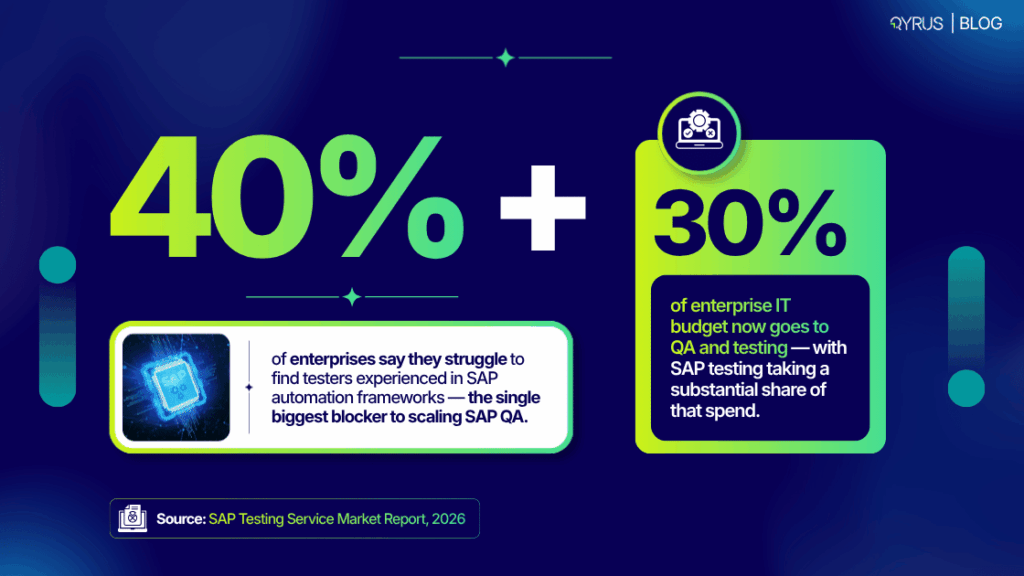
The worldwide demand for SAP testing services and software showcases the immediacy of this change. Independent market reports anticipate market valuations between USD 0.97 billion in 2026 and USD 1.79 billion by 2034, while some predictions expect growth reaching USD 4.7 billion by 2033. More than 3,000 service providers currently function within the SAP QA ecosystem, as companies dedicate as much as 30% of their total IT budgets specifically to QA and testing. 

The primary reason for this expenditure is an expanding skills gap. Industry statistics indicate that over 40% of companies face challenges in locating and keeping testers with extensive expertise in intricate SAP automation frameworks.  

Creating and sustaining conventional test scripts demands a rare combination of business process understanding, ABAP programming knowledge, and proficiency in test automation engineering. When scripts fail because of regular UI changes, manual testers are returned to typical execution, increasing technical debt and exhausting engineering resources. 

This human-capacity issue is encountering an unchangeable architectural deadline: SAP has announced that standard support for SAP ECC ends in 2027. Sticking with a legacy ERP means paying a steep premium for extended maintenance, but moving to S/4HANA is no walk in the park. It isn’t a simple in-place software update, it is a massive architectural tear-down. 

If your team doesn’t have a reliable sap test automation tool locked in before you start, your migration timeline will inevitably derail. You will find yourself trapped in endless manual regression cycles, and surprise production bugs will stall the project for months.  

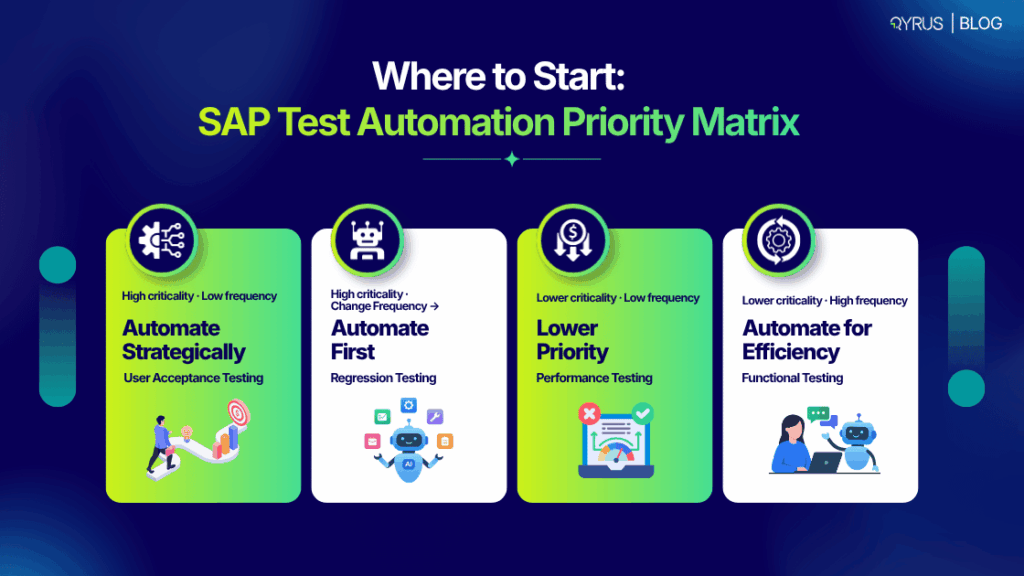
Core Testing Types & What to Automate First 

  1. Implementing a company-wide automation strategy doesn’t entail trying to automate every individual manual test case from the outset. Achieving sustainable success necessitates segmenting the testing area into separate functional categories and utilizing a risk-based prioritization framework. 
  2. SAP Functional Testing: Ensuring that individual transactions, user interfaces, custom ABAP applications, and system computations operate precisely as per technical requirements. This involves confirming both positive and negative validation rules, field dependencies, currency conversions, and automatic tax calculations across separate modules. Automated functional tests act as foundational components for larger regression suites. 
  3. SAP Regression Testing: Confirming that newly implemented transports, custom code improvements, security role changes, or support package stacks do not interfere with existing business operations. Due to the close interconnection of SAP systems, modifying an inventory valuation approach may unintentionally disrupt subsequent billing timelines or financial reports. Automated regression suites need to be designed to operate consistently in distributed environments. 
  4. Performance & Load Testing:  Moving to S/4HANA or rolling out a major Feature Package Stack isn’t just a software update. It completely rewires your underlying infrastructure, memory usage, and database query execution. Performance testing is how you prove this new architecture won’t buckle under real-world pressure. It guarantees the system stays online when it actually counts whether you are pushing through a heavy month-end financial close, handling a brutal Black Friday transaction spike, or running critical overnight payroll batch runs. 
  5. User Acceptance Testing (UAT): We need to make sure that the whole process works the way the business teams need it to be. With tools that use low-code and node-based automation, the business analysts and the team leaders can set up and record real-life business situations without having to write any code. This makes the UAT validation into tests that we can reuse and are automated. This way, it becomes easier and saves time.  

For organizations evaluating current testing methods, the most common mistake is attempting to automate edge cases too soon. Successful implementation demands precise prioritization. Begin by automating the primary “happy paths” of your crucial, high-risk business processes, the pathways that directly impact revenue or compliance, such as Order-to-Cash (O2C) or Procure-to-Pay (P2P). 

Once the core processes are stabilized, extend the focus to address edge cases and integrate the suite into a more extensive SAP CI/CD testing pipeline. Approaching it incrementally is the sole method to demonstrate ROI swiftly and gain the trust of the rest of the business in the automation.  

The 2026 Shift: AI Agents in your Workflow 

The discipline of enterprise software quality assurance is experiencing an architectural paradigm shift. Testing has traditionally been deterministic: if a user clicks a button, the system must produce an exact, predictable output. Nonetheless, SAP’s Hannover Messe 2026 agenda has officially verified that autonomous AI agents are now functioning directly within essential enterprise transactional processes. 

These smart agents are capable of making operational choices, such as adjusting purchase order routing according to live supplier risk ratings or independently addressing invoice discrepancies. This shift fundamentally expands the scope of modern quality assurance. AI-driven SAP testing is no longer restricted to using machine learning models to accelerate script authoring; it now requires validating the actual business logic and operational decisions made by autonomous AI agents operating within SAP itself.  

To manage this evolving landscape, modern orchestration platforms are advancing across three essential capabilities: 

Enterprise Testing Requirement Legacy Automation Approach 2026 Orchestration Standard 
Test Scope Selection Blindly retesting massive regression suites after every transport import, wasting time and compute resources. 

SAP change impact analysis inspects ABAP code and transport layers to pinpoint the exact processes at risk, enabling risk-targeted validation.  


UI Updates & Maintenance 

Static scripts break immediately when SAP Fiori updates dynamic element IDs or CSS classes, causing massive technical debt.  


Self-healing test automation uses dynamic computer vision and DOM heuristics to fix broken object locators in real-time during execution.  


Test Data Provisioning 

Copying static, sensitive production data into non-production environments, creating GDPR/CCPA compliance risks.  


Automated synthetic test data generation creates realistic, parameterized scenarios without exposing actual customer datasets.  


As these technologies converge, expect the enterprise software category to keep splitting into two tiers: native, bundled tooling covering basic Fiori web scenarios, versus specialized cross-system platforms needed for anything touching the SAP GUI, complex APIs, or genuine end-to-end business workflows. For an evaluation of modern synthetic data generation tools, explore KiwiQA’s breakdown of SAP test tools.  

How Qyrus Handles SAP Test Automation 

Moving beyond legacy point solutions requires a fundamental shift in how organizations approach quality engineering. Traditional tools frequently stumble when attempting to link legacy desktop protocols with modern web interfaces. Test orchestration is the company solution provided by Qyrus to seamlessly validate these cross-system business flows. Qyrus serves as both the company name and the comprehensive product platform designed specifically to handle the most demanding enterprise ecosystems. 

Rather than treating automated testing as isolated script files, Qyrus delivers deep architectural integration through purpose-built capabilities: 

  • SAP Scribe: A low-code, visual process authoring engine that allows technical QA architects and non-technical functional analysts to capture, parameterize, and orchestrate complex SAP business workflows without writing lines of brittle script code. 
  • ARS (Auto Recovery System) & Healer: Enterprise environments cannot tolerate test suite crashes caused by intermittent network latency or minor UI modifications. Qyrus’s ARS and Healer engines dynamically resolve broken element paths, handle unexpected system modal popups, and automatically realign object locators in real time during execution, virtually eliminating the maintenance burden.  
  • Cross-System End-to-End Orchestration: Real-world enterprise processes span far beyond the boundaries of an SAP application. A single automated test on Qyrus can originate in a third-party API, execute a transaction in the SAP GUI, validate the approval in SAP Fiori, and confirm the database entry in the backend without breaking session continuity. 
  • DataChain Technology: Resolves the test data bottleneck by automatically generating, conditioning, and injecting synthetic data entities into active test pipelines, ensuring that data availability never delays a release cycle. 

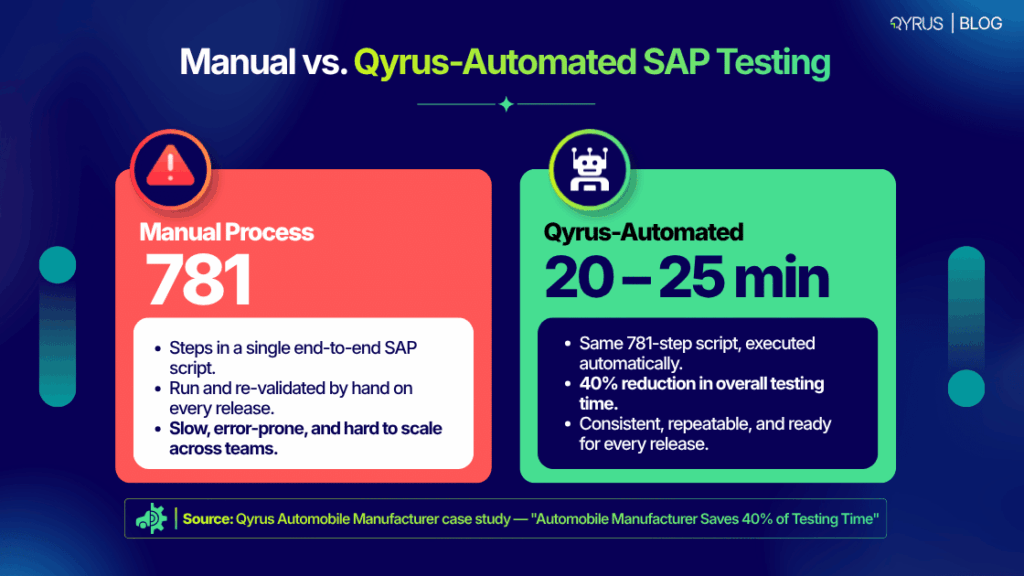
The real-world operational impact of this orchestration approach is proven across complex enterprise environments. A premier global automobile manufacturer utilized Qyrus to automate a massive, multi-departmental SAP business process comprising a 781-step end-to-end workflow. Building the complete automated test flow required just 7 to 8 hours of total authoring time on the Qyrus platform. During active release cycles, full execution was slashed to just 20 to 25 minutes, achieving a 40% total reduction in testing time compared to their manual baseline.  

To read more on how this methodology scales, explore turning nightmares into triumphs with an SAP test automation tool. 

Frequently Asked Questions 

What’s the difference between SAP test automation and regular test automation? 

Regular automation generally targets standalone web or mobile applications using standard DOM selectors. SAP automation requires specialized protocols to interact with proprietary SAP GUI scripting environments, complex ABAP-level integrations, and dynamic SAP Fiori architectures within a single test flow. 

Can you automate SAP GUI and Fiori together? 

Yes. Contemporary cross-system orchestration platforms enable the creation of smooth workflows that transition seamlessly between traditional SAP GUI desktop settings and modern SAP Fiori web interfaces, maintaining execution continuity. 

What’s eCATT vs. CBTA?  

eCATT (Extended Computer Aided Test Tool) is an older, native SAP tool primarily used for testing backend ABAP processes. CBTA (Component-Based Test Automation) is a newer native tool designed to test SAP business processes more modularly. Both often require third-party augmentation for true end-to-end testing across non-SAP enterprise applications.  

What does SAP test automation cost?  

Expenses differ significantly based on the scale of deployment, with options from subscription-based SaaS pricing for nimble teams to extensive enterprise site licensing. When assessing platforms, organizations need to consider typical obstacles such as significant initial setup effort and continuous script upkeep, which frequently surpass the initial software license expense. 

How long does implementation take? 

Traditional frameworks that rely heavily on scripts may require several months for deployment, whereas contemporary node-based orchestration platforms can frequently outline essential business processes and start running valuable regression suites in merely a few weeks. 

Does it work with S/4HANA migrations? 

Absolutely. Implementing a robust automation strategy is a prerequisite for migration. Automated test orchestration ensures you can run continuous validation as you move from ECC to the new data architecture. For further reading on validation requirements, see our complete guide to SAP S/4HANA migration performance testing. 

Conclusion 

The intersection of SAP’s 2027 ECC mainstream support cutoff, ongoing cloud release rhythms, and the integration of autonomous AI agents into transactional processes has fundamentally transformed enterprise quality engineering. Manual testing is no longer a practical operational approach; it subjects the organization to significant system failures, postponed transformation efforts, and unmanageable increases in QA budgets. 

To create a robust enterprise quality framework, QA leaders need to advance past isolated tool script automation and adopt comprehensive test orchestration. By utilizing a smart platform that can validate traditional SAP GUI screens, contemporary Fiori interfaces, intricate APIs, and their underlying databases within a self-healing framework, organizations can convert testing from a hindrance in deployment into a fundamental catalyst for business speed and release assurance. 

Test orchestration is the company solution provided by Qyrus to manage this exact complexity, accelerating your SAP s4hana testing release cycles while drastically reducing maintenance overhead. Request a demo to see how Qyrus automates SAP testing across GUI, Fiori, API, and backend in one flow. 

SAP Functional Testing

A Strategic Framework for CIOs, CTOs, and IT Leaders Navigating SAP Quality Assurance 

Imagine a global manufacturer closing its books for the quarter. On a Tuesday morning, a routine SAP transport—a minor configuration patch applied the previous Friday—silently severs the integration between Sales and Distribution and Financial Accounting. Purchase orders continue to flow. Inventory updates in real-time.  

Yet, invoices stop posting to the general ledger. The oversight remains undetected until Wednesday afternoon, when the finance team discovers a 36-hour gap in receivables. By the time leadership identifies and remediates the break, the company absorbs three days of operational disruption, a delayed financial close, and an emergency session with external auditors. The catalyst? A single change that skipped regression testing before promotion to production. 

This scenario repeats in SAP environments every quarter across every major industry. The financial stakes are absolutely important.  

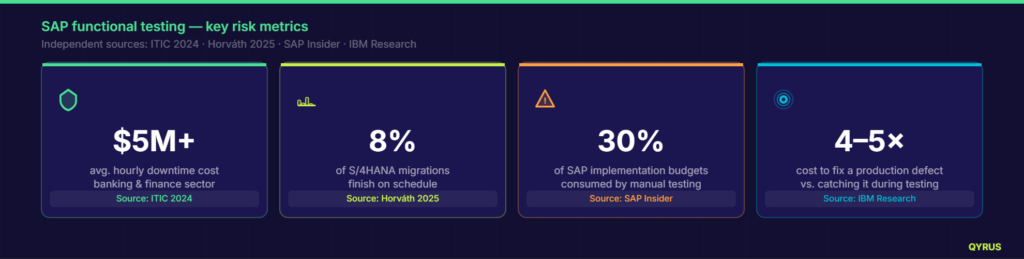
SAP functional Testing-key risk metrics

We designed this guide for executives accountable for the integrity of that nervous system. It outlines: 

  • The Business Risk Profile: Identifying the true cost of inadequate sap functional testing. 
  • Life Cycle Strategy: Defining your testing requirements at every phase of the SAP journey. 
  • The Maturity Model: An honest assessment of the path from manual testing to AI-driven orchestration. 
  • The Executive Diagnostic: A five-question audit to determine if your current approach is a hidden liability. 
  • Systemic Remediation: How Qyrus helps enterprise SAP programs close these gaps. 

Why SAP Testing Failures Are a Board-Level Risk, Not Just an IT Problem 

The ITIC 2024 Hourly Cost of Downtime Survey reveals that 97% of large enterprises report a single hour of downtime costs over $100,000. In sectors like finance, manufacturing, and retail, average hourly outage costs frequently exceed $5 million. SAP serves as the nervous system for these organizations; when it fails, the entire business halts. 

Many leadership teams still misclassify SAP testing as a localized IT task—a technical checkbox to clear before a release. This perspective is a dangerous strategic miscalculation. In reality, SAP quality assurance represents a fundamental pillar of business continuity, financial reporting integrity, and regulatory compliance. 

Over 440,000 organizations worldwide utilize SAP to orchestrate their most critical operations, including payroll, procurement, order management, and global supply chain logistics. These are not peripheral functions; they are the heart of the enterprise. When a core SAP module fails, the resulting operational paralysis extends far beyond the IT department, hitting the balance sheet and achieving board-level visibility within hours. 

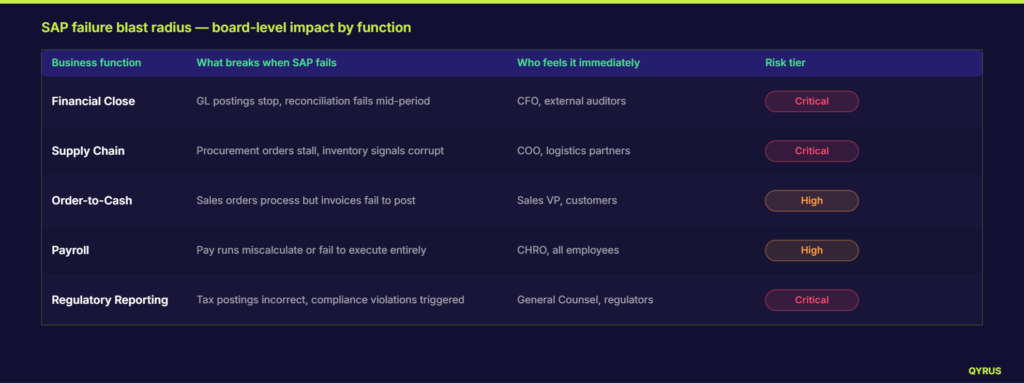
The following table illustrates the immediate impact an untested SAP change can have across typical enterprise functions:

Business Function 

Operational Impact of Failure 

Primary Stakeholders 

Financial Close 

General Ledger postings halt; reconciliation logic fails. 

CFO, External Auditors 

Supply Chain 

Procurement orders stall; inventory signals become corrupt. 

COO, Logistics Partners 

Order-to-Cash 

Sales orders process, but invoices fail to post to the ledger. 

VP of Sales, Customers 

Payroll 

Pay runs miscalculate or fail to execute entirely. 

CHRO, Employees 

Regulatory Reporting 

Incorrect tax postings or compliance omissions trigger penalties. 

General Counsel, Regulators 


SAP Failure blast radius

The Capital Efficiency Problem 

Beyond the immediate operational risk, a significant capital allocation dimension exists that CFOs rarely surface in testing discussions. Research from SAP Insider confirms that manual testing still consumes up to 30% of total SAP implementation budgets. On a $20 million transformation program, the organization effectively spends $6 million on a methodology that is both slower and less effective than modern automated alternatives. We do not view this as a QA budget line; we view it as a massive drain on capital efficiency. Redirecting that capital toward faster release cycles or innovation provides a genuine competitive advantage. 

The Remediation Multiplier 

Post-release risk compounds this financial picture further. According to IBM’s Systems Sciences Institute, fixing a defect in production costs 4 to 5 times more than identifying it during earlier testing phases. However, in the SAP ecosystem, the multiplier is even more punishing. Because SAP modules are so tightly linked, a single defect often cascades across multiple business units. The true remediation cost—accounting for developer hours, business downtime, and extensive data cleanup—frequently grows by an order of magnitude. 

“What gets skipped in testing shows up as a live system issue. And live system issues cost far more to fix.” — SAP S/4HANA Migration Risk Guide 

By shifting testing “left” and automating the validation process, we help enterprises transform QA from a cost center into a risk-mitigation engine that protects the organization’s most vital assets. 

Defining the Domain: What SAP Functional Testing Actually Validates 

Sap functional testing is the process of confirming that configured business processes align with specific business requirements. It is a distinct discipline from end-to-end, performance, or security testing, though a mature quality program must include all four. While other methods test for scale or vulnerability, functional testing confirms that the logic inside your SAP modules matches how your business actually operates. 

The distinction is critical. In most struggling SAP programs, the failure isn’t that teams test too little; they test the wrong things, in the wrong order, using fragmented data. 

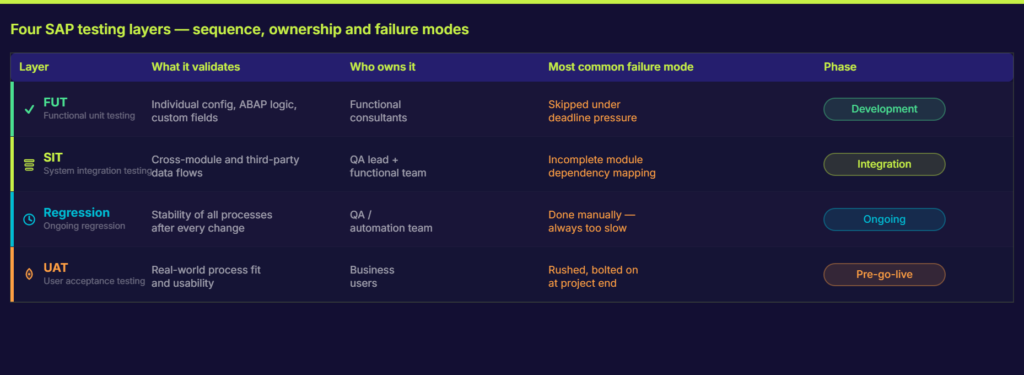
The Four Essential Testing Layers 

To maintain system integrity, every enterprise SAP program requires a structured approach across these four layers: 

Layer 

Strategic Validation 

Primary Ownership 

Primary Failure Mode 

Functional Unit Testing (FUT) 

Validates individual configurations, ABAP logic, and custom fields. 

Functional Consultants 

Sacrificed under timeline pressure. 

System Integration Testing (SIT) 

Validates cross-module and third-party data exchanges. 

QA Leads + Functional Teams 

Fragmented module dependency mapping. 

Regression Testing 

Protects the stability of existing processes after every patch or transport. 

QA / Automation Teams 

Manual execution vs. release velocity. 

User Acceptance Testing (UAT) 

Validates real-world process fit and day-to-day usability. 

Business Users 

Rushed and bolted on at the project’s end. 


The “Integration Wall”: Why SAP Defies Modular Testing 

Most enterprise software allows for siloed, module-by-module testing. SAP does not. Its architecture creates what practitioners call the “Integration Wall”, the point where isolated testing produces false confidence because it ignores how modules interact. 

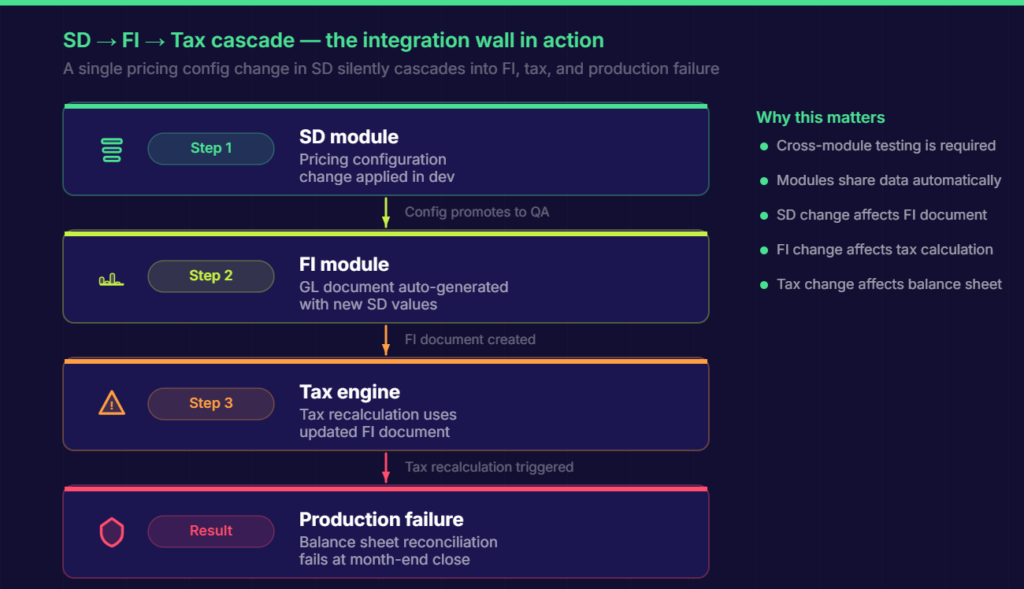
Consider a practical example: A development team applies a pricing configuration change within the Sales and Distribution (SD) module. In isolation, the change validates perfectly. A sales order generates, the pricing logic applies, and the tester signs off. 

The risk lies in the downstream chain that remains untested: that SD pricing change alters the value of a document auto-generated in Financial Accounting (FI). This, in turn, corrupts the tax calculation logic posting to your general ledger accounts, which eventually breaks the month-end balance sheet reconciliation. These defects rarely surface until the finance team attempts to close the books. 

Tax Cascade

This is not an edge case. In a 2025 iLab Quality case study, a manufacturing enterprise discovered, just two weeks before a major go-live, that a critical procurement workflow silently depended on a deprecated transaction code. Because the team had tested isolated modules rather than end-to-end processes, the issue remained invisible. The resulting remediation delayed go-live by six weeks while the team mapped the entire dependency chain. 

S/4HANA and Fiori: The Legacy Script Liability 

If your organization is among the 60% actively planning or undergoing an SAP S/4HANA migration, your existing ECC test scripts represent a systemic risk. They will not just fail occasionally; they will fail systematically. 

The move to S/4HANA introduces three shifts that render legacy test cases obsolete: 

  1. The Fiori UI Layer: Standard SAP GUI scripts cannot interact with web-based Fiori apps. Test automation built over the last decade for the legacy GUI requires complete re-engineering. 
  2. Simplified Data Models: The S/4HANA Universal Journal consolidates tables that previously lived separately across FI and CO. Validation logic that targets specific ECC table structures will return errors or corrupt results in S/4HANA. 
  3. Real-Time Processing: S/4HANA replaces ECC’s batch-oriented processes with real-time processing. This shift invalidates performance assumptions, transaction sequences, and timing dependencies. 

The data confirms the difficulty of this transition. A 2025 Horváth study of 200 SAP user companies found that over 60% experienced schedule and quality deviations during migration, with projects running 30% longer than planned. Only 8% finished on schedule. In the S/4HANA era, undertested migrations have become the norm, not the exception. 

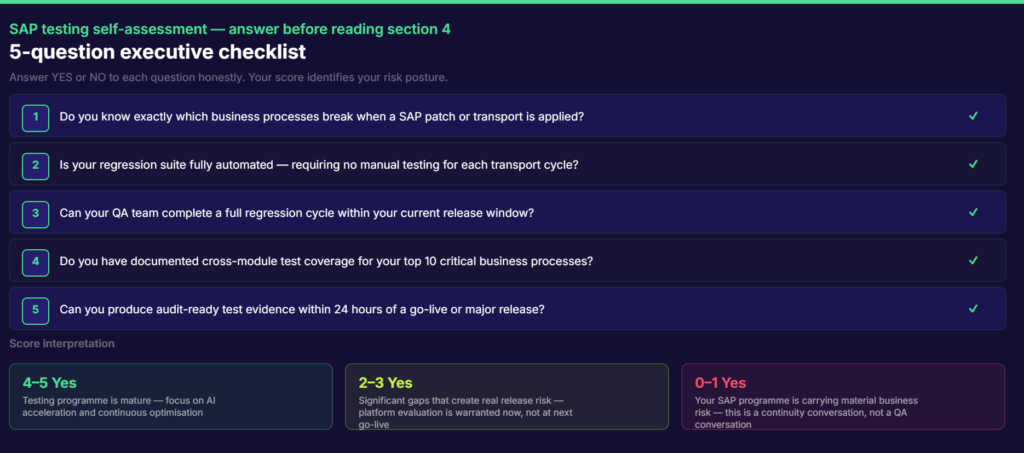
 Is Your SAP Testing Strategy a Hidden Liability? A 5-Question Executive Checklist 

Before evaluating platforms or vendors, you must conduct an objective audit of your current SAP testing maturity. These questions bypass technical jargon to focus on governance and risk. If your leadership team cannot answer these with absolute certainty, your organization is likely carrying unmanaged operational risk. 

Question 1: Impact Visibility 

Do you know exactly which business processes are at risk when an SAP patch or transport is applied? 

Most organizations lack this visibility. They recognize that a change occurred and perhaps identify the specific module it touched, but they cannot trace the downstream impact. Without automated change impact analysis, your team relies on “assumption-based testing.” These assumptions are precisely how six-week go-live delays happen. 

Question 2: The Automation Bottleneck 

Does your regression suite run autonomously, or do you still rely on manual intervention for every transport? 

Partial automation is a bottleneck in disguise. SAP environments receive a constant stream of security patches, enhancement packages, and configuration updates. Each one introduces regression risk. Manual testing creates a compounding cost burden that eventually breaks the project budget. If your testing does not scale horizontally with your release frequency, the math will eventually fail. 

Question 3: The Execution Window 

Can your QA team complete a full regression cycle within your current release window? 

This is the question internal teams often avoid. If your team must “selectively” skip tests to meet a deadline, you are making implicit risk decisions under pressure. Strategic quality assurance requires that every critical path receives validation every time. If your window is shrinking while your manual effort remains static, you are essentially gambling on system stability. 

Question 4: Process-Level Coverage 

Do you have documented cross-module test coverage for your top 10 critical business processes? 

Standard documentation usually lives at the module level (e.g., SD or FI). However, your business operates through end-to-end chains: Order-to-Cash, Procure-to-Pay, and Record-to-Report. If your testing validates modules but ignores the connective tissue between them, you have a massive coverage gap at the process level—where the most expensive failures occur. 

Question 5: Audit and Compliance Readiness 

Can you produce audit-ready test evidence within 24 hours of a major release? 

Regulatory frameworks like SOX, GDPR, and GxP require definitive proof that you validated critical processes before go-live. If your evidence is scattered across spreadsheets and email threads, you lack a proper system of record. This creates a compliance vulnerability that auditors will eventually expose, leading to significant fines or remediation costs. 


Scoring Your Risk Posture 

Score 

Strategic Implication 

4–5 “Yes” 

Mature: Your program is resilient. Focus on AI-driven acceleration and continuous optimization. 

2–3 “Yes” 

At Risk: Significant gaps exist that threaten release stability. A platform evaluation is a priority, not a future project. 

0–1 “Yes” 

Critical Liability: Your SAP program carries material business risk. This is a business continuity conversation that requires immediate executive intervention. 

SAP Testing Checklist

The Evolution of SAP Test Automation: From Scripts to Agentic AI 

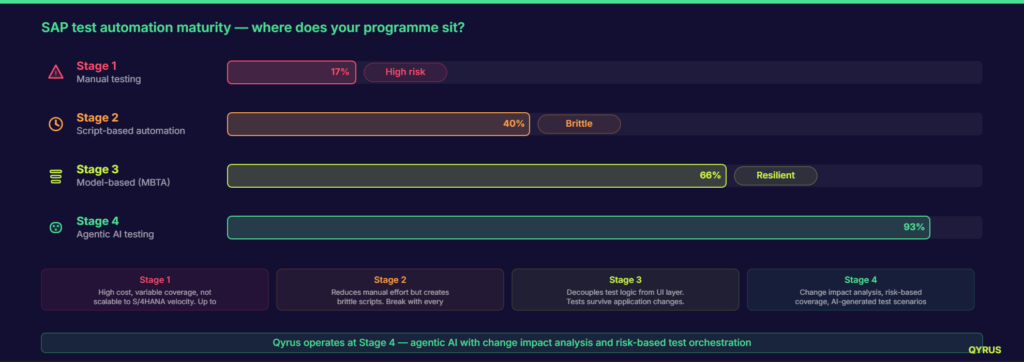
Understanding your organization’s position on the testing maturity curve is the prerequisite for any defensible investment decision. Not every enterprise must reach Stage 4 immediately. However, every leader managing a mission-critical SAP environment must identify their current stage—and calculate the literal cost of remaining there. 

Stage 1: Manual Testing 

This is the legacy starting point where many organizations remain stuck. Functional consultants and business users execute test cases manually, following scripts documented in Excel or Word. They capture results in spreadsheets and exchange sign-offs via email. 

The primary deficit here is not just a lack of speed; it is a lack of repeatability. A manual tester executing 200 cases over three days rarely identifies defects consistently across cycles. Fatigue, interpretation drift, and deadline pressure make manual testing inherently variable and prone to oversight. 

The financial case against this approach is overwhelming. SAP Insider research indicates that manual testing consumes up to 30% of total implementation budgets. On a $15 million S/4HANA program, that represents $4.5 million poured into a methodology that your competitors have already replaced with automation. In this stage, you aren’t just testing software; you are hemorrhaging capital. 

Stage 2: Script-Based Test Automation 

The first wave of automation introduced record-and-playback tools and scripted frameworks. These systems improved repeatability and reduced manual effort significantly. However, they introduced a new problem: brittleness. Scripts written for the SAP GUI often break when screen layouts shift, a frequent occurrence during enhancement package updates or Fiori migrations. 

Maintenance costs represent the “hidden trap” of Stage 2. Many organizations that invested heavily in scripted automation during the ECC era now find their test libraries are liabilities rather than assets. Re-engineering thousands of brittle scripts for S/4HANA Fiori often costs as much as building a new suite from scratch. This realization creates difficult conversations with boards that previously approved major automation investments. 

Stage 3: Model-Based Test Automation (MBTA) 

Model-based testing represents a shift toward resilience by decoupling test logic from the application’s UI layer. Instead of scripts that reference specific, volatile screen elements, MBTA utilizes a business process model. This model describes what a process does—not how the UI renders it. 

This approach offers three strategic advantages: 

  1. Resilience: Test cases survive application changes without manual re-engineering. 
  1. Accessibility: Business users can own and validate test cases without programming expertise. 
  1. Hybrid Coverage: For large enterprises running SAP GUI and Fiori in parallel, a single process model generates tests for both paradigms simultaneously. This is the only sustainable way to manage quality during a long-term migration. 

Stage 4: Agentic AI and Intelligent Orchestration 

The current frontier moves beyond simple automation into genuine intelligence. Agentic AI tools act as “doers.” They receive plain-language instructions—such as “Create a sales order in SD, verify stock reservation in MM, and confirm the FI document posts correctly”—and execute the full cross-module scenario autonomously. 

Early adopters report massive acceleration. A Forrester Total Economic Impact study found that advanced automation can accelerate application delivery by up to four times, with organizations reporting a 334% return on investment. More recent implementations of AI-driven sap test automation report test creation timelines dropping from hours to mere minutes. 

The most transformative dimension of Stage 4 is Automated Change Impact Analysis. Instead of a “test everything and hope” approach, intelligence identifies exactly which business processes a transport will affect before it reaches the QA environment. Teams focus their energy on the 20% of processes that carry 80% of the business risk. This strategy enables faster releases with higher confidence, improving both velocity and coverage in tandem. 

The market reflects this shift: between 2023 and 2025, intelligent testing tools reduced manual effort by nearly 34% on average. Automation now influences approximately 49% of SAP testing engagements, representing a total paradigm shift in how we secure the enterprise nervous system. 

SAP Test Automation Maturity

Bridging the Gap: How Qyrus Secures the Modern SAP Landscape 

Legacy testing platforms often feel like an anchor in an S/4HANA world. They were built for an era of stable ECC instances, infrequent updates, and massive, dedicated QA teams. Today’s reality is the opposite: volatile cloud updates, hybrid GUI/Fiori environments, and release cycles that have compressed from quarters to weeks.  

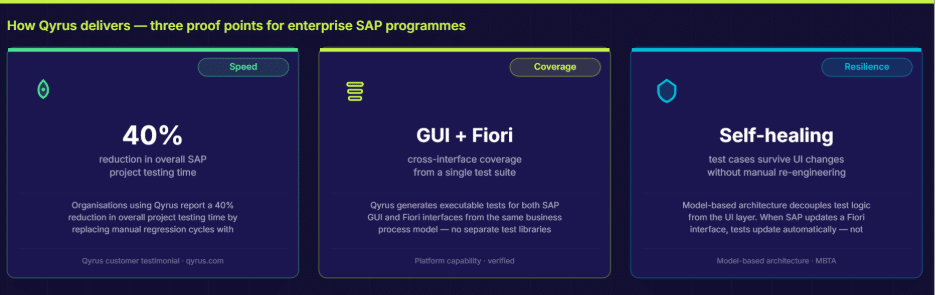
Qyrus bridges the gap between legacy QA constraints and modern release velocity. We provide an intelligent quality engineering platform that addresses the three points where traditional approaches consistently fail: test creation speed, cross-module visibility, and automation sustainability. 

Proof Point 1: Accelerating Test Creation Across GUI and Fiori 

Manual script authorship is a technical debt factory. In traditional models, functional consultants spend weeks translating process documentation into executable scripts. For an enterprise with hundreds of critical workflows, this process takes months and is often obsolete before it finishes. 

Qyrus uses AI to compress this timeline. Business analysts can describe a process in plain language, and the platform generates executable test scenarios that run across both SAP GUI and Fiori apps. You no longer need separate test libraries for different interfaces—a massive advantage during S/4HANA migrations where both environments must coexist. 

Proof Point 2: Ensuring Genuine Cross-Module Coverage 

The most expensive testing gap isn’t an untested module; it’s an untested module interaction. A failure in an order-to-cash process that spans SD, MM, and FI usually stems from data that doesn’t flow correctly between the modules. 

Qyrus validates these end-to-end chains, not just isolated steps. We trace data from the initial sales order through inventory reservation, goods issue, and final GL reconciliation. This prevents configuration changes in one area from triggering unexpected downstream failures that only surface in post-go-live “war room” sessions. 

Proof Point 3: Resilience by Design 

Most SAP automation efforts fail because they are brittle. Scripts break whenever an enhancement package updates a screen layout or a Fiori interface shifts. Maintenance costs eventually outpace the value of the automation, forcing teams back to manual testing. 

Qyrus utilizes a model-based approach that decouples test logic from the UI. When SAP updates an interface, the underlying business process model remains valid. Because updates are localized rather than wholesale re-engineering projects, your automation becomes a long-term asset that survives every update cycle. 

SAP Fiori

6 Strategic Best Practices for High-Performing SAP Programs 

These are not generic QA suggestions. They address the specific failure patterns we see in SAP programs that overrun budgets and miss go-live dates. 

  1. Map Cross-Module Dependencies First

Inadequate scoping causes more defects than inadequate testing. If you write test cases before mapping how SD affects FI or how MM triggers CO postings, you are testing in the dark. Build the dependency map first. This upfront investment saves multiples of that time in production remediation and emergency patching. 

  1. Automate Regression in Parallel,Notas “Phase 2” 

Many leaders treat automation as a secondary activity to be handled after go-live. By then, the team has already built a manual “technical debt” library. Start automation in parallel with test case development. Integrating even partial automation into your implementation creates a sustainable foundation for long-term maintenance. 

  1. Apply the 80/20 Rule to Risk

Not all SAP processes carry equal business risk. A configuration change in a minor HR report is not the same as a change to a high-volume pricing engine. High-performing programs explicitly rank processes by business criticality. Ensure your most critical 20% of workflows receive the deepest testing rigor and the most frequent automated execution. 

  1. Treat Test Data as a Strategic Asset

Misaligned test data causes nearly 30% of migration delays. Tests often fail not because the system is broken, but because the data doesn’t satisfy validation rules. This erodes team confidence and stalls sign-off cycles. Invest in data refresh utilities, masking for sensitive fields, and environment parity from day one. 

  1. Transition to Event-Driven Testing

In many organizations, testing is a periodic activity scheduled before a major release. In a mature program, testing is continuous. Every SAP transport represents a regression risk. Automated checks should fire every time a transport moves from development to QA. This is the only way to catch integration defects before they accumulate into a systemic failure. 

  1. Move Business Users from Gatekeepers to Partners

Late User Acceptance Testing (UAT) is the primary cause of go-live delays. When business users are treated as the final checkpoint, they often find critical defects when the window for remediation has already closed. Integrate UAT as soon as stable builds are available. Shifting UAT “left” ensures that the solution meets operational needs throughout the development cycle, not just at the end. 

SAP Functional Testing — Frequently Asked Questions 

What is SAP functional testing? 

SAP functional testing is the validation that configured business processes in SAP operate according to defined business requirements. It confirms that the logic inside modules like Finance, Materials Management, and Sales and Distribution produces the correct outputs for real business scenarios — not just that individual screens display correctly, but that end-to-end process chains work as your business actually operates. 

How is SAP functional testing  different from SAP performance testing? 

Functional testing validates correctness: does the process produce the right result? Performance testing validates scale: does the process remain fast and stable when 5,000 users are executing it simultaneously? Both are necessary. A process that is functionally correct but collapses under production load is still a production risk. 

How long does a typical SAP functional testing cycle take? 

It depends heavily on the scope of change and the maturity of the test automation program. For a major release in a manual-testing environment, regression cycles often run two to four weeks. For organizations with mature automation coverage, the same cycle can run in hours to days. This compression is one of the primary ROI drivers of investing in SAP test automation. 

What is the difference between SIT and UAT in SAP? 

System Integration Testing (SIT) validates that SAP modules and connected external systems exchange data correctly — it is primarily an IT-led activity focused on technical integration. User Acceptance Testing (UAT) validates that the system meets operational needs from a business user perspective — it is primarily a business-led activity focused on process usability and correctness. Both are required. SIT without UAT misses business process gaps. UAT without SIT misses integration defects. 

How do you protect sensitive data during SAP testing? 

Best practice is to replicate production data volumes in test environments while applying data masking to sensitive fields — employee personal information, customer financial data, and payroll details. This ensures test data reflects real-world complexity and volume without creating compliance exposure. Automated data refresh utilities are essential for maintaining environment parity across long test programs. 

Is SAP test automation worth the investment for mid-size organizations? 

The economics are compelling even at mid-scale. IDC research cited in enterprise testing studies shows enterprises implementing test automation achieving 548% ROI over five years, with average payback periods of seven months. For organizations facing S/4HANA migration timelines, the question is less “is it worth it?” and more “can we afford not to?” Manual testing cannot keep pace with modern SAP release velocity. The choice is not automation versus no automation — it is automation versus repeated production incidents. 

Ready to Close the Gaps in Your SAP Testing Program? 

Treating SAP quality as a secondary IT concern is no longer a viable strategy. As S/4HANA migration deadlines loom and release cadences accelerate, the margin for error has effectively vanished. In this environment, a single production failure carries a price tag—operational, financial, and reputational—that most enterprises simply cannot afford. 

The organizations successfully navigating this shift do not rely on the sheer size of their QA departments. Instead, they prioritize intelligence: risk-based, autonomous testing programs designed specifically for the complexities of modern SAP development. 

Qyrus provides that level of strategic resilience. By addressing the core friction points of enterprise quality—collapsing test creation timelines across GUI and Fiori while deploying automation that actually survives the next update—Qyrus helps teams move beyond the limitations of manual testing. This approach identifies the deep-seated logic defects that legacy scripts and manual checks consistently miss. 

Request a Demo or start with a self-assessment: ask your team the five questions in this guide and see how many you can answer with confidence. The gaps in those answers are the gaps in your SAP risk posture. 

Modern business depends entirely on the integrity of the information flowing through its systems. Poor data quality costs organizations an average of $12.9 million annually, making the choice of validation tools a high-stakes executive decision.  

Tricentis Data Integrity stands as the established player. Meanwhile, Qyrus Data Testing emerges as a unified “TestOS” challenger, designed for teams that prioritize full-stack agility and AI-driven efficiency. Qyrus offers a streamlined testing experience with a focus on consolidating Web, Mobile, API, and Data testing into one environment.  

The Connectivity Illusion: Why 200 Connectors Might Still Leave You Blind 

Volume often acts as a smokescreen for actual utility in the enterprise testing market. 

Tricentis commands the lead in sheer breadth, offering a massive library of 50+ SQL connectors and deep, specialized support for SAP systems and Salesforce. This exhaustive reach positions them big in the data connectivity category. Large organizations with legacy-heavy footprints view this as a non-negotiable safety net for complex IT environments. 

Data Source Connectivity

FeatureQyrus Data TestingTricentis Data Integrity

SQL Databases

MySQL ✓ ✓
PostgreSQL ✓ ✓
MS SQL Server ✓ ✓
Oracle ✓ ✓
IBM DB2 ✓ ✓
Snowflake✗✓
AWS Redshift✓ ✓
Azure Synapse✗✓
Google BigQuery ✗✓
Netezza✗✓

NoSQL Databases

MongoDB✓ ✓
DynamoDB✗ ✓
Cassandra ✗ ✓
Hadoop/HDFS ✗ ✓

Cloud Storage & Files

AWS S3✓ ✓
Azure Data Lake (ADLS) ✗✓
Google Cloud Storage ✗✓
SFTP ✗✓
CSV/Flat Files ✓ ✓
JSON Files ✓ ✓
XML Files ◐✓
Excel Files ◐✓
Parquet ✗ ✓

APIs & Applications

REST APIs ✓✓
SOAP APIs ◐ ✓
GraphQL ◐ ◐
SAP Systems ✗ ✓
Salesforce ✗ ✓

Legend: ✓ Full Support | ◐ Partial/Limited | ✗ Not Available 

However, the Pareto Principle reveals a different reality for modern data teams. 

Research indicates that 80% of enterprise data integration needs require only 20% of available connectors. While platforms like Airbyte offer up to 600 options, the vast majority of high-value workloads concentrate on a “vital few”: MySQL, PostgreSQL, MongoDB, Snowflake, Amazon Redshift, and Amazon S3. 

Qyrus focuses its 75% connectivity score exactly on these critical hubs. It masters the SQL connectors and cloud storage platforms that drive current digital transformations. 

The integration gap is real. Large enterprises manage an average of 897 applications yet only 29% of them are actually integrated. Qyrus bridges this gap by validating the REST, SOAP, and GraphQL APIs that feed your pipelines. It prioritizes the connections that matter most to your daily operations rather than maintaining a list of nodes you will never use. 

Securing the Core: Why Data Validation is the New Standard for Quality 

Precision in data validation determines the difference between a high-performing enterprise and a costly financial sinkhole. While connectivity creates the bridge, validation ensures the cargo remains intact. Organizations currently lose a staggering $12.9 million annually due to poor data quality, making advanced testing capabilities more critical than ever. 

Tricentis Data Integrity excels in deep-layer requirements like slowly changing dimensions (SCD) and data lineage tracking, which are vital for regulated industries needing to prove data history.  

Its “Pre-screening wizard” acts as a high-speed filter, catching structural defects before they enter the processing pipeline. Large, SAP-centric organizations rely on this model-based approach to prioritize risks across complex, multi-layered environments.  

Testing & Validation Capabilities

Feature Qyrus Data Testing Tricentis Data Integrity

Comparison Testing

Source-to-Target Comparison ✓ ✓
Full Data Comparison ✓ ✓
Column-Level Mapping✓ ✓
Cross-Platform Comparison ✓ ✓
Reconciliation Testing ✓ ✓
Aggregate Comparison (Sum, Count) ✓ ✓

Single Source Validation

✓ ✓
Row Count Verification ✓ ✓
Data Type Verification ✓ ✓
Null Value Checks ✓ ✓
Duplicate Detection ✓ ✓
Regex Pattern Validation ✓ ✓
Custom Business Logic/Functions ✓ ✓
Referential Integrity Checks ◐✓
Schema Validation ◐✓

Advanced Testing

Transformation Testing ✓ ✓
ETL Process Testing ✓ ✓
Data Migration Testing ✓ ✓
BI Report Testing ✗ ✓
Tableau/Power BI Testing ✗ ✓
Pre-Screening / Data Profiling ◐ ✓
Data Lineage Tracking ✗ ✓

Qyrus Data Testing takes an agile path, focusing on most core validation tasks that drive daily business decisions. It provides unique value through Lambda function support, allowing teams to inject custom business logic directly into its automated data quality checks. This “TestOS” approach bridges the gap between different layers, enabling you to verify that a mobile app transaction accurately reflects in your cloud warehouse. While it currently skips BI report testing, Qyrus offers a faster, no-code route for teams wanting to eliminate the “garbage in” problem at the point of entry. 

Precision testing must move beyond simple row counts to secure your strategic truth. If your ETL data testing framework cannot see the logic within the transformation, you are only protecting half of your pipeline. 

Beyond the Script: Scaling Quality with Intelligent Velocity 

Automation serves as the engine that moves data quality from a reactive chore to a proactive strategy. Organizations that fail to automate their pipelines see maintenance costs consume up to 70% of their total testing budget. Modern teams now demand more than just recorded scripts; they need platforms that think. 

Tricentis utilizes a model-based approach that decouples the technical steering from the test logic, allowing for resilient automation that doesn’t break with every UI change. With over 100 API calls and native support for the entire SAP ecosystem, it fits seamlessly into the most rigid enterprise CI/CD pipelines. Its “Pre-screening wizard” further accelerates the process by identifying early data errors before heavy testing begins.

Automation and Integration  

Feature Qyrus Data Testing Tricentis Data Integrity

Test Automation

No-Code Test Creation ✓ ✓
Low-Code Options ✓ ✓
SQL Query Support ✓ ✓
Visual Query Builder ✓ ✓
Test Scheduling ✗ ✓
Reusable Test Components ✓ ✓
Parameterized Testing ✓ ✓

AI/ML Capabilities

AI-Powered Test Generation ✓ ✓
Auto-Mapping of Columns ✓ ✓
Self-Healing Tests ◐ ✓
Generative AI for Test Cases ✓ ✓

DevOps/CI-CD Integration

REST API ✓ ✓
Jenkins Integration ✗ ✓
Azure DevOps ✗ ✓
GitLab CI ✗ ✓
GitHub Actions ✗ ✓
Webhooks ◐ ✓

Issue & Test Management

Jira Integration ✓✓
ServiceNow Integration ◐✓
Slack/Teams Notifications ✓ ✓
Email Notifications ✓ ✓

Qyrus Data Testing counters with a heavy focus on democratization through Nova AI. This intelligent engine automatically generates testing functions and identifies data patterns, helping teams build test cases 70% faster than manual methods. Qyrus emphasizes a “no-code” philosophy that allows manual testers to contribute to the ETL data testing framework without learning complex coding languages. It integrates directly with Jira, Jenkins, and Azure DevOps to ensure that automated data quality checks remain part of every code push. 

True velocity requires a platform that minimizes technical debt while maximizing coverage. Whether you lean on Tricentis’ enterprise-grade models or Qyrus’ AI-powered speed, your ETL testing automation tools must remove the human bottleneck from the pipeline. 

The Digital Mirror: Transforming Raw Data into Strategic Intelligence 

Visibility acts as the final safeguard for your information integrity. Without robust analytics, even the most sophisticated automated data quality checks remain silent. Organizations that lack transparent reporting struggle to identify the root cause of data corruption, often treating symptoms while the underlying disease persists. 

Tricentis Data Integrity secures a perfect score for reporting and analytics. It provides deep-drill analysis that allows engineers to trace a failure from a high-level dashboard down to the specific row and column. This platform excels at Root Cause Analysis (RCA), helping teams determine if a failure stems from a physical hardware fault, a human configuration error, or an organizational process breakdown. Furthermore, it offers complete integration with BI tools like Tableau and Power BI, ensuring your executive reports are as verified as the data they display. 

Reporting and Analytics

Feature Qyrus Data Testing Tricentis Data Integrity
Real-Time Dashboards ✓ ✓
Drill-Down Analysis ✓ ✓
Root Cause Analysis ◐ ✓
PDF Report Export ✗ ✓
Excel Report Export ✓ ✓
Trend Analysis ◐ ✓
Data Quality Metrics ◐ ✓
Custom Report Templates ◐ ✓
BI Tool Integration (Tableau, Power BI) ✗ ✓
Audit Trail ✓ ✓

Qyrus Data Testing earns a 72% category score with its modern, real-time approach. Its dashboards focus on “Operational Intelligence,” providing immediate access to KPIs so you can react to changing conditions in seconds. Qyrus emphasizes automated audit trails to ensure compliance without manual paperwork. While its root cause and trend analysis features are currently in Beta, the platform provides the essential visibility needed for high-velocity teams to act with confidence. 

A real-time dashboard is not just a display; it is a tool that shortens the time to a decision. Whether you require the deep forensic reporting of Tricentis or the agile, live signals of Qyrus, your data quality testing tools must turn your pipeline into an open book. 

Fortresses and Clouds: Choosing Your Infrastructure Architecture 

Your choice of deployment model dictates the ultimate control you maintain over your sensitive information. Both platforms offer the flexibility of Cloud (SaaS), On-Premises, and Hybrid deployment models. However, the maturity of their security frameworks marks a significant divergence for regulated industries. 

Platform and Deployment

Feature Qyrus Data Testing Tricentis Data Integrity
Cloud (SaaS) ✓ ✓
On-Premises ✗ ✓
Hybrid Deployment ◐ ✓
Docker Support ◐ ✓
Kubernetes Support ◐ ✓
Multi-Tenant ◐ ✓
SSO/LDAP ✓ ✓
Role-Based Access Control ✓ ✓
Data Encryption (AES-256) ✓ ✓
SOC 2 Compliance ◐ ✓

Qyrus Data Testing earns a strong platform score by prioritizing modern, containerized workflows. The platform fully supports Docker and Kubernetes for teams that want to manage their ETL testing automation tools within a private, scalable infrastructure. It employs AES-256 encryption and Single Sign-On (SSO) for secure authentication. This makes Qyrus an excellent fit for agile, cloud-native organizations that value technical flexibility over legacy certifications. 

If your team demands a lightweight, containerized environment that scales with your code, Qyrus provides the modern edge. 

The Verdict: Architecting Your Truth in a Data-First World 

The decision between Tricentis Data Integrity and Qyrus Data Testing ultimately hinges on the scope of your quality mission. Both platforms eliminate the risk of manual error, but they serve different strategic masters. 

Tricentis Data Integrity provides an exhaustive, enterprise-grade fortress. It remains the clear choice for global organizations with complex, SAP-centric landscapes that require every possible certification and deep forensic validation. If your primary goal is risk-based prioritization and you manage a sprawling legacy footprint, Tricentis offers the most complete safety net on the market. 

Qyrus Data Testing counters with a vision for total platform consolidation. It functions as a specialized module within a broader “TestOS,” making it the ideal choice for agile teams that need to verify quality across Web, Mobile, and API layers simultaneously. Choose Qyrus if you want to empower your existing staff with AI-powered automation and move from pilot to production in weeks rather than months. 

Data quality is not a static checkbox; it is the heartbeat of your digital transformation. Secure your strategic integrity by selecting the engine that matches your operational speed. Whether you need the massive breadth of an enterprise leader or the unified agility of a modern TestOS, stop the $12.9 million drain today. 

Secure your data integrity now by starting a 30-day sandbox evaluation.