Modernize + Operate
The systems you're running are telling you
which ones to modernize
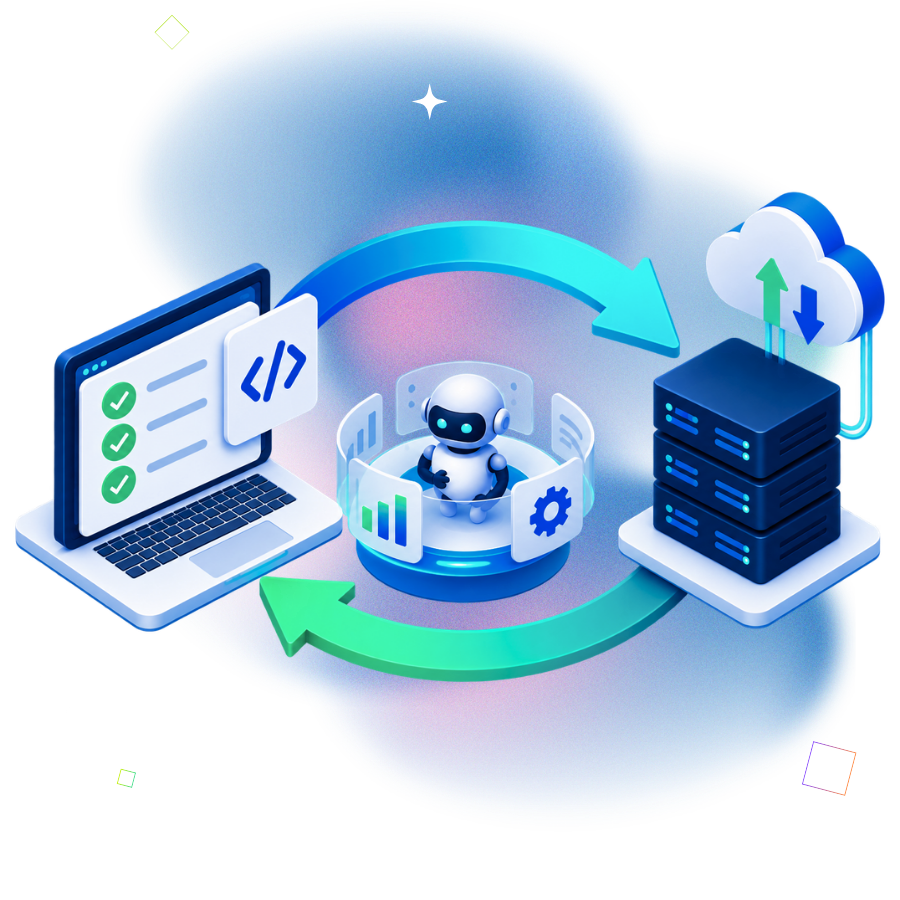
Most modernization roadmaps are built from assumptions — what appears in a spreadsheet, what a consultant recommended three years ago, what leadership believes is “the old stuff.” But your production operations already hold the truth: which applications generate the most incidents, which systems slow the most releases, which components cost the most to keep running. QyrusAI connects Modernization AI to Application Run AI so that operational evidence becomes modernization intelligence — and every system you modernize is validated in production before the project is closed.
Modernize
Modernization roadmap built from opinions. Production evidence never consulted
Operate
Operational evidence drives modernization priorities. Every transformation is validated before close.
The Weight of Complexity
The systems hardest to modernize are the ones you depend on most in production.
That's not a coincidence.
Upgrading mission-critical architecture often means flying blind into hidden dependencies and downstream failures. True transformation only happens when you map the entire blast radius before making a single change to the systems that run your business.
Modernization Roadmaps built on Inventory Spreadsheets
01not operational reality. The highest-cost systems are not always the most visible.
Transformation projects that finish on paper but never close the loop
02In Productions "it works in staging" followed by a week of incidents.
Post-modernization support costs
03Post-modernization support costs that match pre-modernization costs because the estate was not understood before the change was made
Blast-radius unknowns
04The discovery that a SAP Z-object modification cascades into three downstream IDoc failures happens at go-live, not at design time
Operational teams
05Operational teams that inherit modernized systems without the context of what was changed, what was tested, and what the new system's failure modes are
No feedback path from Ops to Modernization
06incidents in production that point directly at a structural weakness never reach the modernization backlog
Compliance pressure
07Regulated industries must prove that a modernized system passes the same tests as the system it replaced — before the old system is decommissioned
THE RESOLUTION
QyrusAI turns Operate from a risky, one-time project into a continuous, AI-powered discipline.
QyrusAI connects the system that runs your estate to the system that transforms it – so operational evidence becomes modernization intelligence, and every modernized system enters production already understood.
Transform With Evidence. Operate With Confidence.
From disconnected transformation and operations
to evidence-driven modernization
Stop letting assumptions dictate your roadmap while operations teams pay the price during go-live. See how shifting to an evidence-driven approach guarantees that new systems are deployed with predefined monitoring and zero hidden blast radiuses.
Before
Legacy Code
- Roadmaps driven by assumptions, not evidence
- UAT passes before production stability
- Operations learn failures through incidents
- Unmapped risks increase post-modernization MTTR
- Operational debt remains after modernization
AFTER
Regression Code Base
- Incident and cost data drive priorities
- Production health validates every modernization increment
- Knowledge Graph pre-configures post-modernization monitoring
- Blast-radius mapping prevents production cascade failures
- Qhive preserves every modernization record
From Legacy Chaos to Continuous Certainty
Customer Journey Rail
In Practice
Follow the journey of an enterprise migration rescued by connecting pre-deployment discovery directly to post-deployment monitoring. When transformation is guided by a continuous loop of operational evidence, dangerous guesswork is eliminated entirely.
- Enterprise Architect Can
Map SAP dependencies, audit ABAP debt, and calculate blast radius automatically — without relying on outdated documentation. - Migration Lead can
Execute the S/4HANA transformation one optimal slice at a time — reducing migration volume by up to 70% through evidence-based archiving. - Release Manager can
Validate downstream dependency health in the Knowledge Graph before the production gate — preventing the blind deployments that previously stalled migrations. - IT Operations Can
Monitor the modernized environment with AIOps and self-healing — automatically feeding operational evidence back to guide the next transformation slice. - CIO canDirect modernization priorities using real-world incident and cost data — choosing the next transformation target based on operational reality rather than a static Gantt chart.
Qyrus Ai Engine
A global manufacturer runs SAP ECC with 400+ Z-objects and a S/4HANA migration mandate. Modernization project has stalled twice after production failures. The root cause each time: blast-radius unknowns that nobody mapped before touching anything.
Enterprise Architect Can
Map SAP dependencies, audit ABAP debt, and calculate blast radius automatically — without relying on outdated documentation.
Modernize
Estate X-Ray
Reads SAP read-only; inventories RFC, IDoc, OData, SOAP, CPI, jobs and events; scores confidence, criticality and blast radius; audits Z-objects and ABAP debt
Migration Lead can
Execute the S/4HANA transformation one optimal slice at a time — reducing migration volume by up to 70% through evidence-based archiving.
Modernize
Govern
Phase Zero: ownership, scope and success measures; Business Partner model; deduplicate and enrich master data; 30–70% lower migration volume where evidence supports archiving
Release Manager can
Validate downstream dependency health in the Knowledge Graph before the production gate — preventing the blind deployments that previously stalled migrations.
MODERNIZE
Transform
One slice at a time; agent converts the optimal sequence
IT Operations Can
Monitor the modernized environment with AIOps and self-healing — automatically feeding operational evidence back to guide the next transformation slice.
OPERATE
Production Gate
before any modernized component enters production, Operate checks downstream dependency health in the Knowledge Graph
CIO can
Direct modernization priorities using real-world incident and cost data — choosing the next transformation target based on operational reality rather than a static Gantt chart.
OPERATE
Monitor Modernized
AIOps watches the modernized system; self-healing handles known patterns; Qhive records all post-modernization events
CIO can
Direct modernization priorities using real-world incident and cost data — choosing the next transformation target based on operational reality rather than a static Gantt chart.
MODERNIZE
Priority Update
Operate's incident and operational cost data flows back to Modernize's prioritization engine; next slice chosen from evidence, not a Gantt chart
THE UNLOCK: QyrusAI’s code analysis models the legacy test architecture; converts it to codeless. Conversion path validated. Evidence generated at every step — automatically, without a separate compliance workflow.
LOREM IPSUM DOLORSIT. AMETARS.
Lorem Ipsum Dolor Sit Amet
Lorem iz Ipsum lorem sit.
Lorum Ipsum Dolor Sit Amet Lorem Ipsum Dolor. Lorem Ipsum Dolor Sit Amet.
incididunt ut labore et dolore magna aliqua. Ut enim ad minim veniam, quis nostrud.

Sense → Evaluate → Execute → Report – an autonomous AI-driven test orchestration framework that intelligently manages testing workflows.
Expedite your web testing with our low-code/no-code platform, featuring an AI-powered test recorder, data management tools, and automated script healing.
Ship reliable mobile releases with real-device coverage, AI-assisted script healing and rapid regression cycles.
Modernize with intelligence.
Run with proof
Modernization
Estate X-Ray
Reads SAP read-only; inventories and scores every RFC, IDoc, OData, SOAP, CPI connection, job and event
Blast-radius scoring
Confidence, criticality, and dependency map before any change is made
Z-object and ABAP debt audit
Find what is expensive to keep, what is safe to retire
Phase Zero governance
Ownership, scope, and success criteria established before transformation begins
Prioritization intelligence
Scores applications by operational cost + technical risk + business value
Operate
Real-time production health feed
current incident frequency, dependency status, and cost of running each system
Pre-migration gate
checks production health of downstream dependencies before a modernized component is promoted
Post-modernization monitoring
AIOps baseline is automatically configured from the modernization knowledge record
Self-healing
known pre-modernization failure patterns are mapped; remediation is ready if they recur in the new system
Operational evidence → Modernization priority
Qhive's incident and cost record feeds the Modernize prioritization engine continuously
A GLIMPSE ON THE NUMBERS
What evidence-driven
modernization delivers, in numbers.
The true cost of modernization isn’t the planned project—it’s the unexpected failures discovered at go-live. See the quantifiable impact of replacing deployment guesswork with continuous, evidence-driven certainty.
Reduction in migration volume where evidence supports archiving or removal
Source: Qyrus Blueprint, Phase Zero guidance — Modernize
Phase Zero timeline: from zero estate visibility to a governed, prioritised modernization plan
Source: Qyrus Blueprint — Modernize + Operate combined
Reduction in AMS / post-modernization operational costs with evidence-driven transformation
Source: Qinfinite customer data — Modernize
Improvement in system availability post-modernization when Operate provides pre- and post-migration monitoring
Source: Qinfinite platform data — Operate
The transformation that costs the most is not the one you planned — it’s the one you discover at go-live. QyrusAI maps the risk before the change and monitors the reality after it. The gap between “finished” and “stable” disappears. Know More.
Join leading enterprises
driving the loop forward.
Resources
Explore our curated library of expert blog posts, in-depth whitepapers, and real-world case studies, designed to help you stay ahead in the world of AI-driven application lifecycle management.
August 19, 2026 |
18 min
User Acceptance Testing Best Practices: A Complete UAT Strategy Guide for SAP Teams
Read More
August 13, 2026 |
2 min
Qyrus Named in Gartner’s Market Overview for API and MCP Testing Tools
Read More
August 13, 2026 |
2 min
Qyrus Named in Gartner’s Market Overview for API and MCP Testing Tools
Read More
Blog
August 19, 2026 |
18 min
User Acceptance Testing Best Practices: A Complete UAT Strategy Guide for SAP Teams
Read More
Case Study
Events
Reports
August 13, 2026 |
2 min
Qyrus Named in Gartner’s Market Overview for API and MCP Testing Tools
Read More
Whitepaper
August 13, 2026 |
2 min
Qyrus Named in Gartner’s Market Overview for API and MCP Testing Tools
Read More
FREQUENTLY ASKED QUESTIONS
Common questions about Modernize + Operate
Transforming mission-critical systems naturally raises complex operational questions. Find clear answers on how our unified platform maps undocumented SAP estates, bridges the gap between observability and transformation, and creates a continuous closed loop.
How does Operate's data actually feed into the Modernize prioritization engine — is this a manual export or automatic?
Both pillars read from the same Knowledge Graph. Operate continuously writes incident frequency, cost signals, and dependency health data to the graph. Modernize’s prioritization scoring reads from the same graph. There is no export, no integration project, no periodic sync. The signal travels through the shared intelligence layer in real time.
Our SAP estate has hundreds of Z-objects and nobody documented them. Can Estate X-Ray actually map something that messy?
Yes — and this is specifically what Estate X-Ray is designed for. It reads SAP read-only, requires no documentation, and constructs the dependency map from the live system itself: RFC, IDoc, OData, SOAP, CPI connections, background jobs, and events. The messier the estate, the more value the map provides — because that is exactly the scenario where blast-radius surprises happen at go-live.
How does post-modernization monitoring differ from what our existing observability tools already do?
Standard observability tools watch metrics and alert on thresholds. Operate knows the context behind the metrics — specifically, it knows what was changed by Modernize, when, and what the pre-modernization failure surface looked like. When an alert fires on a modernized system, Operate can immediately correlate it to the transformation event and surface the relevant context from Qhive. That is contextual incident intelligence, not just alert correlation.
We have a CTO who will ask: "What is different about this from just doing the migration ourselves with better tooling?
The difference is the closed loop. Better tooling can help you discover faster and transform more efficiently. What it cannot do is continuously update your modernization priority from live production evidence, gate every migration increment against production health, and automatically configure post-modernization monitoring from the transformation record. That loop — Operate evidence → Modernize priority → Operate gate → Operate monitor → Operate evidence — is what QyrusAI provides.
Can we start with Modernize and add Operate later, or do we need both from day one?
You can start with Modernize alone. The Estate X-Ray, blast-radius mapping, and prioritization scoring all work independently. Operate is added to provide the production intelligence feed and the post-modernization monitoring layer. Most customers start with Modernize and add Operate once the first transformation slices have been delivered.
ANALYSTS’ REPORTS
Analysts Endorse QYRUS
Explore the independent reports and endorsements that affirm Qyrus’ position as the transformative, all-in-one platform for modern IT estate management.
• STAY AHEAD, STAY IN THE LOOP.
Map your estate honestly.
Modernize what costs the most. Run what you've proved.
30-minute walkthrough – We will run an Estate X-Ray readout against your actual SAP or application landscape.