Application Discovery and Dependency Mapping: The First Step Before You Modernize Anything
 Varun RS
Most enterprise IT environments weren’t designed. They accumulated. A system that ran fine on its own five years ago has since picked up two integrations, a merger’s worth of inherited applications, and a handful of workarounds nobody documented. None of that shows up as a problem, until someone tries to change it.
That’s the real challenge behind modernization: it’s rarely about deciding whether something needs updating. It’s about knowing what else gets affected when it is. Application discovery and dependency mapping is how enterprise architects, IT operations teams, and CIOs answer that question, by building an accurate picture of what’s actually running across an environment and how each piece depends on the rest, before anything gets touched.
What Application Discovery and Dependency Mapping Actually Means
Application discovery and dependency mapping is really two linked steps. Discovery identifies what exists — the applications, services, servers, and infrastructure running across an environment. Dependency mapping traces how those pieces connect: which service calls which database, which application sits on top of which infrastructure, and which business process breaks if a given component goes down.
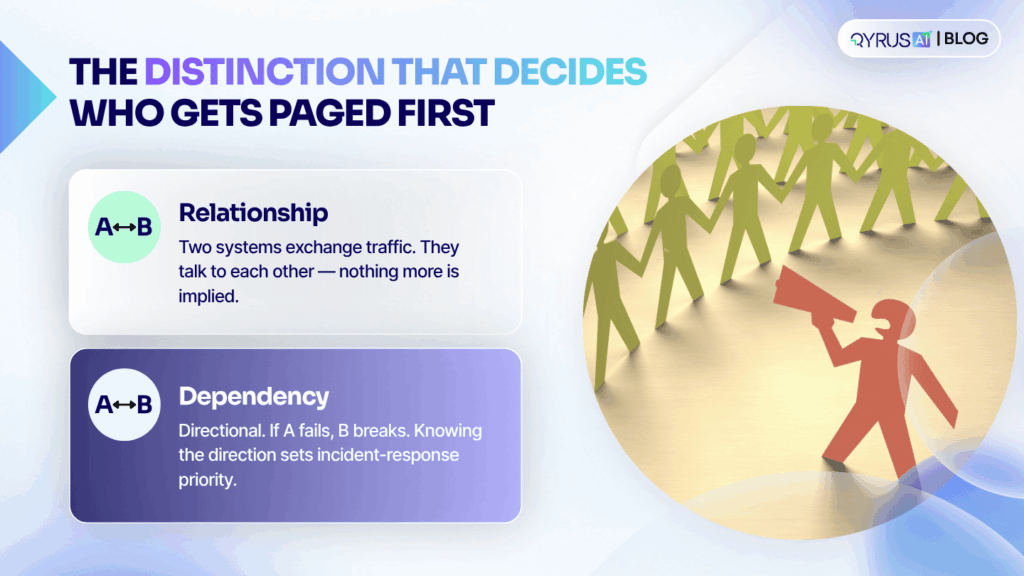
That second part carries more weight than it first appears to. A relationship just means two systems exchange traffic, they talk to each other. A dependency is directional: it means one system’s failure will break another. A payment gateway and an authentication service might have a relationship in a topology diagram, but if the authentication service fails, the payment gateway is the one that stops working, not the other way around. Knowing which direction that failure travels is what determines who gets paged first during an incident, and what teams prioritize before a planned change.
Static inventories and manually maintained configuration management databases (CMDBs) were built for slower-moving environments. They capture what’s there at a point in time, but they don’t hold up once infrastructure starts changing weekly instead of quarterly, which is now the norm, not the exception, for organizations running hybrid cloud and containerized workloads.
Why This Is Harder Than It Used to Be
Enterprise environments have gotten more complex faster than the tools tracking them have kept pace. A typical environment today spans hybrid cloud infrastructure, containerized microservices, distributed APIs and SaaS applications, and infrastructure that scales continuously rather than on a fixed schedule. Layer in a few acquisitions or a legacy system nobody’s fully documented, and the gap between what’s on paper and what’s actually running starts to widen.
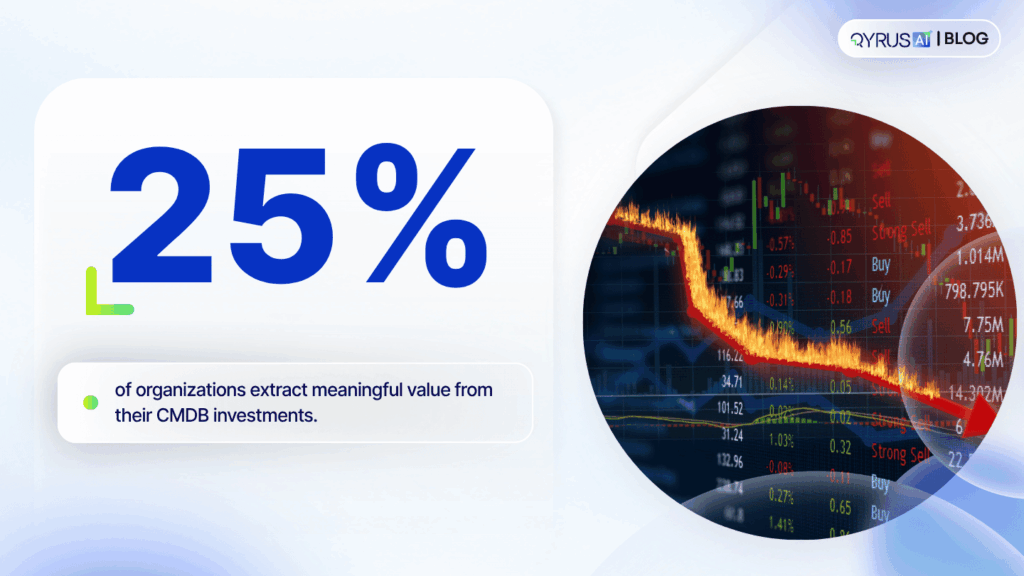
The numbers back this up. Gartner has found that only 25% of organizations extract meaningful value from their CMDB investments, the rest are working from data that’s incomplete, stale, or simply not trusted enough to act on. Separately, Forrester research cited by Virima found that 54% of IT professionals report unknown assets in their environments, systems nobody currently tracks are still running, still connected to something else, and still capable of breaking a change nobody saw coming.
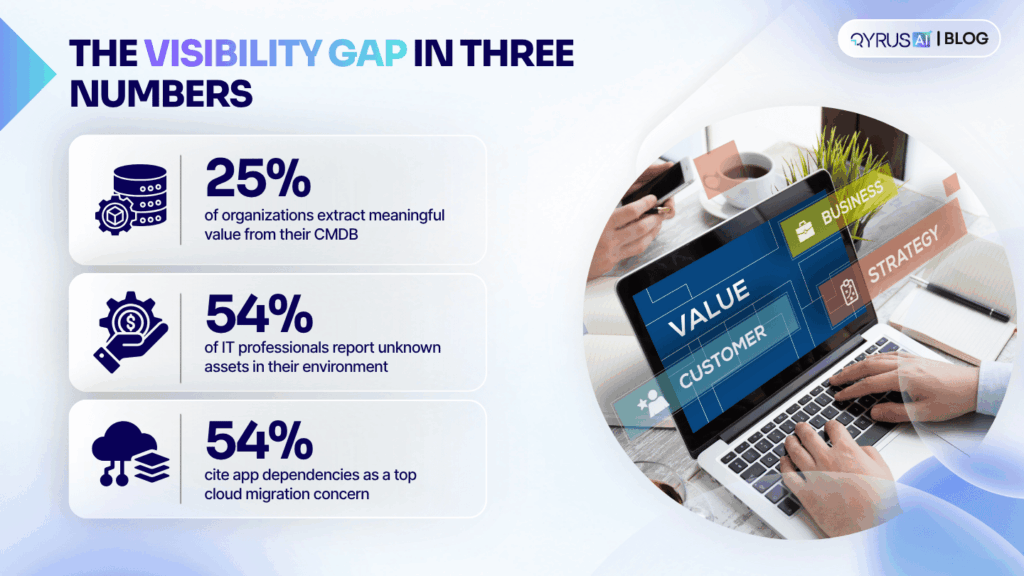
That visibility gap has a direct line to project risk. Application dependencies are one of the most commonly cited concerns IT teams raise about cloud migration projects, and budget overruns tied to unplanned rework are common enough that they show up in nearly every year’s IT leadership surveys. Periodic discovery scans and manually updated spreadsheets can’t keep up with environments that change this often, which is why the shift underway across the industry is toward continuous, automated discovery instead.
From Discovery to a Living Model: The Knowledge Graph
A one-time discovery scan produces a snapshot, accurate the day it’s run, and progressively less accurate after that. Continuous discovery instead produces something closer to a living model: infrastructure changes get detected automatically, dependencies stay current as the environment evolves, and the resulting map doesn’t need to be manually reassembled every time someone asks for it.
The more useful shift is what happens to that discovery data next. Rather than sitting in a dashboard as a point-in-time diagram, discovered assets and their dependencies can feed into a persistent knowledge graph, a structured, queryable model of the environment that stays current as things change. That’s a meaningfully different architecture than “run a scan, export a report.” It turns discovery into infrastructure other systems can build on: incident response tools that can trace an issue back through its dependency chain automatically, planning tools that can simulate the impact of a proposed change, and automation that can act on accurate, current context instead of a document that was correct six months ago.
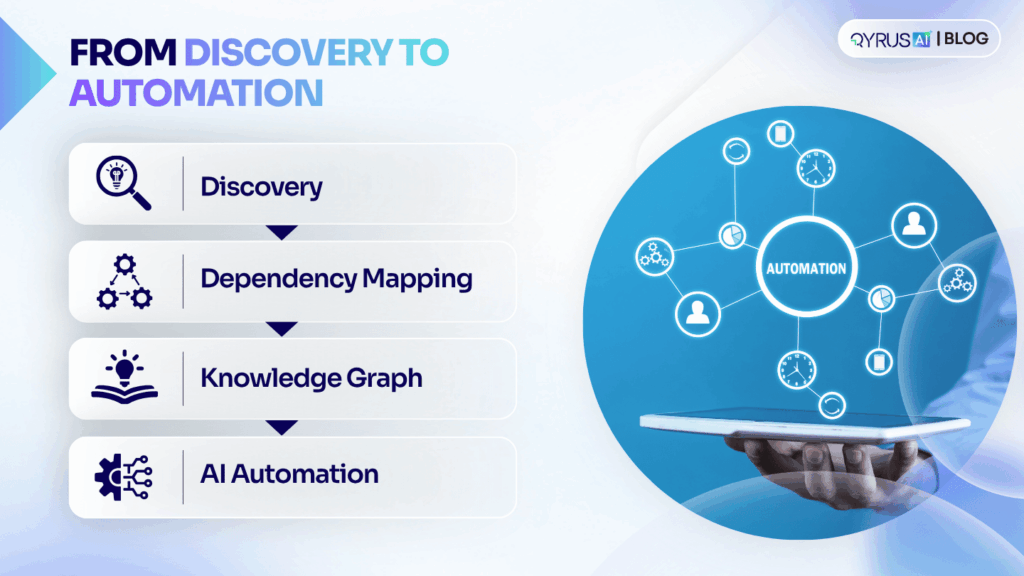
Put together, the pattern looks like a pipeline rather than a single tool: discovery identifies what’s running, dependency mapping traces how it connects, a knowledge graph holds that model in a form other systems can query, and from there, automated and AI-driven operations become possible because they’re finally working from something trustworthy. Skip the first two steps, and everything built on top of them inherits the same blind spots.
Where This Shows Up: Cloud Migration
Cloud migration is where the cost of skipping discovery becomes concrete fastest. Moving an application to the cloud is rarely just moving the application. It may depend on a database that isn’t moving on the same timeline, communicate with a service that stays on-premises, or support a larger business process that spans systems nobody thought to check.
If those dependencies surface after the move, the project has a problem: a service that worked fine in testing breaks in production because something it depended on didn’t come along or came along on a different schedule. If they surface beforehand, the same information becomes a planning input instead of an incident. Teams can sequence the migration around what actually needs to move together, flag the dependencies that need special handling, and set expectations before a cutover date gets missed.
This is also where discovery connects to the rest of the modernization lifecycle rather than standing apart from it. The same dependency data that de-risks a migration is what later informs application rationalization — deciding which systems are redundant or safe to retire — and technical debt assessment, which starts from knowing what’s actually in the environment before deciding what to fix. Discovery isn’t a standalone exercise; it’s the input every later modernization decision draws on.
How QyrusAI Approaches Auto Discovery
QyrusAI is an enterprise AI platform built around three workspaces — Modernize, Assure, and Operate — covering how organizations understand, test, and run their IT environments. Auto Discovery sits under Modernize, where it works alongside dependency mapping, application rationalization, and technical debt analysis to help enterprise teams understand what they’re working with before they change it.
Auto Discovery continuously scans an organization’s IT environment across cloud, on-premises, and hybrid infrastructure, identifying what’s actually running, applications, services, infrastructure, and mapping the dependencies between them. It traces those relationships upstream and downstream and feeds the results into QyrusAI’s Enterprise Knowledge Graph, building a continuously updated model of the environment rather than a static diagram that has to be manually maintained.
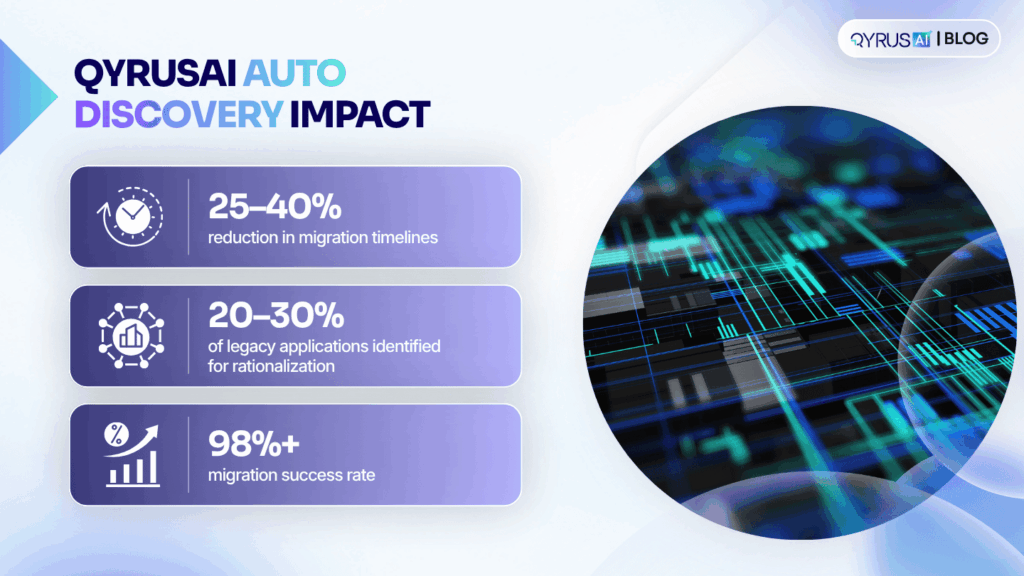
That shift from periodic to continuous, knowledge-graph-backed discovery shows up in the numbers: organizations applying this approach to their modernization lifecycle have seen a 25–40% reduction in migration timelines, 20–30% of legacy applications identified for rationalization, and a 98%+ migration success rate, driven by earlier, more accurate dependency visibility rather than late-stage surprises. The goal isn’t just a more complete inventory — it’s giving teams a foundation they can actually plan against before a project starts, not one they reconstruct after something breaks.
Frequently Asked Questions
What’s the difference between application discovery and dependency mapping?
Discovery identifies what’s running in an environment — applications, services, infrastructure. Dependency mapping traces how those components connect and rely on each other. They’re typically delivered together because discovery data is what dependency mapping is built from.
Is application discovery and dependency mapping the same as a CMDB?
No. A CMDB is a database that stores configuration item records, often updated manually or on a schedule. Application discovery and dependency mapping is the process — increasingly automated and continuous — that keeps that data current and can feed directly into a CMDB rather than replace it.
How often should IT environments be re-discovered?
As close to continuously as the tooling allows. Environments that scale, deploy, or reconfigure weekly can go stale within days under a periodic scan model, which is why the industry trend is toward continuous, automated discovery rather than scheduled scans.
Does application discovery work across hybrid and multi-cloud environments?
Modern discovery tools are generally built to span cloud, on-premises, and hybrid infrastructure in a single pass, rather than requiring separate tools per environment. That unified view is what makes dependency mapping useful — a dependency that crosses environments is invisible if the discovery tool only sees one side of it.
What happens if you skip dependency mapping before a migration?
Dependencies tend to surface anyway — just later, and usually as an incident instead of a planning input. A database, service, or business process that wasn’t accounted for can break after a cutover, turning a planned migration into unplanned rework.
Understand It Before You Change It
Modernization projects don’t start with the first change — they start with understanding what’s already there. Application discovery and dependency mapping gives enterprise architects, IT operations teams, and CIOs the visibility to plan migrations, rationalize applications, and manage change with fewer surprises along the way.
QyrusAI’s Auto Discovery continuously maps environments across cloud, on-premises, and hybrid infrastructure and feeds that model into the Enterprise Knowledge Graph — giving teams a current, connected view of their systems rather than a static inventory. Request a demo to see how QyrusAI Auto Discovery maps your environment before you modernize it.
 October 9, 2026
  8 min
8 min