Assure + Operate
Your production environment knows
something your test suite doesn't.
Every incident that fires at 3 a.m. represents a test your team never wrote. And every release that passes in staging but fails in production represents a gap between what was proven and what was real. QyrusAI closes both gaps simultaneously — by turning production events into quality evidence, and quality evidence into production confidence. Continuously. In both directions.
Assure
Staging says green. Production says otherwise. Nobody knows why.
Operate
Production reality feeds the test suite. Releases are gated by evidence, not hope.
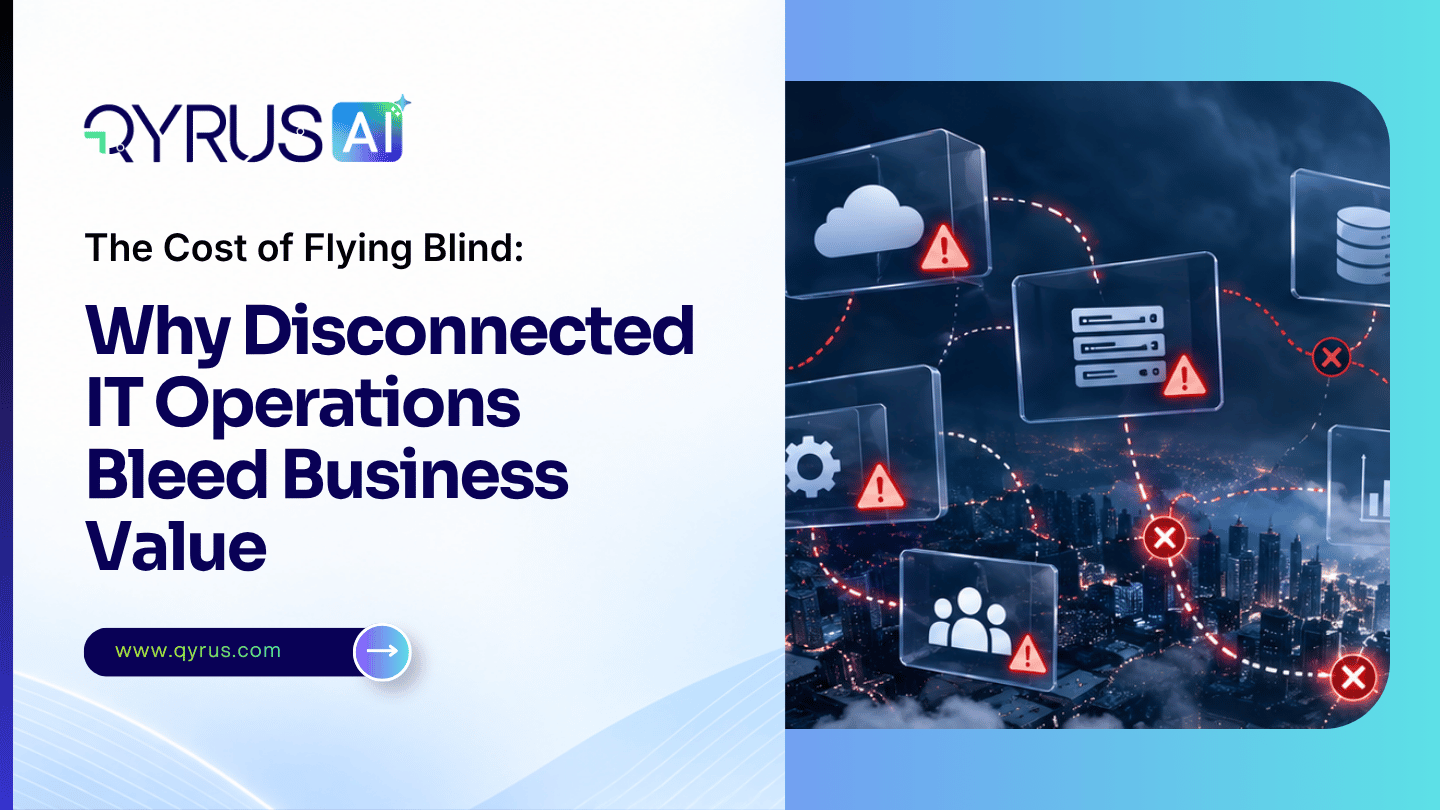
The Weight of Complexity
The gap between "tested" and "working"
is where enterprises bleed.
The most expensive incidents are rarely new problems; they are known failures that slip through disconnected pipelines. Stop treating testing as a pre-release checkpoint and start using it to drive continuous operational health.
Alert storms that tell you something broke
01but not what caused it or how to prevent it next time
Staging environments that cannot replicate production reality
02SAP transports, real data volumes, live integrations
Post-incident tests that are created once,
03never maintained, and drift out of relevance within weeks
Release pipelines
04that treat quality as a gate to pass — not a signal to act on
SRE teams spending 34%
05of their time on toil that repeats because the knowledge never makes it back to QA (Catchpoint SRE Report 2026)
Outage costs
06that exceed $100,000 per significant incident — and the root cause is always something that had been seen before (Uptime Institute, 2026)
Compliance pressure
07Two teams that should share intelligence but operate in separate worlds: QA knows what changed before release; Ops knows what broke after it
THE RESOLUTION
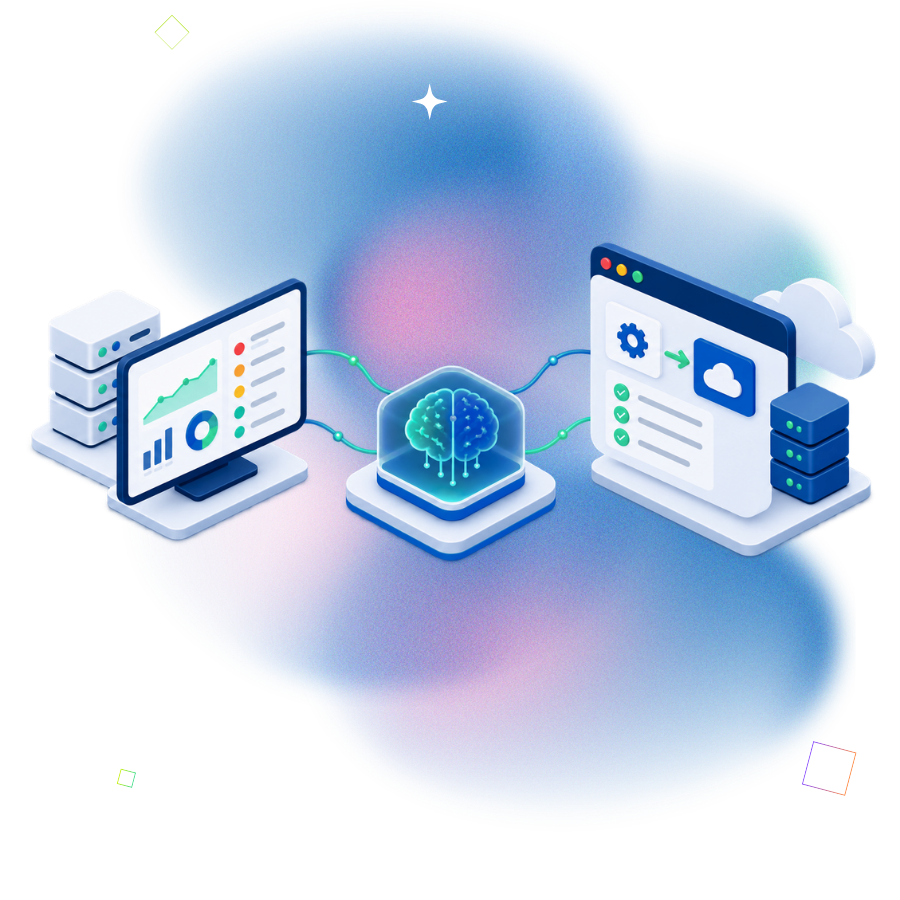
QyrusAI make quality and operations one continuous system not two teams pointing at each other.
QyrusAI connects the system that runs your estate to the system that transforms it – so operational evidence becomes modernization intelligence, and every modernized system enters production already understood.
From disconnected quality and operations
to continuous quality intelligence.
A successful release isn’t the end of the quality lifecycle—it’s the beginning of operational intelligence. Discover how unifying your testing and monitoring engines turns every production incident into an automated defense against the next one.
Before
Disconnected Quality and Operations
- QA signs off on a release. Operations inherits whatever breaks.
- No test is ever written
- Production observability & test evidence live in separate tools
- SRE spends MTTR chasing symptoms, not causes
- Post-mortem actions rarely reach test suites
AFTER
Continuous Quality Intelligence
- Every incident automatically becomes a regression test
- SEER release evidence gates every deployment
- Self-healing actions follow governed audit policies
- Knowledge Graph connects tests, deployments, failures
- AI-driven insights accelerate failure resolution
From Legacy Chaos to Continuous Certainty
Customer Journey Rail
In Practice
Follow the journey of an enterprise migration rescued by connecting pre-deployment discovery directly to post-deployment monitoring. When transformation is guided by a continuous loop of operational evidence, dangerous guesswork is eliminated entirely.
- SRE / Ops Lead can
Convert production incidents into reproducible tests automatically - QA Lead can
Gate releases using production-validated evidence, not just staging results - Dev team can
See which code changes caused production failures – with test proof attached - Risk / Compliance can
Access a single audit trail covering testing, deployment, and production events. - CIO can
View release confidence and production health in one real-time dashboard.
Qyrus Ai Engine
A global manufacturer runs SAP ECC with 400+ Z-objects and a S/4HANA migration mandate. Modernization project has stalled twice after production failures. The root cause each time: blast-radius unknowns that nobody mapped before touching anything.
SRE / Ops Lead can
Convert production incidents into reproducible tests automatically
ASSURE
Test Generation
SEER orchestrates tests from business process models
QA Lead can
Gate releases using production-validated evidence, not just staging results
ASSURE
Evidence Layer
SEER Report stage logs every test outcome with timestamp
Dev team can
See which code changes caused production failures – with test proof attached
OPERATE
Deployment Gate
release evidence is checked before production promotion
Risk / Compliance can
Access a single audit trail covering testing, deployment, and production events.
OPERATE
Production Monitor
AIOps detects anomalies, correlates signals to the Knowledge Graph
CIO can
View release confidence and production health in one real-time dashboard.
OPERATE
Incident → Test
Operate agent generates a failing test from the incident signal
CIO can
View release confidence and production health in one real-time dashboard.
Assure
Regression Suite
New test enters the permanent SEER suite; loop closes
THE UNLOCK: QyrusAI’s code analysis models the legacy test architecture; converts it to codeless. Conversion path validated. Evidence generated at every step — automatically, without a separate compliance workflow.
LOREM IPSUM DOLORSIT. AMETARS.
Lorem Ipsum Dolor Sit Amet
Lorem iz Ipsum lorem sit.
Lorum Ipsum Dolor Sit Amet Lorem Ipsum Dolor. Lorem Ipsum Dolor Sit Amet.
incididunt ut labore et dolore magna aliqua. Ut enim ad minim veniam, quis nostrud.

Sense → Evaluate → Execute → Report – an autonomous AI-driven test orchestration framework that intelligently manages testing workflows.
Expedite your web testing with our low-code/no-code platform, featuring an AI-powered test recorder, data management tools, and automated script healing.
Ship reliable mobile releases with real-device coverage, AI-assisted script healing and rapid regression cycles.
Two systems
One quality intelligence loop.
Pre-release testing and post-deployment monitoring can no longer operate in isolation. By unifying automated test orchestration and live operational health, every production incident instantly fortifies your release pipeline against future failures.
Assure
Qyrus AI Quality Engineering contributes
SEER Orchestration
plans and runs tests with full context
AI-generated test cases from BPM
no manual scripting for coverage gaps
Self-healing test scripts (Healer AI)
test suites don't break when UIs change
Release evidence log
A structured, queryable record every deployment can cite
Blast-radius analysis pre-release
SEER evaluates what this change could break before it ships
Operate
Qyrus Application Run AI contributes
AIOps correlation
Signal-to-incident grouping across SAP
Incident → Test bridge
Agent generates a failing test that reproduces failure
Deployment gate enforcement
release evidence from Assure is checked before any production promotion
Self-healing actions
governed remediation that executes within policy bounds defined by the Trust + Governance layer
Production health feed
live application state enriches the Knowledge Graph that Assure tests against
A GLIMPSE ON THE NUMBERS
The numbers behind
the quality-to-operations loop.
See the measurable impact of a closed quality-to-operations loop. Discover how connecting pre-deployment testing with live monitoring drives unprecedented speed, stability, and return on investment.
Reduction in testing time
Source: Qyrus Blueprint, Phase Zero guidance — Modernize
Reduction in MTTR with AI-assisted incident response
Source: Qyrus Blueprint — Modernize + Operate combined
Reduction in AMS / post-modernization operational costs with evidence-driven transformation
Source: Qinfinite customer data — Modernize
Improvement in system availability post-modernization when Operate provides pre- and post-migration monitoring
Source: Qinfinite platform data — Operate
Join leading enterprises
driving the loop forward.
Resources
Explore our curated library of expert blog posts, in-depth whitepapers, and real-world case studies, designed to help you stay ahead in the world of AI-driven application lifecycle management.
August 19, 2026 |
18 min
User Acceptance Testing Best Practices: A Complete UAT Strategy Guide for SAP Teams
Read More
August 13, 2026 |
2 min
Qyrus Named in Gartner’s Market Overview for API and MCP Testing Tools
Read More
August 13, 2026 |
2 min
Qyrus Named in Gartner’s Market Overview for API and MCP Testing Tools
Read More
Blog
August 19, 2026 |
18 min
User Acceptance Testing Best Practices: A Complete UAT Strategy Guide for SAP Teams
Read More
Case Study
Events
Reports
August 13, 2026 |
2 min
Qyrus Named in Gartner’s Market Overview for API and MCP Testing Tools
Read More
Whitepaper
August 13, 2026 |
2 min
Qyrus Named in Gartner’s Market Overview for API and MCP Testing Tools
Read More
FREQUENTLY ASKED QUESTIONS
Common questions about Assure + Operate
Whether you are managing complex SAP ecosystems or looking to eliminate manual post-mortems, we have you covered. Explore exactly how Assure and Operate work together to create a seamless, self-improving quality loop.
How does a production incident turn into a test automatically — without a developer writing it?
When Operate detects and diagnoses an incident, it captures the execution trace, the affected process, and the failure signal in Qhive. SEER uses that context to generate a failing test that reproduces the failure scenario — using the same test generation engine that Assure uses for proactive coverage. The new test enters the SEER regression suite immediately. No developer writes it; no QA lead reviews it before it runs. The next release cycle will have it as a mandatory gate.
Does the release gate require both Assure and Operate to be deployed together?
Yes, the deployment gate is a joint capability — it requires Assure’s evidence layer to supply the release record, and Operate’s pipeline integration to enforce it. Either pillar deployed alone does not provide this gate. You can start with either independently; the gate activates when both are in place.
How does this work in an SAP environment where test execution is more complex than web or API testing?
Assure includes native SAP testing capabilities (SAP Testing module, SAP transport-aware blast-radius analysis). Operate connects to SAP systems through the SAP connector. The incident-to-test bridge works the same way in SAP environments — Qhive captures the IDoc, BAPI, or RFC failure context, and SEER generates an SAP test case from it.
What happens to the self-healing actions Operate takes — are they visible to the QA team?
Yes. Every governed action Operate takes is logged to the same Knowledge Graph that Assure queries. QA can see what was changed in production, when, under whose policy authority, and what the outcome was. What Operate does in production enriches what Assure knows to test next.
Can this run in a regulated environment where production actions require explicit human approval?
Yes. The governance framework uses the Level 0-3 autonomy model: Level 0 recommends only; Level 1 prepares artifacts; Level 2 acts in controlled environments; Level 3 acts in production with explicit human approval required. All actions are within policy, auditable, and reversible where configured.
ANALYSTS’ REPORTS
Analysts Endorse QYRUS
Explore the independent reports and endorsements that affirm Qyrus’ position as the transformative, all-in-one platform for modern IT estate management.
• STAY AHEAD, STAY IN THE LOOP.
Close the loop between your
test suite and your production environment.
30-minute walkthrough – We will run an Estate X-Ray readout against your actual SAP or application landscape.