





Technical Debt Analysis | Legacy Intelligence | Application Health
Stop Guessing Where Your Debt Lives.
Start Seeing It.
Technical debt isn’t a spreadsheet problem, it’s a visibility problem. QyrusAI continuously discovers your application and infrastructure landscape, maps how debt actually propagates through dependencies, and surfaces which assets are silently draining your teams — so modernization decisions are based on evidence, not tribal knowledge.
Challenges
The Technical Debt Problem
Every Enterprise Knows.
Technical debt compounds silently until it breaks something expensive. Discover how replacing SME tribal knowledge and static architecture diagrams with real-time dependency intelligence turns debt assessment from a periodic audit into a continuous discipline.
Debt Hidden in Tribal Knowledge
Critical logic and dependencies live in the heads of a few SMEs - undocumented, siloed, and lost the moment they leave.
No Way to Tell What's Actually Risky
Every legacy system "feels" risky, but without dependency and signal data, teams can't tell a fragile asset from a stable one.
How it works
See the Estate. Map the Dependencies.
Score the Debt. Prioritize the Fix.
Explore how QyrusAI moves technical debt assessment from subjective SME knowledge to an objective, continuously updated picture of where risk actually lives in your IT landscape.
Continuously discover applications and infrastructure - automatically.
QyrusAI’s Auto Discovery reads your environment in real time across on-prem, cloud, and hybrid infrastructure — servers, VMs, networks, storage, and application configurations as they exist today, not as they were last documented. No manual inventory. No stale architecture diagrams
Understand how debt actually propagates before you touch anything.
Every dependency between applications, services, and infrastructure is mapped into a live Knowledge Graph, so a change in one microservice or legacy database can be traced through the entire ecosystem – reducing the risk of breaking critical systems during remediation.
Identify which assets are actually the problem.
QyrusAI ingests and correlates signals from tickets, logs, code, and operational metrics to flag “noisy” assets (excessive alert generators) and “fragile” assets (high failure rates) – replacing gut feel with evidence.
Model the impact before you commit resources.
Using a Digital Twin of the environment, teams simulate “what-if” scenarios to see the downstream consequences of altering or retiring a component — so modernization effort is directed at the highest-ROI targets first, with a controlled, low-risk path into execution.
Core Features
Built to Turn Technical Debt
From a Guess into a Measurement.
Stop relying on SME memory and outdated diagrams. Discover how real-time discovery, dependency intelligence, and signal-based scoring turn technical debt into a transparent, continuously monitored metric.
Continuous Asset Discovery
Automatically discovers applications, infrastructure, and configurations across legacy and cloud-native stacks in real time - no manual inventory required
Dependency-Aware Knowledge Graph
Maps interdependencies between apps, services, and infrastructure, acting as a "live" enterprise memory that reduces reliance on individual SMEs.
Signal-Based Debt Scoring
Correlates tickets, logs, code, and operational metrics to identify "noisy" and "fragile" assets driving the most operational risk.
Digital Twin Impact Simulation
Models the IT ecosystem to simulate "what-if" changes and predict downstream consequences before any remediation is committed.
A GLIMPSE ON THE NUMBERS
Assess Faster. Decide with Evidence. Reduce the Risk.
Replace subjective SME knowledge with a continuously updated, evidence-based view of where technical debt actually lives — so modernization decisions are objective, defensible, and low-risk.
reduction in migration timelines
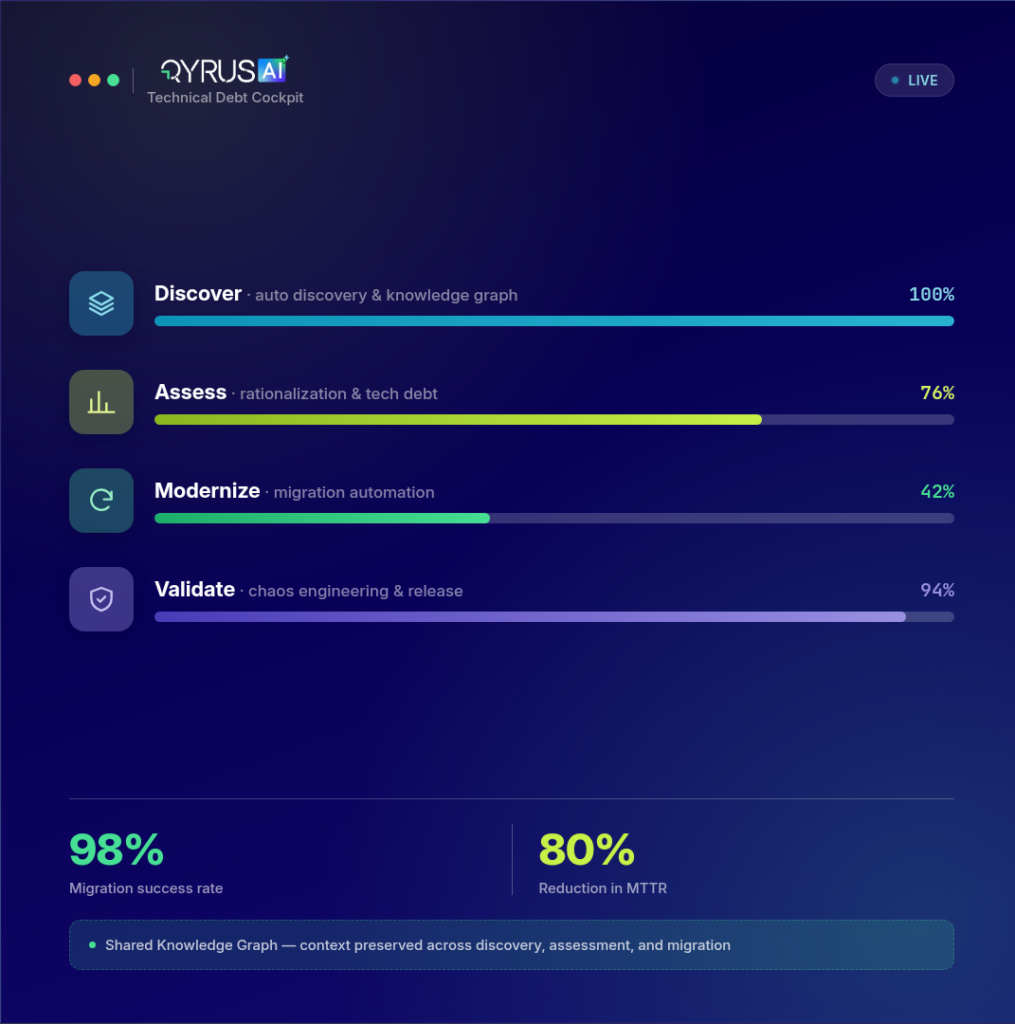
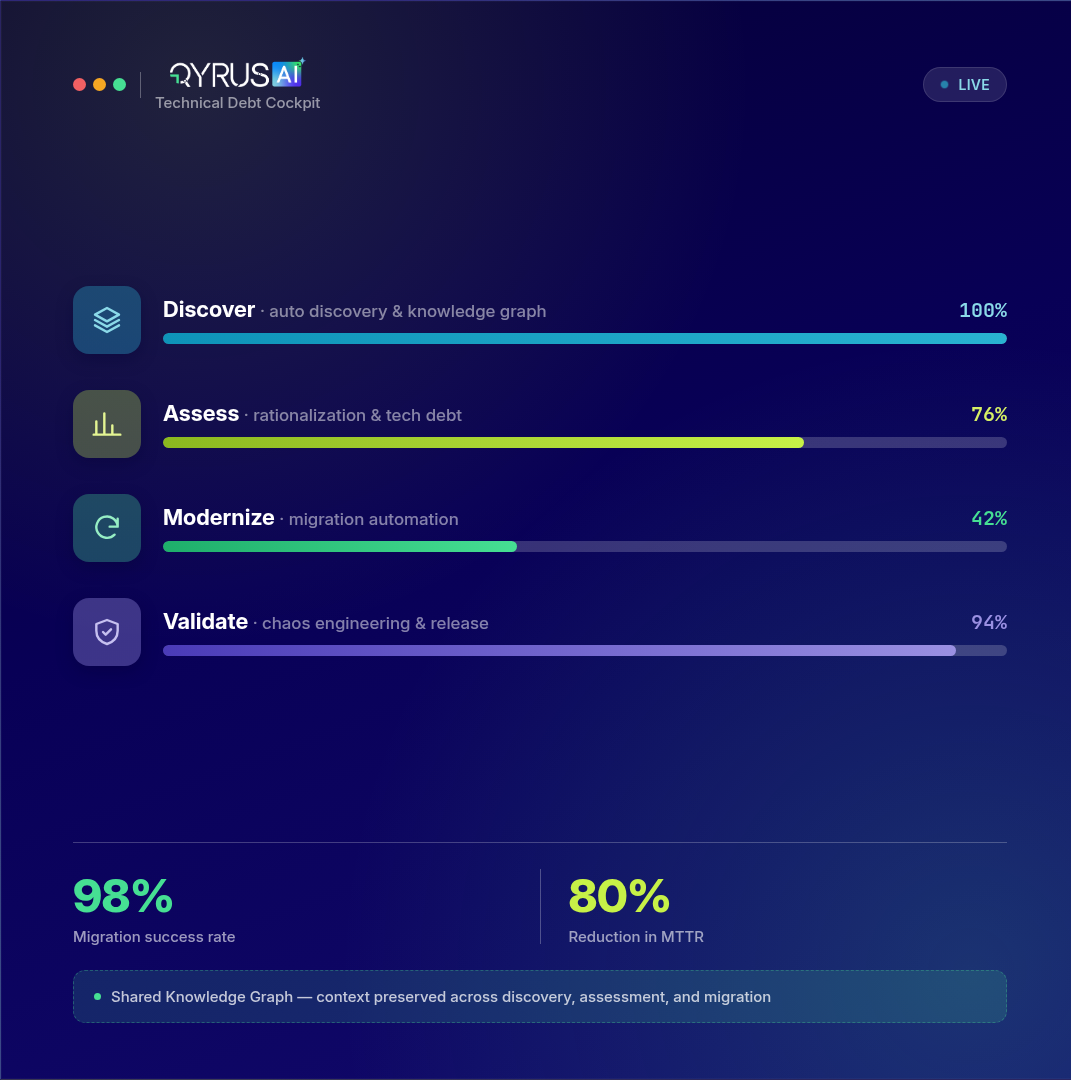
migration success rate
system uptime and
100% SLA adherence
increase in change deployment frequency
Continuous testing. Continuous learning. Continuous value.
Join leading enterprises
driving the loop forward.
Integration
Works With Your Existing Enterprise Stack.
QyrusAI Modernize connects to your existing tools — CMDBs, ITSM platforms, cloud providers, and enterprise architecture repositories — so discovery enriches the tools you already use rather than replacing them.
CUSTOMER TESTIMONIALS
Enterprises running the loop
in their own words.
Real Teams. Real Outcomes. Real Confidence in what ships next.
Qyrus not only supports the testing of our Web, Mobile, and API components as part of our CI/CD processes, but also in ongoing regression-testing across our partner ecosystem. The real power of Qyrus is that we have this extremely broad testing capability in one tool, run in the cloud, and reusable across all our development teams.

The transition to Qyrus has marked a significant turning point for us. By embracing automation, we not only streamlined our SAP test automation process but also achieved a remarkable reduction in overall project testing time by 40%.
... the Qyrus platform have been a great addition to Monument's product delivery capabilities. Within a few months, we have been able to create a comprehensive test suite of complex end-to-end test scenarios spanning multiple platforms and channels. The Quinnox team has helped us embed the Qyrus solution, and the supporting processes around it, into our agile delivery methodology.
Resources
Go Deeper on QyrusAI Technical Debt Analysis
Dive into our latest research and implementation guides. See exactly how combining real-time discovery with a live dependency graph turns technical debt from an unquantified risk into a measurable, prioritized backlog.
September 4, 2026 |
14 min
How to Write Effective Test Scripts: A Straightforward Guide
Read More
September 4, 2026 |
12 min
SAP Test Automation: The Complete 2026 Guide
Read More
August 19, 2026 |
18 min
User Acceptance Testing Best Practices: A Complete UAT Strategy Guide for SAP Teams
Read More
August 13, 2026 |
2 min
Qyrus Named in Gartner’s Market Overview for API and MCP Testing Tools
Read More
August 13, 2026 |
2 min
Qyrus Named in Gartner’s Market Overview for API and MCP Testing Tools
Read More
Blog
September 4, 2026 |
14 min
How to Write Effective Test Scripts: A Straightforward Guide
Read More
September 4, 2026 |
12 min
SAP Test Automation: The Complete 2026 Guide
Read More
August 19, 2026 |
18 min
User Acceptance Testing Best Practices: A Complete UAT Strategy Guide for SAP Teams
Read MoreCase Study
Events
Reports
August 13, 2026 |
2 min
Qyrus Named in Gartner’s Market Overview for API and MCP Testing Tools
Read More
Whitepaper
August 13, 2026 |
2 min
Qyrus Named in Gartner’s Market Overview for API and MCP Testing Tools
Read More
FREQUENTLY ASKED QUESTIONS
Common Questions About QyrusAI Modernization
Lorem ipsum dolor sit amet, consectetur adipiscing elit, sed do eiusmod tempor
incididunt ut labore et dolore magna aliqua. Ut enim ad minim veniam, quis nostrud.
How is this different from a CMDB or an EA repository like LeanIX?
Does Qyrus Modernize work with SAP S/4HANA migrations?
Yes — and SAP migrations are one of the highest-urgency use cases. QyrusAI reads your SAP environment in read-only mode, inventories all RFCs, IDocs, OData services, SOAP connections, CPI integrations, background jobs, and Z-objects, and produces a blast-radius score for every proposed S/4HANA change. The Estate X-Ray and Phase Zero governance workflow are specifically designed for ECC-to-S/4HANA programmes with fixed cutover dates.
How long does the initial discovery scan take?
The first scan of a mid-market estate (200–400 applications) typically produces an initial topology map within 48–72 hours. The map enriches continuously from that point — adding confidence detail, business-service attribution, and dependency validation as more signals are observed. A Phase Zero engagement (discovery, dependency mapping, and modernization prioritization) is typically scoped at 4–6 weeks.
Does it require agent installation on every system?
No. QyrusAI reads from APIs, connectors, log streams, and cloud provider metadata — it does not require an agent on every application or server. For some legacy on-premise environments a lightweight collector may be deployed, but this is scoped per engagement and never required across the full estate before value is delivered.
What happens to the modernization plan if the estate changes while the programme is running?
The Knowledge Graph is continuously updated. If a new application is deployed, a dependency changes, or a system is decommissioned mid-programme, the change is reflected in the graph and the modernization wave plan is re-scored automatically. Your transformation plan is always based on the current estate, not the estate as it was when the programme started.
Does Qyrus Modernize integrate with Assure for testing?
Yes — this is the core joint value of the two pillars. Every modernization slice Modernize produces is automatically handed to Assure for equivalence testing. Assure generates test cases from the code analysis output, runs them against the modernized slice, and produces an evidence record before any release decision is made. The conversion is never marked complete until Assure has proved it works.
Go Deeper on QyrusAI Cloud Migration Intelligence.
Dive into our latest research and implementation guides. See how continuous discovery, impact prediction, and automated validation turn the “Code to Cloud” journey into a streamlined, repeatable competitive advantage.